
When you hear “IT outsourcing services,” do you still picture cost-cutting on basic tasks? In today’s hyper-competitive Web3, AI, blockchain, and carbon sectors, that view is outdated. Modern IT outsourcing is a strategic weapon for innovation, enabling companies to access elite engineering talent on demand.
This guide is for founders, CTOs, and product leaders who need to build, scale, and launch complex technology platforms faster than their competition. It provides a clear framework for leveraging IT outsourcing services to gain a decisive advantage. By the end, you’ll understand how to select the right partner, mitigate risks, and build a high-performing engineering team that drives your vision forward.
What Are IT Outsourcing Services? A Modern Definition
IT outsourcing services involve a strategic partnership where an external organization handles specific technology functions. This goes beyond simple task delegation; it’s about accessing specialized skills in areas like blockchain development, AI model training, or cloud infrastructure management to accelerate product development, improve quality, and maintain financial agility.
For leaders in Web3, AI, or carbon tech, the talent war is a major bottleneck. Finding developers fluent in Solidity, Rust, advanced AI algorithms, or complex carbon analytics is difficult and time-consuming. IT outsourcing provides a direct solution to this talent scarcity.
This model lets you:
- Access a Global Talent Pool: Break free from local hiring constraints and tap into specialized engineering hubs worldwide.
- Accelerate Time-to-Market: Assemble a project-ready team in weeks, not months, allowing you to build, test, and ship products faster.
- Maintain Financial Agility: Shift from fixed payroll costs to flexible operational expenses, scaling your team up or down as project demands change.
- Focus on Core Business Goals: Delegate complex engineering to a trusted partner, freeing your internal team to concentrate on strategy, growth, and customer acquisition.
The Global Outsourcing Landscape: A Data-Driven View
The global nature of IT outsourcing allows you to partner with experts from established tech hubs. India’s IT outsourcing market, for example, is a global force, recently valued at USD 54.10 billion.
This growth is fueled by a massive talent pool of over 5 million skilled software developers. Projections show the market soaring to USD 74.10 billion by 2033, a clear indicator of sustained global demand for specialized tech skills. This ecosystem provides companies with a direct line to cost-effective talent and robust digital infrastructure.
Understanding Different Service Models
To leverage IT outsourcing effectively in high-tech industries, it’s crucial to understand the available models. Services like managed cloud services can offload the burden of complex cloud infrastructure. This guide will provide a complete framework for using IT outsourcing to build secure, scalable, and market-leading platforms.
Which IT Outsourcing Model Is Right for Your Project?
Choosing the right engagement model for IT outsourcing services is a core strategic decision, not just a logistical one. This choice dictates your budget, level of control, and speed to market. Matching the partnership structure to your project’s needs is critical for success.
An incorrect choice creates friction. Forcing a project with an evolving scope into a fixed-price model is a recipe for conflict. Conversely, a simple, one-off task doesn’t require the overhead of a dedicated team. This flowchart outlines a simple framework for deciding when to outsource versus keeping development in-house.
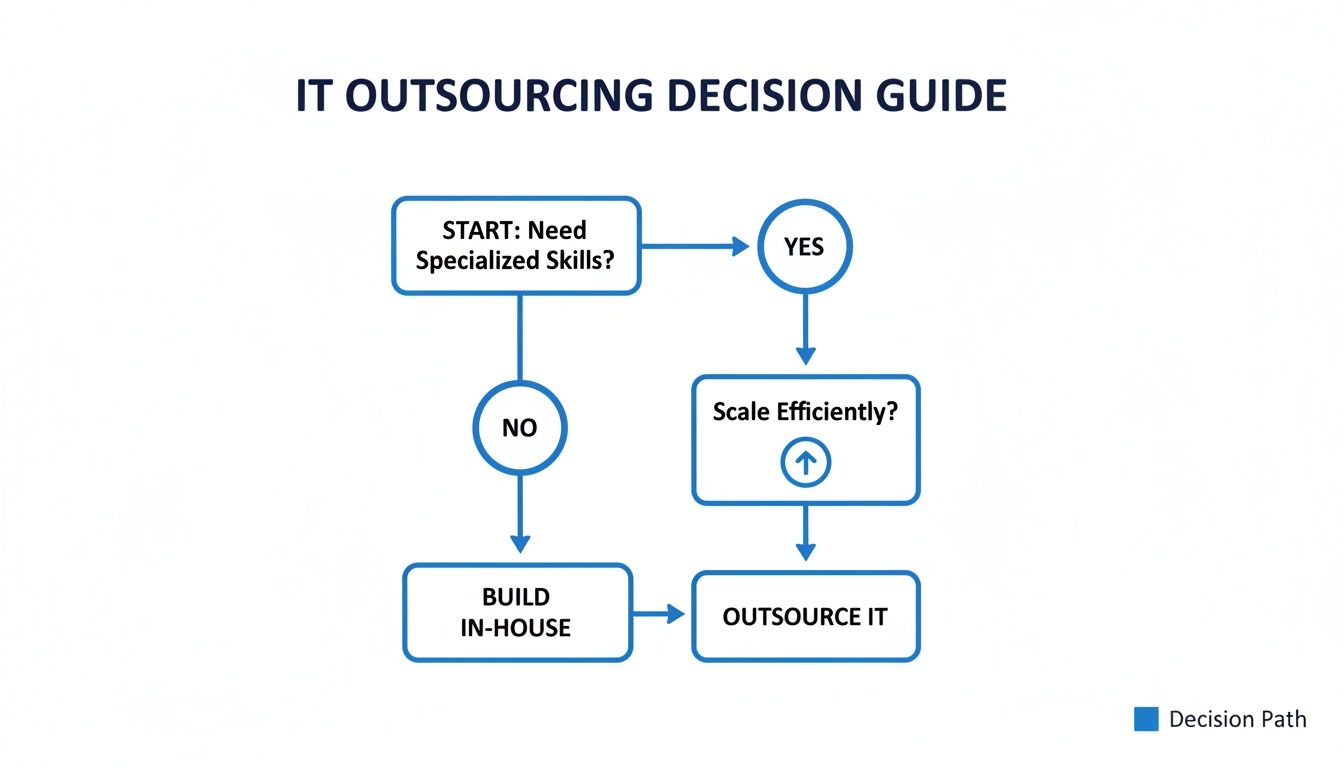
The primary drivers for outsourcing are the need for specialized skills and the ability to scale efficiently. Let’s examine the three main models to help you determine the best fit.
Staff Augmentation: Filling Skill Gaps in Your Team
Staff augmentation involves bringing in a specialist to fill a specific gap in your existing team. For example, you might need a Rust developer for a few months to handle a protocol upgrade or a data scientist for a short-term analytics project.
You manage these augmented team members directly, integrating them into your existing project management tools and workflows. This model provides maximum control over their daily tasks.
This approach works best when:
- You have a solid internal project management process.
- You need a highly specific skill for a limited time.
- You must quickly add capacity to meet a deadline without the long-term cost of a full-time hire.
If this aligns with your needs, a deep dive into IT resource augmentation can offer more insights on integrating external talent. Remember, with this model, the ultimate responsibility for project success and team management remains with you.
Dedicated Teams: An Extension of Your Core Crew
A dedicated team represents a deeper, long-term partnership. Your outsourcing partner provides a full group of engineers who work exclusively on your projects, functioning as a remote extension of your own department.
This is a strategic model designed for complex, long-term product development. It’s ideal for building substantial platforms—like a decentralized exchange or an AI-powered carbon analytics platform—that require continuous development, maintenance, and innovation.
A dedicated team model is built on deep integration. The external team doesn’t just receive tasks; they absorb your company culture, understand your long-term vision, and contribute proactively to your product’s success.
While it’s a larger investment than staff augmentation, the return is a cohesive, focused unit that is 100% aligned with your business objectives.
Project-Based Outsourcing: For Clearly Defined Outcomes
The project-based model is the most straightforward. You define a project with a clear scope, specific requirements, and a fixed timeline. The outsourcing partner then agrees to deliver that exact outcome for a fixed price. The vendor manages the entire lifecycle, from planning and execution to delivery.
This model is perfect for finite tasks with a well-defined finish line, such as:
- Conducting a thorough smart contract security audit.
- Building a specific, isolated feature for an existing application.
- Migrating a legacy system to a modern cloud environment.
The primary benefit is cost predictability. The main drawback is inflexibility; any scope change typically requires contract renegotiation, affecting both cost and timeline. For longer-term projects you might eventually bring in-house, consider frameworks like the Build-Operate-Transfer (BOT) model.
How Do IT Outsourcing Engagement Models Compare?
This table provides a quick comparison to help you match your project’s needs—whether in Web3, AI, or blockchain—with the right partnership structure.
| Factor | Staff Augmentation | Dedicated Team | Project-Based Model |
|---|---|---|---|
| Control | High. You manage individuals directly. | Medium. You manage the team’s direction, not day-to-day tasks. | Low. The vendor manages the entire project. |
| Flexibility | High. Easy to scale up or down as needed. | Medium. Can adapt to changing priorities over time. | Low. Scope changes require formal change requests. |
| Cost Structure | Time & Materials. Pay an hourly/monthly rate per resource. | Monthly Retainer. A fixed cost for the entire team. | Fixed Price. One price for the entire project scope. |
| Best For | Short-term skill gaps, urgent deadlines. | Long-term, complex product development. | Well-defined, finite projects with clear outcomes. |
| Your Role | Direct daily management, task assignment. | Product ownership, strategic guidance. | Defining requirements, providing feedback at milestones. |
The optimal model depends entirely on your project’s specific context, internal capabilities, and long-term business goals.
How to Weigh the Benefits and Risks of Outsourcing
Engaging in IT outsourcing offers powerful advantages, but it requires a clear-eyed view of both the upsides and potential pitfalls. Success depends on striking the right balance.

For companies in hyper-competitive fields like Web3 and AI, the strategic benefits go far beyond simple cost reduction.
What Are the Main Benefits of IT Outsourcing?
The most compelling reason to outsource is to access a global talent pool. This allows you to find engineers with rare, specialized skills—such as multi-chain architecture or AI model training—that are often unavailable in your local market.
Other game-changing advantages include:
- Accelerated Time-to-Market: Assemble a high-performing team in weeks, not months. This speed is a critical competitive advantage in fast-moving sectors.
- On-Demand Scalability: Scale your engineering capacity up or down as needed to meet project milestones without the burden of long-term commitments.
- Focus on Core Business Functions: Delegate complex engineering to free up in-house leaders to concentrate on product strategy, user growth, and market leadership.
This global demand is fueling explosive growth in key tech hubs. The IT services outsourcing market in India, for example, is projected to soar from USD 21,397.7 million to USD 45,633.9 million by 2030, driven by intense global demand for skills in AI, smart contract development, and RWA tokenization. You can explore this growth in more detail on Grand View Research.
How Can You Mitigate Common Outsourcing Risks?
While the benefits are significant, success hinges on proactively managing potential downsides. A solid framework can turn these risks into manageable challenges.
A successful outsourcing partnership is not about avoiding risks entirely, but about anticipating them and implementing strong mitigation strategies from day one. This proactive stance is what separates successful collaborations from frustrating ones.
Common hurdles fall into three main categories:
1. Communication and Cultural Barriers
Working across different time zones and cultures can lead to misunderstandings that delay progress and affect quality.
- Mitigation: Establish a rigorous communication protocol from the start, including daily stand-ups, weekly syncs, and shared project management tools like Jira. Assign a single, dedicated point of contact on both sides to streamline decision-making.
2. Intellectual Property (IP) Security
Protecting your source code, trade secrets, and proprietary algorithms is non-negotiable, especially when building DeFi platforms or unique AI models.
- Mitigation: Start with a rock-solid legal foundation, including a Non-Disclosure Agreement (NDA) and a Master Services Agreement (MSA) that clearly state your organization owns 100% of the IP. Partner with a firm that practices DevSecOps, uses private code repositories, and enforces strict access controls.
3. Quality Control and Oversight
Ensuring code quality meets your standards when your team is remote is a valid concern.
- Mitigation: Insist on a transparent development process that includes mandatory peer code reviews, comprehensive documentation, and regular demos. Define clear acceptance criteria for every deliverable to eliminate ambiguity about what “done” means.
How to Select the Right IT Outsourcing Partner
Choosing the right outsourcing partner is the single most critical decision you’ll make. A great partner multiplies your vision’s impact; a poor one drains resources, time, and morale. For high-stakes Web3, AI, and carbon-focused projects, your evaluation must go beyond generic checklists.
Success depends on finding a team with proven, battle-tested experience in the exact technologies you’re using. You need a specialist who understands the deep technical and security nuances of your domain.

Assessing Technical and Domain Expertise
Your first filter should be technical depth. A potential partner must demonstrate genuine mastery, not just familiarity, with your required technologies.
For any Web3 or DeFi project, look for:
- Verifiable Blockchain Expertise: Ask for specific examples of platforms built using Solidity, Rust, or other key languages. Request links to active smart contracts they’ve deployed on-chain.
- Multi-Chain and L2 Proficiency: A top-tier partner understands the trade-offs between ecosystems like Ethereum, Solana, and Layer-2 scaling solutions.
- Portfolio of Relevant Projects: Look for past work that mirrors your goals, such as decentralized exchanges, RWA tokenization platforms, or prediction markets.
For AI or carbon analytics platforms, the focus shifts to data and algorithms. Can they demonstrate experience with large-scale data processing, training machine learning models, and deploying AI in production? A strong portfolio is your best evidence. Our guide on top outsourcing IT companies offers more context on evaluating technical backgrounds.
Evaluating Security and Process Discipline
In decentralized systems, security is the foundation. A single vulnerability can be catastrophic, making a vendor’s security posture a non-negotiable criterion.
A partner who treats security as an afterthought is a liability you simply cannot afford. Look for firms where security is deeply embedded in their DNA, from the very first architecture discussion to the final deployment.
Drill down into their security practices with specific questions:
- What’s your approach to DevSecOps? A mature partner integrates security throughout the development lifecycle.
- How do you handle smart contract audits? Ask if they conduct rigorous internal audits before submitting code to third-party firms.
- Can you walk me through your VAPT process? Inquire about their methodology for Vulnerability Assessment and Penetration Testing (VAPT) for both on-chain and off-chain components.
Beyond security, assess their project management discipline. A well-organized partner uses tools like Jira for transparent task tracking, maintains clear documentation, and follows a predictable communication rhythm.
Conducting Due Diligence and Spotting Red Flags
Your evaluation must extend beyond marketing materials. Schedule deep-dive calls with their technical leads, not just sales representatives. Ask to speak with past or current clients for an unfiltered perspective.
Watch for these red flags:
- Vague answers to specific technical questions.
- Unwillingness to share code samples or detailed case studies.
- A portfolio filled with simple marketing websites instead of complex applications.
- High-pressure sales tactics.
You’re choosing a long-term partner, not just a temporary contractor. The global talent pool is vast, with India’s outsourcing sector projected to grow from USD 16.01 billion to USD 32.77 billion by 2030, powered by a workforce exceeding 5 million developers. This growth provides ample options, reinforcing the need for meticulous evaluation. You can find more insights on this trend from Insignia Resource.
What Is the Future of IT Outsourcing? (12–24 Month Outlook)
The IT outsourcing landscape evolves with technology. For leaders in Web3, AI, and carbon markets, staying ahead of these shifts is crucial for maintaining a competitive edge. Over the next 12 to 24 months, several key trends will reshape how businesses partner with external engineering teams.
The Rise of AI-Assisted Development
The deep integration of AI-assisted development tools is transforming engineering workflows. AI agents now help debug code, automate unit tests, optimize performance, and suggest architectural improvements. This trend sets a new baseline for efficiency, and top outsourcing partners are already leveraging these tools to amplify their teams’ output.
For clients, this translates into tangible benefits:
- Increased Engineering Velocity: Projects move faster as AI handles repetitive tasks, freeing senior engineers to focus on complex problem-solving.
- Improved Code Quality: AI-driven analysis identifies potential bugs and security vulnerabilities early in the development cycle.
- Focus on Higher-Value Work: With AI covering foundational tasks, outsourced teams can dedicate more resources to strategic innovation.
This integration is a massive part of the future. You can learn more about how these fields are intertwined by exploring the synergy of AI and blockchain.
Specialized As-a-Service Offerings
The “as-a-service” model is expanding into highly specialized domains. As Web3 and AI ecosystems grow more complex, the demand for niche expertise is increasing. Generic development support is no longer sufficient.
The future of outsourcing is specialised. Instead of hiring a generalist firm, companies will seek out partners who offer targeted services like ‘DeFi Security-as-a-Service’ or ‘AI Model Optimisation-as-a-Service’.
This trend reflects a maturing market where one-size-fits-all solutions are inadequate. A DeFi protocol, for instance, requires ongoing managed security, continuous smart contract monitoring, and a rapid incident response plan. Similarly, an AI company may need a partner specializing solely in optimizing machine learning models for cost and speed.
From Transactional Vendors to Strategic Partners
The client-vendor relationship is evolving from transactional to collaborative. The old model of handing over requirements and waiting for a finished product is obsolete. The complexity of modern systems demands a deeper partnership.
The future is about strategic alliances where your outsourced team operates as a genuine extension of your own. They should contribute to your product roadmap, challenge your assumptions, and proactively identify opportunities. This shift requires a partner invested in your business’s success, and it will define the most successful outsourcing relationships moving forward.
How Blocsys Delivers Elite IT Outsourcing for Web3 & AI
Choosing the right partner is what transforms an outsourcing decision from a cost-saving measure into a strategic advantage. Blocsys Technologies was founded on the principle of acting as a dedicated engineering partner for ambitious projects in Web3, AI, and other deep-tech sectors.
Our model is designed to deliver the specialized expertise and operational discipline that high-stakes projects demand. We don’t offer generic software development; we provide deep, domain-specific knowledge where it matters most.
Institutional-Grade DeFi and Web3 Infrastructure
Blocsys specializes in designing and building the robust systems that power next-generation finance. Our expertise lies in creating secure, scalable, and high-performance decentralized infrastructure. We are architects who understand the nuanced complexities of on-chain systems.
Our track record includes:
- Decentralized Perpetual Trading Platforms: We build sophisticated order-book systems, resilient liquidity mechanisms, and rock-solid smart contracts for high-performance trading.
- Real-World Asset (RWA) Tokenization: We create platforms that bring real-world assets onto the blockchain, managing everything from compliance to secure custody architecture.
- Custom Protocol and Smart Contract Engineering: Our teams are fluent in Solidity and Rust, enabling us to architect and deploy secure, gas-efficient protocols tailored to your goals.
An End-to-End Delivery Partner
A successful partnership requires more than just high-quality code. It demands disciplined project management, clear communication, and a security-first mindset. Blocsys offers end-to-end delivery that covers the entire product lifecycle, ensuring your project meets milestones and adheres to the highest industry standards.
Choosing a partner means trusting them with your most critical intellectual property and your market reputation. We build that trust through relentless execution discipline and an unwavering commitment to security at every stage of development.
Our comprehensive approach includes:
- Protocol and System Architecture: We design a resilient and scalable foundation for your platform before writing a single line of code.
- Scalable Backend Development: Our full-stack expertise ensures your on-chain logic is supported by a powerful and reliable off-chain infrastructure.
- Embedded DevSecOps and VAPT: We integrate rigorous security practices, including Vulnerability Assessment and Penetration Testing (VAPT), directly into our development workflow to mitigate risks early.
More Than a Vendor—A Strategic Ally
Our goal is to become a true extension of your team. We act as a strategic partner, as invested as you are in building, scaling, and executing your vision. We provide the specialized engineering talent and operational discipline needed to transform complex ideas into production-ready platforms that compete and win.
If you are building serious infrastructure and need a partner with proven expertise in DeFi, Web3, or AI-driven systems, we should talk.
Speak with a Blocsys expert today to discuss your project requirements.
Frequently Asked Questions
Here are concise answers to common questions founders and product leaders have about IT outsourcing services for complex technology projects.
How Do You Protect Intellectual Property When Outsourcing?
Protecting IP begins with a strong legal framework: a Non-Disclosure Agreement (NDA) and a Master Services Agreement (MSA) that explicitly state your company owns 100% of the intellectual property. Operationally, a trustworthy partner enforces security through private code repositories, strict role-based access controls, and compartmentalized workflows to limit exposure.
What Is the Typical Cost Structure for IT Outsourcing?
The cost structure depends on the engagement model. The project-based model typically uses a fixed price for a well-defined scope. Staff augmentation and dedicated team models usually operate on a monthly retainer, calculated based on the number, skills, and seniority of the engineers. The focus should be on total value and speed to market, not just hourly rates.
How Can We Ensure Quality and Communication?
Quality and clear communication are ensured through a disciplined process established from day one. This includes daily stand-ups, weekly syncs, and shared project management tools like Jira for full transparency. A dedicated point of contact on both sides, mandatory code reviews, and comprehensive documentation are also critical components of a successful partnership.
What Is the Onboarding Process Like for an Outsourced Team?
A structured onboarding process begins with a deep-dive discovery session to align on goals, tech stack, and success metrics. This is followed by a knowledge transfer phase where the new team reviews your existing codebase and documentation. A professional outsourcing partner will drive this process to ensure their engineers are committing meaningful code within the first week.
At Blocsys Technologies, we operate as a strategic delivery partner, providing specialized engineering expertise to help you build, scale, and execute ambitious decentralized systems. Our process is built around the best practices outlined in this guide.
If you’re ready to build serious infrastructure for Web3, AI, or DeFi, let’s talk.
Speak with a Blocsys expert today to discuss your project requirements.
