
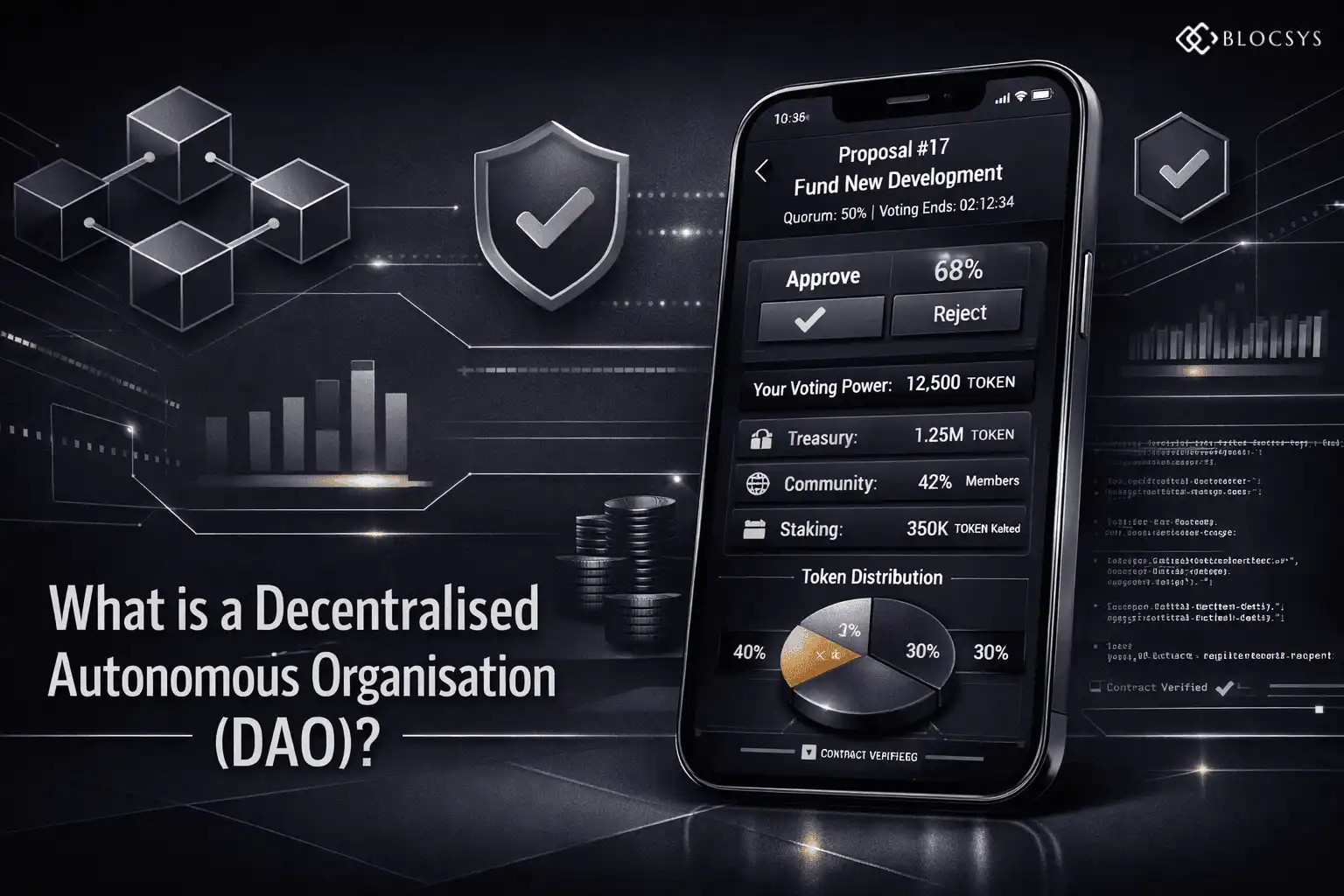
What is a Decentralised Autonomous Organisation (DAO)? At its core, a DAO is a community-led entity with no central authority, managed collectively by its members through rules encoded as smart contracts on a blockchain. This guide is designed for founders, project leaders, and decision-makers in Web3, blockchain, and crypto who need a clear framework for building a secure, scalable, and legally sound DAO. By the end, you’ll understand the critical decisions required to go from concept to a thriving, decentralised organisation.
What Is a DAO and Why Does It Matter for Web3?
A DAO replaces the traditional top-down corporate hierarchy—with its board of directors and C-suite—with a flat, transparent, and democratic governance system. Decisions aren’t made behind closed doors; they are proposed, debated, and voted on by members who hold the DAO’s native governance token.
This model is built on radical transparency. Every action, from treasury spending to rule changes, is recorded on a public blockchain, making it verifiable by anyone. This structure prevents unilateral control by a small group, ensuring the organisation’s direction reflects the collective will of its community. For founders and enterprises, DAOs offer a powerful new model to coordinate capital, talent, and community efforts on a global scale, creating organisations that are more resilient and aligned with their user base.
What Will This Guide Cover?
This guide provides a comprehensive roadmap for building a resilient DAO, moving from foundational theory to practical execution. It tailors itself for Web3 builders who need to make informed decisions on technology, governance, and legal strategy. We will cover:
- Core Concepts: A deep dive into the governance models and tokenomics that drive participation and create sustainable value.
- Technical Architecture: Guidance on selecting the right blockchain, smart contract frameworks, and essential community tools for your tech stack.
- Security & Legal Frameworks: A clear look at non-negotiable security audits and legal wrappers needed to protect your DAO and its members.
- Decision Frameworks: Step-by-step guidance and comparison thinking to help you move from a concept to a launched, scalable, and compliant DAO.
A well-structured DAO is more than just a treasury and a voting mechanism; It’s a living ecosystem that powers aligned incentives and collective ownership. Its success hinges on creating a framework where community participation doesn’t just get encouraged, but drives value as the primary force.
By the end of this guide, you will have a clear understanding of the strategic decisions required to launch and scale a DAO that can thrive in the competitive Web3 landscape. We cut through the noise to provide the insights needed to manage risk, make smart technical choices, and build a future-proof, community-led organisation.
Decoding the Three Pillars of Every DAO
Every successful Decentralised Autonomous Organisation is built on three pillars: its governance model, its economic engine (tokenomics), and its technical foundation (smart contracts). Getting these three elements to work in harmony is the key to building a DAO that not only works but also inspires a passionate, engaged community.
Think of them not as separate parts, but as deeply intertwined systems. Each one reinforces the others, creating a stable and resilient organisation that can stand the test of time.
This simple diagram shows how the layers of a DAO stack up, from the community at the top all the way down to the blockchain that makes it all possible.
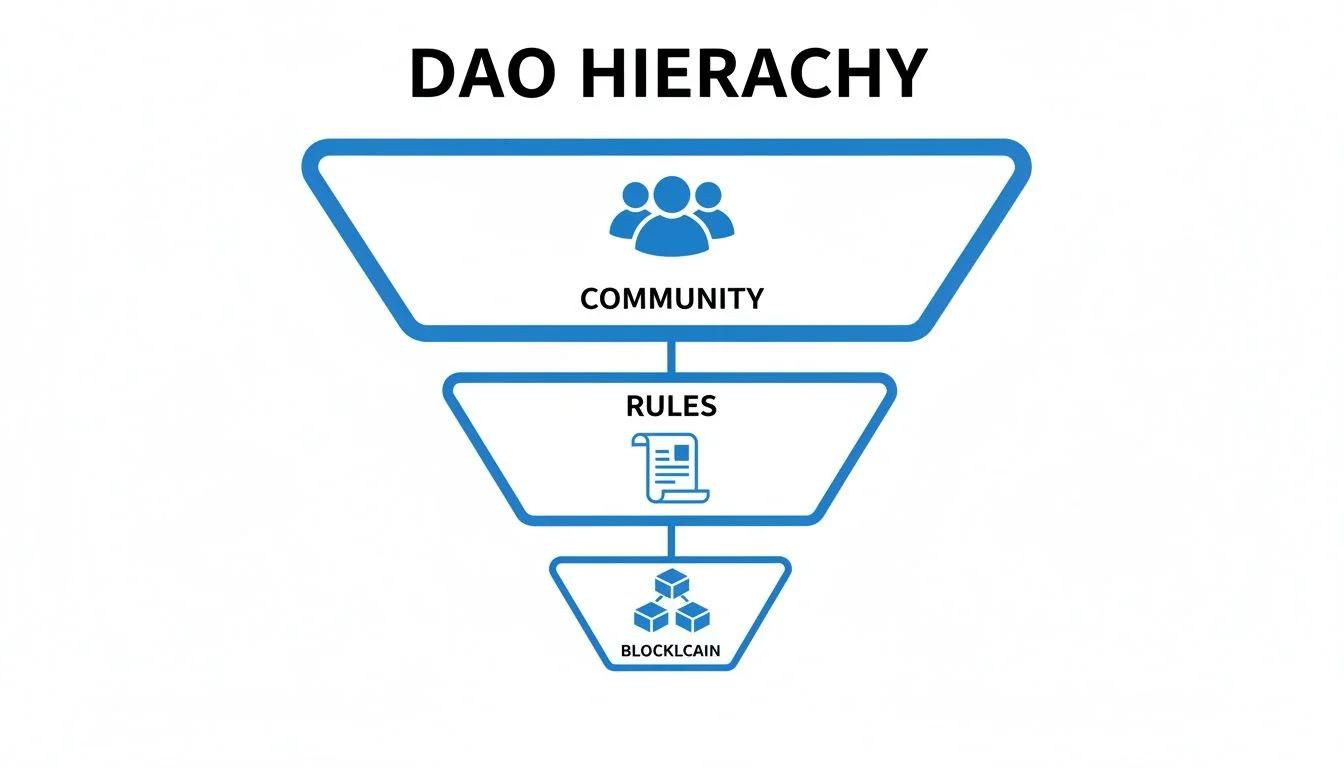
As the visual suggests, a DAO’s rules—enforced by smart contracts on the blockchain—are what give structure and power to its community.
Governance: The Rules of Engagement
What is DAO governance? Governance is the decision-making framework of your DAO, defining how proposals are submitted, debated, and ultimately approved or rejected. This isn’t just a technical choice; it dictates the organisation’s culture, member participation levels, and ability to adapt to new challenges and opportunities. A poorly designed model can lead to voter apathy or hostile takeovers, while a well-designed one empowers the community to steer the project confidently.
Choosing the right governance model is one of the most critical decisions a founder will make. It directly impacts how much members participate and how well the DAO can adapt to new challenges and opportunities. A poorly chosen model can lead to voter apathy or even hostile takeovers, while a well-designed one empowers the community to steer the project with confidence.
To help you navigate this crucial decision, here’s a breakdown of the most common models. Each has its own trade-offs, so it’s essential to pick the one that best aligns with your DAO’s mission and community structure.
How Do You Choose a DAO Governance Model?
This table compares common governance structures to help you select the right framework for your project’s unique needs, whether you’re a startup or a large enterprise.
| Model | Mechanism | Pros | Cons | Best For |
|---|---|---|---|---|
| Token-Weighted Voting | One token equals one vote. Voting power is directly proportional to the number of tokens held. | Simple, direct, and aligns decision-making power with financial stake. | Can lead to centralisation if a few large “whales” control the majority of tokens. | DeFi protocols and projects where financial investment is the primary form of participation. |
| Reputation-Based Systems | Voting power is earned through contributions and participation, not purchased. | Promotes a meritocracy, rewards active members, and prevents wealthy individuals from buying influence. | Can be complex to implement and requires a robust system for tracking contributions fairly. | DAOs focused on collaboration, creative output, or community-driven projects where expertise matters more than capital. |
| Quadratic Voting | Members can allocate votes to express the intensity of their preferences. Casting multiple votes on one proposal costs quadratically more. | Provides a more nuanced view of community consensus beyond a simple yes/no. Mitigates the power of large voting blocs. | Can be more complex for users to understand and for developers to implement securely. | DAOs seeking to balance the influence of passionate minorities with the will of the broader community. |
Ultimately, the goal is to find a model that feels fair and gives your community the tools they need to govern effectively. Don’t be afraid to start simple and evolve your governance as your DAO matures.
Tokenomics: The Economic Engine
If governance is the rulebook, tokenomics is the economic system that makes the game worth playing. It’s the carefully designed set of rules that governs the creation, distribution, and management of the DAO’s native token. A strong tokenomics model does more than just hand out rewards; it aligns the financial incentives of every token holder with the long-term health and success of the entire organisation.
Tokenomics is not just about distributing rewards; it’s about designing a sustainable micro-economy that incentivises behaviours beneficial to the entire ecosystem, from providing liquidity to active participation in governance.
To get it right, your model needs to answer a few critical questions about your DAO’s token:
- What is its utility? Does it grant voting rights, give access to exclusive services, or represent a share in revenue? A token with a clear and compelling purpose is far more likely to be valued by the community.
- How is it distributed? The initial allocation—to the team, early investors, and the community—is huge. It sets the tone for decentralisation from day one. A fair and transparent launch can build incredible trust and grassroots support.
- What is the supply mechanism? Is there a fixed supply like Bitcoin, creating scarcity? Or is it inflationary to fund ongoing development and operations? This single decision has massive implications for the token’s long-term value and the DAO’s sustainability.
Good tokenomics creates the flywheel that drives a DAO forward, turning participation into value and value back into participation.
Smart Contracts: The Automated Constitution
Finally, we have the smart contracts. These are the lines of code that automate and enforce the rules defined by your governance and tokenomics. They act as the DAO’s digital constitution, executing everything from treasury payments to proposal outcomes without needing a human in the middle. This is where the “autonomous” part of a DAO truly comes to life.
These contracts handle the most critical functions: managing the treasury, executing the results of votes, and distributing rewards according to the rules. Because they live on a public blockchain, their execution is transparent, irreversible, and tamper-proof.
The integrity of the entire DAO rests on the security and reliability of its smart contracts. This is why rigorous testing and independent security audits are absolutely non-negotiable before you launch. A single bug or vulnerability can put the entire community’s treasury at risk.
Architecting Your DAO’s Technology Stack
Turning your DAO concept into a living, breathing organisation means getting the technology right. The tech stack you choose is far more than just a technical detail—it’s the foundational blueprint for your entire community. These choices will shape everything from member experience and operational costs to your DAO’s ability to grow securely.
The very first decision, and arguably the most important, is which blockchain network to build on. This choice sets the stage for everything that follows.
How to Select the Right Blockchain for a DAO?
Picking a blockchain is a long-term strategic move. It dictates your security, speed, and transaction costs, and each network comes with its own set of trade-offs. You need to weigh them carefully against what your DAO actually needs to do.
Ethereum: As the original smart contract platform, Ethereum delivers unmatched security and the largest, most battle-tested ecosystem. The catch? High transaction fees (gas costs) on its mainnet can be a deal-breaker for DAOs that need frequent voting or handle lots of small transactions.
Layer 2 (L2) Solutions: Networks like Arbitrum, Optimism, and Polygon are built on top of Ethereum. They inherit its robust security but offer dramatically lower fees and much faster transactions. For most DAOs, an L2 hits the sweet spot between security and affordability.
Alternative Layer 1 (L1) Blockchains: Platforms like Solana or Avalanche are built for speed and scale, offering high throughput and low costs. This makes them great for applications that need to handle massive transaction volumes. The trade-off is often a smaller developer community and a different security model compared to Ethereum.
The best blockchain choice directly aligns with your DAO’s core function. A high-value DeFi protocol might need the ironclad security of Ethereum’s mainnet, while a community-focused DAO with tons of voting will be much better off on a low-cost Layer 2.
Choosing a DAO Framework: Build vs. Buy
With your blockchain selected, the next step is to decide how you’ll build your DAO’s internal logic. You can write your smart contracts from the ground up or leverage an existing framework—a classic choice between total customisation and speed-to-market. Building from scratch demands a top-tier team of skilled blockchain developers. For those looking to launch faster, frameworks provide pre-built, audited components that save a massive amount of time and effort.
Here’s a look at two popular frameworks from both a startup and enterprise perspective:
| Framework | Startup Perspective | Enterprise Perspective |
|---|---|---|
| Aragon | Offers modular, flexible tools perfect for custom governance design. It’s ideal for projects expecting their governance model to evolve and need a powerful, adaptable solution. | Known for its security and battle-tested components, Aragon is a trusted choice for managing significant treasuries and building complex, multi-layered governance structures. |
| Syndicate | Built for simplicity and speed. It makes launching investment clubs and social DAOs incredibly easy, lowering the barrier to entry for founders who aren’t deeply technical. | While not built for highly complex enterprise needs, its simplicity is great for internal R&D projects or specialised investment vehicles that need to get off the ground quickly. |
Ultimately, the “build vs. buy” decision comes down to your specific needs. Frameworks are a fantastic way to get to market quickly with secure, audited code. A custom build gives you complete control but demands a serious investment in development and security.
Integrating Essential Community Tools
A DAO is nothing without its community, and that community needs the right tools to communicate, discuss ideas, and vote. Integrating these tools into a seamless experience is key to fostering a vibrant, active organisation.
Discourse: This forum software has become the gold standard for structured, long-form discussions. It’s the perfect place for members to really dig into proposals and debate the details before a formal on-chain vote.
Snapshot: When it comes to gasless voting, Snapshot is the undisputed leader. It lets token holders signal their preferences off-chain, saving the community a fortune in transaction fees while still creating a verifiable record of sentiment.
Telegram & Discord: These platforms are the social heartbeat of a DAO. They’re essential for real-time announcements, informal chats, and day-to-day engagement that keeps members feeling connected.
By thoughtfully integrating these tools, you create a smooth journey for members, from the first spark of an idea to the final vote. This encourages the active participation that is the lifeblood of any successful DAO. You can learn more about the role technology plays in managing on-chain assets in our complete guide to token management systems.
Navigating the Critical Risks of Security and Law
A DAO is only as strong as its weakest link, and overlooking security and legal risks can be fatal. For founders, building a resilient organisation means embedding fortifications from day one. These two areas—code security and legal structure—are where vision meets reality, and where many promising projects falter.
This section tackles the two biggest threats that can derail your project. We’ll outline a practical approach to security, highlighting the absolute necessity of independent audits and ongoing vulnerability management. We’ll also explore the legal landscape and the frameworks successful DAOs use to operate with confidence.
How to Fortify Your DAO Against Smart Contract Exploits
The history of DAOs is littered with cautionary tales of hacks and exploits where code vulnerabilities led to catastrophic losses. The infamous 2016 hack of “The DAO” saw $60 million worth of ETH drained due to a reentrancy bug—a vulnerability that remains a threat today. This isn’t just a historical footnote; it’s a foundational lesson in DAO security.
A proactive security posture is non-negotiable. It begins with adopting a DevSecOps (Development, Security, and Operations) mindset, where security is integrated into every stage of the development lifecycle, not just tacked on at the end.
This approach includes several critical layers of defence:
- Rigorous Internal Testing: Your development process must include extensive unit tests, integration tests, and simulated attack scenarios to catch bugs early.
- Independent Third-Party Audits: Before a single line of code goes live, it must be audited by at least one—preferably multiple—reputable security firms. An external audit provides an unbiased review and is a powerful signal of credibility to your community and potential investors.
- Bug Bounty Programmes: After launch, incentivise white-hat hackers to find and report vulnerabilities in your code. Offering significant rewards can help you discover critical issues before malicious actors do.
Security in a DAO is not a one-time checklist; it is a continuous process of vigilance.Your smart contracts hold your community’s assets in the vault, and you must treat them with the highest level of scrutiny and protection.
Smart contract security also extends to upgradability. While immutability is a core feature of blockchain, having a mechanism to patch vulnerabilities is essential. For more on this, you can explore our guide on understanding proxy contracts in Solidity, which explains how to build upgradable systems without sacrificing decentralisation.
Why You Need a Legal Wrapper for Real-World Operations
While a DAO can exist entirely on-chain, this “unincorporated” status creates significant legal risks for its members. Without a formal legal structure, a DAO might be treated as a general partnership by regulators, making every token holder personally liable for the organisation’s debts and actions. This is a risk no serious project should take.
A legal wrapper is a traditional legal entity—such as an LLC, a foundation, or an association—that provides a protective layer for the DAO. This structure allows the DAO to interact with the off-chain world safely and effectively.
Choosing the right legal wrapper depends heavily on your DAO’s purpose and jurisdiction. Here are some of the most common options and their benefits:
- Limited Liability Company (LLC): Popular in jurisdictions like Wyoming and the Marshall Islands, an LLC provides liability protection for its members. This is an excellent choice for for-profit DAOs or investment clubs.
- Foundations: Often established in Switzerland or the Cayman Islands, foundations are ideal for non-profit DAOs that manage grants, public goods, or open-source protocols. They provide a clear structure for governance and asset management.
- Unincorporated Nonprofit Associations (UNAs): This is a lighter-weight option that offers some liability protection and is easier to set up. It’s a good fit for smaller community DAOs that don’t manage a large treasury.
Establishing a legal wrapper allows your DAO to open a bank account, sign contracts with service providers, and hire employees. It transforms an abstract on-chain entity into an organisation that can operate with confidence in both the digital and physical worlds, providing the legal clarity and protection your members deserve.
Real-World DAO Examples and Success Stories
Theory is a great starting point, but nothing beats seeing a DAO in action to understand its true potential. These aren’t just fringe experiments anymore; DAOs are actively governing massive protocols, managing billions in assets, and coordinating global communities. By looking at real, tangible examples, we can see not only what they got right but also the tough challenges they had to overcome to scale.
These case studies are a goldmine of information, showing how different governance and economic models hold up under real market pressure. For anyone thinking about building their own decentralised organisation, the lessons here are invaluable. From DeFi titans to niche art collectives, the applications are proving to be incredibly diverse and are expanding all the time.
The DeFi Pioneer: MakerDAO
If you want to understand the power of a DAO, look no further than MakerDAO. It’s the governing body behind the DAI stablecoin, one of the oldest and most resilient decentralised currencies out there. MakerDAO is responsible for managing the complex risk parameters that keep DAI reliably pegged to the US dollar. Its token holders are in the driver’s seat, voting on critical decisions like adjusting stability fees or adding new types of collateral to the system.
The long-term success of MakerDAO is a powerful testament to just how robust on-chain governance can be. It has navigated extreme market volatility and executed complex technical upgrades, all while being managed by a distributed, global community. It’s essentially the blueprint for any DAO tasked with overseeing critical financial infrastructure.
The Expanding Frontier of DAO Use Cases
Beyond the world of decentralised finance, DAOs are popping up in some seriously creative ways across different sectors. They’re proving to be a remarkably flexible structure for almost any kind of collective action.
Here are a few examples to illustrate the breadth of DAO applications in the wild.
Table: DAO Use Cases Across Industries
The table below highlights how DAOs are being applied across various industries, showcasing real examples and the unique value they bring. This isn’t an exhaustive list, but it gives a clear picture of their versatility.
Industry | DAO Example | Primary Function | Key Innovation |
|---|---|---|---|
| Venture Capital | FlamingoDAO | Investment in NFTs & Web3 | Democratises access to high-value digital asset investments. |
| Social Clubs | Friends With Benefits | Cultural & Social Hub | Governs a shared cultural identity through community curation. |
| Real-World Assets | CityDAO | Land Ownership & Governance | Collective management of physical land parcels via on-chain votes. |
| DeFi | Uniswap | Protocol Governance | Community-led upgrades and treasury management for a top DEX. |
| Media | Dirt | Content Creation & Curation | A decentralised media outlet funded and directed by its readers. |
| Philanthropy | Big Green DAO | Grant-Making | Decentralises decisions on which food-related non-profits receive funding. |
As you can see, the core idea of community-driven governance applies to almost anything, from managing digital art collections to funding real-world philanthropic efforts.
Venture Capital: Venture DAOs like FlamingoDAO and MetaCartel Ventures are pooling capital from their members to invest in promising Web3 projects and high-value digital assets like NFTs. This model is prying open the doors to early-stage investing, an arena that was once the exclusive playground of traditional VC firms.
Social Clubs: Friends With Benefits (FWB) is a perfect example of a social DAO. It operates as a digital-native cultural club where membership grants access to an exclusive community, private events, and unique content. It demonstrates how a DAO can build and govern a shared cultural identity from the ground up..
Physical Asset Management: The DAO model is also starting to bridge the gap between the on-chain and off-chain worlds. We’re seeing projects use DAOs to manage real-world assets (RWAs) like property, energy grids, and telecommunications infrastructure. This growing field is often called decentralised physical infrastructure networks, or DePIN.
The real magic of the DAO structure is its sheer adaptability. It’s a general-purpose framework for coordination that can manage anything from a digital currency to a physical solar farm, all governed by a transparent, community-driven process.
A Look Ahead: What’s Next for DAOs in the Next 12-24 Months?
Looking 12 to 24 months into the future, two major trends are set to define the next wave of DAO innovation: the deeper integration of AI into governance and the explosion of growth in high-adoption digital markets. Imagine AI agents that can analyze complex proposals, model the economic impact of a vote, or even automate routine treasury management, making governance more efficient and data-driven.
Simultaneously, markets with high digital adoption, like those across Asia and other emerging economies, are becoming epicenters for DAO activity. According to Chainalysis, Central & Southern Asia and Oceania (CSAO) is the second-largest crypto market globally. A massive, mobile-first user base eager for DeFi, gaming, and real-world asset (RWA) tokenization drives this growth. For founders, this translates to deep liquidity and a tech-savvy community ready to engage with innovative on-chain products. For a closer look at these trends, it’s worth reviewing the latest trends in global crypto adoption.
How Blocsys Can Help You Build a Production-Ready DAO
Launching a successful DAO requires more than just deploying smart contracts; it demands a deep, practical understanding of protocol architecture, tokenomics, and institutional-grade security. At Blocsys, we are a specialised engineering partner for founders and enterprises building complex decentralised systems, from high-frequency DeFi platforms to Real-World Asset (RWA) tokenisation protocols. We bridge the gap between ambitious concepts and production-ready platforms that are secure, scalable, and resilient.
We understand that a DAO’s code is its foundation, where a single vulnerability can compromise the entire treasury and erode community trust. That’s why we integrate a DevSecOps mindset into our entire process, ensuring security is a core component from day one, not an afterthought.
From Concept to Scalable Infrastructure: Our Services
Blocsys offers an end-to-end delivery model designed to help you mitigate risk and accelerate your time-to-market. Our approach combines robust engineering practices with deep domain expertise to architect systems built for long-term growth and security.
Our core capabilities cover the full stack required to build a successful DAO:
- Protocol & System Architecture: We design the complete technical blueprint, ensuring every on-chain and off-chain component works in harmony to deliver a seamless user experience.
- Smart Contract Engineering: Our team develops secure, audited, and gas-efficient smart contracts that serve as the operational backbone of your organisation.
- Institutional-Grade Security: We implement comprehensive security practices, including independent third-party audits and continuous vulnerability assessments, to safeguard community assets.
- Scalable Backend Systems: We build the critical off-chain infrastructure needed to support your DAO’s operations as it scales to millions of users.
A DAO is an economic and social system executed by code. Its success hinges on engineering that is not only technically sound but also deeply aligned with the organisation’s governance and incentive models. This alignment is what transforms a simple smart contract into a thriving, autonomous community.
As your dedicated technical partner, we translate your vision for a decentralised community into a secure and scalable reality. Our first-hand experience building across multiple blockchains and complex financial products gives us the perspective needed to navigate the unique challenges of Web3 development. For a deeper look at our approach, explore our insights on DAO development and the future of governance.
Whether you need a full delivery team to take your idea from whiteboard to mainnet or specialised engineering talent to augment your existing team, Blocsys provides the expertise to build what’s next.
Ready to build a resilient and production-ready DAO? Connect with our experts today.
Frequently Asked Questions About DAOs
To wrap up our deep dive into Decentralised Autonomous Organisations, let’s tackle some of the most common questions that come up once you move past the big ideas and start thinking about execution. We’ve designed this as a quick-reference guide to help you navigate the practical challenges on your journey.
These are the real-world questions founders and builders face when it’s time to get serious about community, treasury management, and long-term sustainability.
How Much Does It Cost to Launch a DAO?
The cost to launch a DAO ranges from a few hundred dollars to over $250,000, depending on complexity. Using a no-code platform like Aragon or Syndicate, you can deploy a simple DAO for minimal gas fees, making it accessible for small communities. A custom-built DAO with unique governance, extensive smart contract development, multiple third-party security audits, and a legal wrapper is a significant investment, typically costing between $50,000 and $250,000+.
How Do You Keep DAO Members Engaged?
Keeping DAO members engaged long-term requires a mix of clear incentives, a strong shared purpose, and a frictionless user experience. Successful DAOs reward meaningful contributions beyond just voting, such as leading working groups or developing code. They also foster clear communication through organized channels like Discourse for debates and Discord or Telegram for real-time interaction, while ensuring the entire proposal-to-vote process is simple and accessible.
Does a DAO Need a Legal Entity?
Yes, for any serious project, a DAO needs a legal entity. Operating without a legal wrapper, such as an LLC, foundation, or association, often classifies the DAO as a general partnership. This makes every member personally liable for the organization’s debts and actions. A legal entity provides limited liability protection, enables the DAO to interact with the off-chain world (e.g., sign contracts, open bank accounts), and offers crucial regulatory clarity.
What Is the Biggest Security Risk for a DAO?
The single biggest security risk for a DAO is a vulnerability in its smart contracts. These contracts control the treasury and execute all governance decisions, making them a prime target for attackers. A bug or exploit can lead to a complete drain of community funds or manipulation of votes, posing an existential threat to the organization. This is why independent, third-party security audits are a non-negotiable step before launch.
A single bug or an overlooked vulnerability in the smart contract code can be exploited to drain the entire treasury or manipulate critical governance votes. It’s an existential threat that can destroy a project overnight.
A thorough audit from a reputable firm is the most important investment you can make in the security and long-term viability of your organisation.
Blocsys Technologies is a specialised engineering partner for founders building serious decentralised infrastructure. From protocol architecture and smart contract engineering to institutional-grade security, we provide the end-to-end expertise to move your DAO from concept to a production-ready platform.
