

In the high-stakes worlds of Web3, blockchain, and fintech, an AI integration service has shifted from a “nice-to-have” to a core strategic component for survival and growth. This guide is for product and engineering leaders tasked with building a competitive edge. It provides a clear, actionable roadmap for integrating AI to solve real-world problems—from flagging sophisticated fraud and crafting hyper-personalized user experiences to automating compliance and creating new revenue streams. By the end, you will understand the decision frameworks required to build, scale, and execute your AI strategy effectively.
What is an AI Integration Service?
An AI integration service is a specialized technical solution designed to embed artificial intelligence and machine learning (AI/ML) capabilities into an organization’s existing software, platforms, and business processes. Its goal is to automate tasks, generate predictive insights, and enhance operational efficiency by making systems more intelligent and adaptive. For Web3 and fintech, this means connecting on-chain and off-chain data sources to power applications like dynamic risk assessment, automated trading, and intelligent user analytics.
Why is AI Integration Critical in Decentralised Systems?
In Web3 and fintech, standing still means you’re already falling behind. The conversation is no longer if you should adopt AI, but how fast you can integrate it to build a real, defensible edge. An AI integration service closes the gap between raw data—both on-chain and off-chain—and the actionable, automated intelligence your products need.
This goes beyond plugging in a generic chatbot. We’re talking about a fundamental re-architecture of your systems to think, predict, and adapt. For product and engineering leaders, this is the shift from building platforms that follow static rules to building systems that spot market opportunities, mitigate risks in real-time, and deliver hyper-personalized value without manual intervention.
To get a clearer picture, let’s look at the most impactful ways AI is being put to work right now. The table below breaks down the core use cases delivering the biggest returns across Web3, blockchain, and fintech.
Core AI Integration Use Cases in Web3 and Fintech
| Domain | AI Application | Key Business Impact | Target Sector |
|---|---|---|---|
| Decentralised Finance (DeFi) | Dynamic Yield Optimisation & Personalised Strategy Recommendations | Maximises user returns, increases platform stickiness, and attracts sophisticated liquidity providers. | Crypto, DeFi |
| Digital Asset Security | Anomaly Detection & Predictive Fraud Prevention | Drastically reduces losses from exploits and scams, building user trust and platform integrity. | Crypto, Web3 |
| On-Chain Analytics | Intelligent Data Indexing & Real-Time Market Sentiment Analysis | Provides traders with a critical edge, enabling faster, more informed decision-making. | Crypto, Fintech |
| Compliance & Risk | Automated AML/KYT Transaction Monitoring & Carbon Credit Verification | Streamlines regulatory reporting, lowers compliance overhead, and mitigates legal and financial risks. | Fintech, Carbon |
| User Experience (UX) | AI-Powered Onboarding & Natural Language Interfaces (e.g., “ask your wallet”) | Lowers the barrier to entry for new users, simplifies complex actions, and boosts adoption. | Web3, Fintech |
| DAO Governance | Proposal Analysis & Voter Apathy Prediction | Improves the quality of governance decisions and encourages more active community participation. | Web3, DAO |
Each of these applications turns a passive platform into an active, intelligent partner. This is the difference between a product that works and a product that wins.
The pressure to build these capabilities is real and growing. Globally, enterprises are accelerating AI adoption, with many worried about being outmanoeuvred by more agile competitors. We’re already seeing the results: in crypto game development, AI automation has slashed development cycles by a massive 30%. You can dig into more of these insights in Deloitte’s report on the state of AI in the enterprise.
The real value of AI integration is turning a platform from a passive tool into an active, intelligent partner. Imagine a decentralised trading platform where an AI agent proactively rebalances a dETF to maximise returns—a job that would otherwise demand constant, tedious manual work.
Ultimately, failing to integrate AI means you’re intentionally shipping a less intelligent, less competitive product. It guarantees slower response times, higher operational costs, and a weaker ability to innovate. To see just how powerful this combination is, you can learn more about the synergy of AI and blockchain and how it’s shaping a new, decentralised intelligent future.
How Do You Plan an AI Integration Strategy?
Every successful AI project starts with a strategic blueprint, not just a burst of code. Before selecting a model or designing architecture, you must define what success looks like for your business. An ai integration service isn’t a magic wand; its real value comes from solving a specific, tangible problem.
Are you trying to automate compliance checks on your RWA tokenization platform? Or perhaps you want to provide users on your decentralized perpetuals exchange with predictive trading insights. Your initial goal will shape every subsequent decision.
Step 1: Conduct a Real-World Readiness Assessment
First, you need to be brutally honest about your organization’s current capabilities. This isn’t just a tech audit; it’s a full, 360-degree evaluation of whether your organization is truly ready to execute an AI strategy.
Dig into three critical areas:
- Data Infrastructure: Is your data—both on-chain and off-chain—actually usable? Is it clean, structured, and accessible? An AI model is only as smart as the data it learns from. Messy, siloed data is a common point of failure.
- Team Skill Sets: Evaluate your in-house talent. Do you have experts in data science, machine learning engineering, and MLOps? Be realistic about any skill gaps. You may need to upskill your team or engage an external partner.
- Technical Architecture: Can your current systems handle the demands of AI workloads? Assess everything from your compute resources and API gateways to your monitoring tools. The last thing you want is a system collapse at launch.
A huge part of this is mapping out the AI/ML pipelines solutions that will manage your data and model lifecycle from end to end, ensuring a smooth flow from data source to actionable insight.
Step 2: Choose Your First High-Impact Project
It’s tempting to tackle your most ambitious AI idea first. This is usually a mistake.
A smarter approach is to select an initial project that delivers a high-impact win without excessive risk. The goal is to secure a quick victory, prove the value of AI to stakeholders, and build momentum for future initiatives.
For a decentralized trading platform, instead of building a fully autonomous trading bot on day one, a better start might be an AI tool that analyzes off-chain news and social media for market sentiment and sends real-time alerts to traders. It’s a high-value feature with a clear scope.
For an RWA tokenization project dealing with carbon credits, an excellent first AI integration could be an automated verification tool. A system using computer vision to analyze satellite imagery could confirm a forestry project’s existence and health, slashing manual verification costs and building massive trust in the asset.
This process is about moving methodically from an idea to a real-world application.
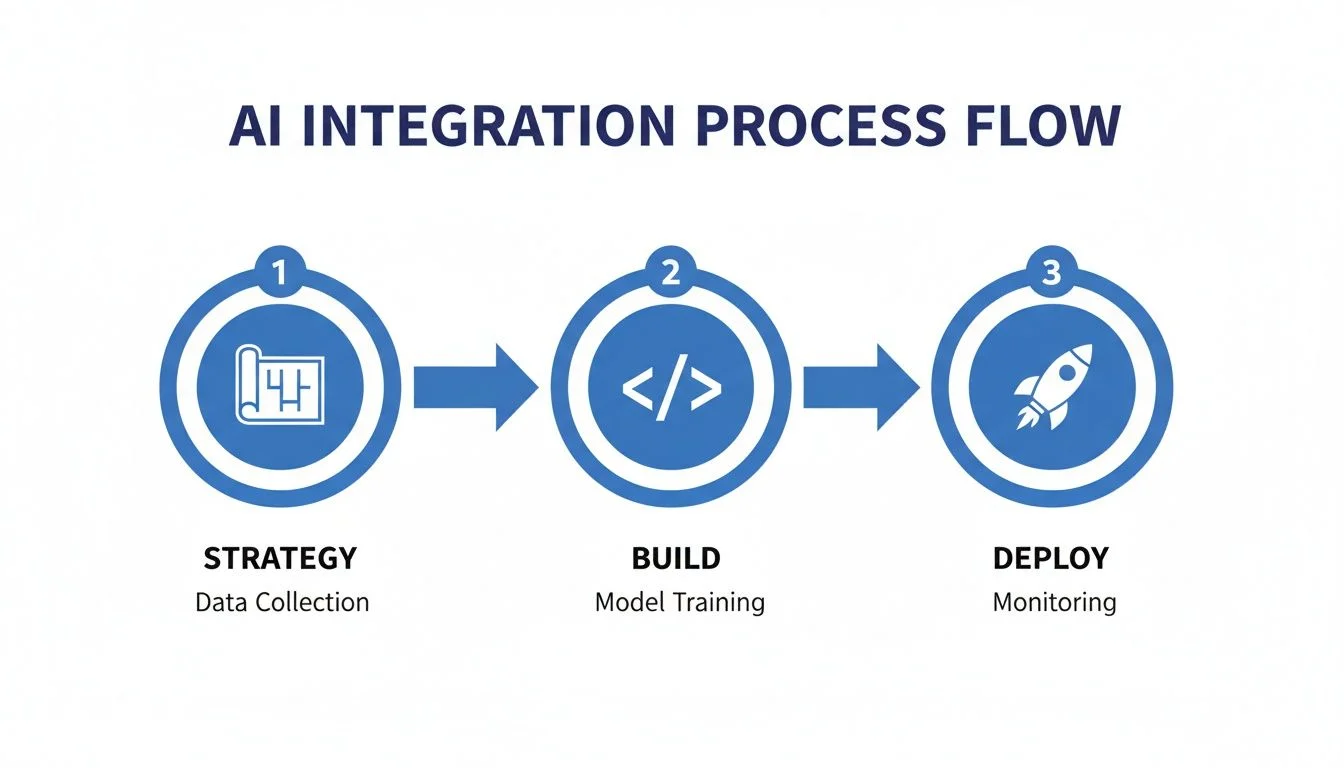
As you can see, a successful deployment is the result of a deliberate strategy and a methodical build-out, not just technology.
Step 3: Create a Clear and Actionable Scope Document
Once you’ve settled on a project, the final piece of your blueprint is a rock-solid scope document. This document serves as your North Star—a single source of truth that aligns everyone from your lead engineer to your key stakeholders.
While it can evolve, the initial version needs to define the essentials:
- Project Objectives: What exact business problem are you solving? Be specific.
- Key Deliverables: What are you actually building? A new API endpoint? A dashboard feature?
- Success Metrics: How will you measure success? Think “reduce manual processing time by 20%” or “increase user engagement by 15%.”
- Timelines and Milestones: A realistic schedule with clear checkpoints.
- Roles and Responsibilities: Who owns what? Eliminate ambiguity.
This blueprint ensures your first foray into AI is grounded in business reality, not just tech for tech’s sake. For more on how this ties into broader automation, our guide on how to integrate AI with RPA for better results is a great next step.
How to Choose the Right Data and AI Models
Every powerful AI engine runs on data. In Web3 and fintech, that fuel is drawn from two distinct worlds: on-chain and off-chain. Your entire AI strategy hinges on how well you can source, clean, and manage data from both. This isn’t just a technical problem—it’s a core business function, especially when security and compliance are paramount.
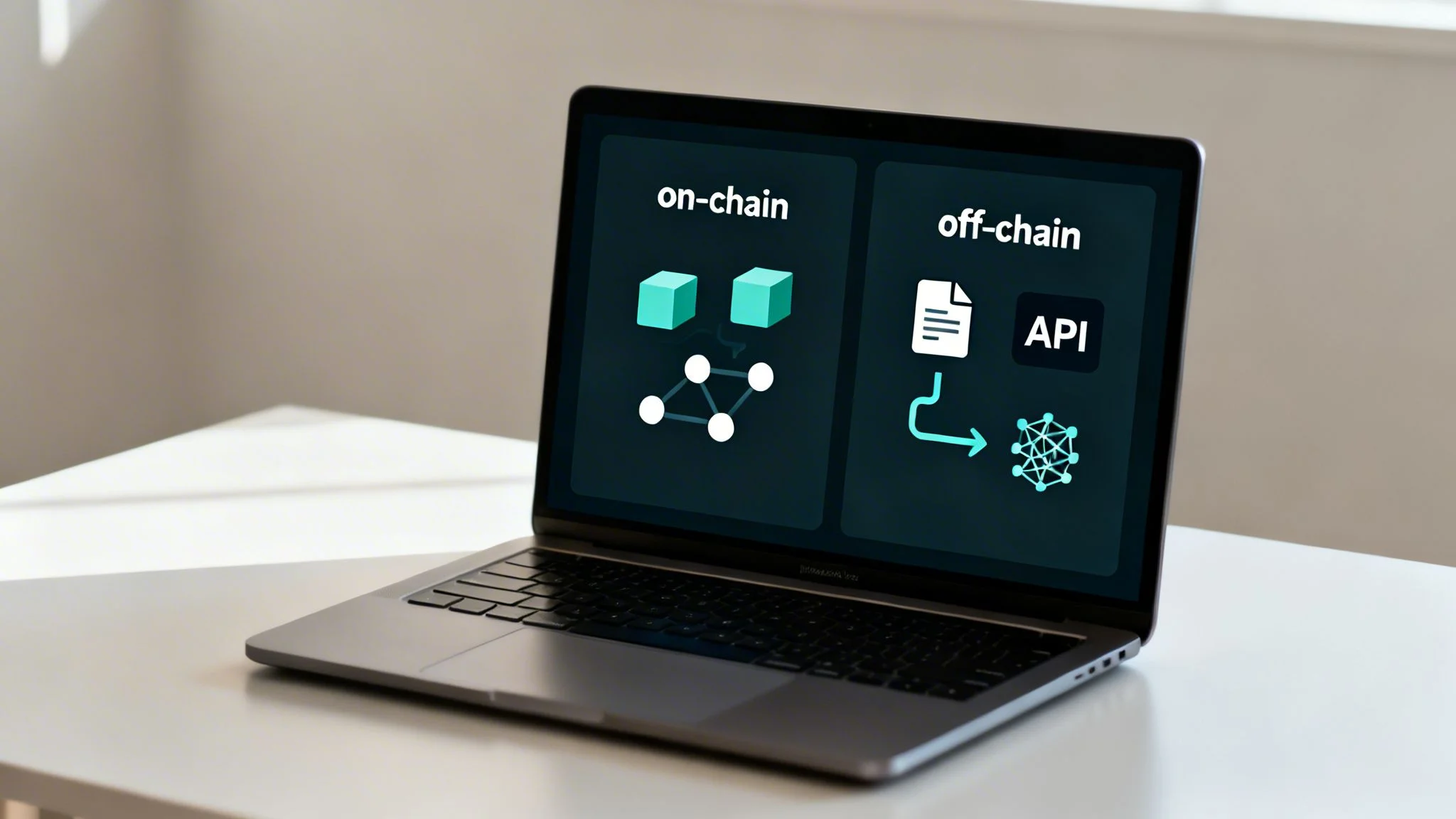
The choices you make now about data and models will directly define your product’s performance, cost, and competitive edge. Nail this, and you’re set up for success. Get it wrong, and you risk building something inefficient, insecure, or that simply doesn’t work as promised.
What is Your Data Sourcing Strategy?
First, map out every potential data source. A solid ai integration service must be able to ingest and harmonize disparate data types to provide the AI model with one clean, coherent picture.
Typically, this means blending:
- On-Chain Data: Transaction histories, wallet activity, smart contract interactions, and governance votes. This is your source of truth—transparent and verifiable.
- Off-Chain Data: Everything else. Market news, social media sentiment, traditional financial data like stock prices, and user behavior from your platform.
For example, an AI agent built to flag risks in OTC trades can’t rely solely on on-chain data. It must combine a wallet’s transaction history with off-chain sentiment analysis and macroeconomic trends to generate a truly predictive risk score. That blended approach is where the real value lies.
Pre-Trained vs. Custom Models: How to Decide?
Once your data plan is solid, you face the next big decision: the AI model itself. You have two primary paths: use a pre-trained, off-the-shelf model or invest the time and resources to build a custom one from scratch.
The choice between a pre-trained and a custom model is a classic speed-versus-specificity trade-off. A pre-trained model gets you to market faster, but a custom model, trained on your unique proprietary data, is how you build a long-term, defensible competitive advantage.
Imagine you’re building an AI agent to optimize liquidity in a decentralized exchange-traded fund (dETF). You could use a pre-trained model like Meta’s Llama to create a basic rebalancing agent quickly. However, a custom model, trained specifically on your platform’s historical liquidity patterns and user behaviors, will almost always deliver superior performance and higher yields over time.
On-Chain vs. Off-Chain: Where to Deploy Your AI?
Finally, you must decide where your AI model will live and execute. This is a critical architectural decision with significant implications for performance, cost, transparency, and trust. A good ai integration service provider will guide you through this complex choice.
The table below provides a framework for this decision, breaking down the key factors for your engineering team to consider.
On-Chain vs. Off-Chain AI Model Deployment: A Comparison
This table serves as a decision-making framework for engineering teams evaluating where to deploy AI models in a decentralized architecture.
| Factor | On-Chain AI | Off-Chain AI | Best For |
|---|---|---|---|
| Transparency | Very High. All logic and decisions are publicly verifiable on the blockchain. | Low. The model’s inner workings are private, operating on a centralized server. | On-Chain: Use cases requiring absolute, provable fairness, like DAO governance voting analysis or protocol parameter adjustments. |
| Performance | Low. On-chain computation is slow and expensive due to network consensus. | High. Can leverage powerful, dedicated hardware for rapid processing and low latency. | Off-Chain: Real-time applications like high-frequency trade signal generation or instant fraud detection. |
| Cost | High. Every computational step incurs gas fees, making it costly for complex models. | Low to Moderate. Based on standard cloud computing costs, which are far more economical. | Off-Chain: Computationally intensive tasks, such as training large models or processing large datasets. |
| Data Access | Limited. Can only access data that is already on-chain or brought on-chain via oracles. | Flexible. Can easily access a vast array of both on-chain and off-chain data sources. | Off-Chain: Models that require a rich, diverse dataset to make accurate predictions, like market sentiment analysis. |
Many of the most sophisticated systems use a hybrid model. An off-chain model might perform a complex risk analysis, then send a simple, verifiable recommendation to an on-chain smart contract for execution. This gives you the best of both worlds: high-powered computation fused with on-chain trust and finality.
How to Build a Secure and Scalable AI Architecture
With your data and model strategy defined, it’s time for the hard engineering: building the infrastructure to run your AI. This is where an AI integration service moves from blueprint to reality, laying down the digital foundation for a system that’s secure, scalable, and built to last. In the Web3 and fintech world, this architecture can’t just be functional—it needs to be bulletproof.

The right architecture allows your AI tools to grow with demand without crumbling under pressure. It also walls off potential threats from day one, protecting your data, models, and, most critically, your users’ assets.
How Can You Architect for Scalability and Performance?
Modern AI systems, especially in high-throughput environments like decentralized trading, require an architecture that’s both nimble and resilient. A rigid, monolithic design won’t cut it. Smart engineering teams are adopting modular approaches.
Two architectural patterns are leading the way:
- Microservices Architecture: This involves breaking down your application into a collection of smaller, independent services. For an AI integration, you might have one service for data ingestion, another for model inference, and a third for interacting with a smart contract. This separation makes the system easier to update, scale, and maintain.
- Agent-Based Workflows: This newer model is gaining serious traction, especially in DeFi. An AI agent is an autonomous program that can observe its environment, make decisions, and act to achieve specific goals—like an agent that monitors a liquidity pool and automatically executes trades to prevent impermanent loss, all without human intervention. It’s the perfect approach for creating self-optimizing, adaptive systems.
When planning your infrastructure, it’s crucial to think long-term. You need an AI architecture for longevity that allows for a fast start without boxing you in later. This foresight prevents you from getting stuck with a rigid system that can’t handle new models or a surge in users.
What is DevSecOps and Why is it Essential?
In a landscape rife with smart contract exploits and data breaches, security cannot be an afterthought. It must be integrated into the entire development lifecycle. This is the core principle of DevSecOps, which embeds security practices directly into your DevOps pipeline.
For any AI integration, this means security is everyone’s job from the first line of code.
A truly secure system is built, not bolted on. DevSecOps for AI means thinking about potential attacks at the architecture stage, not waiting for a security audit to tell you you’re vulnerable. It’s the difference between a fortress and a flimsy fence.
Essential DevSecOps practices for AI include:
- Vulnerability Assessments for AI Components: Regularly scan and penetration test your AI models and dependencies to find weaknesses like model poisoning or evasion attacks.
- Secure Smart Contract Interactions: If your AI agent interacts with smart contracts, those interactions must be locked down. Use multi-signature wallets, set hard spending limits, and ensure every contract call is audited and monitored.
- Continuous Monitoring in the CI/CD Pipeline: Your pipeline should be a security checkpoint, automatically scanning code for vulnerabilities, checking for insecure dependencies, and monitoring model behavior before any change goes to production.
This proactive stance on security is non-negotiable when dealing with financial assets.
Why is Custody and Wallet Architecture So Important?
When you grant an AI system the power to move funds, the underlying custody and wallet architecture becomes the most critical component. Whether you’re building an AI-driven DeFi trading bot or an RWA platform that automates asset issuance, the security of the funds is paramount.
This means implementing battle-tested solutions like multi-party computation (MPC) wallets and hardware security modules (HSMs). It also requires clear, auditable policies that dictate exactly how and when an AI agent can initiate a transaction. The goal is to build a system where assets remain safe even if the AI model itself is compromised.
From our own experience, we’ve seen that a professional AI integration service can reduce breach risks by 40% in audited DeFi platforms. We’ve also seen AI agents in prediction markets boost transaction throughput by a massive 60%. Building a secure and scalable architecture isn’t just a technical requirement; it’s the foundation of user trust and your project’s long-term survival.
How to Test Your Integration and Plan for the Future
Getting your AI integration live is a huge achievement, but it’s just the starting line. The real work of an ai integration service is ensuring the system continues to deliver value long after launch. This requires a continuous cycle of testing, monitoring, and future-proofing.

Without this discipline, even the most advanced AI model can become a “black box” liability, making decisions that are out of sync with real-world conditions.
What Does a Comprehensive Testing Strategy Look Like?
A production-ready AI system needs to be tested far beyond basic unit tests. Your testing framework must cover the entire pipeline, from raw data ingestion to the final decision output, and it must hold up under real-world stress.
This requires clear validation protocols for several key areas:
- Model Accuracy and Reliability: Continuously check the model against a “golden dataset” to ensure its predictions aren’t degrading. This is also where you test for fairness and bias—critical in fintech for applications like risk scoring.
- System Performance and Load Testing: Stress-test your system with high-volume scenarios. What happens when your DeFi platform experiences a sudden surge in trading volume? You need to identify breaking points before they impact users.
- Integration Endpoint Resilience: Verify that every API connection, both on-chain and off-chain, is robust. Implement bulletproof error handling and failover plans for when third-party services inevitably fail.
How Do You Monitor for Success and Prevent Model Drift?
Once the system is live, your focus shifts to constant monitoring. An AI model is not a “set it and forget it” asset. Its performance will degrade over time as the data it sees in production starts to differ from its training data. This is called model drift, and it can silently destroy your ROI.
Think of model drift like a smart contract that becomes outdated as market dynamics change. A model trained to spot fraud in 2024 might completely miss new exploit patterns that emerge in 2026 if it isn’t continuously monitored and retrained.
To combat this, you need to track both operational and model-specific metrics. Operational dashboards show system uptime, API response times, and resource usage. Simultaneously, model monitoring tools must track prediction accuracy, data input distributions, and drift indicators. These are the signals that tell you it’s time to retrain.
What is the 12-24 Month Outlook for AI in Web3?
The AI space moves at a dizzying pace. If you’re only building for today, you’re already behind. A forward-looking perspective is essential. The global adoption of AI integration services is exploding, with recent research showing that AI-powered workflows are boosting efficiency in the blockchain sector by as much as 35%. You can read the full research on global AI adoption to see where things are headed.
Key trends to prepare for now:
- The Rise of Autonomous Agents: AI is moving beyond assisting humans to executing complex, multi-step tasks autonomously. Imagine an agent that not only suggests a trade but also executes it, manages the position, and reports on its performance.
- Generative AI in Smart Contracts: Expect AI to become more involved in the development lifecycle. It will generate, audit, and even optimize smart contract code, dramatically speeding up development and reducing common vulnerabilities.
- AI and Blockchain Convergence for Transparency: Combining AI’s analytical power with blockchain’s immutability will create new standards for verifiable processes, which will be transformative for industries like carbon credit verification and supply chain management.
By planning for these shifts now, your ai integration service will remain a powerful competitive advantage instead of becoming legacy technology.
Partnering with Blocsys for Your AI Integration Service
This guide has laid out the blueprint for a successful AI integration. Now it’s time to talk about execution. Blocsys provides the deep engineering expertise to bring that blueprint to life. Navigating the complexities of AI in Web3, blockchain, and fintech requires more than just a plan—it demands a partner with a proven track record of building secure, high-performance decentralized infrastructure.
We don’t just talk about theory. Our teams have been in the trenches, building the core components of modern decentralized finance. We’ve engineered everything from dETFs that require intricate on-chain logic to perpetual trading platforms where speed and security are non-negotiable. That hands-on experience is now being channelled into our AI integration service, enhancing these very systems with predictive analytics, autonomous agents, and intelligent automation.
From Strategic Roadmapping to Full-Stack Execution
Our engineering services connect directly to each phase discussed in this guide. We help you move from an initial concept to a live, intelligent, and scalable system that’s ready for real-world demands.
Our engagement models are designed to fit your specific needs:
- End-to-End Delivery: We can act as your complete product development partner, handling everything from strategic roadmapping and secure architecture design to full-stack implementation and post-launch scaling.
- Dedicated Engineering Teams: Need to augment your existing crew? We can provide a dedicated squad of specialists with deep expertise in Solidity, Rust, and modern web stacks like MERN to function as a seamless extension of your own team.
Our approach is built on execution discipline. We specialize in translating ambitious AI concepts into production-ready platforms, focusing on the institutional-grade security and robust architecture needed for systems that manage real value.
Your Partner for Mission-Critical Systems
Whether you’re tokenizing real-world assets like precious metals, building sophisticated carbon analytics platforms, or creating the next generation of DeFi trading tools, we understand the technical and security challenges involved. Our deep experience building these systems from the ground up gives us a unique perspective on where and how to integrate AI for maximum impact.
You can explore more about our broader capabilities through our IT outsourcing services and see how we support diverse technological needs.
Ultimately, a successful AI integration project is about finding a partner who understands both the art of the possible with AI and the hard realities of engineering for decentralized environments. We are here to help you build, scale, and execute effectively.
Let’s start the conversation about your project.
Connect with our experts to discuss your AI integration strategy.
Frequently Asked Questions About AI Integration Services
As you get closer to a decision, practical questions arise. Here are the most common ones we hear from product and engineering leaders building sophisticated Web3 and fintech platforms.
Where Do We Even Start with an AI Integration Project?
The first step isn’t writing code; it’s strategic readiness. Start by defining the exact business problem you aim to solve, such as reducing manual compliance checks or enhancing user personalization. Next, conduct a rigorous assessment of your data quality and availability. Simultaneously, evaluate your team’s current AI skills to identify any gaps. Finally, select a small, high-impact pilot project that can deliver a measurable win, build momentum, and justify larger initiatives.
How Do You Actually Measure the ROI of an AI Integration?
Measuring the return on investment (ROI) for an AI integration service requires establishing clear key performance indicators (KPIs) before the project begins. These must be specific and quantifiable. Examples include a 15% reduction in manual transaction verification time, a 10% increase in user engagement with an AI-powered feature, or a measurable drop in fraudulent transactions. By tracking these KPIs before and after integration, the ROI becomes tangible. Also consider qualitative wins, like faster, more accurate risk management decisions.
What Are the Biggest Security Risks with AI in DeFi?
In DeFi, the primary security risks are data poisoning, model evasion, and smart contract exploits triggered by a compromised AI. Data poisoning involves bad actors feeding corrupted data to degrade the model’s integrity and cause flawed decisions. Model evasion is when an attacker crafts inputs to trick the model into making a mistake.
The most critical DeFi-specific risk? An AI agent with smart contract permissions gets exploited to drain funds directly from a protocol. This makes the security of that AI-to-contract link the single most important failure point you need to lock down.
A properly secured AI integration is non-negotiable. It must include rigorous data validation, continuous adversarial testing to find model weaknesses, and strictly audited, minimal-privilege access controls for any on-chain actions. Without these safeguards, the AI becomes a massive vulnerability.
