
Blockchain Post-Trade Reconciliation Platform for Capital Market Operations
Our blockchain post-trade reconciliation platform is a production-ready, permissioned infrastructure layer built for stock exchanges and capital market ecosystems — enabling cryptographic trade reconciliation, immutable cap table management, and real-time regulatory audit trails across clearing corporations, custodians, and depositories, without replacing a single existing system.
India’s Leading Stock Exchange — operating the country’s most critical financial infrastructure, processing millions of trade events daily across equity and government securities segments.
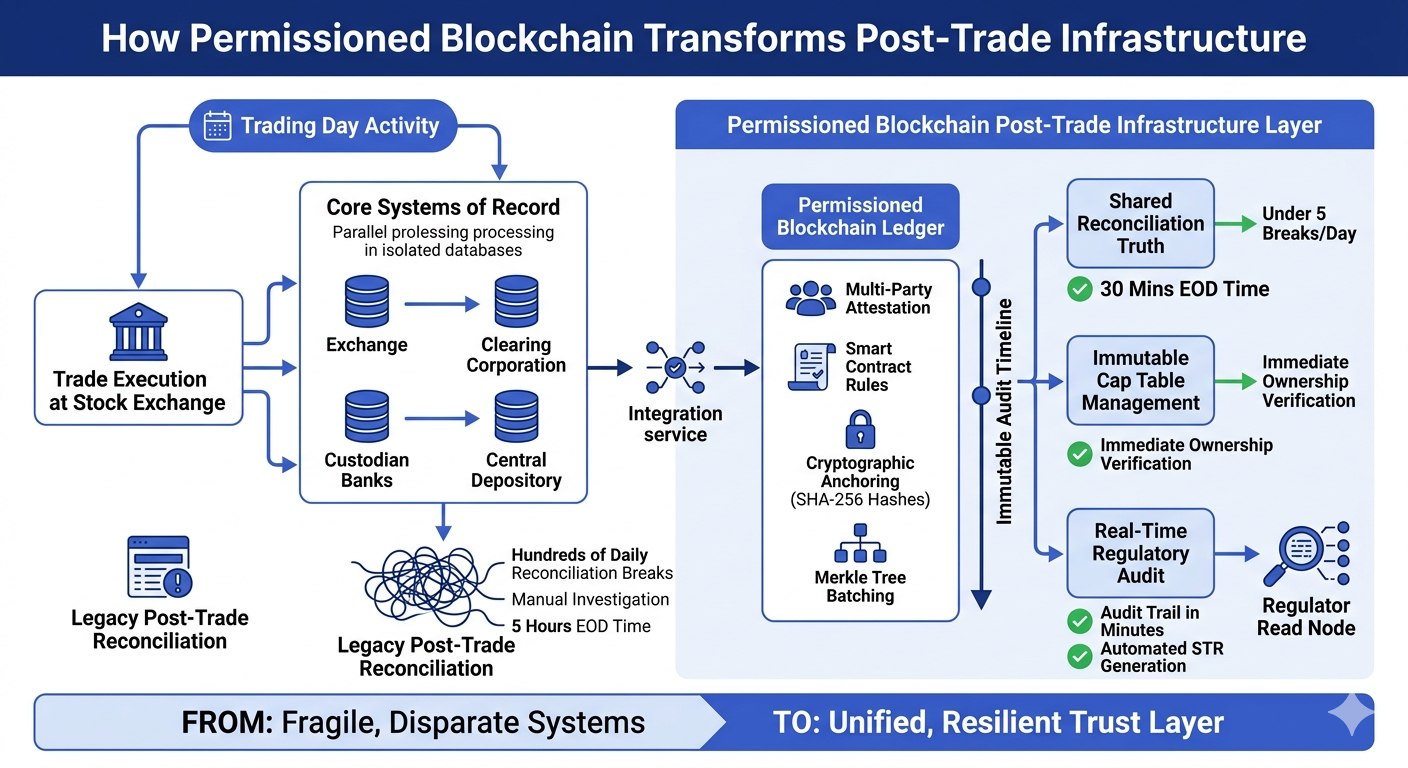
Our blockchain post-trade reconciliation platform eliminates the fragmented, manual reconciliation processes that cost capital market operations teams millions of rupees annually — delivering a shared, cryptographically verified source of truth across clearing corporations, custodians, depositories, and brokers without replacing a single existing system.
Fragmented post-trade systems across clearing corporations, custodians, depositories, and brokers requiring hundreds of manual reconciliation interventions daily, with no shared cryptographic proof of record integrity.
A composable, permissioned blockchain infrastructure layer using hash-anchor-reference architecture — adding tamper-evident proofs, real-time shared checkpoints, and an immutable audit timeline on top of all existing systems.
Reconciliation breaks reduced from 200/day to under 5. EOD reconciliation time cut from 5 hours to under 30 minutes. Regulatory evidence turnaround compressed from 90 days to under 1 day — with zero changes to any existing system.
The Problem — Why a Blockchain Post-Trade Reconciliation Platform Is No Longer Optional
The result is a distributed consistency problem that costs the industry tens of millions of rupees annually in investigation time, settlement failures, and regulatory inefficiency. The core issue is not a lack of technology. It is the absence of a shared, tamper-evident source of truth that all authorised participants can trust simultaneously.
Key Problems Identified in Capital Market Operations
- No shared proof of post-trade state — Every participant maintains an isolated database updated via EOD batch file exchange. There is no single record any party can point to as authoritative. When records diverge, there is no arbiter.
- Hundreds of daily reconciliation breaks, each costing thousands — Operations teams resolve breaks manually by pulling files and comparing records across systems with different schemas. Each break costs ₹5,000–₹50,000. At peak volumes, 50–200 breaks occur on a single trading day.
- Cap table ownership records stored in mutable spreadsheets — In private equity and unlisted SME segments, the share ownership register exists as an Excel workbook — mutable, unversioned, unsigned, with no access control or change audit trail. Multiple versions circulate simultaneously with no mechanism to determine which is authoritative.
- Regulatory evidence reconstruction takes weeks — Assembling the evidence trail for an investigation requires manually pulling records from five or more disparate systems. A single investigation consumes 60–90 days, with 40% spent gathering evidence rather than analysing it.
- No cryptographic proof of event sequence or data integrity — Existing systems timestamp events but do not hash-link them. The sequence can be disputed and records can be updated after the fact without a tamper-evident audit trail.
- Settlement failures from unresolved reconciliation — Unresolved breaks contribute directly to T+2 settlement failures. Even a 0.3% failure rate represents systemic risk exposure that draws regulatory scrutiny.
Our Blockchain Post-Trade Reconciliation Platform — How It Works
The architecture follows a Hash-Anchor-Reference pattern. Full records stay in existing systems. Only cryptographic proofs — SHA-256 hashes, digital signatures, version labels, and event identifiers — are written on-chain. The result is a lightweight, legally defensible, operationally non-invasive proof layer that transforms how every participant in the post-trade ecosystem interacts with data.
Three Composable Use Cases — Each Independently Valuable
Blockchain Post-Trade Reconciliation Platform — Key Features & Capabilities
- Permissioned Write Access with Role Registry — Only wallets holding authorised roles (Exchange Publisher, Clearing Corp Publisher, Custodian Endorser) can submit transactions. Regulator and broker wallets hold read-only access. Unauthorised parties cannot submit or manipulate checkpoints under any circumstance.
- SHA-256 Checkpoint Anchoring with Multi-Party Attestation — Every post-trade golden state is anchored as a SHA-256 digest co-signed by the exchange, clearing corporation, and at least one custodian before being finalised. No single party can unilaterally assert a post-trade state.
- Merkle Tree Batch Anchoring — A single on-chain write covers an entire batch of up to 10,000 trades via a Merkle root hash, with individual trade-level inclusion proofs extractable off-chain, reducing transaction costs to negligible levels.
- Versioned Cap Table Checkpoints with Time-Travel Queries — Cap table states are anchored as versioned, time-stamped snapshots, enabling any participant to query ownership as it existed on any past date with cryptographic proof.
- Hash-Linked Event Chain for Tamper Detection — Every audit event record contains the SHA-256 hash of the preceding event. Any retrospective insertion, deletion, or modification breaks the entire chain and is detected instantly by an automated validator running continuously.
- Real-Time Regulator Node with No Request Latency — The securities regulator operates its own read-only blockchain peer that receives every event as it is anchored, eliminating the wait for manual data responses that may be incomplete.
- Automated Suspicious Transaction Report Generation — Smart contract threshold rules evaluate every on-chain event against configurable compliance criteria and emit structured STR payloads, compressing filing preparation from days to under one hour.
- Zero Impact on Existing Systems — The matching engine, clearing system, depository, custodian platforms, and broker OMS remain entirely unchanged. Only a lightweight integration microservice is added — no core system is modified, migrated, or replaced.
Solution Breakdown — How We Build and Deploy the Platform
- Discovery & Architecture Planning — Mapping all participant systems, data flows, reconciliation processes, and regulatory reporting requirements across the post-trade ecosystem
- Hash-Anchor-Reference Design — Designing the off-chain/on-chain separation model ensuring no sensitive data leaves existing systems while cryptographic proofs are anchored on-chain
- Smart Contract Development — CheckpointRegistry, CapTableMirror, and AuditEventLog contracts with role-based access control and hash-linked event chain logic
- Integration Microservice Development — Lightweight service layer reading events from existing systems, computing SHA-256 digests, and submitting anchors to the permissioned network
- Regulator Node Deployment — Setting up the read-only permissioned validator peer for real-time regulatory visibility with no write capability
- Dashboard & Query API — Reconciliation dashboard for operations teams, evidence reconstruction API for investigators, and LP portal for ownership queries
- Security Audit & Testing — Smart contract audit, cryptographic validation, role registry penetration testing, and stress testing at production trade volumes
- Deployment & Go-Live — Phased rollout: Use Cases 1 and 2 in Phase 1 (parallel), Use Case 3 in Phase 2 consuming events from both
Results Achieved with Our Blockchain Post-Trade Reconciliation Platform
Since deploying the blockchain post-trade reconciliation platform, the client has seen measurable improvements across every critical operational KPI — from EOD reconciliation speed to regulatory response times. The blockchain post-trade reconciliation platform replaces manual, error-prone processes with automated, cryptographically verified workflows that scale at zero marginal cost.
| KPI | Before | After |
|---|---|---|
| EOD reconciliation time per desk | 3–5 hours per trading day | Under 30 minutes |
| Reconciliation breaks per day | 50–200 (varies by session) | Under 5 (version-mismatch flags only) |
| Time to resolve a dispute | 1–3 business days | Under 1 hour via on-chain query |
| T+2 settlement failure rate | ~0.3% of daily trades | Under 0.05% |
| Due diligence verification time | 2–4 weeks | Under 4 hours |
| Cap table disputes per fundraising round | 1 in 3 rounds triggers a dispute | Under 1 in 20 rounds |
| Evidence reconstruction for investigation | 60–90 days manual assembly | Under 1 day via automated API query |
| Regulatory response time to information request | 5–10 business days | Under 2 hours |
| Time to generate STR filing | 3–7 days manual assembly | Under 1 hour from on-chain threshold trigger |
| Real-time surveillance coverage | T+1 to T+7 batch reports | Live event stream with under 60-second lag |
Long-Term Strategic Impact for Capital Market Infrastructure
Let actions talking instead












Ready to Build a Tamper-Evident Infrastructure Layer for Your Capital Market Operations?
Deploy a permissioned blockchain proof layer that eliminates post-trade reconciliation breaks, secures ownership records with cryptographic evidence, and gives regulators real-time, unmediated visibility — without touching a single existing system.
