
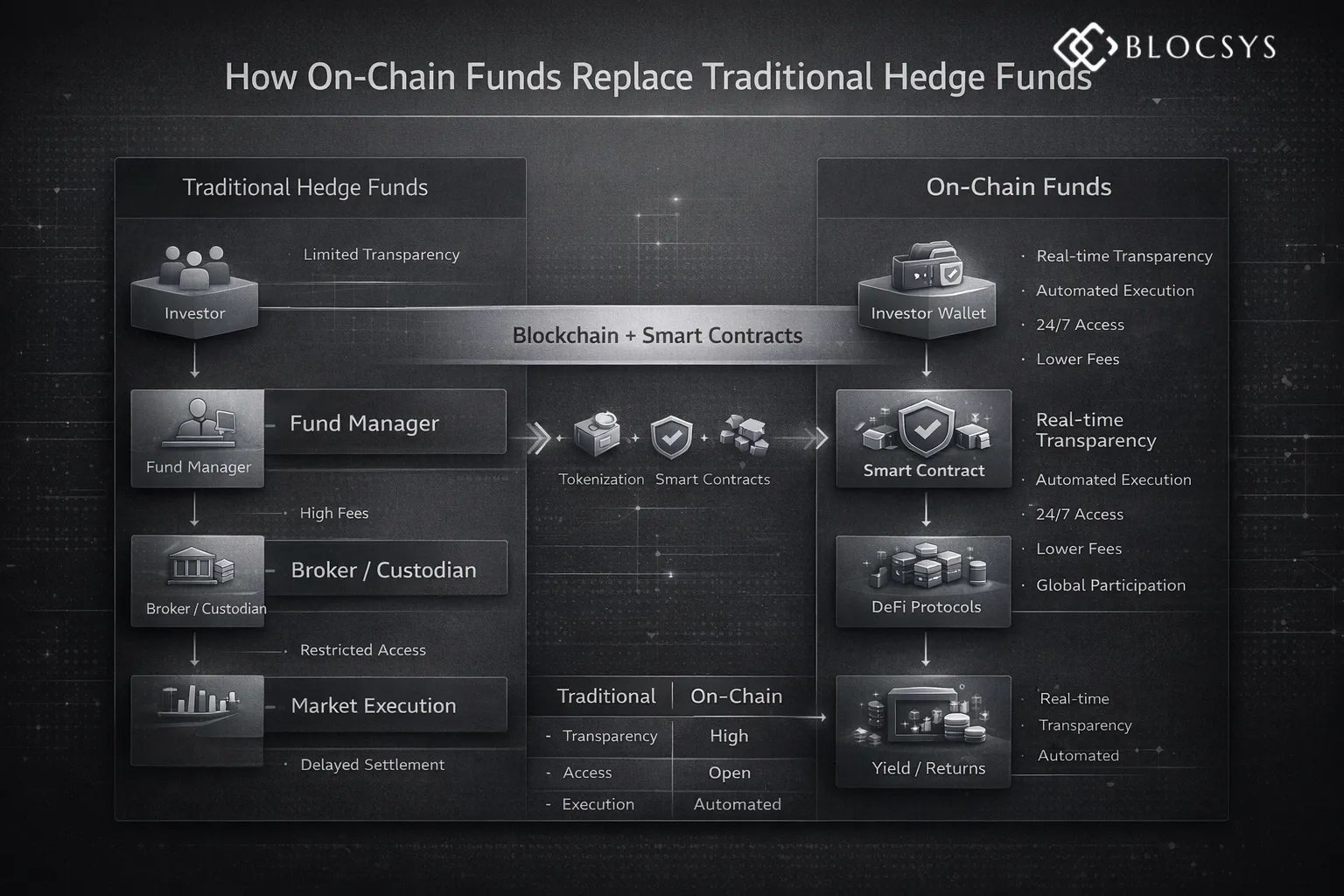
On-chain funds are fundamentally reshaping the investment world, offering a transparent, efficient, and accessible alternative to traditional hedge funds. For investors and fund managers navigating the shift from Web2 to Web3 finance, understanding this transition is critical. This guide breaks down how on-chain funds work, why they are gaining dominance, and what the future of asset management looks like from a 24-month outlook, providing a clear decision framework for building in this new landscape.
What Is Driving the Shift from Traditional to On-Chain Funds?

The world of high finance is undergoing a quiet but profound transformation. For decades, traditional hedge funds have operated as exclusive, walled gardens for institutional players and high-net-worth individuals, defined by steep minimum investments, opaque fees, and a notorious lack of transparency. That entire model is now being challenged by a technologically superior alternative: on-chain funds, which leverage blockchain to automate processes, reduce costs, and provide auditable transparency.
Why Are Investors and Managers Migrating to On-Chain Solutions?
Investors and fund managers are migrating to on-chain solutions to solve the deep-seated limitations of the old system. The primary driver is a demand for radical transparency. Unlike traditional funds that report holdings quarterly, on-chain funds offer an immutable and publicly verifiable ledger of every transaction, a key feature for decision-makers in the Web3, crypto, and AI sectors.
The key benefits accelerating this shift include:
- Lower Operational Costs: Smart contracts automate compliance checks, investor onboarding, and profit distribution, drastically cutting the need for expensive intermediaries like fund administrators and custodians.
- Faster Settlement Times: Blockchain transactions settle in minutes or seconds, a world away from the traditional T+2 settlement cycle, which can take days to complete in legacy financial systems.
- Broader Market Access: Through tokenisation, large, illiquid assets can be fractionalised into smaller, tradable digital units. This democratises investing, opening once-exclusive markets like private equity and real estate to a wider pool of global investors. Explore this further in our guide on what tokenised funds are.
This shift represents a move from a trust-based system, which relies on auditors and legal agreements, to a mathematically verifiable one where code enforces the fund’s rules. It’s a foundational change in how financial trust is established and maintained, aligning perfectly with the core principles of Web3.
How Do On-Chain Fund Models Compare to Traditional Funds?

To understand the financial shift, you need to compare the two models side-by-side. Traditional hedge funds are like walled gardens—exclusive and protected by high barriers like huge minimum investments, opaque fee structures, and slow, paper-based processes. They operate through a web of intermediaries, adding layers of cost and reducing transparency. On-chain funds, conversely, are open, transparent ecosystems powered by smart contracts—self-executing code on a blockchain—to automate everything from investor onboarding to profit distribution.
This fundamental architectural difference creates a domino effect, impacting everything from cost structures and investor access to governance and security.
Traditional vs. On-Chain Funds: A Core Comparison
This table offers a clear, head-to-head comparison, showing just how different these two fund management models are in practice. It provides a decision framework for enterprises and startups evaluating which model aligns with their strategic goals.
| Feature | Traditional Hedge Funds | On-Chain Funds |
|---|---|---|
| Operations | Human-intensive, manual, slow | Automated by smart contracts, instant |
| Fees | High overhead (“2 and 20” model) | Low overhead, transparent, flexible |
| Investor Access | Exclusive, high minimums, accredited only | Open, low minimums, global access |
| Liquidity | Low, long lock-up periods, quarterly redemptions | High, 24/7 trading on secondary markets |
| Governance | Centralised (fund manager control) | Decentralised (token-holder voting) |
| Custody | Centralised with third-party custodians | On-chain, secured by cryptography |
As you can see, the on-chain model introduces major efficiencies and opens up access in ways the traditional structure simply cannot match, offering a clear advantage for modern financial products.
How Does Operational Structure and Fees Differ?
In the old model, operations rely heavily on people. Fund administrators manually track capital accounts, calculate performance fees, and process subscriptions and redemptions. This is slow, prone to human error, and inflates operational costs, which investors ultimately bear through management and performance fees.
On-chain funds flip this model. Smart contracts automate these administrative tasks, executing them instantly and without bias. This disintermediation—cutting out the middlemen—slashes overhead costs dramatically.
With on-chain funds, the classic “2 and 20” fee structure (a 2% management fee and a 20% performance fee) becomes difficult to justify. The efficiency gained from automation enables fee models that are more competitive, transparent, and fair to investors.
What Is the Difference in Investor Access and Liquidity?
Traditional hedge funds are notoriously difficult to access, generally available only to accredited investors and institutions with millions to invest. Investor capital is often locked up for long periods with rigid redemption windows.
On-chain funds demolish these barriers using tokenisation. Fund shares are issued as digital tokens that can be fractionalised, allowing for much lower minimum investments and opening the door to a far wider pool of global investors. These tokens can also trade on secondary markets 24/7, offering a degree of liquidity that is out of reach in the traditional fund world.
How Are Governance and Custody Handled?
Two of the biggest differences are in fund governance and asset custody. Traditional funds have a top-down, centralised governance structure where the fund manager makes all decisions. Asset custody is also centralised with a third-party bank, creating a single point of failure.
On-chain funds introduce two game-changing concepts:
- Decentralised Governance: Many on-chain funds operate as Decentralised Autonomous Organisations (DAOs). In a DAO, token-holding investors vote directly on key fund strategies, such as adding new assets or adjusting risk parameters. This ensures the interests of the fund manager and investors are provably aligned on the blockchain.
- On-Chain Custody: Assets are held directly on the blockchain in smart contract-based vaults secured by cryptography. With custody decentralised, there’s no need to trust a single third-party institution, reducing counterparty risk and guaranteeing that only the rules written in the code can move the assets.
This isn’t just an upgrade; it’s a complete re-architecting of fund management. Power shifts from opaque, centralised control to transparent, automated, and community-driven operations.
What Are the Key Catalysts for the On-Chain Revolution?

The rapid shift from traditional hedge funds to on-chain counterparts is fueled by undeniable catalysts striking at the core weaknesses of legacy finance. The most significant of these is radical transparency. Unlike the “black box” of a traditional fund, on-chain funds operate on a public ledger where every transaction is recorded and permanently verifiable, allowing investors to audit fund activity in real-time. This is a critical evaluation criterion for any organization operating in the Web3 space.
The Economic Power of Disintermediation
A massive economic driver is disintermediation—stripping out costly middlemen from the fund management process. Traditional funds are propped up by a network of third parties like administrators, custodians, and transfer agents, each adding fees and operational drag.
On-chain funds use smart contracts to automate these roles with immediate, powerful impact:
- Reduced Operational Overhead: Automating compliance, capital account management, and fee calculations slashes a fund’s running costs.
- Directly Boosted Returns: With lower overhead, more of the fund’s gross returns can be passed directly to investors, challenging the expensive “2 and 20” fee model.
This shift rewrites the cost structure of fund management. By replacing manual, expensive processes with automated, auditable code, on-chain funds create a more efficient and investor-aligned financial vehicle. The explosive growth in DeFi statistics proves its clear economic advantages at scale.
Enhanced Liquidity and 24/7 Market Access
Another critical factor is the dramatic improvement in liquidity. Traditional hedge funds are notoriously illiquid, trapping investor capital with long lock-up periods and restrictive redemption windows.
On-chain funds solve this by issuing fund shares as digital tokens. These tokens can be traded on secondary decentralised exchanges 24/7, giving investors unprecedented flexibility. This 24/7 market access contrasts sharply with the siloed, time-gated world of traditional finance. This new reality is reshaping investment strategies globally, with on-chain crypto activity in the APAC region soaring by 69% year-over-year. As recent crypto hedge fund statistics show, 43% of hedge funds are already planning to integrate tokenised assets.
The Dawn of Tokenised Real-World Assets
Perhaps the most exciting driver is the ability to tokenise Real-World Assets (RWAs). This process converts ownership rights of physical or traditionally illiquid assets—like real estate, private equity, or carbon credits—into digital tokens on a blockchain, unlocking immense value by opening previously inaccessible markets.
Consider the implications for both startups and enterprise clients:
- Fractional Ownership: A multi-million-dollar commercial property can be tokenised, allowing investors to buy small, affordable fractions.
- New Asset Classes: Assets like private equity, fine art, and carbon credits can be made liquid and tradable.
- Global Reach: Tokenisation dissolves geographical barriers, allowing a global pool of capital to flow into local assets.
By turning illiquid assets into tradable digital instruments, on-chain funds are creating entirely new investment frontiers, pulling capital and talent toward a more open and efficient financial future.
What Are the Risks and Regulatory Hurdles for On-Chain Funds?
While the potential of on-chain funds is clear, the path is complex, marked by both technical vulnerabilities and a constantly shifting regulatory landscape. Knowing how to manage these risks is what separates a sustainable, institutional-grade fund from a failed experiment.
A massive concern is smart contract vulnerability. These self-executing agreements are the backbone of any on-chain fund. A single flaw can be exploited, leading to a catastrophic loss of assets.
This means rigorous, multi-layered security isn’t just a feature—it’s a non-negotiable requirement.
- Comprehensive Security Audits: Before launch, smart contracts must pass exhaustive audits from reputable third-party security firms to hunt for vulnerabilities, logical errors, and potential attack vectors.
- Thorough Penetration Testing: Penetration tests simulate real-world attacks to see how the entire system holds up under pressure.
- A DevSecOps Mindset: Security must be woven into every stage of the development lifecycle, from initial design to post-launch monitoring.
The Fragmented Regulatory Landscape
The next major hurdle is the messy and often contradictory global regulatory environment. The on-chain world still feels like the Wild West in many places. Regulators are scrambling to classify digital assets, resulting in a confusing patchwork of rules that can change overnight.
For any fund with serious ambitions, building compliance in from day one is non-negotiable. This means integrating Know Your Customer (KYC) and Anti-Money Laundering (AML) protocols directly into the platform. A deep understanding of how to build a Web3 regulatory compliance framework is essential.
You must engineer a system that satisfies strict regulatory demands without sacrificing the core benefits of decentralisation. This often involves innovative solutions like zero-knowledge proofs, which can verify a user’s identity without storing their sensitive data on-chain.
Addressing Market and Liquidity Risks
Finally, founders must be realistic about the market itself. The digital asset space is defined by its extreme volatility. Prices can swing wildly, creating a high-risk environment. This can directly impact the value of assets in your fund and its overall health.
And while tokenisation can create liquidity, it’s not guaranteed. For niche asset classes, you might find there simply aren’t enough buyers and sellers to create a healthy market, leading to low liquidity. This makes it difficult for users to exit positions at a fair price. A clear strategy for managing volatility and a realistic assessment of market depth are critical for long-term survival.
What is the Future of Fund Management (2026-2028 Outlook)?
The lines between traditional finance (TradFi) and decentralised finance (DeFi) are blurring faster than ever. Over the next 12 to 24 months, fund management will fundamentally change. Legacy institutions are no longer experimenting; they are actively building on-chain infrastructure, signaling a permanent structural shift in capital markets. This period will be defined by integrating proven financial practices with the raw efficiency and transparency of blockchain. Major players like SkyBridge Capital, which is tokenising hundreds of millions in fund assets, exemplify this strategic move to improve efficiency and broaden investor access.
How Will AI Dominate On-Chain Management?
Artificial Intelligence (AI) is the single biggest force multiplier for on-chain funds. AI will reshape strategy, risk analysis, and portfolio optimisation. Combining AI’s predictive power with real-time, transparent blockchain data creates a uniquely powerful tool for generating alpha.
Expect AI to be embedded across the entire fund management process:
- Automated Trading Strategies: AI algorithms will execute complex trading strategies directly on-chain, reacting to market shifts in microseconds without human intervention.
- Predictive Risk Analytics: Machine learning models will constantly scan on-chain data to spot emerging risks—like smart contract stress points or unusual liquidity movements—giving managers time to act.
- Autonomous Portfolio Rebalancing: AI agents will maintain ideal portfolio allocations by automatically rebalancing assets based on preset rules and live market data.
By delegating high-frequency decisions and complex data analysis to AI, fund managers can focus on high-level strategy and unique sources of return. This is how on-chain funds will deliver superior performance and risk-adjusted returns compared to traditional counterparts.
How Will Decentralised Financial Products Mature?
As blockchain technology matures, the financial products built on it will become exponentially more sophisticated. We will see a clear shift from simple yield farming toward structured, institutional-grade offerings that mirror traditional derivatives but with on-chain transparency and efficiency.
For instance, the rise of complex decentralised options vaults (DOVs) and on-chain structured products will attract the next wave of institutional capital, which requires a richer set of investment tools than what DeFi currently offers.
How Far Will Real-World Asset Tokenisation Expand?
The tokenisation of Real-World Assets (RWAs) will break into new, untouched asset classes, creating unprecedented investment opportunities. While the first wave focused on real estate and private credit, the next will bring more exotic and impactful assets onto the blockchain.
We expect major growth in the tokenisation of:
- Carbon Credits: Creating a liquid, transparent, and global market for environmental assets will be a massive focus, funneling capital directly toward climate-positive projects.
- Intellectual Property: Tokenising patents or music royalties will unlock new revenue streams for creators and give investors access to an asset class with a different return profile.
- Private Equity and Venture Capital: The tokenisation of private equity is set to go mainstream, breaking down the high barriers that have locked most people out of early-stage venture investing.
The future of fund management lies at the intersection of on-chain infrastructure, AI-driven intelligence, and the tokenisation of every form of value. For both startups and established firms, acting on these trends will separate the winners from the rest.
How Blocsys Helps Organizations Build On-Chain Funds
Knowing how on-chain funds are disrupting traditional finance is just the start. The real work—and the biggest opportunity—is in building these next-generation financial instruments. This demands a partner with deep engineering expertise who understands both the technical challenges and the strategic vision needed to succeed in the Web3, blockchain, and AI sectors.
The jump from a concept to a production-ready, institutional-grade platform is where most projects fail. Success requires a holistic approach that weaves together protocol design, battle-tested security, and a scalable backend. This is the specialised domain where Blocsys operates, serving as an end-to-end engineering partner for firms ready to build and scale in this new financial world.
Architecting for a Decentralised Future
Building a successful on-chain fund is about re-imagining financial architecture from the ground up. Our expertise focuses on creating the core pillars for tomorrow’s market leaders, addressing the real decision-stage needs of our clients.
- Decentralised ETFs (dETFs): We architect and engineer dETFs that deliver automated, transparent, and low-cost exposure to a wide range of assets.
- RWA Tokenisation Platforms: Our team designs systems for tokenising real-world assets like precious metals and carbon credits, turning illiquid holdings into liquid, tradable instruments.
- Compliant Market Infrastructure: We build compliance directly into the protocol layer, ensuring your fund can operate globally while adhering to critical KYC/AML rules.
Our approach is built on first-hand experience solving the exact security, scalability, and regulatory challenges discussed throughout this guide. The diagram below maps out the key pillars shaping the future of fund management.

This illustrates that success is built on a foundation where traditional finance merges with DeFi, supercharged by AI and expanded through new asset classes.
From Blueprint to Live System
Turning a visionary idea into a secure, scalable on-chain fund is a complex process. For those looking to build, securing initial capital through investor agreements often requires specialised venture capital legal advice. Once funding is secured, execution is everything.
Blocsys acts as your dedicated engineering force, transforming your blueprint into a robust, market-ready system. We integrate our deep knowledge of smart contract security—a critical component detailed in our guide on smart contract audit costs—with scalable backend systems and compliance-aware workflows.
Our focus is on disciplined execution and delivering institutional-grade products. We bring the technical firepower needed to navigate every stage of development, from initial architecture to final deployment and ongoing scaling. This frees up founders and enterprises to focus on strategy and growth, confident their technology is built to last.
The shift to on-chain finance is accelerating. Partnering with an expert team that has already built the infrastructure you need is the fastest way to secure a competitive edge. If you are ready to build, scale, and execute effectively, connect with Blocsys for expert guidance on architecting the future of your on-chain fund.
Frequently Asked Questions (FAQ)
Are on-chain funds more profitable than traditional hedge funds?
On-chain funds can be more profitable primarily due to drastically lower operational costs. By automating roles of intermediaries like administrators and custodians, more returns can be passed to investors. However, profitability also depends on the fund’s strategy, risk management of smart contract vulnerabilities, and market volatility.
What are the main security risks with on-chain funds?
The primary security risk for an on-chain fund is a smart contract bug or exploit, which could lead to a complete and irreversible loss of assets. Other major concerns include the compromise of private keys (custody risk) and reliance on external data feeds (oracle risk) that could be manipulated.
How difficult is it to launch an on-chain fund?
Launching an on-chain fund is a complex undertaking that requires deep expertise in blockchain development, smart contract security, and the evolving regulatory landscape for KYC/AML. Due to the steep learning curve, many firms partner with a specialised engineering partner to navigate the technical and compliance challenges and accelerate their time to market.
If you’re ready to build and scale in this new financial paradigm, Blocsys acts as an end-to-end engineering partner to bring your vision to life. Connect with our team today to start building your secure, production-ready on-chain fund.
