
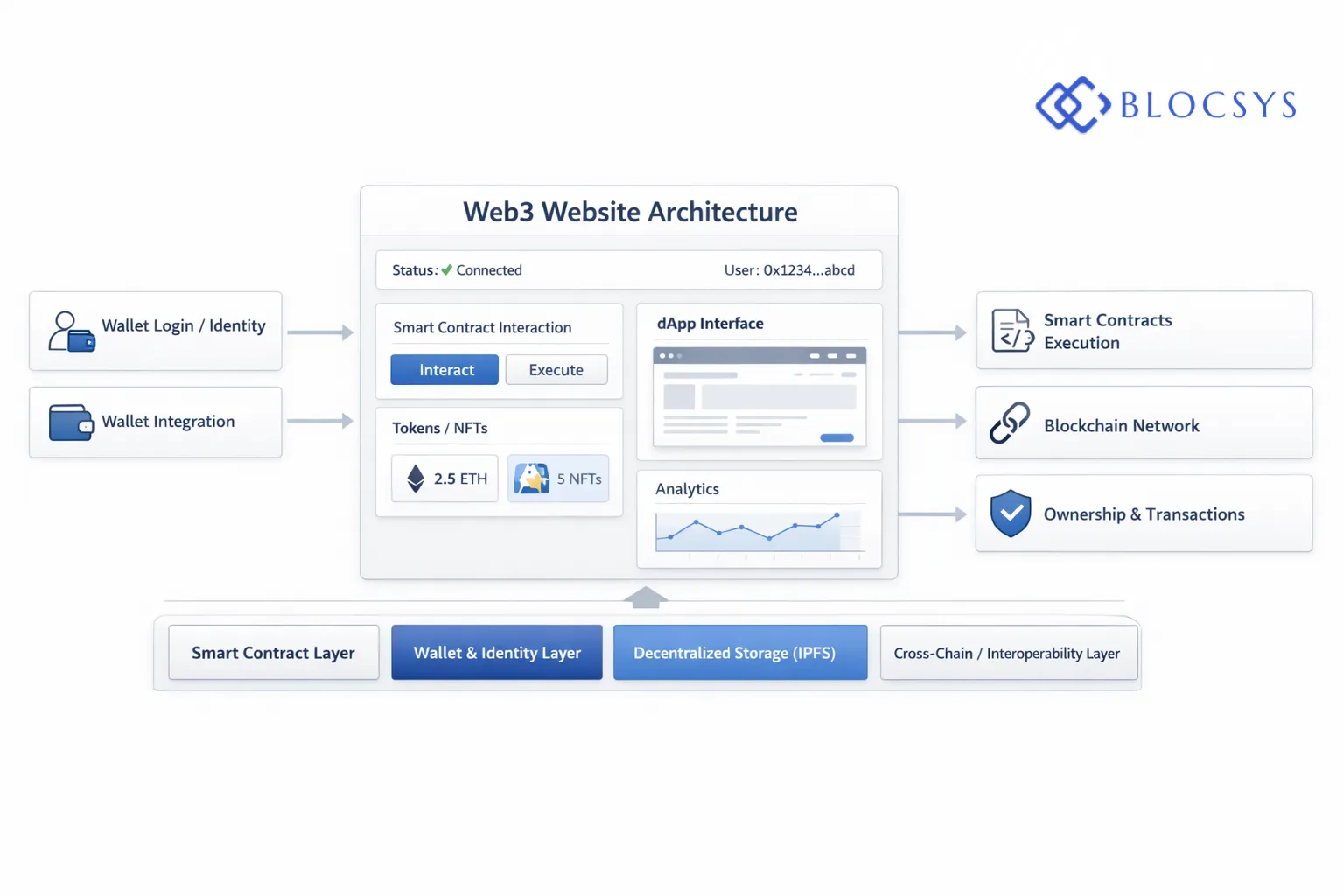
Is your organization building for the next internet? This guide is for founders, product leaders, and enterprise teams moving beyond theory to build secure, production-ready Web 3 websites. While Web2 was about using a centralized web, Web3 is about owning a piece of it through decentralized technologies like blockchain. This shift gives users direct ownership of their data and digital assets, moving control away from corporate servers.
This guide provides the essential frameworks for building robust, scalable platforms, covering architectural DNA, key components, and strategic choices. We will explore how to structure decentralized applications, integrate AI, and plan for a multi-chain future. By the end, you will understand the decision-making process required to move from concept to a successful launch. For a foundational overview, see our in-depth guide on what is Web3.
What are the core principles of Web3?
The transition to Web3 is defined by three core principles that distinguish it from previous internet eras. For anyone building in this space, understanding these concepts is non-negotiable as they dictate the architecture and value proposition of decentralized applications.
- Decentralisation: Instead of relying on a single company’s servers, Web3 applications run on a peer-to-peer network of computers. This architecture eliminates single points of failure, making the system more resilient and resistant to control by any one entity.
- User Data Ownership: In Web3, users control their identity and digital assets through a cryptographic wallet, not a corporate account. This self-sovereign identity model empowers individuals and enables new economic paradigms where users can manage and monetize their own data.
- Censorship Resistance: Because there is no central authority governing the network, it becomes extremely difficult for any single government or corporation to block or remove applications and content, ensuring a more open and free-flowing exchange of information.
At its core, Web3 is about restoring power to the individual. It’s an architecture of trust where the rules are written in open-source code, not dictated by shifting corporate policies. This creates verifiable, transparent, and user-governed digital ecosystems.
Is Web3 ready for enterprise-grade applications?
Yes, the Web3 industry is rapidly maturing from experimental projects to enterprise-grade deployments, particularly in high-growth regions. For instance, India’s Web3 startup ecosystem saw significant growth in 2024, with over 1,200 active companies securing approximately $462 million in funding. This has pushed total funding past $1.3 billion since 2020, fueling advancements in finance, entertainment, and core infrastructure.
With its developer community now representing 12% of global blockchain talent and over 35 million traders, the region is a key hub for building sophisticated, real-world blockchain solutions. Enterprises are using these technologies for supply-chain management, real-world asset (RWA) tokenization, and more, signaling a clear shift toward scalable, practical applications. You can read the full research on India’s rising Web3 ecosystem on Economic Times. This growth fuels demand for expert partners who can navigate complex technical and regulatory landscapes.
Architectural Showdown: Web2 vs. Web3
To truly grasp what makes a Web3 website different, you have to look under the hood. On the surface, a Web2 and Web3 site might look almost identical to a user, but their core architectures are worlds apart. Understanding this shift from centralised to decentralised systems is critical for anyone building, funding, or operating a modern digital product.
At its heart, a traditional Web2 website runs on a simple client-server model. Your browser is the client, and it sends requests to a central server owned by a single company. Everything—user data, business logic, application state—sits in that company’s private database. It’s an efficient and time-tested model, but it concentrates all power and control into one entity’s hands.
How does Web3 architecture differ from Web2?
Web3 fundamentally tears down the client-server model. Instead of trusting a single server, Web3 applications interact with a decentralized network of computers (nodes) that collectively maintain a shared, public ledger—the blockchain. This single architectural change redefines the entire application stack, from user identity and data storage to governance and payments. This evolution is driven by the core principles of decentralization and user ownership.

As the diagram shows, decentralization is the foundation. It enables true user ownership and censorship resistance, which are the primary drivers for building Web3 websites and applications.
To make these differences concrete, the following table contrasts the key components of Web2 and Web3 websites. This framework helps stakeholders quickly understand the architectural shifts required for decentralized product development.
Architectural Comparison: Web2 vs. Web3 Websites
| Component | Web2 Approach (Centralised) | Web3 Approach (Decentralised) |
|---|---|---|
| User Identity | Email & password accounts stored on company servers. Access can be revoked. | Self-custodied crypto wallet (e.g., MetaMask). User owns and controls their identity. |
| Backend Logic | Runs on a private, company-owned server (e.g., AWS, Google Cloud). | Logic executed by smart contracts on a public blockchain (e.g., Ethereum). |
| Data Storage | Stored in private databases (e.g., MySQL, PostgreSQL). Company has full control. | Mix of on-chain (for critical state) and off-chain decentralised storage (e.g., IPFS). |
| Governance | Top-down decisions made by the company’s management and board. | Community-driven decisions made via DAO voting with governance tokens. |
| Payments | Relies on third-party payment processors (e.g., Stripe, PayPal) with fees. | Native, peer-to-peer crypto payments using the user’s wallet. |
| Host & Uptime | Hosted on centralised servers. Vulnerable to single points of failure. | Hosted on decentralised networks (like IPFS). No single point of failure. |
This table clearly illustrates that building in Web3 isn’t just a minor update—it’s a complete rethinking of how applications are structured, secured, and managed from the ground up.
How does user identity change in Web3?
One of the most profound architectural shifts is in user identity. In the Web2 world, your identity is just an account—an email and password pair stored on a corporate server. The company can delete your account, sell your data, or lock you out at any time.
Web3 completely inverts this model. Your identity is a self-custodied wallet, a cryptographic key pair that you, and only you, control. This wallet acts as a universal login for the entire decentralized web, giving you a sovereign way to hold digital assets and manage your data. This transition to wallet-based identity is a paradigm shift in digital interaction, creating a direct, peer-to-peer relationship between the user and the application, governed by code rather than corporate policies.
How is data stored in Web3 applications?
The other massive difference is in how data is stored. Web2 applications hoard user and operational data on private, centralised databases like MySQL or PostgreSQL. The company has exclusive access and control over this information.
In contrast, Web3 websites almost always use a hybrid of on-chain and off-chain storage. It’s a crucial distinction for any product team to understand.
On-Chain Data: This is for the mission-critical information where immutability and verifiability are paramount. Core transactions, asset ownership records, and key state changes are recorded directly on the blockchain, making the data transparent and permanent.
Off-Chain Data: Large files like images, videos, or user-generated content are almost never stored on-chain due to high costs. Instead, they’re kept on decentralised storage networks like the InterPlanetary File System (IPFS), ensuring the data remains distributed and censorship-resistant without bloating the blockchain.
This hybrid model forces founders to make deliberate architectural decisions. You must weigh what data requires the immutable security of a blockchain versus what can be stored more efficiently and privately off-chain. Getting this balance right has major consequences for cost, performance, and user privacy—a new set of trade-offs that simply don’t exist in traditional application design.
The Building Blocks of a Modern Web3 Platform

Building a Web3 website is a bit like assembling a high-tech engine from a set of specialised parts. Each component has a distinct and critical job, and knowing how they interlock is the key to making smart architectural decisions. Let’s pull back the curtain on these core technologies one by one.
What are wallets and why is custody important?
At the heart of every Web3 experience sits the user’s wallet. Forget thinking of it as just a place to stash crypto; it’s really a digital keychain and passport rolled into one. This single piece of software manages a user’s identity, assets, and permissions across the entire decentralised web.
Unlike the corporate-controlled accounts of Web2, Web3 wallets are typically self-custodied. This means the user—and only the user—holds the private keys and has absolute control. This is a massive shift with huge implications for product design, as your application no longer handles sensitive credentials. Instead, the architecture must focus on interacting with wallets through standard, open protocols. Your decisions around wallet architecture are foundational. A decentralized ETF platform, for instance, needs a rock-solid custody solution, while a prediction market might prioritize low-friction connections. To dig deeper, check our guide on custodial vs. non-custodial wallet architecture.
What is the role of smart contracts?
If wallets are the keychains, smart contracts are the automated and transparent rulebooks that run the whole show. These are self-executing agreements where the terms are written directly into code. Once deployed on the blockchain, they’re immutable and can be verified by anyone.
Instead of your business logic running on a private server, smart contracts execute functions automatically when certain conditions are met. For a perpetuals trading platform, a smart contract might trigger liquidations the moment a trader’s margin drops. For a carbon credit marketplace, it could automatically “retire” a token once the underlying credit is used.
Smart contracts are the engine of trust in Web3. They replace the need for intermediaries by enforcing rules programmatically, ensuring that all participants operate on a level playing field defined by transparent, open-source code.
This reliance on code as the ultimate enforcer makes smart contract engineering a mission-critical discipline. The quality and security of this on-chain logic directly dictate the reliability and safety of your entire platform.
How do on-chain and off-chain data work together?
A common myth is that Web3 websites dump everything onto the blockchain. The reality is far more nuanced. A successful architecture strikes a careful balance between on-chain and off-chain data storage—a decision that directly impacts cost, performance, and user privacy.
On-Chain Data: Reserved for critical information where immutability and public verifiability are non-negotiable. Think ownership records, transaction finality, and governance rules. Storing data on-chain is expensive and relatively slow, so it must be used strategically.
Off-Chain Data: Covers everything else—user profiles, images, application frontends, and large datasets. This information is usually stored on decentralised networks like IPFS or even conventional cloud storage. The goal is to keep the application snappy and affordable while ensuring crucial state changes are securely anchored to the blockchain.
For example, a platform for tokenising real-world assets (RWAs) like gold would store ownership tokens and transaction history on-chain. But legal documents, appraisal reports, and the user interface would all live off-chain.
What are indexing and oracles used for?
Blockchain data in its raw form is difficult to query efficiently. Indexing protocols like The Graph solve this problem. They act like a decentralized Google for blockchains, organizing on-chain data into clean, accessible APIs that your frontend can easily use. Without an indexer, loading a user’s balance or transaction history would be painfully slow.
Oracles, on the other hand, are secure bridges that feed real-world data onto the blockchain. Smart contracts are isolated by design and cannot access external information independently. Oracles provide this data—like stock prices for a dETF or temperature readings for a parametric insurance product—allowing on-chain logic to react to off-chain events. This combination makes Web3 websites practical and connected. This is particularly visible in India, where its blockchain developer community surged to represent 12% of the global share by 2024, underpinning its top rank in Chainalysis’ 2025 Global Crypto Adoption Index. You can discover more insights about global crypto adoption at Chainalysis.
Choosing Your Tech Stack and Multi-Chain Strategy
Getting your technology choices right from the start isn’t just a technical exercise—it’s a strategic decision that will define your platform’s entire future. The stack you choose dictates your product’s capabilities, how fast you can build, and even your ability to attract top engineering talent.
At the same time, the days of building for a single blockchain are over. The future is multi-chain, and your architecture needs to reflect that reality from day one to avoid getting trapped in a silo. A forward-thinking strategy bakes in interoperability and cross-chain communication, creating a platform that’s engineered for growth, not just for launch.
How do you select a core tech stack?
There’s no single “best” tech stack. The right choice depends entirely on what you’re building, the blockchain ecosystem you’re targeting, and your team’s existing skills. Right now, two dominant patterns have emerged, each with its own clear advantages.
The EVM-Compatible Stack: This is the most well-trodden path, built around the Ethereum Virtual Machine (EVM). A typical setup pairs a MERN stack (MongoDB, Express.js, React, Node.js) with libraries like Ethers.js or Web3.js to talk to EVM-compatible blockchains. It’s the go-to for projects on Ethereum, Polygon, and Avalanche because of its massive developer community and wealth of documentation.
The High-Performance Stack: For applications that need blistering speed and rock-bottom transaction fees, ecosystems like Solana—built on Rust—are the obvious choice. This stack usually involves a Rust backend, smart contracts written in Rust, and a frontend that communicates directly with the Solana network. While the learning curve for Rust is steeper, the performance payoff is undeniable for high-frequency use cases like perpetuals trading or gaming.
Your tech stack is a long-term commitment. Don’t just look at today’s features—look at the 12-24 month roadmap. Is the ecosystem gaining momentum? Are the developer tools maturing? Is there a deep enough talent pool to hire from? Lock in your choice only after answering those questions.
Why is a multi-chain strategy important?
Building for just one blockchain is like opening a shop that only accepts a single currency. You’re immediately limiting your user base. To maximize reach and provide frictionless access, a multi-chain strategy is a necessity. This doesn’t mean deploying on every chain at once, but it does mean designing an architecture that can easily expand to new networks.
A successful multi-chain architecture is built on one core principle: interoperability. The goal is to let assets and data flow freely between different blockchains without sacrificing security.
Key Interoperability Patterns
- Cross-Chain Bridges: These act as highways for moving tokens between chains. They are essential for connecting liquidity but have also been major targets for hackers, so choosing a battle-tested solution is critical.
- Generalised Messaging Protocols: Services like LayerZero and Axelar allow smart contracts on different chains to communicate directly, unlocking complex cross-chain logic.
- Hub-and-Spoke Models: This architecture uses a central “hub” chain (or an application backend) to coordinate activity across multiple “spoke” chains, creating a unified user experience across different networks.
Designing a future-proof architecture means avoiding vendor lock-in wherever you can. By embracing open standards and a modular design, you build a platform that can adapt. Your Web3 website can then evolve with the market, capturing new users and liquidity across a growing universe of blockchains.
Weaving in AI and Enterprise-Grade Security

For any serious Web3 project, particularly in finance, the twin pillars of airtight security and relentless innovation aren’t just nice-to-haves; they’re non-negotiable. It’s one thing to build a basic Web3 website. It’s another challenge entirely to engineer a production-ready platform that can fend off sophisticated threats while outmanoeuvring competitors.
This demands a deep focus on two advanced, mission-critical areas: enterprise-grade security practices and the smart integration of AI. Getting your platform live is just the beginning. To thrive, it must be resilient by design, which is where DevSecOps becomes essential for building and maintaining trustworthy Web3 websites.
How does DevSecOps apply to Web3 development?
In the high-stakes arena of decentralised finance, security isn’t a final checklist item—it’s a continuous, embedded process. A single smart contract vulnerability can trigger catastrophic financial loss, making a reactive security posture completely obsolete. DevSecOps for Web3 expands on traditional software security, tailoring it to the unique risks of blockchain architecture.
This modern approach involves several core practices:
- Continuous Smart Contract Auditing: Code isn’t just scrutinized before deployment; it’s monitored on an ongoing basis. Automated tools and manual expert reviews work together to catch potential exploits before they ever hit the mainnet.
- Threat Modelling: Before a single line of code is written, teams meticulously map out potential attack vectors. This goes beyond simple bugs to include economic exploits, oracle manipulation, and other protocol-specific logic flaws.
- Secure Deployment Pipelines: Automation is key. It ensures that all code must pass rigorous security checks, vulnerability scans, and comprehensive test suites before it can ever be deployed to a production environment.
For platforms handling significant value, like dETFs or RWA tokenisation systems, this level of rigour is the only way to build lasting user trust. If you’re interested, you can dive deeper into the nuances of this process with our guide on smart contract auditing in our detailed guide.
How can AI provide a competitive edge in Web3?
While security provides the unshakeable foundation, AI delivers the competitive knockout. Integrating artificial intelligence into your Web3 platform unlocks powerful new capabilities for efficiency, insight, and user engagement. This isn’t about chasing buzzwords; it’s about solving real-world problems and creating tangible value that makes your product stand out.
India, in particular, has emerged as a global force in this domain. The country is now home to over 1,000 active Web3 startups. Its blockchain developer community catapulted from just 3% of the global total in 2018 to a leading 12% last year, driving new applications where AI integration is critical. You can find more details in the report on India’s global leadership in Web3 adoption from Hashed Emergent’s report.
As you weave AI into your Web3 platform, establishing effective AI governance is paramount. This framework guides how AI models are built, deployed, and monitored, helping to prevent bias and ensure transparent, ethical decision-making.
Practical AI applications are already giving leading platforms a significant advantage.
Practical AI Applications for Web3 Platforms
- On-Chain Data Analytics: AI agents can sift through massive volumes of blockchain data to spot trading patterns, detect fraudulent activity, or predict network congestion. This provides invaluable insights for both platform operators and their users.
- Intelligent Trading and Liquidity Management: For perpetuals platforms or dETFs, AI-driven agents can execute complex trading strategies, optimise liquidity provision, and manage risk with an efficiency that manual processes simply can’t match.
- Automated Platform Operations: AI can take over routine tasks like monitoring smart contract health, triaging community support tickets, or optimising gas fees for transactions. This frees up your engineering team to focus on innovation.
- Enhanced User Experiences: From personalised recommendations in an NFT marketplace to intelligent assistants that guide users through complex DeFi protocols, AI can make Web3 far more intuitive and accessible to a broader audience.
By combining a rigorous DevSecOps culture with the strategic implementation of AI, founders can build Web3 websites that are not only secure and resilient but also intelligent, efficient, and perfectly positioned to lead the market.
How Blocsys Builds Production-Ready Web3 Platforms
Understanding the theory behind Web3 is one thing. Building a production-grade platform that can handle real-world demands is another challenge entirely. At Blocsys, we specialize in engineering the decentralized financial and market infrastructure that organizations need to compete and scale effectively in Web3, AI, and carbon markets.
Our team has proven, first-hand experience moving complex projects from a strategic blueprint into a secure, scalable, and fully operational system. This isn’t about generic development; it’s about deep, sector-specific expertise that translates directly into faster, more reliable execution and measurable business outcomes.
From Architecture to Execution
Our process begins with deep SERP analysis to align product strategy with clear market intent. We then design protocol architecture engineered for resilience, security, and long-term growth. From there, we execute smart contract engineering and build the robust backend infrastructure needed to support your application at scale. Every component is designed to work in concert to outperform competitors.
We focus on domains where security, compliance, and performance are non-negotiable:
- Decentralised Finance (DeFi): We build the core engines for dETFs, perpetual trading platforms, and crypto OTC desks. Our work focuses on secure order-book systems and highly efficient liquidity mechanisms that can withstand market volatility.
- Real-World Asset (RWA) Tokenisation: Our team has direct experience tokenising commodities like gold, silver, and carbon credits. We manage the entire lifecycle, from asset verification and legal structuring to on-chain settlement.
- AI-Enhanced Operations: We integrate AI-assisted workflows and autonomous agents to automate complex operations, sharpen analytics, and create intelligent user experiences. For a deeper look at effectively integrating AI, this guide to AI Engineering Services offers valuable insights.
For organisations ready to build serious decentralised infrastructure, our process provides a clear path forward. We handle the technical complexity, allowing you to focus on your core business and go-to-market strategy.
This specialized knowledge means we don’t just build platforms; we engineer solutions built to meet the specific compliance, security, and performance demands of your industry. Whether you need a full end-to-end delivery partner or dedicated engineering teams through staff augmentation, we provide the expertise to help you execute in a rapidly evolving market.
Common Questions About Building Web3 Websites
When founders and product teams start exploring Web3, the same set of critical questions always surface. Let’s tackle them head-on, cutting through the noise to give you the practical, real-world answers you need to make informed decisions.
How Much Does It Cost to Build a Web3 Website?
The cost to build a Web3 website is a direct function of its complexity and risk. A simple project like a decentralized frontend with basic smart contract logic may have an initial budget of ₹12,00,000 to ₹25,00,000 (£12,000 to £25,000). For a sophisticated platform like a dETF protocol or RWA tokenization engine, which demand intricate design, multiple smart contract audits, and resilient infrastructure, budgets typically start at ₹60,00,000 and can exceed ₹1,50,00,000+ (£60,000 to £150,000+). The biggest cost driver is security, as rigorous, repeated audits are mission-critical.
How Do You Handle User Data and Privacy?
Privacy in Web3 operates on pseudonymity, as applications primarily interact with a user’s public wallet address instead of storing personal data on a central server. However, since all on-chain activity is public, a robust privacy strategy is essential. This involves minimal data collection, using encrypted off-chain solutions for any sensitive information, and maintaining radical transparency with users about what data is handled and why, ensuring compliance with regulations like GDPR where applicable.
What Are the Biggest Security Risks?
The security landscape for Web3 is unique and unforgiving. The biggest threats are not typical web vulnerabilities but target core blockchain components with high financial stakes. These risks include:
- Smart Contract Exploits: A single logic flaw can lead to a catastrophic, irreversible loss of all funds locked in the contract.
- Oracle Manipulation: Attackers can poison external data feeds to trigger malicious outcomes, such as incorrect liquidations.
- Private Key Compromise: Compromise of platform or user private keys can lead to a complete system takeover.
Can My Existing Web2 Website Be Converted to Web3?
You can’t “convert” a Web2 site directly to Web3; it requires a fundamental re-architecture. A more practical approach is a phased transition. Start by integrating Web3 features into your existing platform, creating a hybrid model. For example, add a “Connect Wallet” option for authentication or enable crypto payments alongside traditional methods. This allows you to introduce decentralized functionality without a disruptive, all-or-nothing rebuild.
Building production-grade decentralised infrastructure requires deep, specialised expertise. Blocsys partners with organizations to design, engineer, and deploy secure and scalable Web3 platforms, from dETFs and RWA tokenisation to complex AI-integrated systems in the blockchain, AI, and carbon sectors. We help you build, scale, and execute effectively.
