

Imagine a digital workforce operating 24/7, running thousands of complex tests with flawless precision and zero fatigue. That’s the reality of robotic process automation in testing. This guide is for engineering leaders and founders in Web3, AI, and fintech who need to ensure their platforms are not just innovative, but also secure, reliable, and ready for enterprise-scale adoption. We will explore how RPA moves beyond traditional QA to validate entire business workflows, manage risk, and accelerate your time to market.
What is Robotic Process Automation in Testing?

Robotic Process Automation (RPA) in testing is the use of software “bots” to mimic human actions and test applications at the user interface (UI) level. An RPA bot is a digital worker that interacts with applications just as a person would—clicking buttons, entering data, and validating outcomes—by following a predefined script.
This represents a crucial departure from traditional test automation, which typically operates at the API or code level. RPA works on the surface—the Graphical User Interface (GUI)—making it uniquely suited for testing end-to-end business processes that span multiple, often disconnected, systems like a dApp, a third-party wallet, and a block explorer.
How Does RPA in Testing Differ from Traditional Automation?
| Attribute | Robotic Process Automation (RPA) | Traditional Test Automation |
|---|---|---|
| Layer of Operation | GUI (Presentation Layer) | API and Code Layer |
| Primary Goal | Simulates human user workflows across multiple applications. | Validates specific functions, APIs, or components within a single application. |
| Scope | End-to-end business processes (e.g., login -> trade -> verify). | Unit tests, integration tests, API contract testing. |
| System Interaction | Interacts with applications as a user would, without needing API access. | Requires direct access to the application’s codebase or APIs. |
| Best For | Legacy systems, third-party integrations, and complex user journeys in Web3, crypto, and AI sectors. | CI/CD pipelines, performance testing, and component-level validation. |
While traditional automation is essential for code quality, RPA validates that the entire business process functions correctly from the user’s perspective, bridging gaps between applications that other testing methods miss.
Why is Replicating Human Workflow a Critical Decision Factor?
For decision-makers in high-stakes sectors like DeFi, crypto, and AI-driven finance, this capability is a fundamental risk management tool, not just an efficiency play. While traditional tests confirm a function works in isolation, RPA simulates an entire user journey from start to finish.
A common Web3 workflow test for a startup or enterprise might include:
- Logging into a platform using credentials from a secure vault.
- Navigating a decentralised application (dApp) to initiate a trade.
- Interacting with a third-party wallet like MetaMask to approve the transaction.
- Verifying the transaction on a block explorer like Etherscan.
- Confirming the final balance is correct back in the dApp.
This holistic validation proves that all system components—both internal and external—work together seamlessly. In Web3, where transactions are often final and irreversible, this level of end-to-end assurance is a non-negotiable criterion for launching secure, scalable products.
Key Insight: RPA in testing doesn’t replace code-level unit tests. It adds a critical validation layer that confirms the entire system behaves exactly as a user expects, bridging the gaps between different applications and platforms that other testing methods can’t reach.
What is the Market Outlook for RPA?
The global adoption of RPA reflects its strategic importance. The market, valued at USD 184.8 million in 2024, is projected to hit USD 897.7 million by 2033, growing at a remarkable 17.7% CAGR. This growth is driven by the urgent need for robust automation in high-stakes financial environments, including testing decentralised equity-traded funds (dETFs) and crypto trading systems. You can explore more about this market expansion in the full report.
Why is RPA a Core Solution for Web3 and AI Sectors?
In high-risk arenas like decentralised finance (DeFi), AI, and carbon markets, errors can be catastrophic and irreversible. Robotic Process Automation (RPA) in testing delivers tangible benefits that directly address the immense operational and financial risks these sectors face. By providing deep-seated assurance, RPA enables organizations to build trust and achieve scale.
The most immediate benefit is a dramatic acceleration of development cycles without compromising on safety. For Web3 platforms, every smart contract update requires exhaustive regression testing. When performed manually, this process is slow, expensive, and error-prone, acting as a bottleneck to innovation. RPA bots demolish this barrier, executing thousands of test cases in hours, not weeks, enabling faster and safer deployments.
How Does RPA Ensure Transactional Accuracy in DeFi and Crypto?
In DeFi protocols and crypto exchanges, financial transactions are complex and demand absolute precision. A minor error in a fee calculation, trade execution, or rewards distribution can lead to significant financial losses and permanently damage user trust.
RPA bots excel at this, simulating thousands of intricate financial transactions with machine-like consistency.
- DeFi Transaction Validation: A bot can execute a multi-step swap on a DEX, verify the correct liquidity pool was used, and confirm the final token amounts in a wallet match the expected output to the last decimal.
- Order Book Stress-Testing: An RPA bot can simulate a flash crash by placing and cancelling thousands of orders per second on a trading platform, testing system resilience and ensuring the matching engine remains stable under extreme pressure.
- Fee Calculation Audits: Bots can run predefined scenarios to verify that complex, dynamic fee structures in a crypto or AI-driven platform are calculated and applied correctly across different user tiers or network conditions.
This level of automated verification provides confidence that your financial logic performs exactly as designed, mitigating costly errors.
Real-World Impact: Imagine launching a new feature for your decentralised perpetuals trading platform. Instead of tying up your senior engineers for weeks of manual testing, you unleash a team of RPA bots overnight. Your team arrives the next morning to a complete report, ready to fix actual issues instead of wasting time on repetitive checks.
How Does RPA Help Achieve Continuous Compliance and Security?
For platforms dealing with Real-World Asset (RWA) tokenisation or carbon credits, regulatory compliance is a continuous, demanding process. Proving adherence to standards requires meticulous evidence gathering and reporting—tasks perfectly suited for automation.
RPA bots can run compliance checks automatically. A bot can log into a system, generate required reports, cross-reference data against regulatory databases, and archive the evidence securely. This creates an unbroken, auditable trail that simplifies compliance and lowers the risk of penalties.
This automation is also a powerful security asset. By automating vulnerability scans and penetration test scenarios at the UI level, RPA helps you identify security gaps before they can be exploited. This proactive stance is essential for building the resilient systems that the financial sector demands.
When you integrate AI, these capabilities become even more powerful. To learn more about this synergy, you can explore our guide on how to integrate AI with RPA for better results. By automating these critical but repetitive tasks, you free up your engineers to focus on innovation.
What Are the Key Use Cases in Web3, AI, and Carbon Sectors?
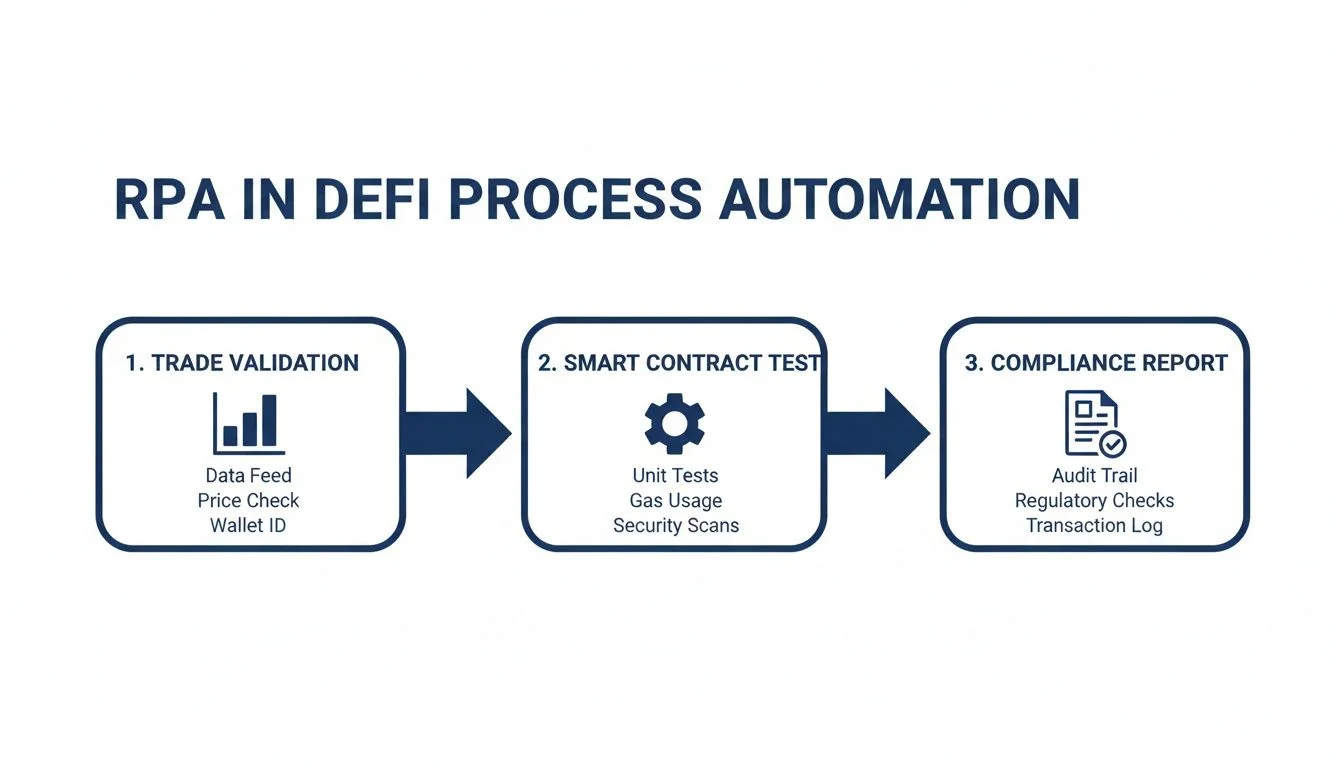
The power of robotic process automation in testing is best understood through its real-world applications. For founders and engineering leaders in decentralised and AI-driven sectors, these use cases are high-impact and directly address risk management and growth objectives. RPA bots act as a front-line defense, ensuring the integrity of complex, high-stakes platforms.
How is RPA Used for Validating End-to-End Crypto Trades?
On a crypto exchange, a single trade initiates a cascade of events—from the user interface to the matching engine, wallet confirmations, and on-chain settlement. Unit tests are insufficient as they leave dangerous gaps in the overall process.
This is a prime scenario for an RPA bot, which can simulate the complete user journey with absolute precision.
- Login and Authentication: The bot securely logs into the trading platform, handling 2FA prompts as needed.
- Order Placement: It navigates the UI to place a market or limit order with exact price and quantity details.
- Wallet Interaction: The bot interacts with a browser extension wallet, like MetaMask, to approve the transaction signature.
- On-Chain Verification: Once broadcast, the bot opens a block explorer, finds the transaction hash, and confirms it was successfully mined.
- Balance Confirmation: Finally, it returns to the exchange to verify that asset balances have updated correctly.
By replicating this entire flow, the bot proves that the front-end, back-end, and blockchain layers are all working in concert, delivering assurance impossible to achieve with code-level tests alone.
Can RPA Test Smart Contract Interactions via a dApp UI?
Yes. While smart contract audits are critical for security, they don’t test how contracts behave when used through your front-end. Your users interact with your dApp’s UI, not its code. RPA bridges this gap by testing from the user’s perspective.
For example, a bot can test a lending protocol by:
- Connecting a wallet to the dApp.
- Depositing collateral into a smart contract.
- Borrowing an asset against that collateral.
- Repaying the loan plus any interest.
- Withdrawing the original collateral.
Each step is executed through the UI, ensuring the front-end correctly triggers smart contract functions and handles responses. This catches integration bugs between the UI and the blockchain that even the most rigorous in-depth guide on smart contract security might miss.
Key Insight: Testing through the UI is not redundant; it is a vital validation layer. It confirms that your application’s user experience is correctly wired to its on-chain logic, preventing user-facing failures that erode trust.
How is RPA Applied to Compliance and Stress Testing?
Beyond trading, RPA is a game-changer for specialized platforms in Web3, AI, and sustainability.
- Carbon Credit Platforms: For platforms tokenizing carbon credits, compliance and reporting are paramount. An RPA bot can automate the entire audit trail by logging in, generating periodic reports on asset tokenization and retirement, checking them against external registries, and archiving evidence for regulators.
- AI-Driven Prediction Markets: To ensure a prediction market can handle a surge of activity, bots can run stress tests. They can simulate thousands of users placing and resolving bets simultaneously, testing platform scalability and oracle data feed reliability under extreme pressure.
These use cases demonstrate how robotic process automation in testing augments your workforce. Industry analysis projects that by 2025, RPA in testing will handle over 53% of enterprise functions, delivering a potential first-year ROI of over 200% through error-free regression testing. You can read the full research about these market drivers and projections.
How to Build a Scalable RPA Testing Framework
Transitioning from ad-hoc scripts to a scalable, resilient testing framework requires a strategic plan. Building an effective system for robotic process automation in testing involves integrating technology, process, and governance into your DevSecOps pipeline. This blueprint outlines the architectural and organizational components needed for success, comparing startup and enterprise needs.
The first step for any organization is selecting the right RPA platform and integrating it with existing CI/CD tools like Jenkins, GitLab, or CircleCI. This creates a “push-and-validate” workflow where every code commit automatically triggers a suite of RPA-driven tests, providing immediate feedback on how changes impact the end-user experience.
What is the Role of a Center of Excellence (CoE)?
A common pitfall for both startups and enterprises is a technology-first approach. To scale RPA effectively, you must establish a Center of Excellence (CoE). This central group provides the governance, best practices, and expertise to manage your digital workforce. Their role is to standardize tools, develop reusable automation components, and train technical and business teams.
Without a strong CoE, RPA programs often devolve into a chaotic collection of siloed bots. The CoE provides strategic oversight to align automation with business goals, manage bot lifecycles, and measure ROI.
What are the Key Roles in an RPA Center of Excellence?
| Role | Primary Responsibilities | Enterprise vs. Startup Perspective |
|---|---|---|
| RPA Sponsor | Secures budget, champions the program, and aligns automation with business strategy. | In a startup, this is often the CTO or CEO. In an enterprise, it’s a dedicated executive. |
| RPA Lead/Manager | Oversees the entire program, manages the CoE, and ensures on-time project delivery. | A startup might combine this with a senior developer role; enterprises have a dedicated manager. |
| Solution Architect | Designs the end-to-end automation architecture, including integrations and security. | Crucial for both, but enterprise architects must navigate more complex legacy systems. |
| Process Analyst | Identifies and documents business processes for automation, quantifying benefits. | In a startup, product managers often fulfill this function. Enterprises have specialized analysts. |
| RPA Developer | Designs, develops, and tests the automation bots based on process requirements. | This core technical role is essential for both, but enterprise developers may focus on larger, more complex bots. |
| Infrastructure Engineer | Sets up and maintains the RPA infrastructure, including servers and bot environments. | Often handled by a DevOps generalist in a startup; a dedicated role in an enterprise. |
| Support & Maintenance | Monitors bot performance, troubleshoots issues, and manages updates for live automations. | Critical for ensuring long-term value; often shared in a startup, dedicated in an enterprise. |
What are the Common Technical Hurdles and Solutions?
Integrating RPA, especially in the fast-paced Web3 and AI sectors, presents unique technical challenges.
Secure Credential Management: Bots require application access, but hard-coding credentials is a major security risk. The solution is to integrate the RPA platform with a dedicated secrets vault like HashiCorp Vault or CyberArk to manage and rotate bot credentials securely.
Handling Dynamic UIs: Decentralized apps and modern web platforms often feature dynamic UIs where element IDs change. Resilient bots must use “smart” object recognition based on multiple attributes (e.g., text labels, relative positions) rather than fragile selectors. Specialized browser testing solutions like Wallaby can also be effective.
Building Resilient Scripts: Automation scripts must include robust error handling. Bots should be designed to recover from unexpected pop-ups, network lag, or application glitches without halting the entire test run.
Key Takeaway: A successful RPA framework is a complete system built on strong CoE governance, secure credential management, and resilient bot design. For startups, this means being lean but disciplined; for enterprises, it means formalizing processes to manage scale.
What is the Future of Testing? A 12-24 Month Outlook

Looking ahead to the 2026–2028 horizon, the line between process automation and artificial intelligence is dissolving. The future of robotic process automation in testing is not just about faster bots, but smarter ones. This evolution is propelling us into the era of Intelligent Process Automation (IPA), where AI and machine learning empower bots to think, learn, and adapt.
Unlike traditional RPA bots that follow rigid rules, IPA-powered bots can navigate ambiguity and make independent decisions. This is a game-changer for testing complex and unpredictable systems in Web3, AI, and crypto, allowing automation to handle dynamic tasks previously requiring human testers.
The Dawn of Intelligent Process Automation (IPA)
Imagine an AI that analyzes user behavior data from your dApp to automatically generate new, relevant test cases. Now, picture that same system predicting high-risk areas in your smart contract code after an update and focusing its testing efforts accordingly. This is the promise of IPA.
- Predictive Test Generation: AI models can analyze code changes and historical bug data to forecast where new defects are likely to appear, creating tests aimed at those weak points.
- Self-Healing Bots: When a UI element changes, a self-healing bot can detect the change, locate the new element, and adapt its script in real-time. This drastically reduces the maintenance overhead of traditional automation.
This shift transforms testing from a reactive chore into a proactive, predictive discipline. Instead of just finding existing bugs, intelligent automation helps prevent them from reaching production.
The Rise of Autonomous Agentic Testing
Taking IPA a step further leads to advanced concepts like agentic test automation. Here, AI agents autonomously manage the entire testing process. An “agent” is an independent system that can define goals, create plans, and execute them without human intervention.
For instance, you could give an AI agent a single, high-level directive: “Thoroughly test the new liquidity pool feature and find any vulnerabilities.”
The agent would then independently:
- Explore the dApp to understand the feature.
- Formulate a complete test plan with user personas and scenarios.
- Execute hundreds of tests, covering standard flows and edge cases.
- Discover a vulnerability, document the reproduction steps, and file a detailed bug report—all without human input.
This forward-looking approach is the future of building resilient, intelligent decentralized systems. By learning how to integrate AI with RPA for better results, organizations can prepare for this next wave of autonomous quality assurance today.
How Blocsys Delivers Resilient Systems with Automated Testing
At Blocsys, we execute, we don’t just theorize. We have integrated robotic process automation in testing as a fundamental component of our delivery model. This is not an add-on; it is a core discipline that combines our deep expertise in Web3 security with a robust strategy for building institutional-grade decentralized infrastructure. Our philosophy is clear: we build serious infrastructure, not experiments.
Every product we deliver—from a white-label crypto trading platform to targeted staff augmentation—is secure, reliable, and production-ready from day one. RPA is a critical tool that helps us fulfill this commitment by ensuring systems can withstand real-world stress and meet enterprise evaluation criteria.
Our Integrated Automation Approach
We embed automated testing directly into our development lifecycle, creating a powerful and immediate feedback loop for our engineers. This approach ensures that quality and security are built in, not bolted on, delivering the resilience demanded by high-stakes environments like DeFi, AI, and RWA tokenization.
- End-to-End Workflow Simulation: We design RPA bots to meticulously mimic complete user journeys. For a decentralized perpetuals platform, a bot executes an entire trade sequence—from login and collateral deposit to opening a position, monitoring funding rates, and closing it—verifying every on-chain and off-chain step.
- Continuous Regression Testing: Immediately after every smart contract update or new feature deployment, our automated test suites run, catching regressions in hours instead of weeks and maintaining a rapid-yet-safe development pace.
A Focus on Security and Real-World Scenarios
Our testing strategy is relentlessly focused on security and replicating real-world conditions. We use robotic process automation in testing to simulate the chaotic nature of live markets and user behavior. By pushing systems to their limits before they face real users, we build platforms that can withstand genuine market stress.
Our Commitment: We build systems designed for zero-failure tolerance. By automating the validation of complex financial logic, cross-chain interactions, and compliance workflows, we provide the assurance that your platform’s most critical operations will perform flawlessly under pressure.
This expertise extends to specialized areas like carbon credit reporting and precious metal tokenization, where absolute accuracy is paramount. We deploy bots to automate evidence gathering and reporting, creating a transparent audit trail that satisfies stringent regulatory demands. This meticulous attention to detail is what separates an experimental project from production-ready financial infrastructure.
Whether you’re a founder launching a new DeFi protocol or an enterprise leader scaling existing Web3 operations, our blend of disciplined engineering and automated quality assurance delivers the resilience you need. We help you build, scale, and execute your vision with confidence.
Frequently Asked Questions (FAQ)
Here are clear, concise answers to common questions about implementing robotic process automation in testing for Web3, AI, and crypto platforms.
What is the difference between RPA and Selenium?
The primary difference is their layer of operation and purpose. Selenium is a code-driven library for automating web browsers, ideal for developers testing specific web application components. In contrast, RPA operates at the GUI level, mimicking human actions to test end-to-end business processes that span multiple applications (e.g., a dApp, a wallet, and a block explorer), without needing to access the underlying code.
Can RPA test smart contracts and blockchain interactions?
Yes, RPA is ideal for testing the complete ecosystem around a smart contract. An RPA bot can interact with your dApp’s front-end, initiate a transaction, confirm it in a wallet like MetaMask, and then verify the transaction was successfully mined on a block explorer. This end-to-end testing validates that the UI, APIs, and on-chain logic work together cohesively, a task that isolated unit tests cannot perform.
How do we measure the ROI of implementing RPA in testing?
The ROI of RPA in testing is measured by several key factors. Beyond direct cost savings from reduced manual effort, metrics include faster time-to-market due to accelerated regression testing, lower operational costs from fewer production defects, and improved productivity as skilled QA engineers are reallocated to more complex, high-value tasks. For fintech, crypto, and AI platforms, the most significant return is risk mitigation—preventing a single critical bug can save multiples of the entire RPA program’s cost.
What are the first steps to start with RPA in testing?
Begin with a pilot project to demonstrate clear value. Identify a business-critical process that is highly manual, rule-based, and repetitive, such as user registration or a core transaction validation flow. A successful pilot builds momentum and provides a business case for scaling. The next step is to establish a governance model or a Center of Excellence (CoE) to manage bot development, deployment, and maintenance, ensuring the initiative can scale securely and efficiently.
At Blocsys Technologies, we integrate robotic process automation into our core delivery model to build institutional-grade decentralised infrastructure that is secure, reliable, and production-ready. If you’re ready to build, scale, and execute your vision with a partner who understands the demands of modern financial systems, connect with our experts today.
