
Founder Checklist 2026: Blockchain Startup Guide | Blocsys

Send Report to Your Email

Confirm your email address and we'll send your personalised PDF report directly to your inbox.

Please enter a valid email address.

Generating your PDF and sending it to your inbox…
This takes a few seconds.

Report Sent! 🎉

Your Blockchain Readiness Report has been sent to


Check your inbox (and spam folder just in case).

Something Went Wrong

Email sending failed. Please try again or contact us on WhatsApp.

Free Founder Resource · 2026 Edition

Founder Checklist 2026: Before You Build Your Blockchain Product, Check This First

If you're planning to launch a Web3 project, this founder checklist 2026 will guide you through every step of building a successful blockchain startup, from idea validation to launch.
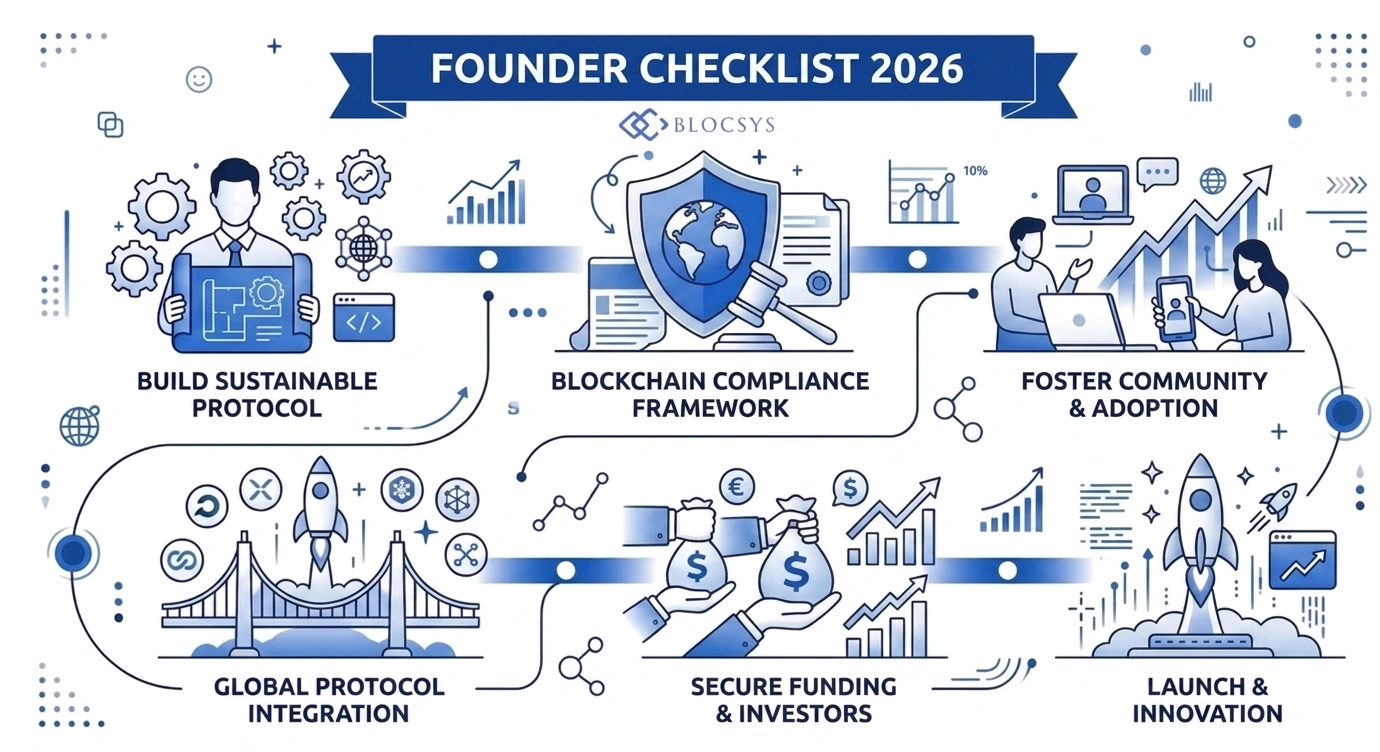
Crypto Founder Checklist 2026
200+
Projects Consulted
51
Checklist Questions
9
Critical Categories
24hr
Expert Response
The Checklist

Founder Checklist 2026: Validate Your Blockchain Project

Answer honestly — this isn’t a test, it’s a mirror. This founder checklist 2026 helps you identify gaps early, so you can fix them before they turn into costly mistakes.

Problem & Market Validation
6 questions · Foundational
Be honest — this is where most founders fail
I can describe the problem my product solves in one sentence without using the word "blockchain."
I have spoken directly with at least 10 potential users or customers about this problem.
There is a clearly defined market segment with measurable size (TAM/SAM/SOM).
Potential users have expressed willingness to pay for a solution to this problem.
I have identified at least 3 direct competitors and understand why my solution is different.
The problem genuinely requires blockchain — a traditional database cannot solve it equally well.
Free Founder Resource – 2026

Unlock the Full Founder Checklist 2026

Get access to the complete founder checklist 2026 with all 51 questions. Validate your blockchain startup across tokenomics, revenue model, tech stack, legal compliance, security, and go-to-market strategy.

    We usually respond within 24 hours. Your information is never shared with third parties.

    We respond within 24 hours. Your data is never shared with third parties.

    Checklist Unlocked! 🎉

    All 51 questions are now available. Complete the checklist and click Get My Report below to receive your personalised PDF by email.

    8 Sections Locked

    Fill the short form above to instantly unlock Token Design, Revenue Model, Tech Stack, Legal, Team, Funding, Go-to-Market & Security sections.

    Unlock Now — It's Free
    Token Design
    6 questions · Critical — token structure & mechanics
    Token design mistakes are irreversible after launch — answer carefully
    I can explain the core utility of my token in one sentence — beyond "governance" or "access" — with a specific, concrete use case.
    My token supply schedule (emission rate, vesting, unlock events) is fully defined and modeled to avoid inflation shocks at key milestones.
    Token allocation across team, investors, ecosystem, treasury, and public sale has been reviewed for fairness and long-term sustainability.
    My tokenomics model has been stress-tested for sell pressure scenarios — I know what happens if 20% of token holders sell at once.
    Token classification (utility vs. security) has been assessed by a crypto-specialized legal advisor in my primary jurisdiction before any public sale or distribution.
    I have a clear plan for token liquidity on day one — including which DEX or CEX will list it, initial liquidity amount, and LP lock period.
    Revenue Model
    6 questions · Critical — how you actually make money
    Token price is not a business — define how you generate real revenue
    My project has a clearly defined revenue stream that generates income independent of token price appreciation (fees, subscriptions, licensing, or protocol revenue).
    I have modeled revenue projections for Year 1, Year 2, and Year 3 with documented assumptions — not best-case-only estimates.
    My pricing strategy has been validated with at least 5 potential customers or paying beta users — not just assumed based on competitor pricing.
    I understand the difference between protocol revenue and token price, and my financial model does not conflate TVL, token market cap, or trading volume with actual earned revenue.
    My unit economics are defined — I know the cost to acquire a customer or user (CAC), and the expected lifetime value (LTV) is at least 3× CAC.
    I have identified my path to breakeven — I know the exact number of users, transactions, or protocol volume needed to cover operating costs.
    Technology & Architecture
    6 questions · Technical
    Wrong choices here are expensive to reverse — think carefully
    I have chosen a blockchain network (Ethereum, Solana, Polygon, BNB, etc.) and can justify that choice for my use case.
    My technical architecture has been reviewed by a senior blockchain developer, not just designed by me alone.
    I have estimated gas/transaction costs at scale and they do not make my product economically unviable.
    Smart contracts will undergo a professional security audit before mainnet launch.
    I have a plan for smart contract upgradeability (proxy patterns, emergency pause, admin controls).
    My off-chain infrastructure (APIs, indexers, oracle feeds) is planned alongside on-chain components.
    Legal & Regulatory Compliance
    5 questions · High Stakes
    Be honest — most founders skip this and pay heavily later
    I have consulted a crypto-specialized legal advisor about token classification (security vs. utility) in my jurisdiction.
    My KYC/AML strategy is defined and compliant with regulations in all markets I intend to serve.
    I understand the regulatory landscape in my top 3 target markets and have a geo-restriction plan if needed.
    Intellectual property, trademarks, and code ownership are formally assigned to the right legal entity.
    My terms of service and privacy policy are drafted and reviewed by a legal professional.
    Team & Execution Capability
    5 questions · Foundational
    If unsure, mark No — investors see through vague answers here
    My core team has direct experience building and shipping blockchain products, not just academic knowledge.
    Critical roles are filled: smart contract developer, backend engineer, product designer, and growth lead.
    Equity split, vesting schedules, and cliff periods are formally documented and signed.
    My team has shipped at least one product together — we know how we work under pressure.
    I have advisors with relevant expertise (DeFi, RWA, compliance, exchange listings) actively engaged.
    Funding & Runway
    5 questions · Financial
    Most projects run out of runway at the worst possible moment — plan early
    I have a detailed 12-month budget broken down by development, legal, marketing, and operations.
    My current runway covers at least 18 months of operations without additional fundraising.
    I have warm introductions to at least 5 crypto-native investors or VCs relevant to my sector.
    If raising through a token sale, I understand the legal implications and have explored SAFTs or equity alternatives.
    I have a Plan B if the primary funding strategy does not work within 60 days.
    Go-to-Market Strategy
    6 questions · Growth
    Building great tech is the easy part — getting users is the real challenge
    My first 100 users are specifically identified — I know where they are online and how to reach them.
    I have a community-building strategy (Discord, Telegram, X/Twitter) already in motion, not planned for later.
    My launch strategy includes at least one partnership, integration, or co-marketing arrangement.
    I have a clear plan for liquidity on day one (for DeFi/DEX) or distribution channel agreements (for B2B).
    My product has a waitlist, beta testers, or letters of intent from real prospects already signed.
    I can define one single metric that proves product-market fit for my specific product type.
    Security, Risk & Incident Response
    6 questions · Critical
    One exploit can destroy years of work and user trust permanently
    I have a documented incident response plan for smart contract exploits or protocol hacks.
    A bug bounty program is planned or active with meaningful rewards to incentivize responsible disclosure.
    Multi-sig wallets are used for treasury and protocol admin functions — no single point of failure.
    My team's private key management has been reviewed and is hardware-wallet secured.
    I have a communication plan for users in case of a security incident — templates, channels, and spokesperson.
    Centralization risks are documented and communicated transparently to users and investors.
    Common Pitfalls

    Where Most Blockchain Projects Go Wrong

    These are not hypotheticals. We see these patterns repeatedly across founders we consult.

    Building Without a Revenue Model
    Token price is not a business. Projects that rely solely on speculative value collapse when market sentiment shifts. Define how you make money from day one.
    Confusing Token Design with Tokenomics
    Token supply schedules and utility design are different disciplines. Many founders nail one but botch the other — both must be stress-tested before launch.
    Choosing Blockchain Before Defining Product
    "We're building on Ethereum" is not a product strategy. The blockchain is infrastructure. Define what you're solving first, then choose the right chain.
    Overengineering Instead of Validating
    Spending 6 months on complex smart contracts before validating demand is the number one killer of crypto startups. Build the simplest thing that proves the concept.
    Ignoring Legal Until It's Too Late
    Retroactive legal compliance in blockchain is expensive — sometimes impossible. Know your token classification before launch, not after.
    No Community Before Launch
    Web3 products live and die by community. Founders who skip community-building until after launch find themselves with great technology and zero users.
    Underestimating Security Risks
    In traditional software, bugs are embarrassing. In smart contracts, bugs are permanent and can cost millions. Security is a foundation, not a phase.
    Building Without User Feedback
    Many teams build in isolation and assume they understand user needs. Without early feedback loops, you risk launching a product nobody actually wants.
    Rushing to Launch Without Testing
    Speed is important, but skipping proper testing leads to critical failures post-launch. A rushed launch can damage trust before you even gain traction.

    If you relate to even one of these, you're not alone — and it's not too late to course-correct.

    Your Result

    How Ready Are You Really?

    1 point per Yes answer. Complete the checklist above — your score updates live.

    0
    High Risk
    Complete the checklist above to see your score update in real time.
    0 – 22
    High Risk — significant gaps need addressing before you build
    23 – 39
    Needs Validation — promising start, but critical gaps remain
    40 – 51
    Close to Ready — strong foundation, focus on execution

    "Most founders overestimate their readiness by 30–40%. The ones who don't are the ones who succeed."

    Get Your Personalised Report
    Complete at least 1 checklist item, then click below to receive your PDF report by email.
    Please check at least one item in the checklist above before generating your report.
    ✓ Check items above and they'll appear here.
    Ready to turn this into a real product? Talk to the expert:
    CEO & Founder
    Meet Your Expert

    Shantikumar Chougule

    CEO & Founder · Blocsys Technologies · Pune, India

    With over 20+ years of experience in blockchain infrastructure and enterprise-grade software, Shantikumar Chougule has led the successful delivery of blockchain consulting and development projects. His expertise spans RWA tokenization, DeFi protocol architecture, smart contract systems, and AI-powered automation solutions.

    As the Founder of Blocsys Technologies, he has helped startups and enterprises build scalable, secure, and production-ready blockchain solutions across Ethereum, Solana, and Polygon ecosystems. His mission is simple — help founders build it right the first time with the right architecture, security, and long-term scalability.

    Prediction Markets PlatformCrypto Trading PlatformRWA TokenizationDeFi ProtocolsSmart ContractsAI AutomationB2B SaaSToken EconomicsSolanaEthereumPolygon

    Frequently Asked Questions About the Founder Checklist 2026

    01
    What is a founder checklist for a blockchain project?
    A blockchain founder checklist is a structured framework that helps entrepreneurs systematically evaluate their project before launch. It covers key areas such as idea validation, market demand, technology selection, tokenomics design, legal compliance, security considerations, and go-to-market strategy. By following this checklist, founders can identify gaps, reduce risks, and ensure their blockchain product is well-prepared for a successful launch.
    02
    What types of blockchain solutions do you offer across different use cases?
    We provide a wide range of blockchain solutions tailored to different needs and industries: - Enterprise solutions: Platforms like Hyperledger and private blockchains offer secure, permissioned environments for businesses, ideal for use cases like supply chain, finance, and data management. - Trading platforms: High-performance blockchain systems designed for fast, secure, and reliable transaction processing, suitable for exchanges and trading applications. - Crypto & DeFi solutions: Public blockchains such as Ethereum, Binance Smart Chain, and Solana enable the development of tokens, NFTs, and decentralized finance (DeFi) applications. - All-in-one platforms: Flexible ecosystems that support multiple use cases, allowing businesses to build and scale solutions based on their specific requirements.
    03
    Why is this checklist important?
    It helps identify gaps, reduce risks, and ensures your project is well-prepared for investors, users, and market launch.
    04
    What does this checklist cover?
    It typically includes: - Use case validation - Blockchain selection - Tokenomics - Security & audits - Team and roadmap
    05
    Do I really need blockchain for my project?
    Not always. Blockchain should only be used if your project requires decentralization, transparency, or trustless systems.
    06
    What is tokenomics?
    Tokenomics defines how your token works, including supply, distribution, and utility within the ecosystem.
    07
    How important is security in a blockchain project?
    Very important. Smart contract audits and proper testing are essential to prevent hacks and vulnerabilities.
    08
    Can I launch without a working product?
    It’s not recommended. Having an MVP or demo increases credibility and trust among users and investors.
    09
    Does this checklist guarantee success?
    No, but it significantly improves your chances by helping you build a strong and validated foundation.

    Blocsys

    Application Submitted!
    Our HR team will review your application and get back to you soon.