

How to Build a Prediction Market Platform Like Polymarket
Launching a white label prediction market platform is now the fastest route into the space Polymarket popularized. Crypto builders, institutional analysts, and everyday traders all watch this market grow, and the technology stack has never been more accessible. However, the real challenge lies in combining blockchain infrastructure, smart contract design, oracle mechanics, and liquidity strategy into a product that feels both trustworthy and intuitive. This guide walks through every critical layer — from build-vs-buy decisions to monetization models — so you can ship a real prediction market solution, not just a prototype.
What Makes Prediction Markets Worth Building?
A prediction market lets users buy and sell positions on the outcome of future events. Instead of company shares, participants purchase “YES” or “NO” positions on questions like “Will X win the election?” or “Will Bitcoin exceed $150,000 by Q3?” Prices reflect the crowd’s aggregate probability estimate.
Think about what that makes possible. During elections, well-calibrated prediction markets consistently outperform traditional polling. During financial events, traders with real money on the line produce remarkably accurate probability estimates. Therefore, the information-aggregation property of these markets makes them genuinely valuable analytical tools, not just gambling interfaces.
Platforms like Polymarket combine decentralized finance mechanics, oracle networks, and information economics in a single product. Understanding each layer isn’t optional — it’s the foundation of everything you build.
White Label vs Custom Build: Which Path Fits Your Timeline?
Most founders face this decision first. Do you commission a fully custom protocol, or launch on a white label prediction market platform and customize from there? Both paths reach the same market, but the cost, timeline, and ownership tradeoffs differ sharply.
A custom build gives you full control over smart contract architecture, tokenomics, and branding. However, it typically demands 9-18 months and a team fluent in Solidity, oracle integration, and security auditing. You own every line of code, which matters if you plan to raise institutional funding or need bespoke compliance logic.
A white label prediction market platform, by contrast, ships pre-audited contracts, an existing oracle integration, and a configurable front-end. Most teams launch in 6-10 weeks. You trade some architectural flexibility for speed, lower upfront cost, and reduced audit risk since the core contracts already carry a security track record.
| Factor | Custom Build | White Label Solution |
|---|---|---|
| Timeline | 9-18 months | 6-10 weeks |
| Upfront cost | $150,000-$500,000+ | $25,000-$90,000 |
| Code ownership | Full | Partial to full, depending on license |
| Audit burden | New audits required | Often pre-audited base contracts |
| Customization ceiling | Unlimited | Configurable, not unlimited |
Most early-stage teams start on a white label prediction market platform to validate demand, then migrate to custom infrastructure once volume justifies the investment. That phased approach reduces capital risk considerably.
How to Build a Prediction Market Platform — Core Architecture
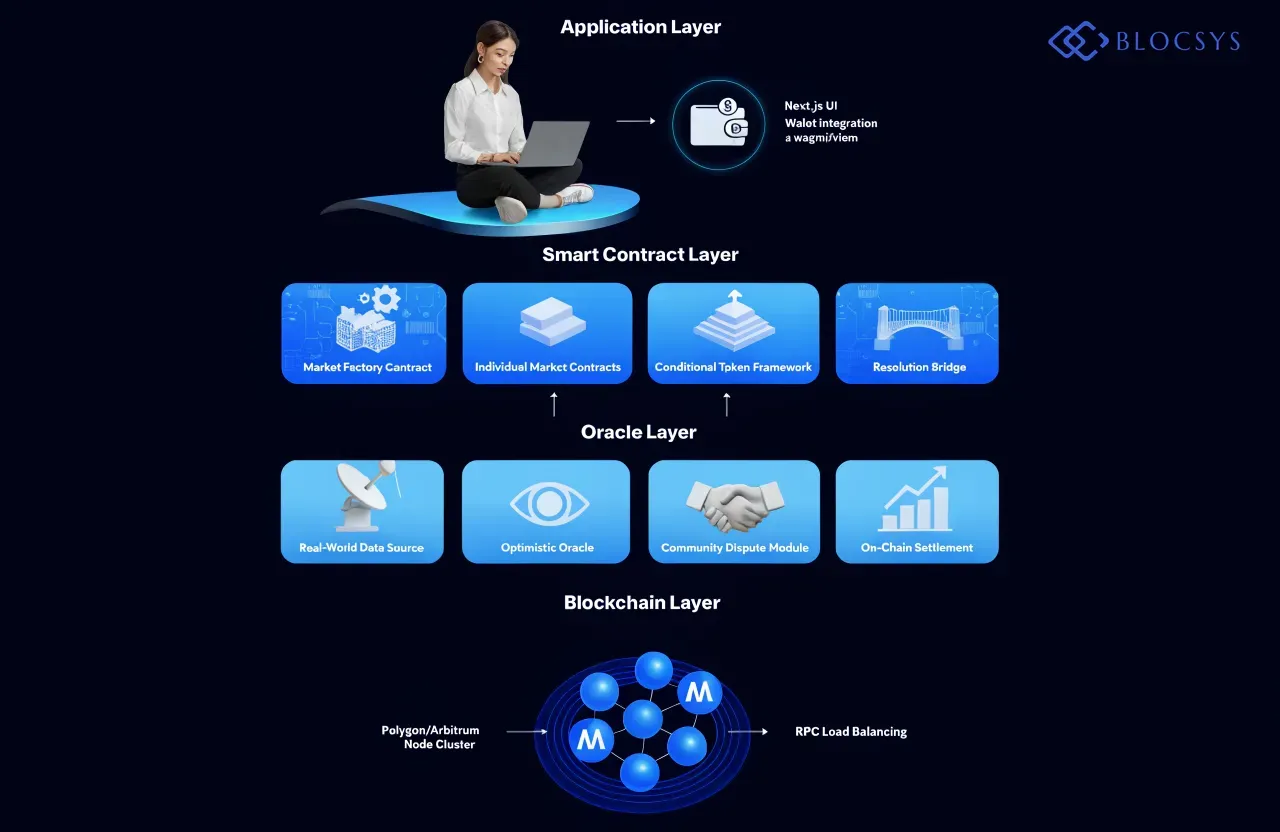
Before writing a single line of code, map your architecture clearly. A production-ready prediction market platform has four primary layers: the blockchain layer, the smart contract layer, the oracle layer, and the application layer. Each layer depends on the others, and architectural decisions cascade in ways that are painful to reverse later.
Start lean. Binary outcome markets — simple yes/no questions with USDC collateral — represent the right MVP scope. You can expand to multi-outcome markets and scalar resolution once your core infrastructure is battle-tested and audited.
Understanding how to build a secure and upgradeable smart contract suite is where many teams invest their first few months most wisely. A contract architecture that stays clean and modular saves enormous pain during audits and feature expansion.
Choosing Your Blockchain
Your blockchain selection shapes every downstream technical decision. Polygon remains the most battle-tested choice for prediction markets since it offers Ethereum compatibility, fast finality, and deep USDC liquidity. Arbitrum and Base are compelling alternatives with growing ecosystems and strong developer tooling.
Mainnet Ethereum is generally impractical for retail prediction markets. Gas fees of $5-$20 per trade kill the user experience for casual participants. Layer 2 solutions solve this directly. Furthermore, chains with native USDC integration simplify your collateral model considerably.
Solana deserves consideration for high-throughput scenarios where speed matters most. However, its Rust-based smart contract environment carries a steeper learning curve and a smaller prediction market ecosystem to build on top of.
Smart Contract Architecture
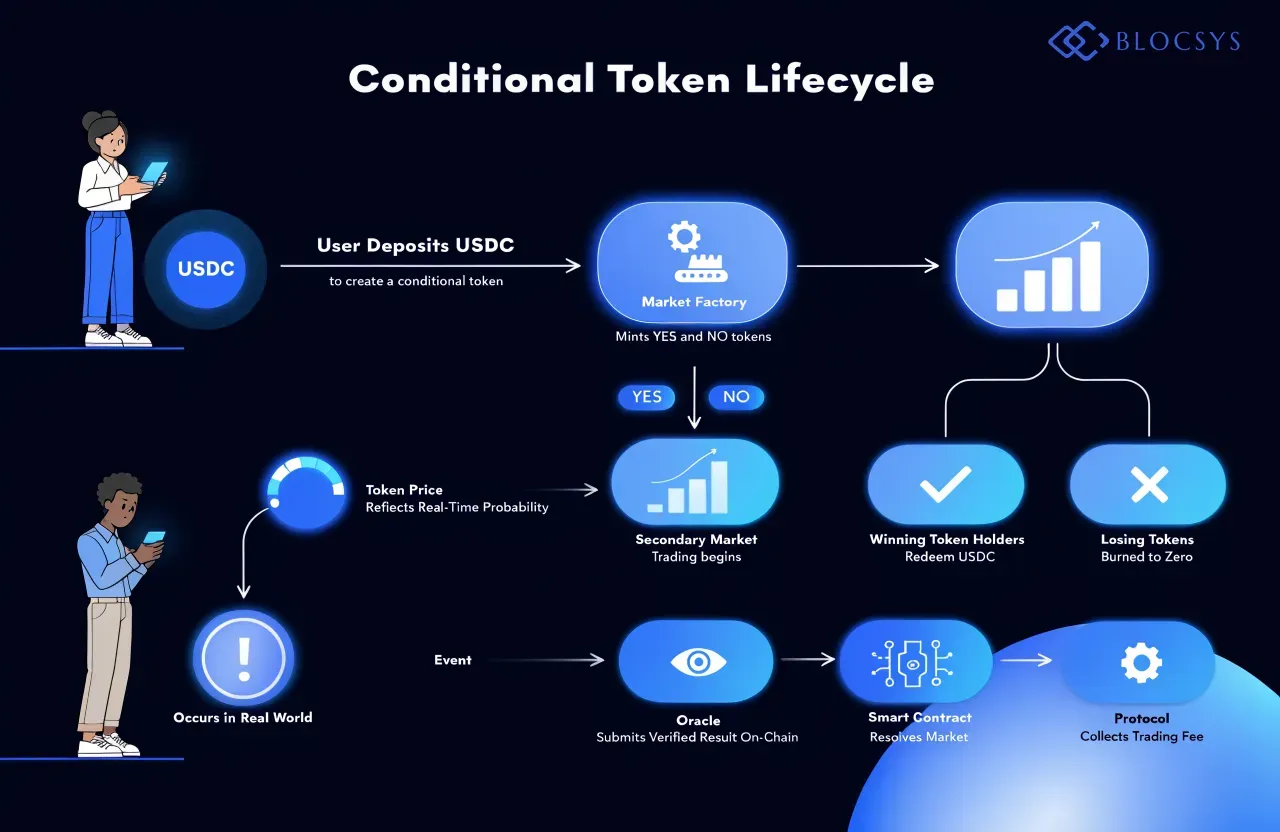
Your smart contract suite is your platform’s engine. A standard configuration includes a market factory contract, individual market contracts, a conditional token framework (CTF), and a resolution bridge. The factory deploys new markets dynamically, while each market contract holds collateral, mints outcome tokens, and routes payouts after resolution.
Audit everything before launch. Budget for at least two independent security audits from reputable firms like Trail of Bits, OpenZeppelin, or Halborn. Smart contract vulnerabilities have cost DeFi platforms hundreds of millions of dollars, so this is non-negotiable infrastructure spending.
Crypto Prediction Market Platform Development: The On-Chain Stack
Crypto prediction market platform development lives or dies on stack choices made in month one. Beyond blockchain selection, you need a smart contract framework, an oracle provider, a wallet layer, and a settlement mechanism that all interoperate cleanly.
Gnosis’s Conditional Token Framework (CTF) remains the industry-standard base layer for outcome tokenization. Most serious prediction market platform development teams fork or extend CTF rather than write tokenization logic from scratch, since it already handles splitting, merging, and redeeming positions safely.
Which Chains Actually Support Prediction Markets Well
Polygon, Arbitrum, and Base currently offer the deepest tooling and USDC liquidity for this use case. Additionally, each provides sub-cent transaction costs, which matters enormously when users place small, frequent positions.
- Polygon: Deepest existing prediction market liquidity, proven at scale by Polymarket itself.
- Base: Strong retail on-ramp via Coinbase, growing institutional interest.
- Arbitrum: Mature DeFi ecosystem, solid developer tooling and composability.
- Solana: High throughput, but a smaller library of reusable prediction market frameworks.
Oracle selection follows chain selection closely. UMA’s optimistic oracle and Chainlink both deploy across these networks, so your chain choice rarely locks you out of a preferred oracle provider.
Oracle Design — The Layer Most Teams Get Wrong
An oracle feeds real-world outcome data into your smart contracts. When the game ends, the oracle tells your contract who won. That sounds straightforward, but it isn’t — oracle design is where many prediction market builds encounter their most serious trust and technical problems.
Two main approaches exist: decentralized oracle networks or centralized admin resolution. Polymarket uses UMA Protocol’s optimistic oracle, which enables community-based dispute resolution with financial incentives for honest reporters. Chainlink handles reliable data feeds for financial and market-data events.
Building a Trustworthy Resolution System
Centralized resolution is faster to build but creates a trust gap. Users must trust your team to resolve fairly, which creates counterparty risk and undermines your decentralization story. Decentralized oracles take more integration work but dramatically improve platform credibility and censorship resistance.
A hybrid approach works well for your MVP. Resolve markets manually but publish your reasoning on-chain, and give users a structured dispute window. Migrate toward decentralized resolution as your platform scales.
On-chain data integrity patterns from our Permissioned Blockchain Infrastructure for Capital Market Post-Trade Operations use case offer valuable frameworks that translate directly to oracle design and settlement reliability.
“The oracle layer is where most prediction market teams underestimate complexity. You’re not just fetching data — you’re establishing a trust boundary between the off-chain world and on-chain settlement. Get that boundary wrong, and your platform’s credibility collapses under its first contested resolution.” — Senior DeFi Protocol Architect
Case Study: How Election Markets Stress-Test Resolution Design
Real-world events reveal oracle weaknesses faster than any internal test suite. Consider Polymarket’s coverage of the Hungarian election and other closely contested national votes. Traders poured volume into these markets in the final days, and resolution accuracy came under intense public scrutiny within hours of polls closing.
Contested elections are the hardest resolution case a prediction market platform faces. Official results sometimes lag, get disputed, or come from multiple conflicting sources. A platform without a clear, pre-published resolution source for each market invites exactly the kind of controversy that erodes user trust permanently.
The lesson for anyone pursuing prediction market platform development: define your resolution source explicitly at market creation, not after the event resolves. Publish it in the market rules, and give your dispute window enough time to absorb slow-reporting jurisdictions without freezing user funds indefinitely.
How to Build a Liquidity System That Works From Day One
Liquidity is your platform’s most significant challenge at launch. Without it, markets show wide spreads, users receive poor prices, and they don’t return. Solving this is as much a product decision as a technical one, and it requires planning well before you open registration.
Most modern prediction markets use automated market makers (AMMs) rather than order books. The Logarithmic Market Scoring Rule (LMSR) and Constant Product AMMs both provide instant liquidity at mathematically determined prices. You seed the AMM with initial capital, and the pricing curve handles everything automatically.
Strategies to Bootstrap Early Liquidity
You need a concrete liquidity plan before any public launch. Options include seeding markets from your own treasury, running a liquidity mining program to incentivize early liquidity providers, or partnering with professional market makers who provide liquidity in exchange for fee revenue sharing.
Thin markets are worse than no markets. Sophisticated traders — the users who drive volume and attract others — immediately spot shallow liquidity and move on. Aim to seed your highest-profile launch markets with $10,000-$50,000 in initial depth.
Our Hybrid Trading & Prediction Market Platform Development service tackles exactly these architecture and liquidity bootstrapping challenges for teams building production platforms from the ground up.
Conditional Tokens and Tradeable Positions
When a user enters a prediction market, they don’t receive a static bet receipt — they receive tokenized outcome shares. These ERC-20 tokens represent their position and trade freely before resolution. This design, pioneered by Gnosis’s Conditional Token Framework, transforms prediction markets into genuine liquid asset markets.
A user can buy YES tokens at 40 cents, watch implied probability rise to 70%, and sell at 70 cents, even before the event resolves. This creates real secondary market dynamics and additional trading revenue.
Teams interested in broader tokenization mechanics will find useful context in our Equity Tokenization Platform Development resource, which covers token lifecycle management and regulatory frameworks that apply across asset classes.
PvP Prediction Market Business Models and Monetization Strategies
Building the platform is only half the challenge. You need a business model that funds ongoing development, security audits, and team growth. PvP prediction market business models — where traders effectively wager against each other’s positions rather than against the house — open several monetization paths that don’t compromise user experience.
Fee-Based Revenue: Trading Fees, Spreads, and Rake
The most direct approach is a trading fee of 1-2% on market volume. This scales with usage and aligns your revenue directly with platform activity. Some platforms also charge market creation fees, which simultaneously generate revenue and deter low-quality spam markets.
A rake model, borrowed from peer-to-peer betting exchanges, takes a small percentage of the losing side’s payout rather than a flat trading fee. This structure feels fairer to high-frequency traders since it only charges on realized outcomes, not on every trade.
Spread-based revenue works differently. Instead of a visible fee line, the platform sets AMM buy and sell prices slightly apart, capturing the difference as implicit revenue. However, transparency matters here — hidden spreads that widen during volatility damage trust quickly.
Token Incentives and Advanced Revenue Streams
Native governance tokens can offer fee discounts and voting rights while creating network effects and community ownership. However, token launches carry serious legal complexity, so don’t pursue this path without advice from qualified securities counsel.
As your platform matures, additional revenue streams open up. White-labeling your infrastructure to enterprises, media companies, or research institutions that want private prediction markets generates substantial B2B revenue. Institutional data subscriptions — selling aggregated probability data to hedge funds and analysts — represent a high-margin opportunity that scales without significant added infrastructure costs.
Our Prediction Markets Platform Development team regularly helps founders model PvP prediction market business models and select the right monetization mix for their market, user base, and regulatory context.
Choosing a Prediction Market Development Company: A Checklist
Most founders don’t build entirely in-house. Selecting the right prediction market development company determines whether your launch ships on time, passes audits, and holds up under real trading volume. Evaluate every vendor against these criteria before signing.
- Prior prediction market or AMM experience: Ask for deployed mainnet contracts, not just generic DeFi work.
- Audit history: Request past audit reports and confirm which firms performed them.
- Oracle integration depth: Confirm they’ve shipped UMA, Chainlink, or comparable oracle integrations in production.
- White label prediction market platform option: Ask whether they offer a faster, pre-built path alongside custom development.
- Post-launch support: Clarify SLAs for monitoring, incident response, and contract upgrades.
- Compliance awareness: A capable partner flags jurisdictional and KYC/AML issues proactively, not after you ask.
- Transparent pricing: Get a itemized quote covering contracts, audits, front-end, and oracle integration separately.
A vendor that hesitates to share audit reports or reference deployments is a red flag. Therefore, treat this checklist as a minimum bar, not a nice-to-have.
Prediction Market Platform Development: Pricing and Cost Breakdown
Cost varies enormously based on scope, chain, and whether you choose a white label prediction market platform or a fully custom build. The table below breaks down typical line items.
| Component | MVP / White Label | Full Custom Build |
|---|---|---|
| Smart contract development | $10,000-$25,000 | $60,000-$150,000 |
| Security audits (per round) | $15,000-$30,000 | $20,000-$80,000 |
| Oracle integration | Pre-integrated | $15,000-$40,000 |
| Front-end development | $10,000-$20,000 | $40,000-$100,000 |
| Legal and compliance setup | $5,000-$15,000 | $20,000-$60,000 |
| Total estimated range | $25,000-$90,000 | $150,000-$500,000+ |
Ongoing costs also matter. Budget for RPC infrastructure, monitoring, customer support tooling, and periodic re-audits whenever you ship major contract upgrades.
How to Build a Compliant Prediction Market Platform
Regulation is the most important non-technical variable in your planning. Prediction markets occupy a legal gray zone in many jurisdictions. Polymarket paid a $1.4 million CFTC settlement in 2022 for operating without proper registration. That’s not a reason to avoid building — it’s a reason to build with legal counsel from day one.
Your legal strategy needs to answer three questions early: what jurisdiction will your entity operate from, which user geographies will you restrict, and what compliance infrastructure do you need before going live?
Entity Structure and Jurisdiction Selection
Most teams incorporate in crypto-friendly jurisdictions — the Cayman Islands, British Virgin Islands, UAE, or Switzerland. Serving US users legally requires CFTC registration as a Designated Contract Market, a multi-year and expensive process. Most startups geo-block US IP addresses initially and revisit that market when regulatory resources allow.
KYC/AML compliance is increasingly expected even for DeFi-native platforms. Integrate providers like Chainalysis, Sumsub, or Persona early, since retrofitting them later proves far more painful.
Scaling Infrastructure for Event-Driven Traffic Spikes
Prediction markets spike hard during major events. Elections, championship games, and central bank decisions can send traffic 10-50x above baseline in minutes. Your infrastructure must absorb these spikes without failed transactions or degraded performance.
On-chain, select a network with sufficient throughput. Polygon handles thousands of TPS, which covers realistic prediction market loads comfortably. On the application side, use a CDN, cache market data aggressively, and build graceful RPC fallbacks for chain congestion.
Our Decentralized Prediction Market Platform development expertise covers high-throughput architecture design for exactly these event-driven traffic scenarios where uptime directly translates to revenue.
“Prediction markets are fundamentally information markets. The price IS the probability estimate. Teams that internalize this build better products — they display percentage probabilities rather than raw prices, and they give traders meaningful context about what’s actually moving the market.” — Quantitative Prediction Market Researcher
Front-End UX — Where Good Platforms Lose to Great Ones
Too many teams obsess over blockchain mechanics and neglect user experience. That’s a costly mistake. Most users don’t care about AMMs or conditional tokens — they want clarity on what they’re predicting, what the odds are, and how they get paid if they’re right.
Your front-end stack should prioritize speed and clarity. React or Next.js with wagmi and viem for wallet integration represents current industry standard practice. Display implied probabilities clearly, since “67% chance of YES” communicates far more than a raw price of $0.67.
Wallet Onboarding and Account Abstraction
Crypto wallet friction causes massive user drop-off. MetaMask and WalletConnect remain your baseline. However, account abstraction solutions like Privy, Dynamic, or Coinbase’s Smart Wallet let users register with email or Google, and the wallet creates itself transparently in the background.
Reducing this friction directly increases activation rates. Platforms that replace MetaMask-only onboarding with email-first flows consistently see significantly higher first-trade conversion. Consequently, wallet UX deserves as much engineering attention as your smart contract architecture.
Common Pitfalls to Avoid When Building Your Platform
Understanding how to build a prediction market correctly means understanding where smart teams have stumbled. We see the same avoidable mistakes repeated across builds, and each one carries a real cost.
Building before validating your oracle strategy is the single most critical error. Many teams build polished front-ends and complex smart contracts, then discover their resolution mechanism is gameable or produces disputes that shake user confidence. Nail oracle design first.
Launching with thin liquidity signals weakness to the sophisticated early adopters you need most. If you can’t seed your markets meaningfully at launch, delay the public release.
Ignoring mobile users is a costly oversight. A substantial portion of crypto-native users primarily use mobile wallets, so WalletConnect deep-linking and responsive design are baseline requirements, not optional extras.
Skipping legal counsel early is a false economy. Regulatory issues discovered post-launch are exponentially more expensive to resolve than proactive legal structuring.
Teams exploring complementary on-chain financial infrastructure will find useful architectural patterns in our Decentralized Traded Funds (DTF) Platform — AI-Powered On-Chain Asset Management use case, which covers on-chain asset management approaches that pair naturally with prediction market infrastructure.
Frequently Asked Questions
What is a white label prediction market platform?
A white label prediction market platform is a pre-built, auditable protocol that you customize with your own branding, market categories, and fee structure instead of writing smart contracts from scratch. It typically launches in 6-10 weeks and costs a fraction of a custom build.
How much does it cost to build a prediction market platform?
A production-ready custom platform typically costs $150,000-$500,000, covering smart contract development, two rounds of independent security audits, oracle integration, front-end development, and legal structuring. A white label prediction market solution can come in closer to $25,000-$90,000.
What should I look for in a prediction market development company?
Prioritize firms with prior AMM or prediction market deployments, transparent audit history, proven oracle integration experience, and a white label option alongside custom builds. Ask for reference deployments and itemized pricing before signing.
Which blockchain works best for crypto prediction market platform development?
Polygon remains the most established choice, offering Ethereum compatibility, low fees, and deep USDC liquidity. Base and Arbitrum are strong alternatives with growing ecosystems. Avoid Ethereum mainnet, since gas fees make retail trading impractical.
What are the most common PvP prediction market business models?
The dominant models include a 1-2% trading fee on volume, a rake taken from losing-side payouts, spread-based AMM pricing, and B2B white-labeling to enterprises or media companies. Many platforms combine two or three of these to diversify revenue.
Ready to move beyond theory and build an intelligent platform that delivers real-world value? Blocsys Technologies specialises in engineering enterprise-grade AI and blockchain solutions for the fintech, Web3, and digital asset sectors. Connect with our experts today to discuss your vision and chart a clear path from concept to a secure, scalable reality.
