

When evaluating web 2.0 vs web 3.0, many teams start with the wrong question. They ask which one is newer. The better question is which trust model fits the product they’re trying to build.
That matters because the shift isn’t mainly about interface trends. It’s about who controls data, who verifies transactions, who captures value, and who carries compliance risk when money, identity, or tokenised assets move through a system.
For product leaders, founders, and engineering teams in fintech, digital assets, DeFi, AI, and tokenisation, that changes roadmap decisions at every layer. Architecture, custody, onboarding, settlement, incentives, governance, and auditability all sit on different foundations in Web 2.0 and Web 3.0.
If you’re building trading infrastructure, tokenisation systems, decentralised finance products, or compliance-heavy workflows, the difference is strategic, not cosmetic. A platform built on centralised cloud logic behaves differently from one built on decentralised protocols and smart contracts. The trade-offs are real. So are the opportunities.
The Next Internet Era From Centralised to Decentralised
Web 2.0 is the platform internet businesses already know. Users read, write, share, transact, and collaborate through applications run by central operators. Those operators control infrastructure, policy, monetisation, and usually the underlying data environment.
Web 3.0 is often described as the ownership internet. The core idea is that applications run on decentralised infrastructure, value can move natively through tokens and smart contracts, and users can hold stronger control over assets, identity, and data.
That sounds abstract until you translate it into operating logic.
In Web 2.0, a company decides access rules, stores customer records in its own environment, and acts as the primary trust intermediary. In Web 3.0, parts of that trust shift into protocol design, distributed validation, wallet-based access, and programmable settlement.
Why this matters to product teams
For a social app, that distinction may affect moderation and monetisation. For a fintech or tokenisation platform, it affects the entire business model.
Product teams need to decide:
- Where trust sits: inside a company, inside a regulated institution, or inside protocol rules.
- Who controls data: the platform, the user, or both through a hybrid architecture.
- How value moves: through bank rails, internal ledgers, tokens, or a mix.
- What must be auditable: user actions, asset provenance, compliance checks, and settlement records.
Web 3.0 isn’t automatically better. It’s better when removing or reducing intermediaries creates a measurable business advantage.
The practical framing
The strongest way to think about web 2.0 vs web 3.0 is this:
- Web 2.0 optimises for speed, convenience, and operational control.
- Web 3.0 optimises for verifiability, user sovereignty, and programmable ownership.
For many companies, the answer won’t be pure Web 2.0 or pure Web 3.0. It will be a selective combination of both.
Web 2.0 vs Web 3.0 at a Glance
If you need the short version, Web 2.0 is the platform web and Web 3.0 is the ownership web. One is built around centralised service delivery. The other is built around decentralised coordination, cryptographic verification, and token-based participation.
| Attribute | Web 2.0 (The Platform Web) | Web 3.0 (The Ownership Web) |
|---|---|---|
| Core architecture | Centralised applications and databases | Decentralised protocols, blockchains, peer-to-peer networks |
| Data control | Usually held by the platform operator | Designed for stronger user or protocol-level control |
| Identity model | Account-based, platform-managed logins | Wallet-based, decentralised identity patterns, privacy-preserving approaches |
| Trust model | Trust the company, bank, or service provider | Trust code, distributed validation, and network rules |
| Monetisation | Ads, subscriptions, transaction fees, data-driven models | Tokens, protocol fees, staking, governance-linked incentives |
| Governance | Controlled by management and shareholders | Can include community governance and token participation |
| Speed and UX | Usually smoother and faster | Often more complex unless abstracted well |
| Audit trail | Internal logs and databases | On-chain records and programmable transparency |
| Custody | Provider often controls infrastructure and records | Users or protocols can hold direct control over assets and keys |
| Product risk | Vendor dependency and central points of failure | Smart contract risk, scalability pressure, regulatory ambiguity |
Where most search results stop too early
Many explain web 2.0 vs web 3.0 as a philosophical shift. That’s useful, but incomplete. Product teams need to make build decisions, not just understand a slogan.
The useful comparison is operational:
- If your product depends on institutional throughput and simple user flows, Web 2.0 patterns still solve many problems efficiently.
- If your product depends on asset ownership, interoperable settlement, or reduced intermediary dependence, Web 3.0 starts to justify its complexity.
- If your product handles regulated financial activity, architecture and compliance cannot be separated.
A more foundational explainer on what Web 3.0 means in practice is helpful if your team is still aligning on terminology before evaluating delivery models.
The strategic takeaway
Companies generally shouldn’t ask, “Should we move to Web 3.0?” They should ask:
- Which product layer benefits from decentralisation?
- Which layer still works better under central control?
- Where does ownership create revenue, trust, or defensibility?
That framing prevents expensive architecture decisions driven by hype rather than business fit.
Architectural and Data Model Differences Explained
The deepest difference in web 2.0 vs web 3.0 sits below the interface. It’s in the architecture that decides where data lives, who controls logic, and how the system behaves when trust is contested.
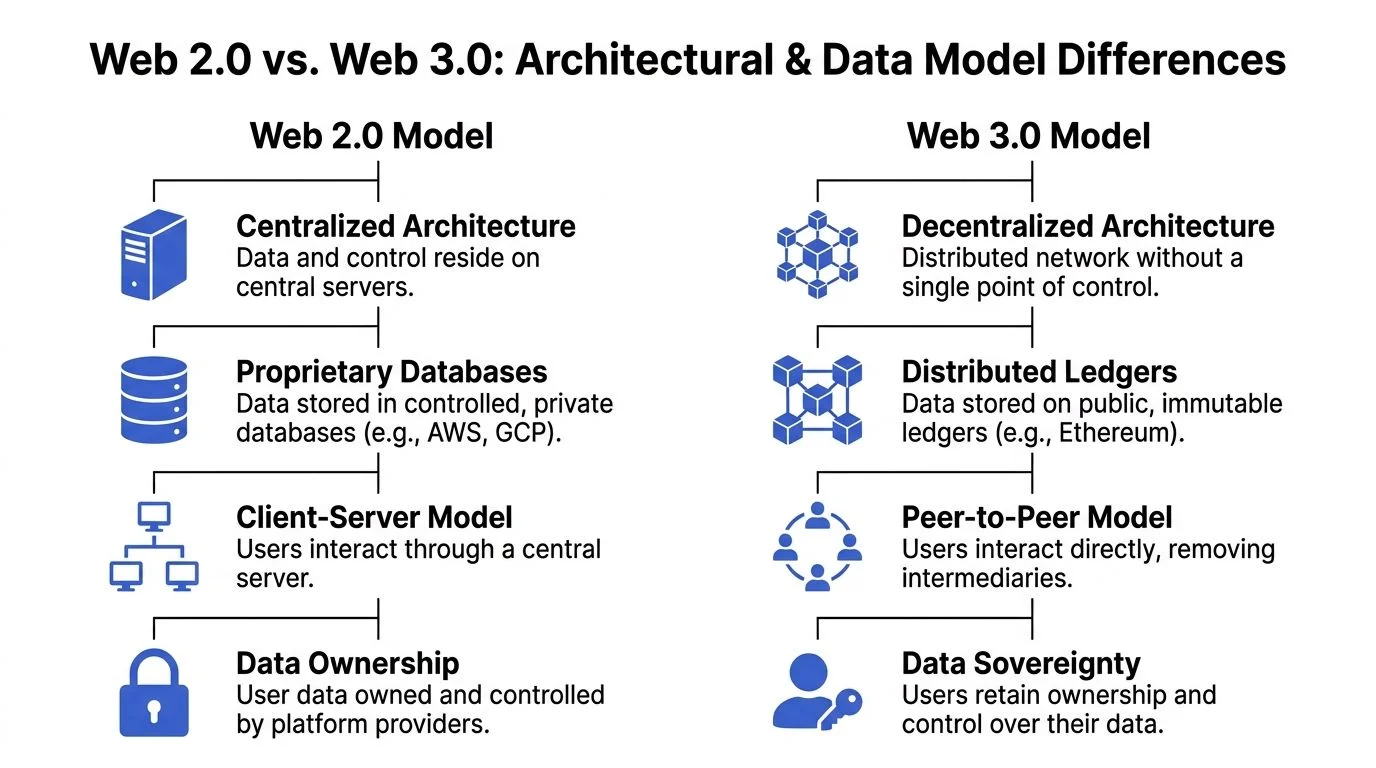
Web 2.0 applications usually rely on central servers, proprietary databases, cloud infrastructure, and a client-server model. Web 3.0 applications distribute more of that responsibility across blockchains, peer-to-peer storage, smart contracts, and wallet-based interaction.
Central servers versus decentralised infrastructure
The architectural split is direct. Web 2.0 uses a centralized data architecture where “platforms like Meta, Google, and Amazon store, mine, and monetize user data” with “central control”. Web 3.0 replaces that model with “decentralized infrastructure”, “no central servers”, and “data distributed across peer-to-peer networks using blockchain and IPFS” according to Squareboat’s Web 3.0 vs Web 2.0 analysis.
For product teams, that difference changes failure modes.
In a centralised system, one operator can patch a database, reverse an entry, suspend access, or change business logic quickly. In a decentralised system, resilience improves because there isn’t a single point of control, but change management becomes slower and more deliberate.
Data ownership becomes a product decision
Web 2.0 platforms usually treat user data as a managed asset inside the company’s operating perimeter. That can simplify analytics, personalisation, and customer support.
Web 3.0 changes that assumption. The same Squareboat analysis states that Web 3.0 “lets you retain complete control over your data and makes the product safer for users.”
For fintech, tokenisation, and asset platforms, this creates a serious design fork:
- Platform-managed model: easier customer recovery, support, and permissions.
- User-sovereign model: stronger ownership guarantees, less custodial burden, and fewer single points of failure.
- Hybrid model: off-chain orchestration plus on-chain proof, often the most practical option for regulated products.
Practical rule: If your business advantage comes from holding and monetising user data, Web 2.0 aligns naturally. If your advantage comes from proving ownership and reducing custodial exposure, Web 3.0 deserves closer attention.
Smart contracts move business logic closer to the protocol
In Web 2.0, business logic sits mostly inside private application code. Teams deploy updates through conventional release cycles. Users trust the operator to execute rules fairly.
In Web 3.0, some of that logic moves into smart contracts. That matters because settlement, transfers, permissions, and incentives can execute at the protocol layer.
Consequently, teams comparing public vs private blockchain models need to think beyond ideology. The central question is where shared state and shared trust create value, and where private control is still the safer or more workable answer.
New incentive design changes the economics
Web 3.0 doesn’t only redistribute control. It can also redistribute value. Squareboat notes that Web 3.0 supports “token-based incentives” where “every interaction can be rewarded” with “native tokens” that support governance, utility, and staking.
That changes product strategy in at least three ways:
- User behaviour can be incentivised directly. Participation, liquidity provision, validation, or governance can become part of the product loop.
- Communities can become stakeholders. That’s useful when network effects matter more than conventional subscription economics.
- Governance becomes design work. Token incentives can align participants, but poor design can also distort behaviour.
Privacy architecture also changes
One of the most strategically important Web 3.0 features for enterprise workflows is the use of zero-knowledge proofs, described by Squareboat as “cryptographic techniques [that] allow data verification without exposing the data itself.”
For compliance-heavy systems, that opens a meaningful option. A team can design workflows where a user proves a condition without revealing the full underlying data. That’s especially relevant where identity, transaction screening, and privacy requirements collide.
In practice, this means some products won’t choose Web 3.0 for ideology at all. They’ll choose it because privacy-preserving verification becomes commercially useful.
The business consequence
Architectural choice shapes the company’s long-term operating model.
A centralised stack gives teams speed, control, and familiar tooling. A decentralised stack gives them stronger sovereignty, programmable ownership, and new coordination mechanisms. The best products often combine both, but they do so intentionally, not by accident.
How Web 3.0 Redefines Trust Security and Performance
Web 3.0 changes the source of trust. In Web 2.0, users trust a platform, an exchange, a bank, or a software provider to maintain records accurately and execute transactions. In Web 3.0, that assurance shifts toward distributed validation, cryptographic proof, and immutable records.
That’s powerful, but it comes with a cost.

Why trust works differently
In blockchain-based systems, multiple participants validate and agree on state changes. That means the system doesn’t rely on one operator’s internal database as the sole source of truth.
According to Purrweb’s comparison of Web 2.0 and Web 3.0, “each transaction on the blockchain needs to be confirmed through complex procedures”. That validation model is the source of both Web 3.0’s assurance and its friction.
The same analysis notes that “a higher number of nodes validating data generally equals greater security”. For digital asset settlement, cross-chain operations, or tokenised instruments, that’s not a minor technical difference. It changes what users can independently verify.
Security improves in one dimension and gets harder in another
Security discussions around web 2.0 vs web 3.0 often become simplistic. The better view is that Web 3.0 strengthens some properties while introducing a different operational burden.
What improves:
- Distributed validation: a single compromised operator isn’t the only line of defence.
- Tamper resistance: records become harder to alter.
- Auditability: participants can inspect state changes more directly.
Purrweb also notes that in distributed ledger systems, “data once stored cannot be deleted and any updates made to it will be permanently recorded.” For asset management and regulated workflows, that creates a durable audit trail.
What gets harder:
- Smart contract risk: deployed code can be unforgiving if the logic is flawed.
- Key management: user-controlled assets create recovery and security challenges.
- Operational abstraction: teams must hide protocol complexity without weakening safety.
Security in Web 3.0 is less about trusting a gatekeeper and more about designing systems that remain safe when no gatekeeper can fix mistakes.
Performance is the trade-off teams can’t ignore
Many ambitious Web 3.0 roadmaps struggle with this. User expectations were shaped by Web 2.0 products that load quickly, sync instantly, and hide infrastructure complexity.
Blockchain networks don’t behave like that by default. Because every confirmed state change passes through distributed procedures, latency becomes part of the architecture. That’s especially difficult for products like exchanges, trading platforms, or high-frequency transaction systems.
For teams building such systems, the practical answer is rarely “put everything on-chain.” It’s selective placement of trust-critical logic.
Common patterns include:
- Layer 2 scaling: moving execution away from the base chain while preserving security relationships.
- Off-chain orchestration: handling fast interactions outside the ledger, then settling critical state on-chain.
- Protocol optimisation: reducing unnecessary on-chain writes and reserving blockchain use for high-value events.
A more detailed look at Web3 startup technical challenges across scalability, security, and smart contract risk is useful if your team is deciding how much performance pressure can realistically move into blockchain infrastructure.
What this means for enterprise products
For enterprise teams, the trust-security-performance triangle isn’t academic. It affects product acceptance.
A treasury platform may accept slower final settlement if verifiability is stronger. A trading interface usually won’t. A tokenisation platform may need immutable provenance but still require centralised compliance services and user support around it.
That’s why the strongest Web 3.0 products don’t worship decentralisation. They use it precisely where it improves trust and leave the rest of the stack optimised for usability.
Practical Applications in High-Growth Sectors
The cleanest way to understand web 2.0 vs web 3.0 is to look at where the architectures produce visibly different business outcomes. The gap becomes obvious in finance, tokenisation, exchange design, and digital governance.
Fintech rails versus DeFi protocols
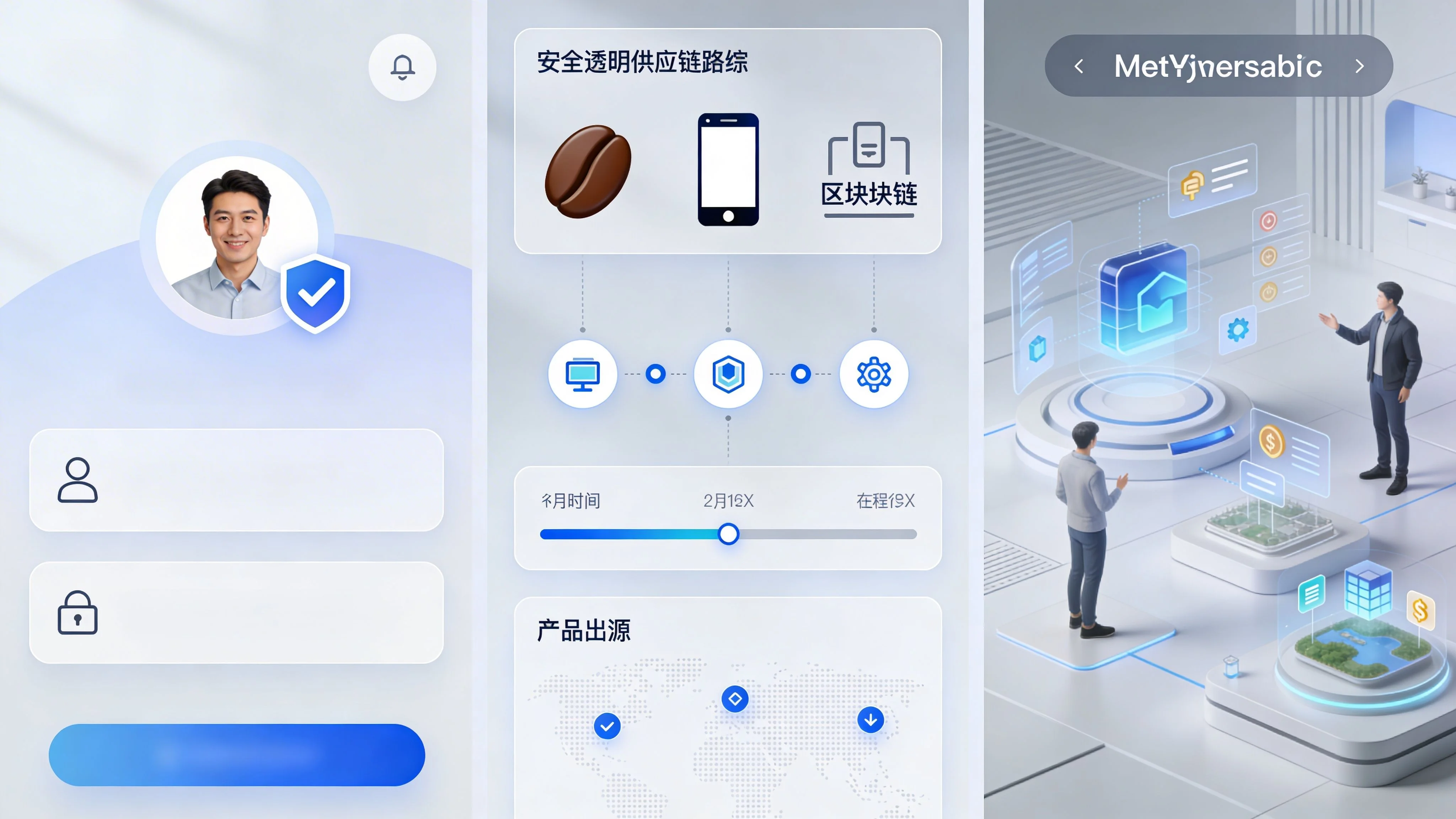
A traditional fintech app usually sits on top of bank integrations, card processors, identity vendors, and internal ledgers. The company controls user accounts, transaction visibility, and service rules.
A DeFi protocol such as Aave flips that model. Users interact through wallets, assets are represented on-chain, and financial logic executes through smart contracts rather than a single operating company’s internal database.
The strategic difference is not just disintermediation. It’s composability. A DeFi product can interact with other protocols as part of the same programmable environment. That creates faster product experimentation, but also more dependency on external protocol behaviour.
Centralised registries versus tokenised assets
A conventional asset registry records ownership inside a private database. Transfers depend on operator processes, legal documentation, and reconciliation between institutions.
A tokenised precious metal or fund structure works differently. Ownership can be represented on-chain, transfer conditions can be programmed, and settlement records become easier to verify across counterparties. That doesn’t remove the need for legal agreements, custody controls, or compliance review, but it can reduce operational fragmentation.
Commercial opportunities for Web 3.0 arise in areas like precious metal tokenisation, decentralised fund structures, and cross-border digital asset settlement. The blockchain layer doesn’t replace the business. It standardises part of the trust fabric around it.
Centralised exchanges versus decentralised exchanges
A centralised exchange holds custody, runs an order book, controls listings, and manages market access. That makes performance and customer support easier to control.
A decentralised exchange such as Uniswap reduces the role of central custody and lets users trade through on-chain liquidity mechanisms. The benefit is reduced intermediary dependence. The cost is that transaction certainty, slippage, and network behaviour become visible parts of the user experience.
Product teams deciding between these models should focus less on ideology and more on user expectations:
- Institutions often want controlled onboarding, predictable compliance workflows, and familiar support structures.
- Crypto-native users may prioritise self-custody, permissionless access, and transparent execution.
- Hybrid exchanges often win by combining centralised interfaces with decentralised settlement or liquidity components.
Corporate governance versus DAO-style coordination
Web 2.0 governance is company governance. Boards, executives, and private cap tables decide priorities.
Web 3.0 adds the option of DAO-style governance, where token holders or community members can vote on treasury use, protocol parameters, or ecosystem proposals. That can improve participation and alignment, but only when the governance design is disciplined. Without clear operating boundaries, governance can become slow, noisy, or captured by concentrated interests.
Strong Web 3.0 products don’t decentralise everything. They decentralise the decisions that benefit from transparency and shared participation.
AI and Web 3.0 are starting to intersect
A practical trend product teams are already exploring is the combination of AI systems with blockchain-based coordination, provenance, and automation. AI can handle classification, monitoring, routing, and decision support. Blockchain can provide auditable state, incentive design, and programmable execution.
If your team is experimenting with workflow automation, a useful adjacent resource is this guide to building production-grade AI agents without writing code. It’s relevant because many companies won’t adopt Web 3.0 in isolation. They’ll pair it with AI-driven operations for support, compliance, and asset lifecycle management.
The pattern across sectors
The products seeing the most credible Web 3.0 adoption usually share one trait. Ownership, settlement, provenance, or coordination is central to the business model. Where those features are peripheral, Web 2.0 architecture often remains the better fit.
Should Your Business Build on Web 3.0 A Decision Framework
The strongest answer to web 2.0 vs web 3.0 is rarely binary. Most businesses need a filtering framework that separates genuine architectural need from trend-chasing.

Five questions that decide the architecture
Ask these in order.
Is shared trust a core product requirement
If multiple parties need to verify records without relying on one operator, decentralised architecture becomes more compelling. Tokenisation, settlement, shared registries, and cross-entity workflows often fit this model.
If your users are happy trusting one provider, a centralised system may be cleaner and faster.
Does user ownership create a competitive advantage
Some products improve materially when users hold direct control over assets, permissions, or identity. Others don’t.
If ownership is central to the value proposition, Web 3.0 can create product differentiation. If ownership only complicates onboarding and support, keep it abstracted or keep it out.
Can your team absorb the technical complexity
Smart contracts, wallet flows, transaction simulation, protocol monitoring, and key-management choices all raise delivery complexity.
That doesn’t mean teams should avoid Web 3.0. It means they should scope it precisely. The right move is often to decentralise one trust-critical layer rather than rebuild the whole product stack around a chain.
Is regulation part of the product, not an afterthought
This question becomes decisive in financial products.
Merkle Science’s overview of Web 2.0 and Web 3.0 highlights that regulatory compliance is a major hurdle in India, where stringent RBI guidelines on crypto and tokenisation create unique barriers. The same source notes that 20% of Indians show crypto awareness, but only 2-3% are active users, with a 70% compliance drop-off rate for startups due to KYC and AML mismatches. It also states that India’s PMLA amendments complicate the picture further, with 85% of audited DeFi projects failing centralised reporting mandates.
For founders, that leads to a non-obvious conclusion. Permissionless architecture may be technically elegant and commercially unusable if reporting obligations still assume centralised accountability.
Regional regulation can turn a clean decentralisation thesis into a hybrid architecture requirement.
Enterprise and startup decisions won’t look the same
Enterprises usually adopt Web 3.0 where it reduces reconciliation, improves auditability, or enables new asset models. They often keep customer support, identity, and compliance orchestration in more conventional layers.
Startups can build natively around token incentives, wallet-based access, and protocol composability, but they carry more regulatory and user education risk from day one.
That difference changes product sequencing:
- Enterprise path: pilot tokenisation, controlled settlement, private or permissioned environments, then expand.
- Startup path: launch narrow, prove liquidity or utility, then mature governance and compliance architecture.
A short strategic perspective is useful here:
A realistic 12 to 24 month outlook
Over the next 12 to 24 months, the strongest products are likely to look more hybrid, not more pure.
Three developments matter most:
- Layer 2 maturity should make more transaction-heavy applications commercially realistic.
- Compliance engineering will become a bigger differentiator than token issuance itself.
- AI and Web 3.0 convergence will push more teams toward automated monitoring, onboarding support, and policy execution around decentralised systems.
The teams that win won’t be the ones that “go Web 3.” They’ll be the ones that identify exactly where decentralisation improves trust, economics, or settlement, then wrap that layer in a product experience people can use.
How Blocsys Can Accelerate Your Web 3.0 Strategy
If your team is weighing web 2.0 vs web 3.0, the hard part usually isn’t understanding the concept. It’s translating the concept into a platform that can survive real-world demands.
That means making disciplined decisions about where to place on-chain logic, how to design tokenisation and trading workflows, how to support compliance without destroying usability, and how to build infrastructure that can scale beyond a prototype.
Blocsys Technologies works with fintechs, exchanges, and digital asset businesses building production-ready blockchain and AI-powered platforms. That includes tokenisation systems, trading infrastructure, and intelligent compliance workflows designed for secure, scalable, enterprise-grade operations.
For teams building in DeFi trading, cross-chain swaps, decentralised fund structures, carbon-linked products, or precious metal tokenisation, that kind of execution support matters because architecture mistakes compound quickly. A weak custody model, a poorly scoped smart contract layer, or an under-designed compliance workflow can stall a launch long before the product reaches market fit.
If you’re evaluating your next platform move, Blocsys can help your team shape the right architecture, delivery plan, and technical execution model from the start.
Frequently Asked Questions About Web 2.0 and Web 3.0
Will Web 3.0 completely replace Web 2.0
Probably not. The more realistic outcome is coexistence. Web 2.0 remains strong for speed, convenience, and centrally managed services. Web 3.0 is more useful where ownership, verifiability, and programmable settlement matter. Many products will combine both.
What’s the simplest way to explain web 2.0 vs web 3.0
Use a control analogy. In Web 2.0, users access services inside platforms that control accounts, policies, and data environments. In Web 3.0, users can hold more direct control over assets, identity, and participation through decentralised infrastructure and protocol rules.
Is Web 3.0 only relevant for crypto companies
No. It’s relevant anywhere shared trust, auditability, provenance, or digital ownership affects the business model. That includes tokenised assets, digital identity, settlement systems, supply chain records, and some AI coordination workflows.
What skills does a Web 3.0 team need
A Web 3.0 team typically requires a mix of smart contract development, backend engineering, wallet and frontend integration, security review, infrastructure design, and compliance understanding. Product leadership also matters because many Web 3.0 failures come from poor workflow design, not just poor code.
When should a company stay with Web 2.0
Stay with Web 2.0 when central control is a feature, not a bug. If your users want fast support, simple logins, predictable performance, and conventional compliance operations, a centralised architecture may be the better commercial decision.
If you’re planning a tokenisation platform, exchange, DeFi product, AI-integrated workflow, or secure digital asset system, Blocsys Technologies can help you evaluate the right architecture and execute it with production-grade engineering. Connect with the team to discuss your roadmap, technical constraints, and the fastest path to a scalable Web 3.0-ready platform.
