The digital economy moves fast. AI agent crypto payments explained — this phrase captures one of the most exciting developments in fintech today. AI agents now make autonomous financial decisions, sending and receiving cryptocurrency without human input. Consequently, businesses and developers are racing to understand how this technology works and what it means for the future of money.
How AI Agents Are Reshaping Digital Transactions
Traditional payment systems require human approval at every step. AI agents, however, change that model completely. These software programs execute tasks independently, following predefined rules or learned behaviors. Therefore, they can initiate crypto transactions, verify balances, and settle payments in seconds.
Furthermore, AI agents operate continuously. They never sleep, take breaks, or make emotional decisions. This makes them ideal for time-sensitive financial operations. Moreover, they integrate seamlessly with blockchain networks, opening the door to a new era of programmable money.

AI Agent Crypto Payments Explained: The Core Mechanics
Understanding the mechanics is essential. At their core, AI agents interact with blockchain networks through APIs and smart contracts. They hold or access crypto wallets and use private keys to authorize transactions. Additionally, they parse real-time data — such as gas fees or exchange rates — before deciding whether to execute a payment.
However, security is a major consideration here. AI agents must protect private keys from exposure at all times. Consequently, many implementations use multi-signature wallets or hardware security modules. These methods ensure that no single point of failure can drain funds.
Smart Contracts and Automated Execution
Smart contracts are self-executing code stored on the blockchain. AI agents trigger these contracts to release funds when specific conditions are met. For example, an agent might pay a freelancer automatically once a project milestone is verified. Therefore, smart contracts eliminate the need for intermediaries like banks or payment processors.
Additionally, smart contracts are transparent and immutable. Once deployed, nobody can alter their logic. This gives all parties confidence that agreed terms will execute exactly as written. Furthermore, platforms like Chainlink provide real-world data feeds that smart contracts rely on for accurate, automated decisions.
Wallets, Keys, and Authentication
Every AI agent needs a crypto wallet to send payments. These wallets store private keys that sign each transaction on the network. Moreover, modern AI frameworks allow agents to generate and manage wallets programmatically. This means developers can spin up payment-ready agents in minutes.
However, key management remains a critical challenge. Many teams use custodial solutions or trusted execution environments to protect keys. Consequently, the security architecture around an agent’s wallet is just as important as the agent’s logic itself.

Real-World Use Cases for AI Agent Payments
The applications grow rapidly across industries. AI agents already power a range of crypto payment scenarios that were impossible just a few years ago. Additionally, the variety of use cases continues to expand as agent capabilities improve. Explore how AI agents are transforming DeFi for a deeper look at specific examples.
DeFi and Autonomous Trading
In decentralized finance, AI agents execute trades, provide liquidity, and rebalance portfolios automatically. Therefore, they maximize yield opportunities that human traders would otherwise miss. Furthermore, they respond to market shifts in milliseconds, acting on data before conditions change.
Cross-Border Payments and Microtransactions
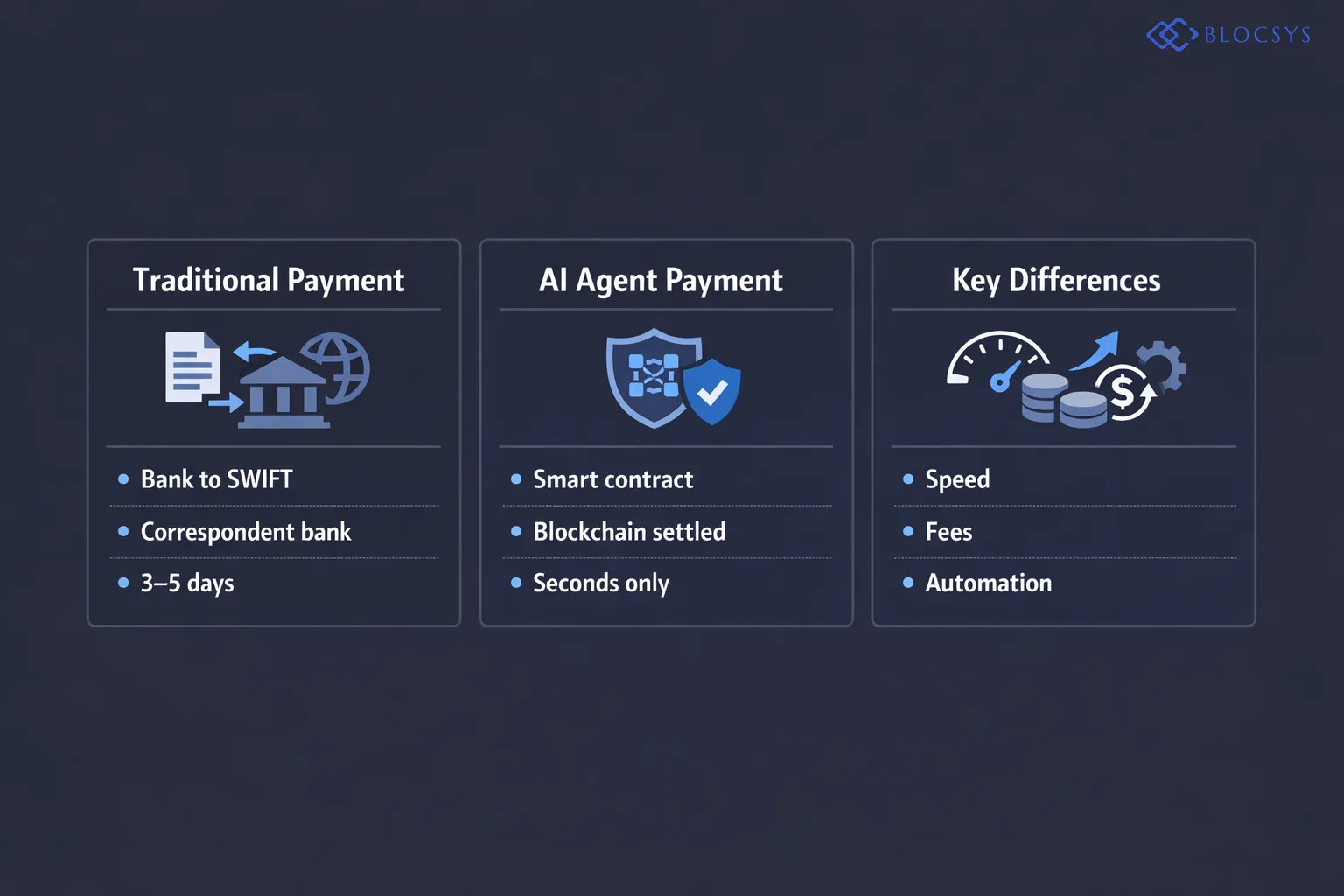
AI agents also simplify cross-border payments significantly. Traditional wire transfers take days and carry high fees. Conversely, AI agents settle crypto payments globally in seconds at a fraction of the cost. Additionally, they handle microtransactions efficiently — something legacy systems genuinely struggle with. This is particularly valuable in the creator economy, where platforms frequently pay contributors small amounts.
Key Benefits and Challenges to Consider
AI agent crypto payments deliver clear advantages for businesses and developers alike. Speed, automation, and reduced costs are the most obvious benefits. Moreover, they remove human error from repetitive payment tasks. However, challenges remain. Regulatory uncertainty is a significant concern, as governments worldwide still debate how to classify AI-initiated transactions.
Additionally, technical risks like smart contract bugs or agent misbehavior can cause serious financial losses. Therefore, thorough auditing and testing are non-negotiable before deploying any payment agent in production. Read our guide on crypto payment security for practical risk management strategies you can apply today.
What the Future Holds for Autonomous Crypto Payments
The trajectory is clear. AI agents will handle an increasing share of global crypto transactions in the coming years. Furthermore, as large language models improve, agents will make far more nuanced financial decisions. Consequently, the boundary between software and financial intermediary will continue to blur at an accelerating pace.
Moreover, interoperability across blockchains is advancing quickly. Agents will soon move value across networks like Ethereum, Solana, and Bitcoin seamlessly and without friction. This multi-chain capability will unlock payment use cases we can barely imagine today. Therefore, builders, investors, and regulators must stay informed and adapt swiftly to this fast-moving landscape.