The concept of ai agent crypto payments explained is rapidly reshaping how businesses and developers approach financial automation. AI agents are autonomous software programs that independently initiate, verify, and settle cryptocurrency transactions — all without human intervention. Moreover, as blockchain infrastructure continues to mature, these agents are becoming essential components of decentralized financial systems. Understanding how they function, what they can do, and why they matter is critical for anyone operating in today’s Web3 economy.
AI Agent Crypto Payments Explained: Core Concepts
An AI agent is a software entity that perceives its environment, makes informed decisions, and takes targeted actions toward specific goals. Therefore, when deployed in a crypto payment context, an agent connects directly to blockchain networks, manages digital wallets, and executes transactions entirely autonomously. Furthermore, these agents operate continuously around the clock, making them ideal for global, always-on payment workflows.
Cryptocurrency payments depend on public-key cryptography, digital signatures, and distributed ledgers. However, managing these systems manually introduces friction, delays, and costly human error. AI agents automate the full payment lifecycle — from initiation through confirmation. Consequently, organizations that adopt this approach reduce operational overhead and significantly improve the speed and reliability of their payment systems.
What Makes AI Agents Different from Traditional Bots?
Traditional bots follow rigid, pre-programmed rules and break when conditions change. AI agents, however, use machine learning and adaptive reasoning to handle dynamic, real-world conditions. Additionally, they manage complex multi-step payment flows — including currency conversion, identity checks, and fund routing — all in real time. Furthermore, AI agents continuously learn from historical transaction data to optimize future performance, giving them a decisive edge over static automation tools.
How AI Agents Execute Crypto Transactions
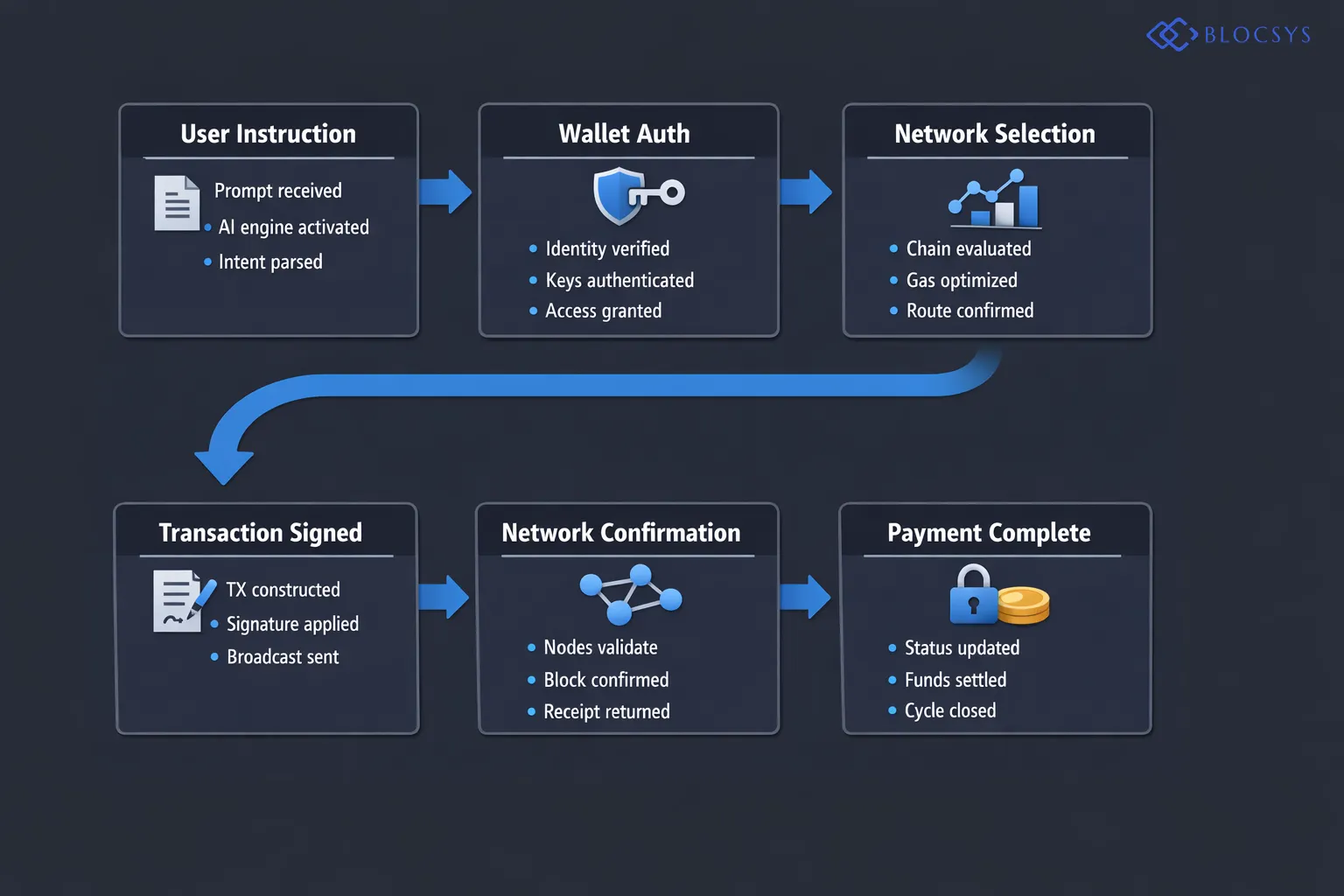
The process starts when an AI agent receives an instruction from a user, application, or another autonomous agent. Moreover, the agent evaluates this instruction against its decision logic — analyzing available balance, current gas prices, and network congestion simultaneously. It then selects the optimal blockchain, signs the transaction with a private key, and broadcasts it to the network. Therefore, complex payment tasks that once required multiple manual steps now complete in milliseconds.
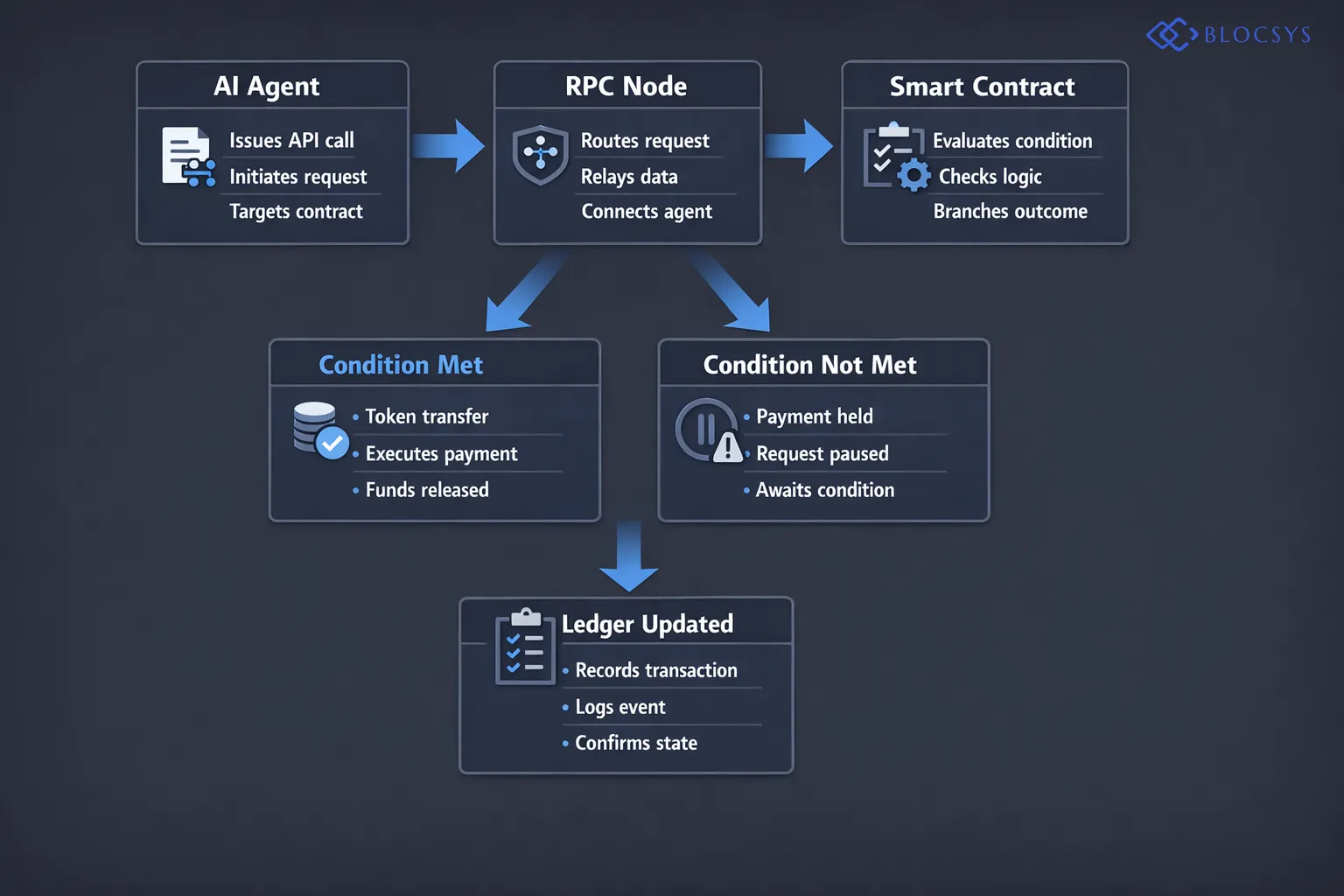
Most AI agents use wallet APIs and RPC nodes to interface with blockchains such as Ethereum, Solana, or Polygon. Furthermore, they frequently integrate with ERC-20 token standards to manage fungible digital assets seamlessly across networks. This interoperability is critical for businesses running multi-chain payment operations at scale.
The Role of Smart Contracts
Smart contracts are self-executing programs deployed on blockchains that activate automatically when preset conditions are satisfied. Consequently, AI agents use smart contracts to trigger conditional payments — for instance, releasing funds automatically upon confirmed delivery of goods or services. Additionally, smart contracts eliminate intermediaries entirely, cutting settlement times from days to mere seconds. They form the trustless foundation of most AI-driven payment systems.
Key Benefits of AI Agent Crypto Payments
Organizations adopting AI agent payment systems gain significant competitive advantages. Moreover, these benefits compound over time as agents learn and continuously refine their strategies.
- Speed: Transactions settle in seconds, not business days.
- Cost efficiency: Agents optimize gas fees and routing to minimize expenses automatically.
- Scalability: A single agent manages thousands of simultaneous transactions without performance degradation.
- Transparency: Every payment records permanently and immutably on the blockchain.
- Programmability: Payment logic adapts dynamically to changing business conditions and rules.
Furthermore, AI agents reduce reliance on third-party payment processors. Businesses therefore retain full control over their financial infrastructure and data. Additionally, cross-border payments become frictionless, since crypto networks operate globally and bypass traditional banking intermediaries entirely.
Real-World Applications
AI agents are already transforming multiple industries. Decentralized finance platforms use them to automate lending, borrowing, and liquidity management strategies. Therefore, capital flows efficiently without constant human oversight. Similarly, e-commerce platforms deploy AI agents to process real-time crypto refunds, manage subscription billing, and handle split payments across different currencies and chains simultaneously.
In gaming and metaverse environments, AI agents manage entire in-game economies — rewarding players, processing purchases, and facilitating peer-to-peer asset trades autonomously. Consequently, the economic layer runs without any manual intervention. Moreover, supply chain companies trigger milestone-based vendor payments the moment shipment confirmations arrive. Explore more in our guide to AI agents in DeFi.
Challenges and Risks to Consider
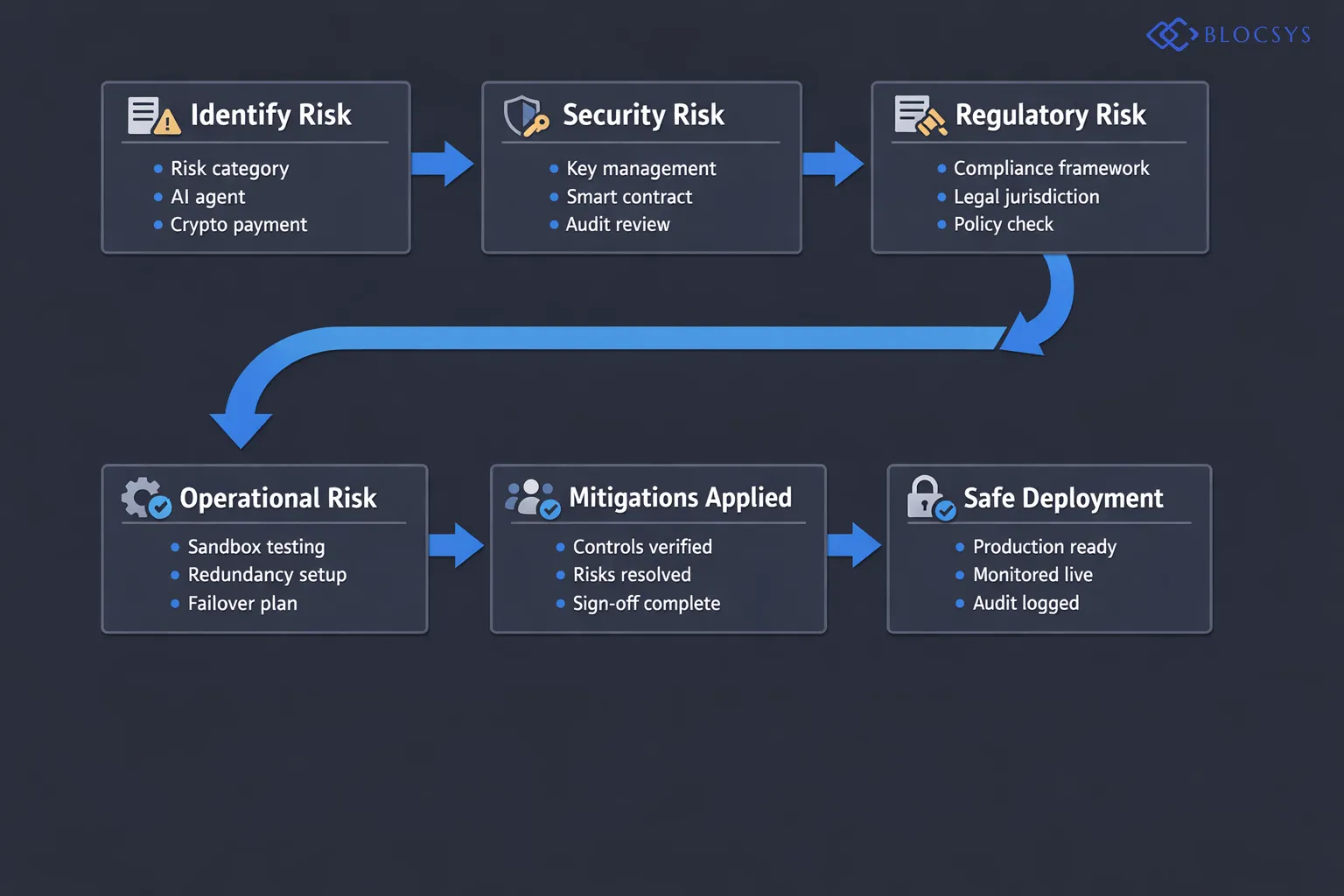
Despite its promise, AI agent crypto payments carry real risks. Smart contract vulnerabilities remain one of the most significant threats — a single coding flaw can result in devastating financial loss. Additionally, regulatory frameworks governing autonomous payment agents are still evolving in most jurisdictions. Businesses must therefore integrate compliance mechanisms and detailed audit trails into their systems from the very beginning.
Private key security presents another critical challenge. If an agent’s signing key is compromised, attackers gain complete access to its associated wallet. Furthermore, cross-chain operations introduce additional complexity around liquidity management and bridge risks. Rigorous testing, multi-signature authorization schemes, and hardware security modules are essential safeguards before any production deployment.
The Future of AI-Driven Crypto Payments
The convergence of artificial intelligence and blockchain remains in its early stages. However, the direction is clear — autonomous agents will increasingly govern financial transactions across global decentralized networks. Moreover, standards like ERC-4337 account abstraction are making it significantly easier for AI agents to operate programmable smart wallets. According to CoinDesk, the AI-crypto intersection is among the most closely watched trends in digital assets today.
Multi-agent ecosystems are also emerging, where networks of specialized AI agents collaborate on complex financial workflows. Consequently, entire payment systems may soon operate with minimal human involvement. Additionally, our crypto payment automation guide offers practical next steps for getting started. Therefore, acting now positions your organization firmly ahead of the curve in the rapidly evolving decentralized economy.