
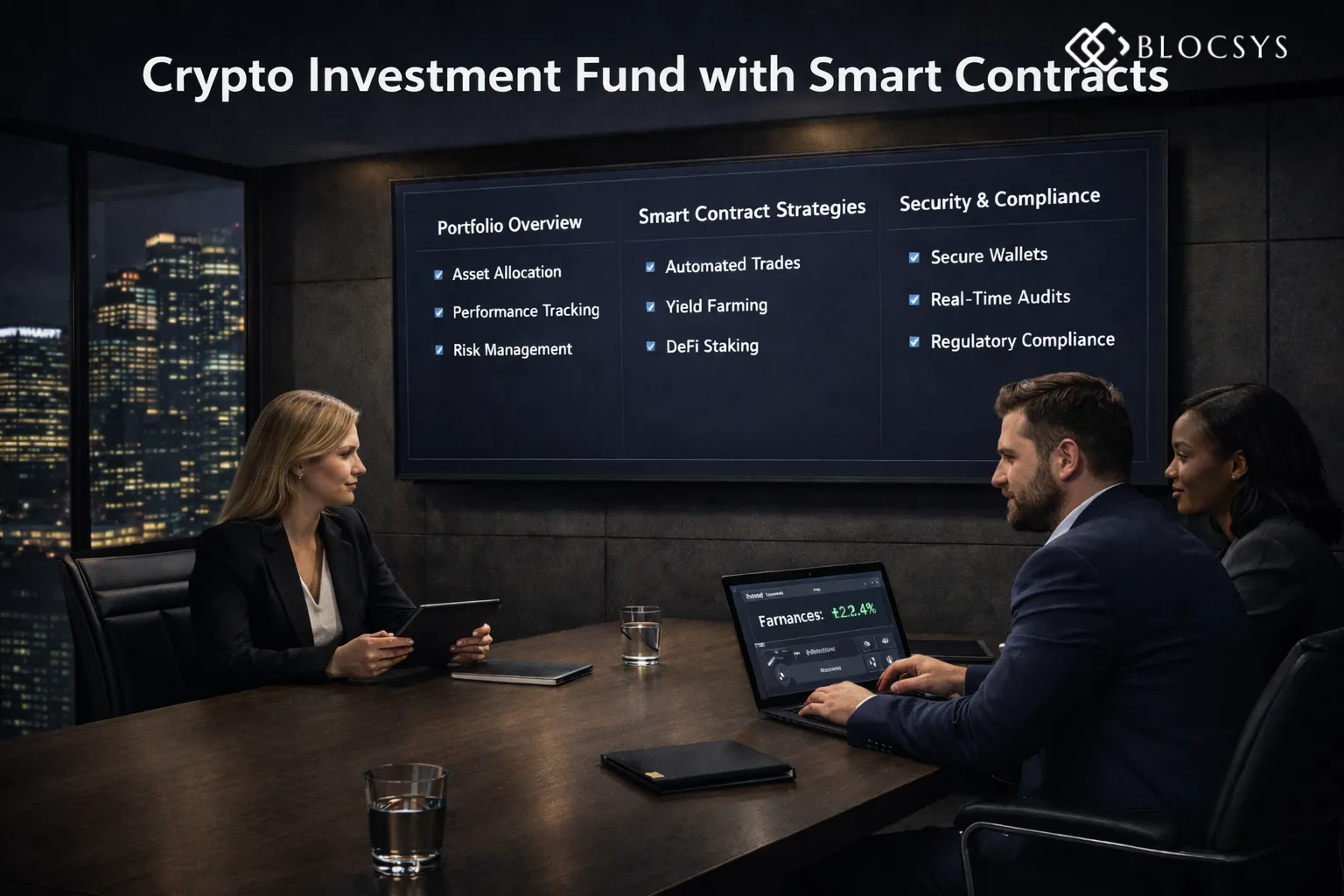
Launching a crypto investment fund using smart contracts is a high-stakes venture requiring more than just technical skill. Success depends on mastering four key areas: legal setup, smart contract architecture, investment strategy, and security. For founders and enterprise teams entering decentralised finance, getting these elements right separates a concept from a scalable, institutional-grade investment vehicle.
This guide provides an actionable blueprint for decision-makers and technical leads ready to build a resilient, on-chain investment platform. It moves beyond theory to offer a structured plan for navigating the real-world technical and strategic hurdles, ensuring you can build a fund that attracts serious capital and operates with institutional-grade security.
What is a Crypto Investment Fund Built on Smart Contracts?
A crypto investment fund built on smart contracts is an automated, on-chain vehicle that manages pooled investor capital. The smart contracts serve as the fund’s operational engine, executing tasks like investor subscriptions, asset management, fee collection, and redemptions without manual intervention. This structure offers transparency, efficiency, and reduced overhead compared to traditional funds.
Who This Guide Is For
This blueprint is tailor-made for decision-makers and technical leads who are past the “what if” stage and need a structured plan for execution. It’s for teams who see the huge potential in automating fund operations on-chain but need a clear path to get there.
- Web3 Founders: Use this framework to structure your product roadmap—from legal setup to security audits—and build a fund that attracts both retail and institutional money.
- Fintech Innovators: Learn how to fuse decentralised tech with your existing financial products to unlock new revenue streams and build more efficient investment vehicles.
- Enterprise Teams: Understand the strategic moves for launching a corporate venture fund or asset management product on the blockchain, with a sharp focus on security, compliance, and scale.
What You Will Learn
This guide walks you through the entire lifecycle of creating a smart contract-based fund. You’ll get a deep, practical understanding of the core pillars you need to build on.
The goal here is to get you out of the weeds of theory and into a tangible plan of attack. By focusing on a rock-solid legal foundation, secure architecture, and a sharp strategy, you can build a fund that’s not just innovative but also trusted by investors and regulators.
Here’s the promise: by the end of this article, you’ll have an actionable plan for building your decentralised fund. We’ll cover everything from navigating complex regulatory landscapes to engineering institutional-grade smart contracts and integrating tokenised Real-World Assets (RWAs). You’ll know exactly how to turn your vision into a robust, market-ready platform.
How to Set Up the Legal and Regulatory Framework

Before writing a single line of smart contract code, you must anchor your fund in a solid legal and regulatory framework. This isn’t about ticking boxes; it’s about building a durable foundation that attracts serious capital and ensures your operation’s long-term survival. Operating without full compliance is a non-starter for anyone managing investor funds.
A proactive approach to compliance de-risks your project and signals to the market that you’re a professional, long-term player. This focus has been a massive growth driver in markets with increasing regulatory clarity. For example, some regions saw explosive growth in decentralised investment vehicles, with smart contract-based funds capturing over 25% of total crypto inflows in early 2026. This surge is a direct result of clearer registration mandates for Virtual Asset Service Providers (VASPs). You can explore more about these institutional crypto flows in this 2026 market analysis.
What is a Virtual Asset Service Provider (VASP)?
A Virtual Asset Service Provider (VASP) is any entity that conducts one or more specific activities on behalf of another person, including exchange between virtual assets and fiat, exchange between different virtual assets, and safekeeping of virtual assets. A crypto investment fund manager squarely fits this definition.
The single most important regulatory hurdle for any crypto fund is mandatory registration with the relevant financial intelligence authority, such as the Financial Intelligence Unit (FIU). This is not optional.
Compliance with this mandate means taking on several key duties under frameworks like the Prevention of Money Laundering Act (PMLA):
- KYC/AML Procedures: You must implement robust Know Your Customer (KYC) and Anti-Money Laundering (AML) processes. This involves verifying every investor’s identity and actively monitoring transactions for suspicious activity.
- Transaction Reporting: You’re required to report certain transactions to the FIU, including all cash dealings above a specific threshold and any activity that seems out of the ordinary.
- Record Keeping: Maintaining detailed records of all transactions and investor identities for a legally specified period is a must.
Think of VASP registration not as a barrier, but as your licence to operate. It legitimises your fund, makes it bankable, and gives you a clear framework for engaging with the traditional financial system. Without it, you’re invisible to institutional partners and at high risk of regulatory action.
How to Choose Your Fund’s Legal Structure
Your choice of legal entity has massive implications for liability, taxation, and fundraising. While smart contracts automate operations, a legal wrapper is essential to interface with the real world.
Here’s a comparison of common structures:
- Limited Liability Partnership (LLP): This is a popular choice for funds. An LLP offers the flexibility of a partnership with the limited liability of a company, protecting your personal assets from business debts. It’s relatively straightforward to set up and manage.
- Private Limited Company (Pvt Ltd): This structure creates a clean separation between the business and its owners. It can be more attractive if you plan to raise equity capital from VCs, but it also comes with more intense compliance and reporting obligations.
- Trust: A trust structure is excellent for asset protection and creating clear beneficiary designations. It’s often used in traditional fund management and can be adapted for crypto funds, especially for family offices or funds with a specific mandate.
Your decision here should be driven by your fund’s goals. Are you targeting retail investors or a small circle of high-net-worth individuals? Are you planning to raise venture capital for the management company itself? Consulting a legal expert who specialises in corporate and securities law is non-negotiable.
How Does Compliance Differ for Crypto-Native vs. RWA Funds?
The compliance rules for your fund change based on its holdings. Regulations for a fund trading only crypto-native assets like Bitcoin and Ethereum differ from those for a fund investing in tokenised Real-World Assets (RWAs).
For RWAs, like tokenised real estate or precious metals, you must navigate a separate layer of rules for the underlying asset. This often means complying with securities regulations, particularly if the tokenised asset is legally considered a security. This dual-layer compliance—one for the crypto wrapper and another for the underlying asset—is more complex but essential for building a legally sound RWA fund.
How to Engineer Your Fund’s Smart Contract Architecture
The smart contract is the engine of your decentralised fund. It automates everything from investor deposits and portfolio rebalancing to fee collection. Getting this architecture right isn’t just a coding exercise; it’s about engineering a secure, efficient, and scalable financial machine that can operate autonomously on-chain.

Your first major decision is choosing the right blockchain—a choice with lasting consequences for your fund’s cost structure, speed, and security profile. It’s a critical trade-off between user experience, cost, and decentralisation.
How to Choose a Blockchain Platform for Your Fund
Different chains serve different strategic goals. An institutional-grade fund has vastly different needs than one targeting retail users with a high-frequency strategy. The legal and compliance steps shown above must happen in parallel with development, as these rules dictate what your smart contracts must enforce.
- Ethereum (Enterprise Perspective): The undisputed leader in security and liquidity. Building on Ethereum signals institutional seriousness but comes with higher transaction costs (gas fees). This is acceptable for high-value, low-frequency transactions typical of enterprise or HNW funds.
- Layer-2s like Polygon (Startup Perspective): L2 solutions offer a compelling middle ground. By processing transactions off the main Ethereum chain, they deliver significantly lower fees and faster speeds while still inheriting Ethereum’s robust security. This makes them ideal for startups and funds aiming for a broader retail user base.
- High-Throughput Chains like Solana or Avalanche: Known for extremely high throughput and low costs, these platforms are excellent for funds that rely on high-frequency trading or complex on-chain computations. However, their security models and developer ecosystems are less mature than Ethereum’s, a factor to weigh carefully.
Blockchain Platform Comparison: Enterprise vs. Startup
| Platform | Primary Language | Gas Fees | Transaction Speed (TPS) | Best Use Case | Perspective |
|---|---|---|---|---|---|
| Ethereum | Solidity | High | ~15-30 | Institutional funds; high-value, low-frequency activity. | Enterprise |
| Polygon (L2) | Solidity | Low | Up to 7,000 | Retail-focused funds; strategies requiring lower transaction costs. | Startup |
| Solana | Rust | Very Low | ~65,000+ | High-frequency trading; complex DeFi strategies. | High-Growth Startup |
| Avalanche | Solidity | Low | ~4,500 | DeFi apps; funds needing custom subnets and high throughput. | Scale-Up |
Why Should You Design Modular and Upgradeable Contracts?
A monolithic, unchangeable smart contract is a massive liability. A modular design is the only sensible approach, breaking down your fund’s logic into smaller, interconnected contracts. This separates concerns, making the system easier to audit, debug, and upgrade.
The most critical architectural decision you will make is implementing an upgradeability pattern from day one. A non-upgradeable contract is a ticking time bomb. A single bug or required feature update could force a costly and risky migration of all assets to a new set of contracts.
Using a proxy pattern is the industry standard for achieving this. Proxies are simple contracts that delegate all calls to a separate logic contract. To upgrade your fund, you simply deploy a new logic contract and point the proxy to the new address. To deepen your understanding, you can learn more about how to implement these patterns in our detailed guide on proxy contracts in Solidity.
What Core Logic Should Your Fund’s Smart Contracts Include?
Your core logic is where the fund’s strategy comes to life in code, automating its day-to-day operations.
Key Functions to Engineer:
- Subscription and Redemption: This logic must securely handle investor deposits (e.g., in USDC or ETH) and mint corresponding fund shares as tokens. The redemption process works in reverse, burning share tokens to return the underlying assets. It’s vital to include checks to prevent front-running and enforce any specified lock-up periods.
- Fee Calculation: You’ll need functions to automatically calculate and collect management and performance fees. Performance fees often use a “high-water mark” mechanism, which ensures fees are only taken on new profits, a standard practice that builds investor trust.
- Portfolio Management: For active strategies, this logic executes trades based on predefined signals. This might involve swapping tokens on a DEX like Uniswap or interacting with other DeFi protocols. When engineering these functions, tools like a Free AI Contract Generator can help draft initial templates for these complex interactions, saving valuable development time.
- Oracle Integration for RWA Pricing: If your fund holds Real-World Assets (RWAs), you need a secure way to get their prices on-chain. This involves integrating with a reliable oracle network like Chainlink to feed real-world data (e.g., the price of gold or carbon credits) into your smart contract for accurate Net Asset Value (NAV) calculation.
Throughout this process, implementing robust access control is non-negotiable. Using standard patterns like Ownable allows you to restrict critical functions—such as upgrading the contract or changing fee parameters—to authorised addresses only. This ensures that only the designated fund manager can perform administrative actions, protecting the integrity of the fund and its investors’ assets.
How to Integrate RWAs and Advanced Trading Mechanisms
To truly stand out, a modern crypto fund must look beyond native digital assets. The next frontier is integrating tokenised Real-World Assets (RWAs) like precious metals, real estate, and carbon credits. This move diversifies your portfolio, attracts a different class of investors, and opens up entirely new value propositions.
When you combine RWAs with sophisticated trading mechanisms built directly into your fund’s smart contracts, you create a major competitive edge. You are no longer just an investment vehicle; you become a dynamic, on-chain financial platform.
How to Architect for RWA Tokenisation
Integrating RWAs isn’t as simple as minting a token. It requires a specific architecture to bridge the off-chain and on-chain worlds, ensuring the token’s value is credibly and legally tied to its underlying asset.
The core components of this architecture are non-negotiable:
- Custody Solutions: The physical asset—whether it’s gold bars in a vault or a property deed—must be held by a trusted, verifiable custodian. The legal agreements with this custodian are the bedrock of the token’s claim on the asset.
- Special Purpose Vehicle (SPV): In many cases, the physical asset is placed into a legal entity like an SPV. It’s this entity, not the asset itself, that gets tokenised. This legal wrapper simplifies ownership transfer and isolates risk.
- Oracle Integration: Your smart contracts need a constant, reliable feed of off-chain pricing data to accurately calculate the fund’s Net Asset Value (NAV). This is where oracles like Chainlink become absolutely indispensable, feeding tamper-resistant price data for assets like gold or carbon credits directly on-chain.
For anyone serious about building a decentralised fund, understanding RWA tokenisation is no longer optional. It represents a massive expansion of the design space for on-chain finance. To get a deeper understanding of the mechanics, our guide on what RWA tokenisation is and how it works provides a foundational overview.
We’re already seeing this integration deliver remarkable results. The RWA market is expected to surge from a few hundred million to over $5 billion by 2026, a growth heavily reliant on smart contract oracles that ensure price fidelity. You can explore more about these trends in the 2026 crypto outlook.
How to Build Advanced On-Chain Trading Features
With a diverse asset base including RWAs, you can build powerful trading features directly into your fund’s smart contracts. This creates an all-in-one platform where investors don’t just hold assets—they actively manage them to generate additional yield.
Consider adding these powerful features:
1. Decentralised Perpetual Swaps
Instead of just holding assets, let users trade perpetual futures contracts based on the assets in your fund. For example, if your fund holds tokenised gold (rGOLD) and Ethereum (ETH), you could offer a rGOLD/ETH perpetual market. This requires a sophisticated on-chain risk engine to manage liquidations and funding rates.
2. On-Chain Order Books
While most of DeFi runs on Automated Market Makers (AMMs), an on-chain order book offers a more traditional trading experience. This is especially valuable for institutional investors accustomed to limit orders and deeper liquidity analysis. Building this requires a highly efficient smart contract design and a performant L2 blockchain.
3. Automated Liquidity Management
If your fund provides liquidity to other DeFi protocols, build automated strategies to manage those positions. A smart contract could, for example, automatically rebalance a concentrated liquidity position on Uniswap V3 to keep it in range. This maximises fee revenue while minimising impermanent loss, turning a passive holding into an active, yield-generating strategy.
By weaving these mechanisms into your fund’s core DNA, you graduate from being a simple container for assets. You become an active financial ecosystem, giving investors more reasons to join and stay.
How to Build an Institutional-Grade Security and Risk Framework

For a crypto investment fund on smart contracts, security is the bedrock of investor trust and survival. A single exploit can wipe out millions in assets and shatter your reputation. An institutional-grade framework means engineering resilience into every layer of your operations.
This demands a multi-pronged strategy that marries deep technical rigour with proactive risk management. For example, by March 2026, some decentralised trading platforms had amassed billions in open interest, with smart contract funds delivering impressive returns even during market drawdowns. A critical factor was their commitment to comprehensive Vulnerability Assessment and Penetration Testing (VAPT), which drove exploit incidence down to just 0.02%.
Why Should You Adopt a DevSecOps Culture?
A one-time audit won’t cut it. Top funds operate with a continuous security mindset, known as DevSecOps, where security is woven into the development lifecycle from day one.
This begins with multiple, independent smart contract audits from reputable firms. Every auditor brings a different lens, increasing the odds of catching hidden vulnerabilities. Our own guide on smart contract auditing details how to choose the right partners.
A cornerstone of robust smart contract security involves diligent and expert-led security code reviews. This process should be a constant, iterative part of your development workflow, not a final gate before deployment. It fosters a culture where developers are the first line of defence.
A thorough VAPT program should also be standard procedure. This involves simulating real-world attacks against your entire technology stack, including APIs and front-end interfaces, which are frequent targets.
How to Implement On-Chain Risk Management
Your smart contracts must be coded to manage risk autonomously. Think of these on-chain guardrails as your fund’s automated defence system.
Key on-chain risk controls include:
- Programmatic Drawdown Limits: Hard-code rules that automatically halt redemptions or trading if the fund’s Net Asset Value (NAV) drops by a preset threshold—say, 15%—within a short window.
- Circuit Breakers: These are emergency-stop functions. They can be triggered to pause all contract activity, which is vital for containing damage during a flash loan attack or a sudden market crash, buying your team critical time to respond.
- Robust Wallet Architectures: Use multi-signature (multi-sig) wallets for all treasury and administrative functions. By requiring multiple key-holders to approve transactions, you eliminate single points of failure and protect against private key compromise.
What is the Role of AI in Real-Time Threat Monitoring?
Sophisticated funds are now using AI for real-time threat monitoring. AI-powered tools can sift through immense volumes of on-chain transaction data, social media sentiment, and dark web chatter to spot potential threats before they materialize.
These systems can flag suspicious behaviour, such as an unusual accumulation of your fund’s tokens by a single wallet or coordinated transaction patterns that suggest a planned exploit. This proactive intelligence gives your security team a massive head start, transforming your security posture from reactive to predictive. Looking ahead 12-24 months, we expect AI-driven security to become a standard, non-negotiable component for all institutional-grade DeFi platforms.
How Blocsys Accelerates Your Fund’s Path to Market
Turning a sophisticated fund concept into a live, institutional-grade platform is more than just an idea—it demands deep engineering expertise and disciplined execution. While the blueprint in the previous sections maps out how to build a crypto investment fund, Blocsys Technologies is the end-to-end engineering partner that brings that map to life, massively cutting down your time to market.
We build the next generation of financial infrastructure. Our experience comes from delivering the complex, production-ready systems that are already powering the decentralised economy.
Proven Experience in Sophisticated On-Chain Systems
Our teams have a track record of engineering the very platforms discussed in this guide. We don’t just talk about it; we build the core infrastructure that opens up new market opportunities.
- Decentralised ETFs (dETFs) and Trading Platforms: We design and build the smart contract architecture for on-chain funds and advanced trading systems, including decentralised perpetuals and order book mechanisms.
- RWA Tokenisation Systems: Our expertise extends to architecting platforms for tokenising real-world assets like precious metals and carbon credits, complete with secure custody solutions and oracle integrations.
This hands-on experience means we’ve already navigated the technical hurdles you’re about to face. We provide the execution horsepower to get you from concept to launch with confidence.
Choosing the right engineering partner isn’t just about finding developers. It’s about securing a team that truly gets the strategic intersection of finance, security, and decentralised technology. We provide the execution discipline needed to build platforms that are not just innovative but also secure and scalable from day one.
Your End-to-End Delivery Partner
Blocsys offers flexible ways to work together, designed to fit your needs whether you’re an early-stage startup or an established enterprise. We bring the technical leadership and development capacity to make sure your project succeeds.
Our Core Service Offerings:
- Full Product Delivery: We can act as your complete product development team. We’ll handle everything from system architecture and smart contract engineering to backend infrastructure and final deployment.
- Dedicated Engineering Teams: Need more firepower? We provide a dedicated, managed team of blockchain and full-stack engineers who integrate seamlessly with your existing organisation.
- Staff Augmentation: We can augment your in-house team with our expert developers, bringing specialised skills in Solidity, Rust, security, and AI-assisted workflows exactly where you need them.
By bringing our expertise in smart contracts, institutional-grade security, and scalable infrastructure, we help you cut through the technical complexities. We give you the tools to build, scale, and execute effectively, ensuring your crypto investment fund launches quickly and operates reliably from the moment it goes live.
Frequently Asked Questions
When planning to create a crypto investment fund using smart contracts, founders face a series of critical decisions. Here, we address the most common questions, providing clarity on timelines, costs, and security to help you navigate the path from concept to launch.
What Is the Typical Timeframe to Launch a Smart Contract-Based Fund?
A realistic launch timeline runs 6-9 months from the initial concept to full deployment on-chain. This schedule is typically broken down into distinct, sequential phases.
Expect to dedicate 2-3 months for the foundational legal structuring and regulatory groundwork, which includes critical steps like VASP registration. Following that, the core smart contract development and initial security audits will require another 3-4 months. The final 1-2 months should be reserved for exhaustive testing, final security hardening, and all go-to-market preparations. Keep in mind that funds with more complex features, such as novel integrations with Real-World Assets (RWAs), may need an extended timeline.
How Much Does It Cost to Build a Crypto Investment Fund?
The cost to build a crypto fund varies significantly based on its complexity. A foundational on-chain fund (Startup) might start around $150,000. In contrast, a sophisticated platform (Enterprise) with advanced trading, RWA tokenisation, and institutional-grade security can easily surpass $500,000.
Your primary expenses will fall into three main categories:
- Legal and Compliance Fees: Budget for specialised legal experts to establish the correct entity and navigate required mandates.
- Smart Contract Audits: This is non-negotiable. Securing multiple, independent audits from reputable security firms represents a significant and essential cost.
- Expert Blockchain Development: The fees for experienced Solidity or Rust engineers will be a primary driver of your overall budget.
Can I Upgrade My Fund’s Smart Contracts After Launch?
Yes, but this capability must be architected into the system from day one. Implementing an upgradeable contract pattern, such as a proxy, is a crucial design choice. The most common approaches today are the UUPS or the Transparent Upgradeable Proxy patterns.
This design allows you to deploy new logic—whether to patch a bug or introduce new features—without forcing a high-risk, complex migration of all investor assets to an entirely new contract address. For any serious, long-term fund, planning for upgradeability is an absolute must.
What Are the Main Security Risks for a Smart Contract Fund?
The primary security risks are multifaceted and demand a defence-in-depth strategy. Smart contract exploits, including reentrancy attacks and integer overflows, remain a persistent threat. Another major vulnerability is oracle manipulation, where an attacker feeds your contracts incorrect price data to exploit the system for their own gain.
Beyond just the code, private key compromise can result in a total loss of administrative control and allow for unauthorised withdrawals. Finally, economic exploits—which abuse the intended logic of your fund’s investment strategy in unforeseen ways—are a growing area of concern. A truly robust security framework must combine multiple audits, active bug bounty programmes, and continuous on-chain monitoring to effectively mitigate these diverse risks.
As a specialised engineering firm, Blocsys Technologies builds the decentralised financial infrastructure that powers next-generation on-chain products. We partner with organisations to move from concept to live systems, providing the execution discipline to launch secure, scalable platforms.
Ready to build your decentralised fund? Connect with our experts today to discuss your vision.
