
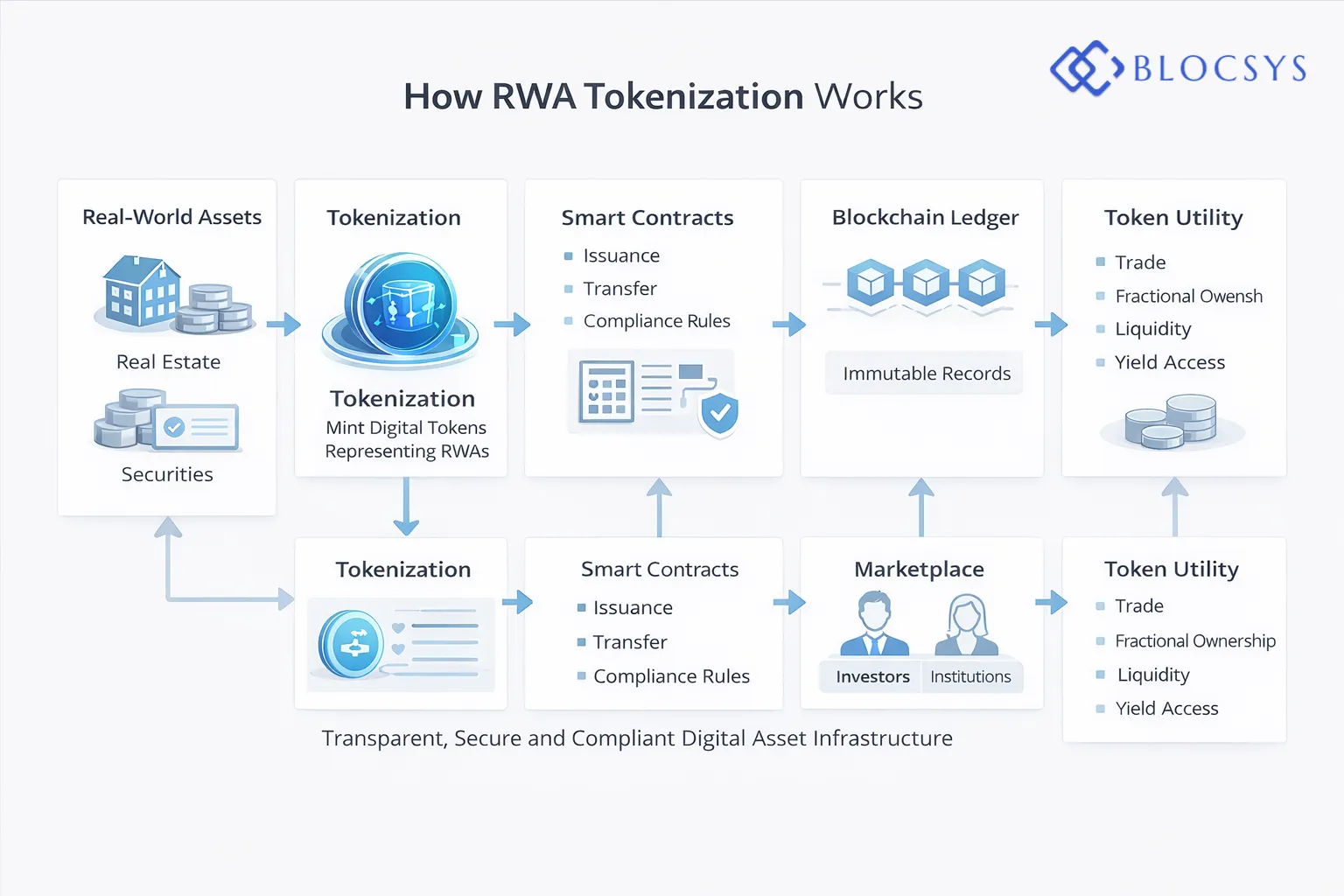
What is RWA Tokenization? How It Works in Blockchain
RWA tokenization is the process of converting ownership rights of a physical or financial asset into a digital token on a blockchain. This guide explains how real world asset tokenization works for Web3 founders, enterprise leaders, and product teams. Furthermore, it covers the core technology, key benefits, GIFT City regulatory opportunities, and the step-by-step rwa tokenization process for unlocking new liquidity across real estate, private credit, and carbon markets.
What RWA Tokenization Means for Modern Finance
At its core, tokenization of real world assets bridges traditional finance with the efficient, transparent infrastructure of blockchain. It converts assets that are slow and expensive to trade — fine art, private equity, commercial properties — into divisible, programmable digital units. Therefore, the goal is not to reinvent the assets themselves but to revolutionize how we record, manage, and transfer ownership rights globally.
Imagine trying to sell a fractional stake in a commercial building. Traditionally, you face legal paperwork, multiple intermediaries, and prohibitive transaction costs. However, RWA tokenization eliminates that friction, making the process fast and accessible to a worldwide investor base.
“RWA tokenization makes illiquid assets like real estate or private credit easily tradable 24/7 on global markets, dramatically lowering investment barriers and increasing market efficiency through fractional ownership and enhanced transparency.” — Blockchain Finance Analyst
The market is expanding rapidly. In India, the asset tokenization market is projected to grow from USD 122.4 million in 2025 to USD 222.3 million by 2032, with real estate leading adoption. Learn more about the strategic implications in our comprehensive guide on real-world assets and RWA blockchain tokenization.
Key Benefits of Real World Asset Tokenization
Moving assets on-chain delivers fundamental upgrades over legacy systems. Additionally, builders and investors in Web3, crypto, and environmental markets gain access to opportunities that institutional walls previously blocked.
- Fractional Ownership: Tokenization splits a high-value asset — like a multi-million-dollar property — into thousands of affordable shares. Moreover, this opens access to a much wider investor audience than traditional markets allow.
- Enhanced Liquidity: Illiquid assets become easily tradable on secondary markets. Therefore, capital previously locked in long holding periods becomes accessible on demand, around the clock.
- Global Accessibility: Blockchain removes geographic investment barriers. Investors anywhere can participate with lower minimum thresholds than traditional markets require.
- Increased Transparency: Every transaction records permanently on-chain. Furthermore, this eliminates expensive intermediaries and reduces settlement times from days to minutes.
- Programmable Compliance: Smart contracts embed compliance rules directly into tokens, ensuring only verified investors can hold or transfer assets at any time.
Traditional Assets vs Tokenized RWAs: A Comparison
This table contrasts traditional real-world assets with their tokenized counterparts, highlighting the core advantages of the rwa tokenization process for both enterprise and startup decision-makers.
| Characteristic | Traditional Asset Management | RWA Tokenization |
|---|---|---|
| Ownership | Physical deeds, paper certificates, centralised ledgers | Digital tokens on an immutable blockchain ledger |
| Liquidity | Low; sales are slow and require intermediaries | High; tokens are tradable 24/7 on global secondary markets |
| Fractionalisation | Difficult and expensive; limited to high-net-worth investors | Simple and cost-effective; enables micro-investments |
| Transaction Speed | Slow; settlement can take days or weeks | Fast; settlement occurs in near real-time (minutes) |
| Transparency | Opaque; ownership records are private and fragmented | High; all transactions are publicly verifiable on-chain |
| Accessibility | Limited by geography and high minimum investments | Global and inclusive; lower barriers for all investors |
| Intermediaries | High reliance on brokers, lawyers, and banks | Reduced reliance on intermediaries, lowering costs significantly |
Types of Real-World Assets Eligible for Tokenization
Almost any asset with measurable value can undergo tokenization. However, certain categories lead market adoption due to strong investor demand and clearer regulatory pathways already established by regulators worldwide.
- Real Estate: Commercial buildings, warehouses, and residential properties. Tokenization enables fractional ownership and continuous secondary market trading.
- Commodities: Gold, silver, and oil. Digital tokens backed 1:1 by physically vaulted metals eliminate storage and logistics friction entirely.
- Bonds and Fixed Income: Government and corporate bonds. Tokenization speeds settlement and dramatically lowers minimum investment thresholds for retail participants.
- Private Credit: Direct lending instruments. Tokenization brings high-yield debt products to DeFi investors for the first time, broadening access significantly.
- Art and Collectibles: High-value cultural assets. Tokenization enables shared ownership and verifiable provenance tracking permanently recorded on-chain.
- Carbon Credits: Verified emission reduction units. Blockchain tokenization prevents double-counting and creates transparent, auditable environmental markets.
- Private Equity: Fund interests and startup equity. Tokenization lowers barriers to entry and enables earlier investor exits through secondary trading markets.
The global asset tokenization market is projected to grow from USD 3.01 trillion in 2026 to USD 18.74 trillion by 2031, at a compound annual growth rate of 44.25%. Real estate holds a 30.12% market share, while commodities represent the fastest-growing segment. Managing these diverse asset classes at scale requires a comprehensive token management system built for the full asset lifecycle.
The RWA Tokenization Process: A Step-by-Step Breakdown
Understanding the rwa tokenization process is essential for any team building or evaluating a tokenization platform. Furthermore, each phase ensures the on-chain token maintains a legally enforceable link to its off-chain counterpart. The journey covers three core phases — asset structuring, token issuance, and secondary market activation.
Phase 1: Asset Selection and Legal Structuring
The first step is selecting the right asset. Teams evaluate market demand, inherent value, and clarity of ownership. Commercial real estate, private credit, and precious metals lead adoption because they offer stable value and strong institutional investor interest.
Once selected, rigorous due diligence begins. Independent experts perform valuation, title verification confirms clear ownership, and a full risk assessment identifies any encumbrances on the asset. After due diligence, a legal wrapper — typically a Special Purpose Vehicle (SPV) or trust — isolates the asset from the originator’s balance sheet. Therefore, digital tokens represent ownership rights in the SPV, which protects investors from unrelated financial risks originating elsewhere.
Phase 2: Custody, Token Standard Selection, and Minting
With the legal framework established, a qualified custodian — a regulated bank, trust company, or specialized vaulting service — takes physical or legal control of the asset. This gives investors confidence that each token is genuinely backed by real underlying value at all times.
Next, the technical implementation begins. Teams make four critical decisions:
- Blockchain Selection: Ethereum provides robust security and deep liquidity access. However, Layer 2 solutions like Polygon deliver lower fees for high-frequency platforms. Permissioned blockchains suit institutional privacy requirements better.
- Token Standard Selection: ERC-20 handles fungible tokens effectively. Moreover, ERC-3643 embeds compliance rules at the smart contract level, making it purpose-built for regulated RWA tokens in permissioned environments.
- Smart Contract Development: Developers write and deploy contracts governing the full token lifecycle — minting, burning, transfers, and on-chain compliance enforcement for every transaction.
- Minting: Tokens are minted with a total supply corresponding directly to the value of the underlying asset held in custody.
Phase 3: Distribution and Secondary Market Liquidity
Tokens enter primary distribution through a secure investor portal. Robust Know Your Customer (KYC) and Anti-Money Laundering (AML) checks verify every participant before they can receive or hold tokens. However, a successful tokenization project does not stop at the initial sale.
Secondary market listing — on a decentralized exchange or a regulated security token platform — creates ongoing liquidity. This allows investors to buy and sell freely, unlocking the full value of the rwa tokenization process over time. For example, when the Hong Kong government issued tokenized green bonds, blockchain reduced settlement time from T+5 to T+0, while underwriting fees dropped by 25.8%.
Provenance Blockchain for Institutional RWA Tokenization
As more financial institutions adopt real world asset tokenization, Provenance Blockchain is gaining significant attention as infrastructure designed specifically for regulated financial markets. Unlike general-purpose blockchain networks, provenance blockchain helps organizations securely issue, manage, and transfer tokenized assets while supporting compliance and full auditability at every step.
Whether the asset is private credit, real estate, investment funds, or corporate bonds, Provenance Blockchain demonstrates how purpose-built infrastructure simplifies enterprise tokenization and improves operational efficiency considerably. Several US-based financial institutions already use it to manage billions in tokenized assets. Furthermore, its design integrates with existing financial market infrastructure, reducing onboarding complexity for institutional adopters substantially. Reliable data feeds are essential for keeping tokenized asset prices accurate — learn how oracle infrastructure supports this in our guide on Chainlink oracles in blockchain.
GIFT City Tokenization: India’s Regulatory Gateway for RWA
India’s Gujarat International Finance Tec-City — known as GIFT City — is emerging as a key regulatory hub for RWA tokenization in Asia. Furthermore, its International Financial Services Centre (IFSC) framework provides a structured environment for deploying tokenized financial instruments under clear, evolving regulatory oversight from the IFSCA.
GIFT City tokenization benefits from several distinct regulatory advantages:
- Offshore Financial Zone: GIFT City operates as an offshore jurisdiction, enabling cross-border asset issuance with favorable tax treatment for international investors seeking India exposure.
- IFSCA Regulatory Sandbox: The sandbox program lets startups and institutions test tokenization models with regulatory guidance before full market deployment at scale.
- Multi-Asset Support: The framework supports tokenized bonds, funds, real estate, and other financial instruments under one regulatory authority, simplifying compliance significantly.
- Global Investor Access: Tokens issued within GIFT City can target international investors, expanding available capital pools well beyond domestic Indian markets.
For companies exploring RWA tokenization in India, GIFT City represents a practical and legally sound entry point into regulated digital asset markets. Additionally, India’s asset tokenization sector projects strong growth through 2032, signaling robust domestic demand for tokenized financial products. Explore how Blocsys supports clients navigating this landscape through our overview of real-world asset blockchain tokenization strategies.
Real-World RWA Projects: BlackRock BUIDL, Ondo Finance, and Beyond
Tokenization of real world assets is not theoretical anymore. Major institutions and DeFi protocols are actively deploying tokenized assets at scale, proving the model works across multiple asset categories and jurisdictions today.
BlackRock BUIDL: Tokenized Treasury at Scale
BlackRock launched its BUIDL fund — the BlackRock USD Institutional Digital Liquidity Fund — on Ethereum in 2024. Moreover, it rapidly became one of the largest tokenized money market funds globally. BUIDL invests in US Treasury bills and repo agreements, distributing daily dividends directly to token holders via smart contracts. Therefore, even the world’s largest asset manager now treats real world asset tokenization as a core strategic priority rather than an experiment.
Ondo Finance: Bringing Fixed Income to DeFi
Ondo Finance tokenizes US Treasuries and investment-grade bonds, making them accessible to DeFi protocols and individual crypto investors simultaneously. Furthermore, Ondo’s products give on-chain investors direct exposure to short-term government securities without leaving the blockchain ecosystem. This model proves that tokenized fixed income products can serve both institutional and retail demand in parallel, broadening the addressable market for regulated digital assets significantly.
Real Estate and Carbon Credit Tokenization in Practice
Multiple platforms tokenize commercial real estate, enabling fractional ownership of office buildings, warehouses, and mixed-use developments for a global investor base. Additionally, carbon credit tokenization creates transparent, auditable markets where each token represents a verified tonne of CO2 reduction. Blockchain prevents double-counting and gives corporations a reliable mechanism for meeting sustainability targets. Blocsys has direct engineering experience in both precious metals and carbon credit tokenization — two asset classes demanding rigorous verification, secure custody, and a transparent on-chain ledger at all times.
Risks, Challenges, and Legal Considerations in RWA Tokenization
RWA tokenization delivers clear advantages, but teams must navigate real risks from the outset. Understanding these challenges upfront prevents costly mistakes later in the development and deployment lifecycle.
Securities Classification Risk
The biggest legal challenge is determining whether a token qualifies as a security under applicable law. If it does, complex and expensive regulatory requirements apply immediately across every jurisdiction where the token is offered. Therefore, engaging securities law experts before token design begins is non-negotiable. Misclassification exposes the entire project to fines, forced restructuring, or complete operational shutdown.
Smart Contract Vulnerabilities
Smart contract bugs cause multi-million-dollar losses in minutes when exploited. Reentrancy attacks, access control errors, and logic flaws are active and ongoing threats that sophisticated adversaries continuously probe for. Furthermore, teams must conduct multiple independent audits and run automated vulnerability scanners continuously alongside rigorous manual code review processes to maintain security posture effectively.
Oracle Manipulation and Custody Failures
If price feeds are compromised, on-chain asset valuations become unreliable immediately. Therefore, aggregating data from at least three independent oracle sources and implementing circuit breakers that pause transfers on abnormal price deviations is essential for platform integrity. Similarly, custody failures — whether physical or digital — instantly undermine investor confidence and erode token value permanently. Explore oracle risk management in depth in our guide on Chainlink oracles in blockchain.
Cross-Jurisdictional Legal Enforcement
Token ownership must be legally enforceable across every jurisdiction where investors reside. Establishing a binding legal link between the digital token and its physical counterpart remains a significant challenge in global markets today. Additionally, evolving regulations — particularly in emerging frameworks like GIFT City tokenization under IFSCA — require continuous legal monitoring and proactive policy updates to stay compliant.
Building the Core Technology for RWA Platforms
Turning a tokenization idea into a production-ready product requires a carefully selected technology stack built from sound architectural principles. Furthermore, getting the blueprint right from the start is the foundation for a platform that is secure, compliant, and ready to scale with growing investor demand.
Choosing the Right Blockchain Layer
Public blockchains like Ethereum offer unmatched security and liquidity access for broad markets. However, gas fees can be prohibitive for high-frequency or low-value asset trading platforms. Layer 2 solutions like Polygon and Arbitrum deliver faster transactions at lower costs, striking a strong balance between scalability and security. Permissioned blockchains like Hyperledger Fabric prioritize privacy and access control, making them the preferred choice for institutional use cases where confidentiality is paramount above all else.
Smart Contracts for Asset Lifecycle Management
Smart contracts automate the full token lifecycle — issuance, compliance checks, dividend distributions, and redemption at maturity. Moreover, standards like ERC-3643 embed compliance rules at the protocol level, ensuring only verified investors can hold or transfer tokens regardless of which secondary market they trade on. A well-designed smart contract system reduces operational overhead significantly while maintaining regulatory integrity. Managing contracts at scale requires a dedicated token management system that handles investor relations and corporate actions seamlessly throughout the asset’s life.
Oracles, Identity, and Custody Infrastructure
Oracles feed critical off-chain data — property valuations, interest rates, and audit reports — directly to smart contracts on-chain. Therefore, a tokenized real estate platform can pull quarterly appraisal data from certified valuers and update token prices automatically. KYC and AML checks link every on-chain wallet to a verified real-world entity, which is non-negotiable for any regulated RWA platform. Additionally, institutional-grade digital asset custody using MPC wallets eliminates single points of failure for private key management across the entire platform infrastructure.
“Embedding compliance in code and governance in culture is the best defence against evolving threats in the RWA tokenization space.” — Leading Blockchain Auditor
From Theory to Execution: Building with Blocsys
Knowing what RWA tokenization is and how it works is one thing. Building an institutional-grade platform is an entirely different challenge, demanding serious engineering expertise and strategic foresight from the very beginning of the project.
At Blocsys, we bridge that gap. We take complex tokenization concepts and deliver production-ready solutions for startups and established enterprises alike. Furthermore, we guide organisations through every step — product strategy, legal structuring, smart contract engineering, and scalable backend infrastructure that grows reliably with your investor base.
Our services cover the full stack: blockchain selection and architecture, SPV legal structuring, audited smart contract development, oracle integration, KYC infrastructure, and compliant secondary market connectivity. Blocsys has successfully engineered platforms for tokenizing precious metals and carbon credits — two asset classes demanding rigorous verification, secure custody, and a transparent on-chain ledger. This hands-on experience gives us unique insight into the real-world challenges every RWA team eventually faces. Connect with our experts today to discuss your RWA tokenization project.
Frequently Asked Questions
What is RWA tokenization and how does it work?
RWA tokenization converts ownership rights of a physical or financial asset into a digital token on a blockchain. The process involves legal structuring via an SPV, asset custody with a qualified custodian, smart contract deployment, token minting, and secondary market listing. Therefore, tokenized assets become tradable, fractional, and globally accessible — unlike their traditional illiquid counterparts that can take months to sell.
What is the RWA tokenization process step by step?
The rwa tokenization process covers three phases. First, teams select the asset, complete due diligence, and create a legal wrapper such as an SPV. Second, a qualified custodian secures the physical asset while developers deploy smart contracts and mint tokens corresponding to asset value. Third, tokens distribute to KYC-verified investors via a primary sale portal, then list on secondary markets for ongoing investor liquidity.
What is GIFT City tokenization and why does it matter for India?
GIFT City tokenization refers to issuing and managing tokenized financial assets within India’s Gujarat International Finance Tec-City IFSC framework. GIFT City offers regulatory sandbox access, favorable offshore tax treatment, and support for multi-asset tokenization under IFSCA authority. Therefore, it serves as India’s primary regulated entry point for RWA tokenization, targeting both domestic and international investors through a single structured jurisdiction.
How does provenance blockchain support institutional RWA tokenization?
Provenance Blockchain is purpose-built for regulated financial markets, unlike general-purpose chains designed for broad decentralized applications. It embeds compliance and regulatory controls directly at the network layer rather than only in application-level smart contracts. Moreover, provenance blockchain supports the issuance, management, and transfer of tokenized assets — including private credit, real estate, and investment funds — while maintaining full transparency and auditability that institutional participants require for fiduciary obligations.
What are the biggest risks in real world asset tokenization?
The primary risks include securities misclassification, smart contract vulnerabilities, oracle price manipulation, and cross-jurisdictional legal enforcement challenges. Additionally, custody failures for either the physical asset or digital private keys can instantly undermine token legitimacy and investor confidence. Therefore, teams must address legal, technical, and operational risks systematically from the earliest stages of platform design — not as afterthoughts added before launch.
