
Trading infrastructure is evolving fast, and the demand for a robust hybrid exchange platform has never been stronger. A hybrid platform combines the execution speed of centralized systems with the transparency and self-custody benefits of blockchain-based settlement. Teams building in this space need a clear architectural blueprint before writing a single line of production code. If you are planning a project in this area, our Hybrid Trading & Prediction Market Platform Development service provides a structured path from design to deployment. For the most comprehensive technical reference available, the Hybrid Trading & Prediction Market Platform Development: The Complete Architecture and Implementation Guide covers every architectural layer in depth.
What Is a Hybrid Exchange Platform?
A hybrid exchange platform sits between a fully centralized exchange (CEX) and a fully decentralized exchange (DEX). Centralized exchanges deliver speed but require users to trust a custodian with their funds. Decentralized exchanges, however, offer trustlessness but struggle with throughput and latency under heavy trading volume. A well-designed hybrid model consequently solves both challenges simultaneously.
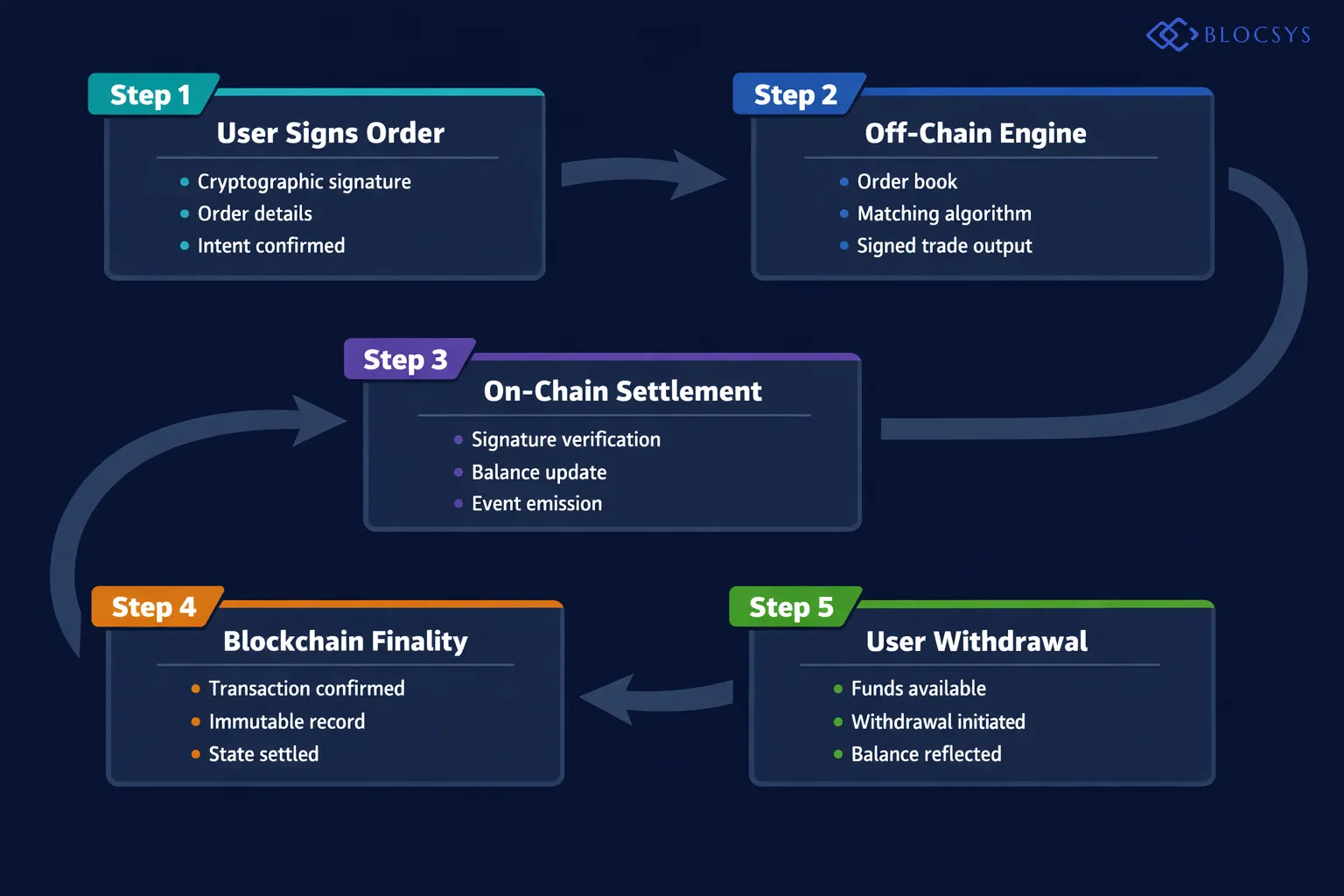
In this model, order matching happens entirely off-chain for maximum execution speed. Settlement and final custody, however, occur on-chain for security and verifiability. Users retain control of their assets until a trade finalizes on the blockchain. This architecture has therefore become the preferred pattern for scalable DeFi Trading Platform Development projects targeting both retail and institutional participants.
Furthermore, hybrid platforms can integrate prediction markets, derivatives, and lending modules within the same infrastructure stack. This flexibility makes them especially powerful for builders targeting complex, multi-product financial ecosystems.
Core Architecture of a Hybrid Exchange Platform
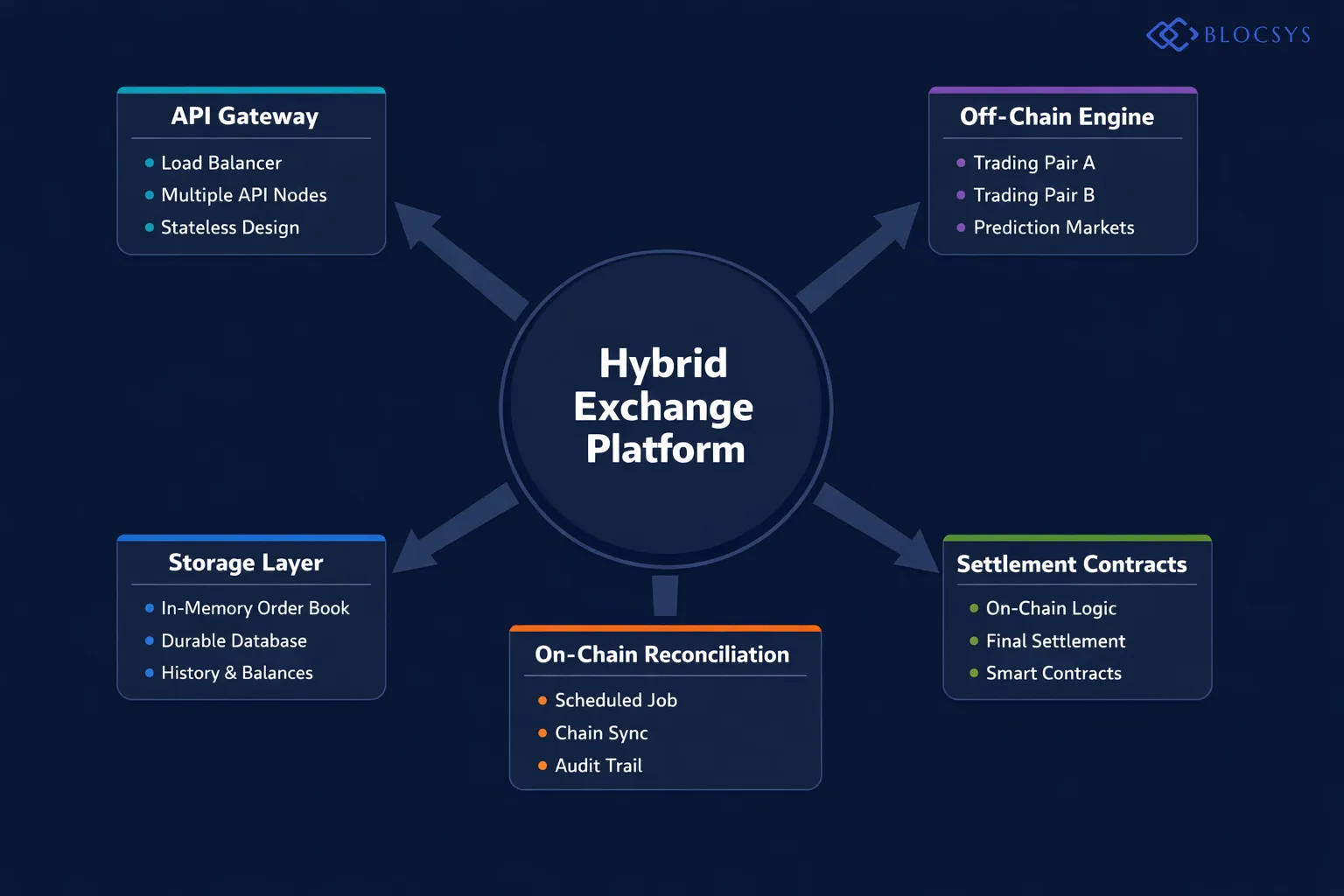
The architecture of a hybrid exchange platform consists of several distinct, responsibility-separated layers. Each layer handles a specific system domain. Separating concerns across layers ensures the platform scales without creating bottlenecks in any single component.
The Off-Chain Order Processing Engine
The off-chain engine handles order intake, order book management, and trade matching. It operates similarly to a traditional centralized exchange engine — fast, low-latency, and capable of extremely high throughput. Consequently, traders experience near-instant order fills without waiting for blockchain block confirmations.
The engine typically uses an event-driven architecture built on message queues such as Apache Kafka or Redis Streams. Incoming orders flow into the matching algorithm, which pairs buyers and sellers in microseconds. Additionally, the engine produces cryptographically signed state updates that the on-chain settlement contract later validates independently. Every signed update must be tamper-evident and verifiable on-chain, even if the off-chain operator behaves maliciously.
The On-Chain Settlement Layer
The on-chain settlement layer is where trades become final and immutable. Smart contracts receive signed trade outputs from the off-chain engine. They then verify cryptographic signatures, update user balances, and emit settlement events on the blockchain.
Moreover, the settlement contract acts as the authoritative source of truth for user balances. Users can withdraw funds directly from the contract without relying on the platform operator at all. This non-custodial property fundamentally distinguishes a hybrid platform from a standard CEX. For related smart contract design patterns, Prediction Market Smart Contract Development: Building Trustless Outcome Resolution on Blockchain explains how contract logic handles complex multi-outcome resolution scenarios.
How to Build a Decentralized Exchange with Prediction Market Integration
Many engineering teams today want to build decentralized exchange with prediction market functionality inside a unified platform. This combination unlocks powerful use cases — users can trade spot markets, hedge with derivatives, and simultaneously speculate on real-world outcome events.
To achieve this, the smart contract architecture must support two distinct resolution mechanisms. Standard exchange trades settle deterministically based on executed prices. Prediction markets, however, require oracle inputs or governance-based mechanisms to resolve events correctly. Therefore, the contract layer must accommodate both resolution types without introducing shared failure modes. For a complete step-by-step implementation walkthrough, How to Build a Decentralized Exchange with Prediction Market: Step-by-Step Developer Guide covers every technical stage in detail.
Oracle Integration for Prediction Markets
Oracles bridge real-world data with on-chain smart contracts. In a hybrid platform with prediction markets, oracles feed price data, event results, and external data points directly into settlement contracts. Consequently, prediction markets can resolve automatically without requiring manual operator intervention.
Decentralized oracle networks provide tamper-resistant, aggregated data feeds that resist manipulation. Additionally, some architectures implement optimistic oracle designs, where results are submitted and challenged within a fixed dispute window. This approach keeps on-chain gas costs low while maintaining trustless outcome resolution for all participants.
Liquidity Pool Architecture
Liquidity pools power both spot trading depth and prediction market share issuance. A hybrid platform typically maintains automated market maker (AMM) pools alongside a central limit order book (CLOB). Liquidity providers deposit assets into smart contracts and earn protocol fees in return.
Furthermore, the platform routes orders intelligently across both sources. Large orders fill against the order book first, then tap AMM pools for remaining depth. This hybrid routing maximizes fill quality for traders while ensuring sufficient market depth even in low-liquidity conditions.
“The teams that win in hybrid exchange development are the ones who treat on-chain settlement not as a bottleneck, but as a trust anchor. Speed belongs off-chain. Finality belongs on-chain. Confuse those two, and your architecture will fight itself at every scale milestone.” — Senior Blockchain Infrastructure Architect
![Order routing decision tree for a Hybrid Exchange Platform: Incoming Order → Size Threshold Check → [Below Threshold: Direct AMM Pool Route → Single Settlement Transaction → On-Chain Confirmation] / [Above Threshold: CLOB Order Book Match → Remaining Volume to AMM Pool → Aggregated Batch Settlement → On-Chain Finality]](https://s3.blocsys.com/blocsys/blog-images/1774483467669-b6ce43e07a897386.webp)
Hybrid Trading Platform Development: Scalability Patterns
Effective hybrid trading platform development demands deliberate scalability decisions from day one. A poorly architected system may handle test volumes comfortably but collapse under real production load. Therefore, engineering teams must select scalability patterns before entering active development.
Horizontal Scaling of the Off-Chain Engine
The off-chain matching engine should support horizontal scaling through market sharding or segment isolation. Each trading pair runs inside its own dedicated engine instance. Consequently, adding new markets does not degrade performance for existing trading pairs already live on the platform.
Additionally, stateless API gateway layers sit in front of the matching engine cluster. Load balancers distribute incoming connections across multiple API nodes in real time. This design ensures the system absorbs sudden traffic spikes without degrading the user experience during peak trading sessions.
Database and State Management
The off-chain system requires two types of storage working in parallel. First, a high-performance in-memory store holds the live order book state for microsecond-level read access. Second, a durable relational or time-series database persists trade history, user account balances, and compliance audit logs permanently.
Moreover, the on-chain state and the off-chain state must remain continuously synchronized. The system runs periodic reconciliation jobs that compare on-chain balances with off-chain records. Any detected discrepancy immediately triggers an alert and an automated reconciliation workflow. These data architecture patterns are also explored in Prediction Market Software Development: Key Features, Tech Stack, and Platform Components Explained.
Integrating Web3 Betting and Prediction Platform Modules
A growing segment of platforms combines exchange trading with a full web3 betting and prediction platform experience. Users want to trade prediction market shares, bet on real-world outcomes, and hedge existing positions — all within a single unified interface. This consolidation creates a stickier product with higher user engagement and deeper liquidity across all market types.
The architecture supports this by adding a dedicated prediction market module alongside the core exchange engine. This module handles market creation, share issuance, and event resolution as distinct smart contract operations. However, it shares the same liquidity infrastructure, wallet system, and compliance layer as the core trading engine. For strategic context on use cases and market opportunities, Web3 Betting and Prediction Platform: Use Cases, Compliance Considerations, and Market Opportunities provides an excellent product planning reference.
Compliance Layer Design
Compliance is non-negotiable for any platform handling real-money prediction events. Therefore, the architecture must embed KYC and AML checks at the user onboarding layer before any trading activity is permitted. Smart contracts can enforce jurisdiction-based access control using on-chain credentials or off-chain attestation services integrated at the API gateway level.
Additionally, the platform records all transactions with immutable on-chain timestamps, creating a permanent and auditable trail. This satisfies regulatory requirements across major jurisdictions and builds long-term user trust. Platforms targeting institutional participants should also review Institutional OTC Crypto Trading Platform Built on Blockchain for compliance architecture patterns suited to professional-grade deployments.
“Prediction market platforms that defer compliance architecture always face a painful and costly rebuild later. The compliance layer costs ten times more to retrofit than to design in from the beginning. Build it right the first time — your regulators, your investors, and your users will all thank you for it.” — Web3 Compliance and Legal Technology Advisor
Bringing the Hybrid Exchange Platform Architecture Together
A successful hybrid exchange platform requires more than strong technical execution alone. It demands a coherent architectural strategy that aligns performance requirements, security guarantees, compliance obligations, and user experience goals from the very beginning.
The on-chain and off-chain components must complement each other without creating dependencies that undermine either layer. Speed flows through the off-chain engine. Trust flows through the on-chain settlement layer. Integrating prediction markets, liquidity pools, oracle networks, and compliance modules into this foundation produces a platform capable of competing with both established CEX and DEX incumbents effectively.
If your team is ready to move from architecture to execution, our Hybrid Trading & Prediction Market Platform Development services deliver end-to-end engineering and strategic support. For teams still in the research and planning phase, the Hybrid Trading & Prediction Market Platform Development: The Complete Architecture and Implementation Guide remains the definitive technical reference for teams building serious platforms at scale.
Frequently Asked Questions
Here are direct answers to the questions we hear most often about hybrid exchange platform architecture, development timelines, and integration decisions.
What makes a hybrid exchange platform different from a pure DEX?
A pure DEX executes all operations on-chain, including order matching. This approach is trustless but delivers slow execution and high transaction costs under heavy trading load. A hybrid exchange platform, however, processes order matching off-chain for near-instant speed and settles final trade states on-chain for immutable security.
The fundamental difference is user custody combined with operator speed. In a hybrid system, users retain on-chain custody of funds throughout the entire trading process. In a CEX, the exchange holds all user funds off-chain, creating custodial risk at every moment.
How do prediction markets integrate with a hybrid exchange architecture?
Prediction markets integrate as a separate smart contract module within the same on-chain settlement layer. The module issues binary or categorical outcome shares, accepts collateral from participants, and resolves based on oracle data or governance votes at event conclusion. Traders interact with prediction markets through the same wallet connection they use for standard spot and derivatives trading.
The off-chain engine can additionally manage prediction market order books, routing trades to AMM pools or CLOB matching as market conditions dictate. This unified architecture creates a seamless cross-product experience for active users.
What blockchain networks work best for deploying a hybrid exchange platform?
Ethereum Layer 2 networks — particularly optimistic rollups like Arbitrum and Optimism, and ZK-rollups like zkSync Era and Polygon zkEVM — are currently the most practical deployment targets. They offer Ethereum-level security with dramatically lower transaction fees and significantly higher settlement throughput.
For platforms requiring cross-chain functionality, a multi-chain architecture with bridge integrations allows users to trade assets from multiple networks within one unified platform. The optimal choice depends on your target user base, supported asset types, and acceptable fee levels.
How long does it typically take to build a hybrid exchange platform?
A minimum viable hybrid exchange platform with basic spot trading and smart contract settlement typically takes four to six months with an experienced, focused team. Adding prediction market modules, advanced compliance integrations, and multi-chain support extends the total timeline to nine to fourteen months realistically.
The most time-intensive components are smart contract security audits, compliance service integrations, and liquidity bootstrapping strategies. Teams should allocate significant time specifically to audit cycles, since smart contract vulnerabilities are effectively irreversible once deployed to mainnet with real user funds at stake.
How does a hybrid exchange platform protect users against operator manipulation?
A properly designed hybrid platform protects users through cryptographic guarantees at the smart contract layer. The off-chain engine produces signed state updates that the on-chain settlement contract verifies completely independently. Users can always withdraw their on-chain balance directly, even if the operator goes offline, becomes insolvent, or acts maliciously.
Additionally, the smart contract architecture should implement a forced withdrawal mechanism that allows users to exit positions on-chain without any operator cooperation required. Regular third-party security audits of the settlement contracts further reduce systemic risk across the entire platform.
Ready to move beyond theory and build an intelligent platform that delivers real-world value? Blocsys Technologies specialises in engineering enterprise-grade AI and blockchain solutions for the fintech, Web3, and digital asset sectors. Connect with our experts today to discuss your vision and chart a clear path from concept to a secure, scalable reality.