
The financial technology landscape is evolving at an extraordinary pace, and hybrid trading platform development now sits at the intersection of that transformation. Builders, enterprises, and blockchain startups are discovering that merging centralized exchange efficiency with decentralized prediction market capabilities creates a uniquely powerful product. However, achieving this combination successfully requires careful architectural planning, robust smart contract engineering, and a deeply considered user experience strategy. This guide covers every critical implementation layer — from protocol selection to deployment and scaling. Before diving in, explore our Hybrid Trading & Prediction Market Platform Development service page for a complete view of what a production-ready integrated solution looks like.
What Is a Hybrid Trading and Prediction Market Platform?
A hybrid trading and prediction market platform merges two distinct financial primitives into a single, unified system. On one side, you have a trading exchange — a venue where users buy, sell, and swap assets. On the other side, you have a prediction market — a mechanism where participants stake capital on the outcomes of real-world events.
Traditional exchanges focus on price discovery for existing assets. Prediction markets, however, create entirely new instruments tied to future outcomes. Combining both systems generates a richer product ecosystem. Furthermore, it attracts a broader user base — traders and speculators can coexist on the same platform, driving liquidity across both verticals simultaneously.
The hybrid approach also unlocks unique product opportunities. For instance, a prediction market about an asset’s future price range can exist alongside a live trading pair for that same asset. Therefore, the platform simultaneously functions as both a trading venue and an information market, creating a self-reinforcing data feedback loop that benefits participants across both product surfaces.
Additionally, hybrid platforms generate compounding network effects. Each new user who joins the trading side also becomes a potential participant in prediction markets. Consequently, user acquisition costs decrease over time as the platform’s combined utility attracts organic traffic from multiple crypto-native communities.
Core Architecture for Hybrid Trading Platform Development
Understanding the On-Chain and Off-Chain Balance
The most critical architectural decision in hybrid trading platform development is determining what lives on-chain versus off-chain. Fully on-chain systems offer maximum transparency and censorship resistance. However, they suffer from latency and gas cost limitations that make high-frequency trading impractical for most users.
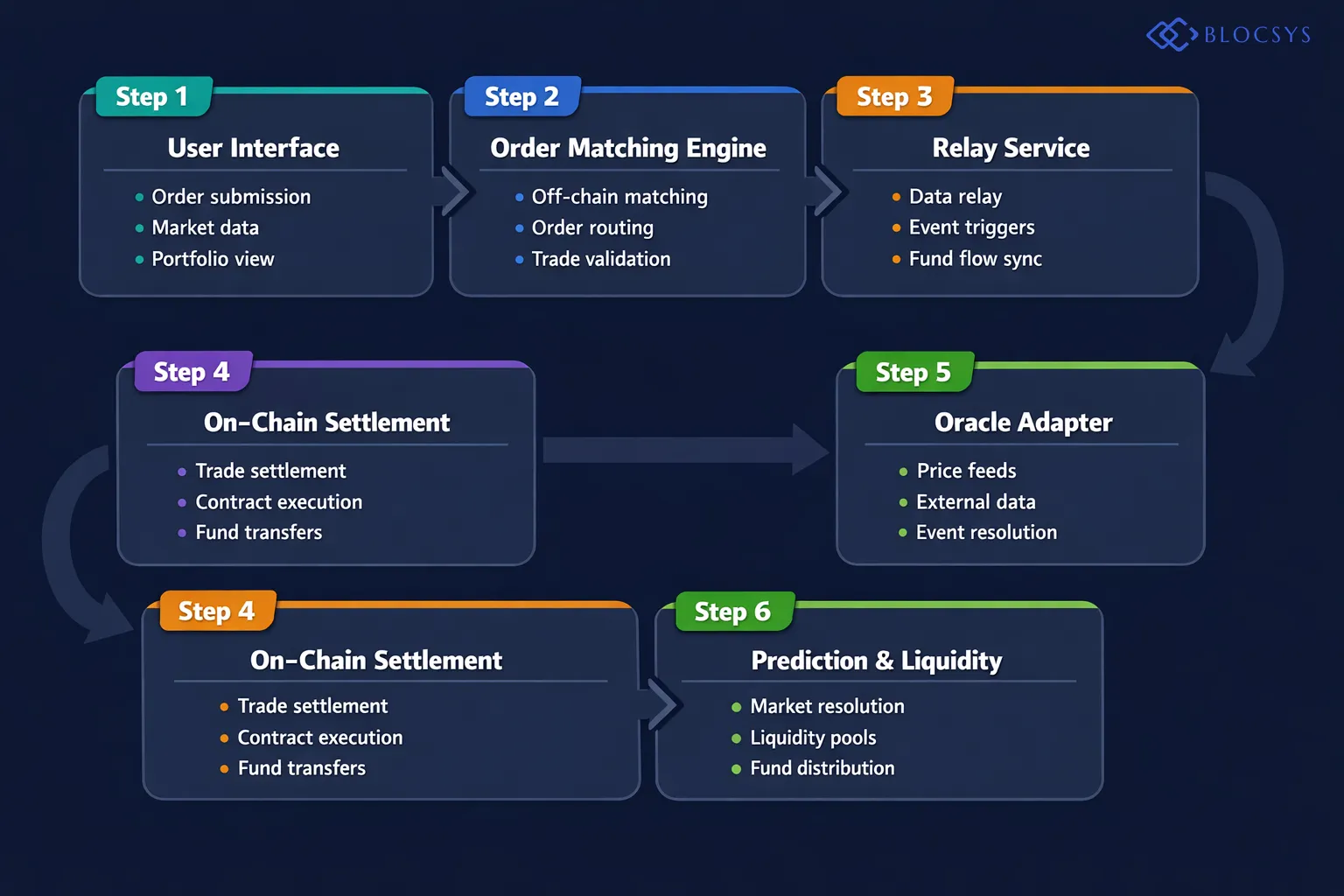
Off-chain components — such as order matching engines and user interfaces — deliver the speed and responsiveness traders expect. The key is to use on-chain settlement as the source of truth while keeping execution off-chain. This hybrid model, sometimes called “off-chain order books with on-chain settlement,” powers many leading decentralized exchanges today.
For prediction markets, most outcome resolution logic should remain on-chain. Smart contracts hold funds in escrow, verify oracle data, and distribute winnings automatically. Consequently, users trust the resolution process without relying on a centralized administrator. Explore this architecture further in our guide on Hybrid Exchange Platform Architecture: How to Design a Scalable On-Chain and Off-Chain Trading System.
Order Book Design and Matching Engine
Your order book design directly impacts trading experience and capital efficiency. Central limit order books (CLOBs) remain the gold standard for professional trading platforms. They support limit orders, market orders, and advanced order types that sophisticated traders expect as standard features.
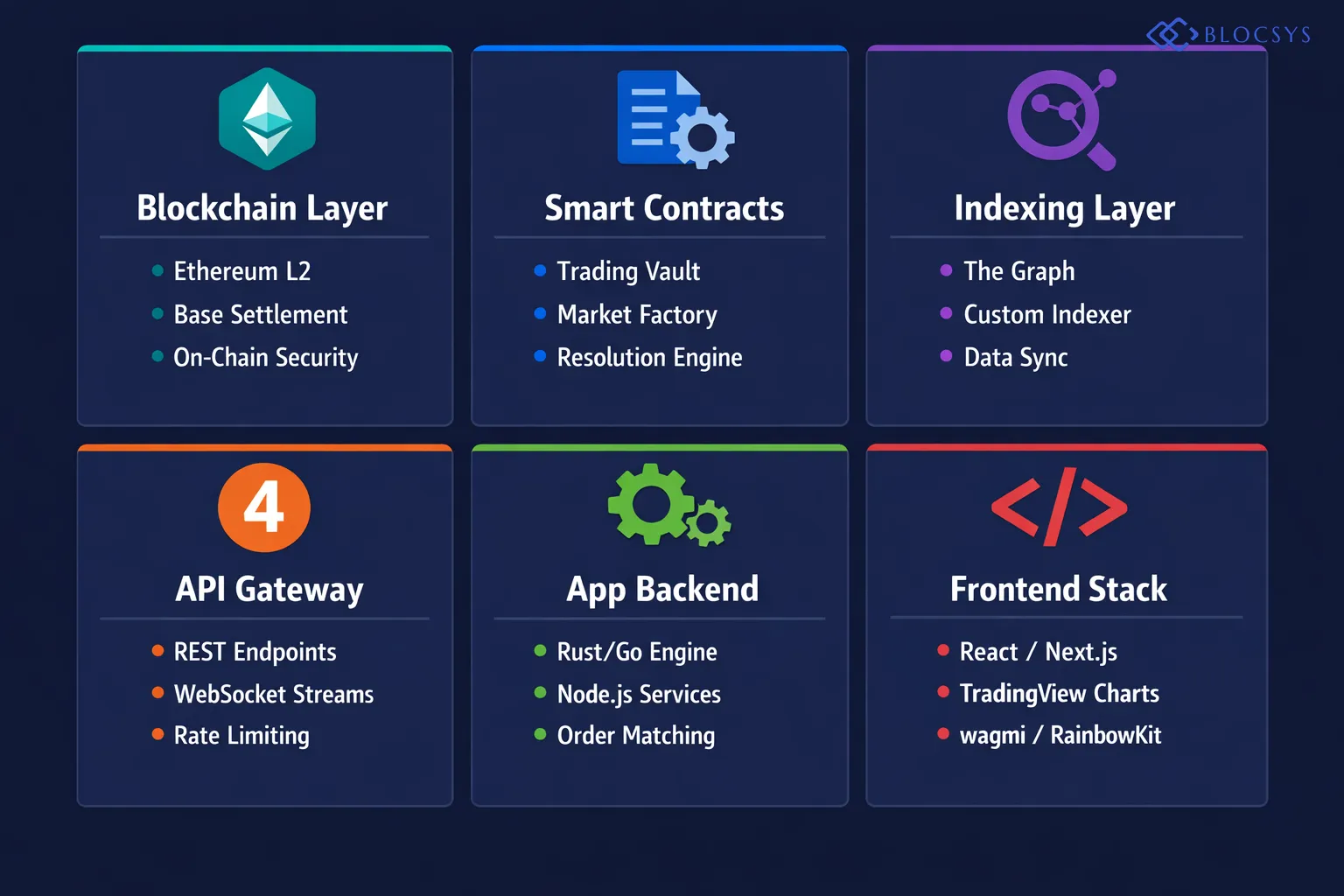
Building a high-performance matching engine requires careful engineering choices. The engine must process thousands of orders per second with sub-millisecond latency. Therefore, most teams build this component in Rust or Go, deploying it on dedicated, low-latency infrastructure separate from general application servers.
For prediction markets, automated market makers (AMMs) often replace traditional order books. AMMs use mathematical formulas — typically constant product or logarithmic market scoring rules (LMSR) — to set prices dynamically based on demand. Additionally, AMMs eliminate the need for active market makers, making it significantly easier to bootstrap liquidity for newly launched prediction markets.
Smart Contract Layer Design
Your smart contract layer serves as the trust anchor for the entire system. All fund custody, settlement logic, and asset issuance should route through professionally audited smart contracts. Moreover, a modular contract design allows individual components to undergo upgrades without requiring a full system redeployment.
Use proxy patterns — such as OpenZeppelin’s UUPS or Transparent Proxy — for contract upgradability. Separate your business logic contracts from your storage contracts to maintain clean architectural boundaries. Furthermore, implement emergency pause mechanisms and multi-signature controls on all admin functions to protect users if a vulnerability surfaces post-launch.
Prediction Market Software Development: Core Concepts
Market Types and Structures
Prediction market software development begins with selecting the right market structure for your intended use cases. Three primary market types dominate the landscape: binary markets, scalar markets, and categorical markets. Each serves different event types and audience expectations.
Binary markets present a simple yes/no question — for example: “Will Bitcoin exceed $150,000 by year-end?” Scalar markets allow outcomes across a numerical range, making them ideal for price prediction or economic indicator markets. Categorical markets, however, let users select from multiple discrete outcomes, such as predicting the winner of an election with several candidates.
Each market type requires slightly different smart contract logic and UI treatment. Therefore, your platform architecture should support all three market types from the beginning rather than retrofitting later. This flexibility makes your platform substantially more versatile and commercially attractive to a diverse user base. For a thorough breakdown, see our article on Prediction Market Software Development: Key Features, Tech Stack, and Platform Components Explained.
Oracle Integration and Outcome Resolution
Oracle infrastructure represents the single most important external dependency in prediction market development. Oracles connect your on-chain contracts to real-world data, enabling trustless outcome resolution without any centralized intermediary. Without reliable, manipulation-resistant oracles, prediction markets simply cannot function correctly.
Chainlink is the most widely used decentralized oracle network and works excellently for financial data. However, for niche or novel event types, decentralized dispute resolution systems like UMA or Kleros offer more flexibility. Some platforms additionally build custom reporting systems backed by economic incentives for honest data submission.
Your oracle strategy should closely match your market types. Price-feed oracles work well for financial prediction markets with on-chain verifiable data. Sports or political event outcomes, however, require human-reported or crowd-sourced data combined with robust dispute resolution mechanisms. Consequently, many production platforms integrate multiple oracle providers and implement a fallback priority hierarchy.
For deeper technical guidance on this critical topic, our article on Prediction Market Smart Contract Development: Building Trustless Outcome Resolution on Blockchain covers the full resolution lifecycle — from market creation to final settlement — in comprehensive detail.
Liquidity Provisioning in Prediction Markets
Liquidity is the lifeblood of any market. In prediction markets, thin liquidity produces wide bid-ask spreads and a poor user experience that drives away participants quickly. Therefore, your platform needs a clearly defined liquidity strategy from day one, not as an afterthought.
AMM-based prediction markets solve the cold-start problem elegantly. Liquidity providers (LPs) deposit capital into a pool that automatically prices outcomes based on demand. As traders interact with the pool, prices adjust to reflect collective sentiment. Moreover, LPs earn fees on each trade, creating a sustainable economic incentive loop that supports ongoing capital provision.
Order book-based prediction markets require active market makers — typically sophisticated traders or automated bots that continuously post buy and sell orders. Consequently, launching new markets on order book platforms requires either recruiting dedicated market makers or incentivizing participation through fee rebates and platform token rewards.
Building a Hybrid Exchange Platform: Technical Stack Selection
Blockchain Layer: Choosing Your Network
Selecting the right blockchain is foundational to your hybrid exchange platform‘s long-term success. Ethereum remains the most secure and widely integrated smart contract platform in the world. However, high gas fees and limited throughput make it unsuitable as the primary execution layer for most retail-facing applications.
Layer 2 networks — particularly Arbitrum, Optimism, and Base — offer Ethereum-level security with dramatically reduced transaction fees and faster finality. These networks have become the preferred deployment targets for new DeFi and prediction market platforms in recent years, and their ecosystem depth continues to grow rapidly.
Polygon zkEVM and zkSync offer even greater throughput via zero-knowledge proof technology. Furthermore, if your target user base spans multiple blockchain ecosystems, a multi-chain architecture becomes strategically essential. Our team has deep experience deploying across networks — explore our DeFi Trading Platform Development capabilities for multi-chain deployment strategies and considerations.
Backend Infrastructure and API Layer
Your backend infrastructure must handle two very distinct workloads: real-time trading operations and blockchain event indexing. These workloads carry fundamentally different performance profiles and therefore should be architected and scaled independently of each other.
The trading engine requires ultra-low latency, high throughput processing, and persistent stateful connections. Build it in Rust or Go using WebSocket-based APIs for real-time order book updates and trade confirmations. Additionally, use Redis or similar in-memory data stores to maintain live order book state with microsecond read performance.
Blockchain indexing requires event-driven processing with reliable reorganization handling and historical backfill capabilities. The Graph Protocol excels at decentralized indexing of on-chain events and is well supported across major EVM chains. However, for lower latency requirements or proprietary data needs, custom indexers built with ethers.js or viem provide more architectural flexibility. Complement your backend with a comprehensive REST and WebSocket API layer so mobile applications and third-party integrations can connect easily.
Frontend and User Experience Design
Your frontend must serve two distinct user segments: active traders and prediction market participants. These groups carry different behavioral patterns and UX expectations. Therefore, your design system should support both workflows simultaneously without creating friction for either audience.
Trading UX should prioritize speed, information density, and keyboard efficiency. Use React or Next.js with a professional charting library — TradingView Lightweight Charts is the industry standard — for trader-grade interfaces. Wallet integration via wagmi and RainbowKit provides a smooth and familiar Web3 connection experience across major wallet providers.
Prediction market UX, however, needs simplicity, clarity, and intuitive outcome visualization. Market browsers, real-time odds displays, and clear settlement timelines are all critical interface components. Moreover, onboarding flows must accommodate Web2 users who are unfamiliar with wallets and blockchain transactions. Progressive disclosure — starting with simple UI and revealing advanced features contextually — effectively broadens your addressable user base without overwhelming newcomers.
How to Build a Decentralized Exchange with Prediction Market Integration
Many development teams approach this challenge as two separate builds that later merge. However, a more efficient strategy designs the shared infrastructure first and builds both product verticals on top of that common foundation. Our detailed developer resource on How to Build a Decentralized Exchange with Prediction Market: Step-by-Step Developer Guide covers this full integration process comprehensively.
Step 1: Define Your Protocol Architecture
Start by defining the core protocol modules your platform requires. These typically include a token vault, a settlement layer, a liquidity manager, a market factory, and an oracle adapter. Designing these as separate, interoperable contracts from the outset prevents costly architectural refactors during later development phases.
The token vault handles all user fund custody and should implement strict role-based access controls. It must support multiple asset types — ERC-20 tokens for trading collateral and ERC-1155 tokens for prediction market outcome shares. Moreover, implement daily withdrawal limits and multi-signature controls as defense-in-depth security measures that protect users from both external attacks and insider risks.
Step 2: Build and Audit Core Contracts
Begin smart contract development with your highest-criticality components: the vault, the settlement contract, and the market factory. Write comprehensive tests using Foundry or Hardhat, targeting 100% branch coverage across all financial logic. Additionally, use formal verification tools for your most sensitive functions — particularly those controlling fund releases and oracle consumption.
Engage an audit firm early in the process — ideally before completing your full contract suite. Auditors frequently surface architectural issues that are far cheaper to fix in early stages. Furthermore, consider running a public bug bounty through Immunefi or Code4rena to supplement professional audits with continuous community scrutiny after launch.
Step 3: Deploy Your Matching Engine and Order Infrastructure
Your off-chain matching engine connects to the on-chain settlement layer through a relay service that signs and submits settlement transactions on behalf of users. This architecture abstracts gas complexity away from traders, significantly improving user experience. Furthermore, implement strict rate limiting and anti-manipulation checks in the matching engine to prevent order spoofing, layering, and front-running.
For prediction markets running on AMMs, you do not need a traditional matching engine at all. Instead, deploy liquidity pool contracts and build a price-feed aggregation service that continuously pushes current odds and pool depths to your frontend. Consequently, the operational architecture for AMM-based prediction markets is substantially simpler to maintain than equivalent order book-based systems.
Step 4: Integrate Oracles and Resolution Logic
Oracle integration demands thorough scenario testing across multiple failure modes. Simulate oracle failures, delayed data delivery, and disputed outcomes extensively in your staging environment before any mainnet deployment. Your resolution contracts should include configurable timeout mechanisms that gracefully handle scenarios where expected oracle data never arrives.
Build a transparent resolution UI that clearly communicates market lifecycle status to users — open, pending resolution, in active dispute, and fully resolved. Moreover, provide complete settlement history with transaction proof links so users can independently verify that all outcomes were processed correctly. This level of transparency builds genuine platform trust more effectively than any marketing or incentive program.
Smart Contract Security and Audit Strategy
Common Vulnerabilities in Hybrid Platforms
Hybrid platforms combine the attack surface of both exchanges and prediction markets simultaneously. Therefore, the security engineering challenge is substantially larger than building either system independently. Understanding the most common vulnerability classes helps your team design better defenses from the earliest architectural stages.
Reentrancy attacks remain the most frequently exploited critical vulnerability in DeFi contracts. Always follow the checks-effects-interactions (CEI) pattern rigorously and apply reentrancy guards to all external calls. Furthermore, flashloan attacks can manipulate oracle prices and exploit market resolution logic in sophisticated, multi-transaction patterns that standard unit tests often fail to detect.
Price oracle manipulation poses particular danger for prediction markets tied to on-chain price data. Use time-weighted average prices (TWAPs) instead of spot prices whenever consuming on-chain oracle data. Additionally, implement automated circuit breakers that pause market activity if price data moves beyond statistically expected bounds within a short time window.
Audit Process and Security Best Practices
A professional smart contract audit is non-negotiable for any platform handling real user funds at scale. Plan for at least two independent audits from separate reputable firms — different auditors consistently find different vulnerability classes. Moreover, conduct internal security reviews at every major development milestone, not solely as a pre-launch checklist item.
Implement a formal incident response process before your platform goes live. Define clearly who holds admin keys, how contract upgrades are triggered, and what the escalation path looks like if a vulnerability is discovered after launch. Furthermore, all admin functions should require multi-signature approval with time-lock delays to prevent unilateral or unauthorized fund movements in any scenario.
“The most expensive lesson in DeFi development is consistently skipping security reviews to ship faster. Every platform that has lost user funds to exploits shared one defining characteristic: the team prioritized speed over thoroughness at the audit stage. A thorough $80,000 audit engagement is infinitely cheaper than a single $5 million exploit, and the reputational damage that follows is often unrecoverable.” — Senior Blockchain Security Architect, Protocol Infrastructure
Web3 Compliance and Regulatory Considerations
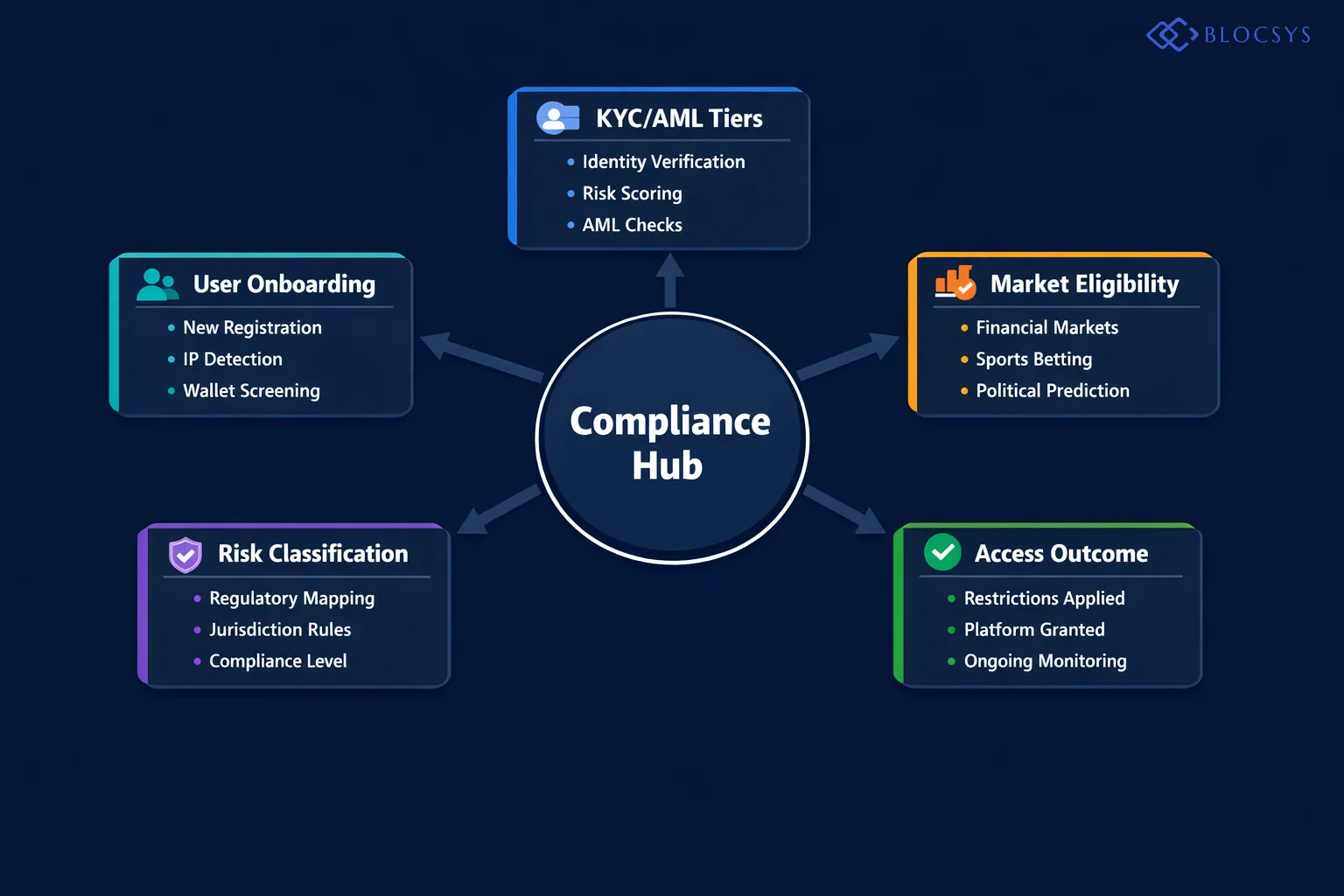
Regulatory clarity for prediction markets and decentralized exchanges remains an evolving and jurisdiction-specific challenge globally. However, proactively addressing compliance from the design phase reduces legal exposure substantially and builds long-term user trust. Ignoring compliance entirely has become an increasingly high-risk strategy as regulators expand their enforcement focus across the DeFi ecosystem.
Geographic restrictions represent the most practical and widely implemented compliance tool available today. Implement IP-based geoblocking for jurisdictions where your platform’s specific features create material regulatory risk. Additionally, wallet screening tools can flag addresses associated with sanctioned entities, helping your platform meet OFAC compliance requirements without disrupting the majority of legitimate users.
Prediction markets that allow wagering on election outcomes, sports events, or other regulated categories face particularly heightened regulatory scrutiny in most Western jurisdictions. Therefore, consult specialized legal counsel before launching these market types in any form. Our guide on Web3 Betting and Prediction Platform: Use Cases, Compliance Considerations, and Market Opportunities addresses these nuances with practical, actionable detail.
For platforms targeting institutional users specifically, additional KYC and AML infrastructure becomes necessary. Explore our Institutional OTC Crypto Trading Platform Built on Blockchain case study to understand how compliance layers integrate practically with blockchain-native infrastructure and smart contract systems.
Liquidity Strategy and Market Making
Bootstrapping Liquidity for New Markets
Liquidity bootstrapping is one of the most operationally difficult challenges for any new hybrid platform. Without liquidity, markets are unattractive to traders. Without attractive, liquid markets, user acquisition stalls. Therefore, you need a deliberate, multi-pronged strategy to break this classic chicken-and-egg cold-start problem.
Token incentive programs — commonly called liquidity mining — distribute platform-native tokens to early liquidity providers as a reward for capital commitment. This creates a financial incentive to provide capital before organic trading activity develops naturally. However, poorly designed incentive programs attract purely mercenary capital that exits immediately when reward emission rates decrease.
A more sustainable approach pairs time-locked token incentives with a formal market maker partnership program. Recruit professional market making firms and offer them competitive fee rebates, reduced settlement costs, and priority API infrastructure. Additionally, for prediction markets specifically, consider seeding initial pool liquidity from your own treasury to establish starting prices and enable trading activity from launch day.
Cross-Market Liquidity Synergies
One of the most compelling structural advantages of a hybrid platform is cross-market liquidity synergy. Capital providing liquidity for spot trading pairs can also back prediction market pools through shared vault architecture. Moreover, prediction market collateral can serve as a yield-generating asset when integrated with your exchange’s native lending or money market module.
These synergies create a capital efficiency advantage that no standalone platform can match competitively. Consequently, your tokenomics and protocol design should explicitly model, incentivize, and reward these cross-market capital interactions. Platforms that successfully implement this architecture receive a structural liquidity moat that compounds over time as the ecosystem matures.
“Hybrid platforms that architect cross-market capital reuse from day one consistently outperform single-product platforms on capital efficiency metrics. When the same dollar simultaneously earns trading fees and prediction market LP fees, you attract a fundamentally different — and stickier — class of liquidity provider than platforms that treat each product as an isolated silo.” — DeFi Protocol Design Lead, Institutional Market Structure
Development Timeline and Cost Considerations
Realistic Development Phases
Building a production-ready hybrid trading and prediction market platform typically spans 12 to 18 months for a well-resourced, experienced team. However, timeline varies significantly based on feature scope, team size, and audit cycle length. Breaking the project into clearly defined phases reduces overall risk and enables earlier revenue generation from initial platform capabilities.
Phase one focuses on core infrastructure: smart contracts, matching engine, and functional basic UI. This phase typically requires four to six months of focused development work. Phase two adds prediction market functionality, oracle integration, and advanced trading features. Additionally, phase two includes the first comprehensive external security audit, which adds six to ten weeks to the schedule. Phase three covers horizontal scaling, multi-chain deployment, and production-grade compliance tooling.
Team Composition and Expertise Requirements
Hybrid platform development demands rare cross-disciplinary expertise that few individual teams possess at the outset. Your core engineering team needs blockchain developers proficient in Solidity and EVM architecture, backend engineers experienced with high-performance distributed systems, and frontend developers deeply familiar with Web3 primitives and wallet integration patterns.
Furthermore, you need a dedicated security engineer embedded in the development process, not just brought in at audit time. Legal counsel with genuine blockchain and financial regulation expertise rounds out the essential team. Many founding teams find it significantly more practical to partner with a specialized development firm for the initial build phase, accelerating delivery while transferring deep technical knowledge to their in-house team. To understand what a fully supported engagement looks like in practice, explore our Hybrid Trading & Prediction Market Platform Development service in detail.
Cost Drivers and Budget Planning
Smart contract development and professional auditing typically represent the largest single budget line item — often 30 to 40 percent of total development spend. Backend infrastructure engineering and DevOps form the second-largest cost category. Frontend development, while strategically important, generally represents the smallest cost component in blockchain-native platform builds.
Additionally, ongoing operational costs include oracle subscription fees, RPC node infrastructure, monitoring tooling, and compliance data providers. Budget for these from the initial planning stage, as they directly impact platform reliability and regulatory standing. Moreover, security bug bounty programs — while technically optional — represent high-value insurance against catastrophic exploits post-launch and should be funded from day one.
For platforms aiming to reduce upfront capital requirements, our Crypto Trading Platform Development and Decentralized Prediction Market Platform services offer modular, pre-audited components that can be combined strategically rather than building every system layer from scratch. Additionally, our Prediction Markets Platform Development practice brings deep vertical expertise that reduces iteration cycles and audit remediation costs substantially.
Frequently Asked Questions
Here are direct answers to the questions we hear most often about hybrid trading and prediction market platform development.
How long does it take to build a hybrid trading and prediction market platform?
A production-ready hybrid platform typically requires 12 to 18 months from initial architecture design to mainnet launch for a well-resourced team. Smart contract auditing alone adds six to twelve weeks to your schedule and must be planned for proactively — not treated as a last-minute step.
Teams using modular, reusable smart contract libraries and pre-built UI component systems can compress timelines to eight to twelve months in some cases. However, compressing the security review process to meet aggressive deadlines significantly and measurably increases post-launch vulnerability exposure.
What blockchain network should I use for a hybrid exchange and prediction market?
For most new projects, an Ethereum Layer 2 network — specifically Arbitrum, Base, or Optimism — offers the best balance of security, transaction cost, and ecosystem depth. These networks inherit Ethereum’s battle-tested security guarantees while delivering gas fees low enough for retail users to engage with prediction markets and trading actively.
If cross-chain reach is strategically important for your product, design your protocol to support multi-chain deployment from the initial architecture phase. Retrofitting a single-chain architecture for multi-chain support later is significantly more expensive and disruptive than designing for it upfront.
How do prediction markets resolve outcomes trustlessly?
Trustless outcome resolution relies on oracle networks that deliver cryptographically verified real-world data to on-chain smart contracts. For financial markets, Chainlink price feeds provide reliable, manipulation-resistant data. For event-based markets — covering sports, politics, or custom outcomes — systems like UMA or Kleros use economic incentive mechanisms and structured dispute resolution to reach on-chain consensus.
The resolution contract holds all participant funds in escrow until a confirmed outcome is delivered by the designated oracle. Once the oracle delivers a verified result, the contract automatically distributes winnings proportionally according to the predefined payoff structure. This entire process is transparent, publicly auditable, and requires no human intermediary at any stage.
What security measures are essential before launching a hybrid platform?
At minimum, your platform requires professional smart contract audits from at least two independent firms, an active public bug bounty program, multi-signature admin controls with mandatory time locks on all sensitive functions, and TWAP-based oracle consumption to resist price manipulation attacks.
Additionally, implement real-time on-chain monitoring tools — such as Forta Network or OpenZeppelin Defender — to detect anomalous behavioral patterns and trigger automatic market pauses if a potential exploit is identified. Prevention matters most, but rapid automated incident response often determines whether a discovered vulnerability becomes a contained minor incident or a catastrophic, unrecoverable loss.
Can a single hybrid platform combine spot trading, derivatives, and prediction markets?
Yes — and this three-product combination represents one of the most compelling value propositions in the current market. A well-architected protocol can support spot trading pairs, perpetual futures, and prediction markets on shared liquidity and settlement infrastructure with thoughtful modular design.
The key engineering challenge is managing the complexity of multiple distinct market types within a coherent smart contract system. Modular architecture — where each market type operates through its own dedicated contract module but shares a common vault, settlement layer, and oracle adapter — is the most practical and proven approach for platforms building across all three product verticals.
Ready to move beyond theory and build an intelligent platform that delivers real-world value? Blocsys Technologies specialises in engineering enterprise-grade AI and blockchain solutions for the fintech, Web3, and digital asset sectors. Connect with our experts today to discuss your vision and chart a clear path from concept to a secure, scalable reality.