
IT resource augmentation is a strategic staffing model where you integrate external technology professionals directly into your in-house team to fill specific skill gaps. These augmented team members work alongside your permanent staff, report to your project managers, and adhere to your company’s processes and workflows.
For companies in high-demand sectors like Web3, AI, blockchain, and carbon tech, this approach provides immediate access to specialized talent without the overhead and delays of traditional hiring. Think of it as surgically adding the exact expertise you need—like a senior Solidity developer or a machine learning engineer—for a specific project duration. This guide is for technology leaders, CTOs, and project managers who need to scale their teams quickly while maintaining complete control over project outcomes. By the end, you’ll have a clear framework for selecting the right model, vetting partners, and implementing augmentation successfully.
What is the IT Resource Augmentation Model?
In fast-moving sectors like Web3, AI, and carbon-tech, the race for talent is fierce. Niche skills in areas like Solidity, Rust programming, or advanced AI/ML engineering are in such high demand that the available supply simply can’t keep up. For most companies, traditional hiring is just too slow and expensive to compete, creating a massive bottleneck for innovation.
This is exactly where IT resource augmentation comes in. It’s a strategic solution that lets you integrate highly skilled professionals into your existing workflows and culture almost overnight. This isn’t like traditional outsourcing where you hand over an entire project and hope for the best. With augmentation, you stay firmly in the driver’s seat, managing the new team members just like your own—ensuring they align perfectly with your goals, timelines, and quality standards.
Why is Augmentation Gaining Momentum in Web3 and AI?
The real magic of this model is its agility. Instead of settling for a one-size-fits-all team, you can pinpoint the exact skills you’re missing and fill those gaps on demand. This is why it’s become an essential play for any organization that needs to move fast and adapt quickly.
Here’s why so many businesses are turning to this model:
- Lightning-Fast Access to Talent: Forget spending months on recruitment. You can onboard specialized developers, engineers, or project managers in a matter of days.
- Smart, Cost-Effective Scaling: You get to sidestep the heavy overheads of permanent hires—things like benefits, long-term training, and recruitment agency fees.
- Total Project Control: You never lose authority. Your project’s direction, day-to-day management, and precious intellectual property remain entirely in your hands.
- A Stronger In-House Team: Bringing in outside experts does more than just fill a gap. It injects fresh skills and new perspectives into your team, sparking innovation and knowledge sharing.
The global shift toward flexible talent isn’t just a trend; it’s a tidal wave. Take India, a major hub for augmentation services. Its IT staffing market hit an incredible $20 billion in 2023 and is on track to reach $48.53 billion by 2030. That explosive growth, highlighted in Zyoin’s recent analysis, shows just how critical on-demand expertise has become in fields like blockchain and AI.
This is about more than just filling seats. It’s a strategic move to acquire the exact skills you need to outmaneuver competitors and deliver complex, ambitious projects on time and on budget. By augmenting your team, you’re building a more resilient, adaptable workforce that’s ready to tackle any technical challenge thrown its way. To see how this fits into the bigger picture, check out our guide on IT outsourcing services.
Which Augmentation Model is Right for Your Project?
Picking the right IT resource augmentation model isn’t just about logistics; it’s a strategic move that will shape your project’s timeline, budget, and chances of success. You wouldn’t use a hammer to drive a screw, and you shouldn’t force a single team structure onto every project. Each model has its own strengths, designed for different needs and stages of development.
Getting a handle on these differences is the first step to building a flexible, high-performing team. The real trick is matching the engagement model to what your initiative actually demands, whether you’re launching a groundbreaking dApp or refining a sophisticated AI trading algorithm.
This decision tree helps visualize that initial choice between bringing on temporary or permanent talent.
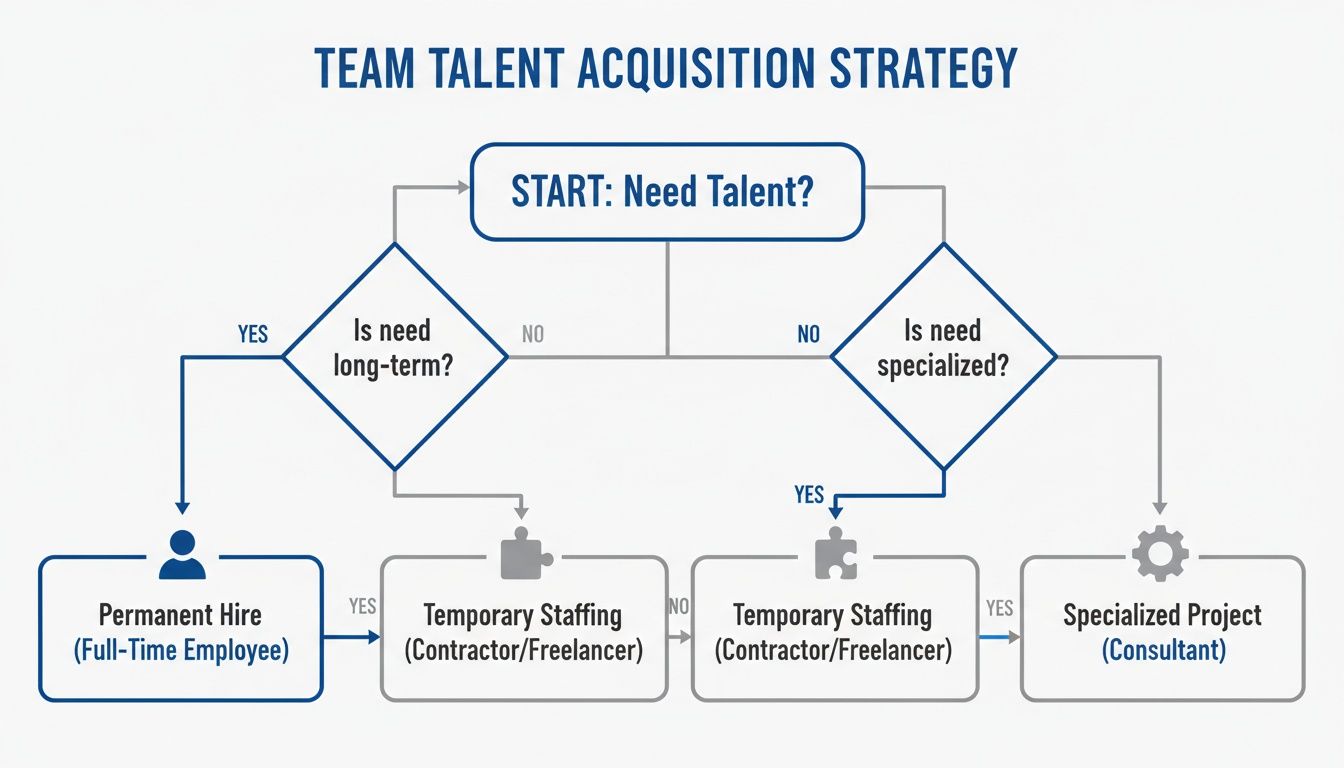
As the flowchart shows, augmentation sits firmly on the “temporary” branch. It’s the strategic play when you need specific skills or a short-term capacity boost without the overhead of permanent hiring.
The Dedicated Team Model
The Dedicated Team model is your best bet for complex, long-term projects where deep domain knowledge and consistent progress are non-negotiable. With this setup, a partner like Blocsys assembles a full-time crew of specialists who work exclusively on your project. They essentially become an extension of your in-house staff, fully plugged into your culture, workflows, and Slack channels.
This approach shines for projects like:
- Building a complex Web3 platform from the ground up. Imagine creating a real-world asset (RWA) tokenization platform. You’d need a team that lives and breathes blockchain, security, and compliance over a 12-18 month roadmap.
- Handling ongoing product maintenance and evolution. If you run a DeFi protocol that requires constant updates, security patches, and new features, a dedicated team provides the continuity and accumulated knowledge you need to stay ahead.
- Training and refining long-term AI models. Developing sophisticated AI-driven trading bots isn’t a one-and-done task. It demands a stable team that can manage massive datasets and iterate on algorithms for the long haul.
A key part of choosing the right model comes down to mastering resource allocation optimization. Even if the principles are applied to customer support, the core strategy is universal.
The Time and Materials Model
The Time & Materials (T&M) model is all about flexibility. It’s perfect for projects with fuzzy requirements or a scope that’s likely to change. You simply pay an hourly, daily, or monthly rate for the experts you need, letting you scale your team up or down with almost zero friction. That kind of agility is priceless, especially in the early stages of innovation.
You’ll want to go with T&M when you’re:
- Developing a Minimum Viable Product (MVP). When you’re building a new crypto wallet or a carbon credit tracking app, the feature list is guaranteed to evolve with early user feedback. T&M lets you pivot on a dime without being locked into a rigid scope or budget.
- Experimenting with new tech. Is your team exploring a new Layer-2 solution or integrating a novel AI library? T&M gives you the freedom to explore and experiment without a heavy, long-term commitment if things don’t pan out.
- Plugging short-term skill gaps. Need a Solidity wizard for a three-week smart contract audit? T&M is hands-down the most efficient way to get that specific expertise exactly when you need it.
The Hybrid Model
For many companies, the sweet spot is somewhere in the middle. The Hybrid Model gives you the stability of a core dedicated team combined with the on-demand flexibility of T&M resources. It’s a balanced approach that lets you maintain a steady pace on your core product while parachuting in specialists for specific, short-term missions.
Real-World Scenario: A FinTech company is building an AI-powered analytics platform. They use a dedicated team of five developers to build and maintain the core application. When it’s time to integrate a complex machine learning module—a six-week job—they bring in two specialized ML engineers on a T&M basis. Once the module is live, the T&M contract ends, and the core team seamlessly takes over its maintenance.
This structure delivers the best of both worlds: cost-efficiency, stability, and the agility to tackle any technical curveball. To see how these teams are put together, you can explore the options for a remote development team.
What are the Strategic Benefits of Augmenting Your Tech Team?
Beyond the different ways to structure a team, the real question is: what results can IT resource augmentation actually deliver? The answer starts with speed. Getting fast access to specialized talent—like sought-after Solidity, Rust, or AI/ML engineers—is the quickest way to shorten your development cycles and accelerate your time-to-market.
This agility is a genuine game-changer. For a crypto startup, it could mean launching its platform months ahead of schedule, capturing that crucial early market share before competitors even have a chance to react. It turns a rigid development roadmap into a dynamic asset you can adjust on the fly.
Accelerate Innovation and Market Entry
In hyper-competitive fields like Web3 and AI, a few months can be the difference between leading the market and being an afterthought. We all know traditional hiring is painfully slow. Sourcing, vetting, and onboarding a senior blockchain developer can easily burn through three to six months. IT resource augmentation shrinks that timeline down to just a few days or weeks.
This speed gives you a direct competitive edge. Picture these scenarios:
- A carbon credit marketplace needs to integrate complex blockchain logic for tokenization. Instead of a long delay building a team from scratch, they can bring in experts and get it done now.
- A DeFi project can quickly pull in smart contract auditors to secure its protocol right before a major launch, building immediate trust with its users.
Drive Significant Cost Efficiencies
Speed is one thing, but augmentation also delivers powerful cost savings. This model lets you completely sidestep the heavy expenses of full-time hiring—recruitment fees, employee benefits, payroll taxes, and office infrastructure all add up. By engaging experts on a project basis, you turn fixed personnel costs into flexible operational expenses.
This strategic shift gives you far more financial predictability and control. You pay only for the exact skills you need, for precisely how long you need them, cutting out the financial burden of a permanent hire for what might be a temporary project.
Gain Unmatched Operational Agility
The ability to scale your team up or down on demand is perhaps the most strategic advantage of all. Business needs are never static; project requirements pivot, new market opportunities pop up, and priorities change. Resource augmentation gives you the elasticity to adapt instantly.
This operational agility keeps your organization lean and resilient. You can add developers to hit a critical product deadline, then scale back down right after launch to manage your costs effectively. To really grasp these outcomes, it’s also important to think about how you’ll approach engineering productivity measurement.
This flexibility is especially critical as the tech market continues to expand. With India’s IT spending projected to hit US$176.3 billion (Rs. 15,61,665 crore) in 2026, the IT services sector—the engine behind resource augmentation—is expected to grow by 11.1% that year. This boom is being supercharged by AI and data center expansions, where augmentation is essential for deploying AI agents and blockchain solutions for carbon tokenization. You can explore more insights from Gartner on the booming Indian IT market. By building a flexible tech team, you’re positioning your business to capture a piece of this explosive growth.
How do you Select the Right Augmentation Partner?
Choosing the right IT resource augmentation partner is the single most critical decision you’ll make in this entire process. Get it right, and they become a seamless extension of your team. Get it wrong, and you’ll face friction, wasted resources, and serious risks to your project’s success.
This isn’t about ticking boxes on a generic technical checklist. You need a partner who lives and breathes your industry—someone who understands the high-stakes, security-first mindset of Web3 or the complex, data-heavy world of AI.

Assessing Deep Domain Expertise
Generic technical skills are a dime a dozen. In specialized fields like blockchain and carbon tech, they’re simply not enough. You need a partner with proven, hands-on experience in your exact domain.
For a Web3 project, that means they should speak fluently about smart contracts, tokenomics, and the nuances of chains like Ethereum or Solana. For an AI initiative, you’re looking for a deep bench of talent in machine learning, NLP, and serious data engineering.
When vetting a potential partner, cut to the chase with direct questions:
- Have you successfully delivered projects in the Web3 or AI space that are similar to ours?
- Can you show me case studies or connect me with client references from my industry?
- How do you keep your team’s skills sharp with the constant changes in blockchain protocols and AI frameworks?
Scrutinizing Security and Compliance Protocols
In these high-stakes industries, a single security vulnerability can be catastrophic. Your partner’s approach to security can’t be an afterthought; it needs to be woven into the fabric of their entire development process.
Look for a genuine commitment to DevSecOps, where security is built in from day one. Ask them about their experience with Vulnerability Assessment and Penetration Testing (VAPT). A proactive partner doesn’t wait for threats to appear—they hunt for weaknesses.
A partner’s approach to security is a direct reflection of their professionalism. If they can’t clearly articulate their security protocols, from code reviews to access controls, they are not the right fit for a mission-critical project.
Evaluating Project Management and Integration
The most brilliant engineer is useless without disciplined project management and a smooth integration plan. Your chosen partner must have a structured, repeatable process for embedding their talent into your existing workflows.
Drill down on their integration methodology:
- What’s your process for getting new team members onto our tools, like Slack for communication and Jira for project tracking?
- How do you guarantee IP protection and confidentiality? Show me your NDAs and internal policies.
- What framework do you use for monitoring performance and giving constructive feedback?
The goal here is seamless collaboration. You want augmented staff who feel and act like a genuine part of your core team. A partner with a well-defined process proves they’ve mastered the crucial human element of IT resource augmentation.
To help you navigate this, here’s a practical checklist for evaluating potential vendors.
Vendor Evaluation Checklist for IT Augmentation
Choosing a partner requires a structured approach. This table provides key questions to guide your evaluation and highlights red flags that should give you pause, ensuring you find a partner that truly aligns with your technical and business needs.
| Evaluation Criteria | Key Questions to Ask | Red Flags to Watch For |
|---|---|---|
| Domain Expertise | “Can you share 2-3 case studies of Web3/AI projects you’ve completed?” “How do you train your developers on new blockchain protocols or ML models?” | Vague answers about past projects. No industry-specific client references. A generic, one-size-fits-all skill set. |
| Security & Compliance | “Describe your DevSecOps process.” “What is your protocol for handling a security incident?” “Are you familiar with GDPR, CCPA, or other relevant regulations?” | Security is treated as a final “testing” phase. No formal incident response plan. Unfamiliarity with key compliance standards. |
| Integration Process | “What does your onboarding process for new team members look like?” “How do you handle IP protection and NDAs?” “What tools do you use for project management?” | A lack of a structured onboarding plan. Weak or generic NDAs. Resistance to using your existing project management tools. |
| Cultural Fit & Communication | “How do you manage time zone differences?” “What is your approach to feedback and performance reviews?” “Can we interview the specific engineers who would join our team?” | Poor communication during the sales process. A rigid, inflexible approach to collaboration. Unwillingness to let you vet individual team members. |
| Scalability & Flexibility | “How quickly can you scale our team up or down if our needs change?” “What are your contract terms regarding termination or changes in scope?” | Long-term, inflexible contracts. Slow response times for providing additional resources. High penalties for adjusting team size. |
This checklist is your starting point. A truly great partner will have confident, detailed answers for every question and will welcome the scrutiny. They’ll see it as an opportunity to prove they’re the right fit for a long-term, successful collaboration.
How do you Implement IT Resource Augmentation?
Once you’ve picked the right augmentation partner, the game shifts to execution. A solid implementation plan is what turns a promising handshake into a high-performing, integrated team. This hands-on roadmap breaks the entire process down into clear, actionable stages to make sure the integration is smooth and successful.
The real goal here is to make your augmented members feel like a genuine part of your crew from day one. That takes more than just a welcome email. It’s a deliberate process of alignment, integration, and continuous monitoring.
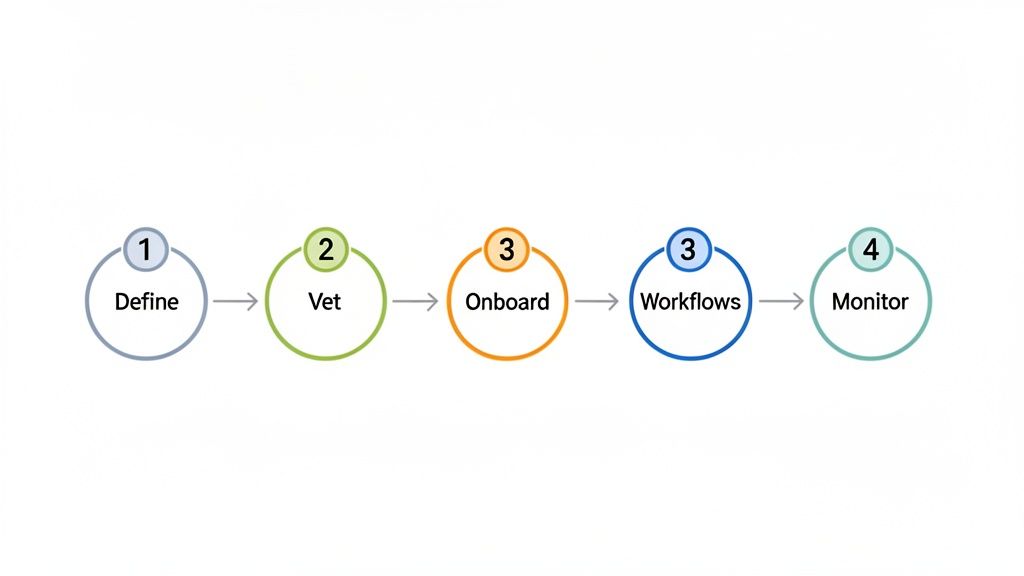
Stage 1: Clearly Define Requirements
The entire foundation of a successful partnership is built on an exceptionally clear definition of what you need. Vague job descriptions are a recipe for mismatched candidates and wasted time. You need to be precise about the technical skills, the experience level, and even the soft skills you’re after.
For instance, don’t just ask for a “blockchain developer.” Instead, specify that you need a “Senior Solidity Engineer with 3+ years of experience in DeFi protocols and a deep understanding of ERC-721 standards.” This kind of clarity lets your partner zero in on the perfect candidates fast.
Stage 2: Vet and Select Candidates
Your partner will bring you a shortlist of vetted professionals, but the final call is yours. Treat this stage with the same gravity as you would a full-time hire.
- Conduct Technical Interviews: Get your in-house tech leads or senior engineers to run rigorous technical interviews. Validate their skills.
- Assess Cultural Fit: Set up a call with the project manager and key team members. You need to know if the candidate’s communication style and work ethic click with your team’s culture.
- Review Past Work: If you can, ask to see a portfolio or code samples. Nothing gives you a better sense of work quality than seeing the work itself.
Stage 3: Ensure Seamless Onboarding
A well-organized onboarding process is simply non-negotiable. The aim is to get your new team members productive as quickly as possible, and that means having everything ready before they even start.
Onboarding isn’t just about system access; it’s about cultural integration. Adding new members to your team’s primary Slack channels and Jira boards from day one is crucial. This simple step immerses them in the project’s daily rhythm and communication flow immediately.
Your onboarding checklist should cover these essentials:
- System Access: Make sure all necessary accounts and permissions—for code repositories, project management tools, and communication platforms—are created and working.
- Project Briefing: Schedule a detailed kickoff meeting to walk through the project roadmap, key milestones, and immediate priorities.
- Team Introductions: Formally introduce the new members to the entire team they’ll be collaborating with.
Stage 4: Establish Clear Workflows and Communication
Define exactly how the integrated team will operate. Document everything, from daily stand-up times to the process for code reviews and deployments. Clear workflows kill confusion and make sure everyone is on the same page.
Establish a regular communication cadence. Daily check-ins on Slack or Microsoft Teams and weekly sync-up calls are vital for keeping projects on track and tackling roadblocks before they become problems.
Stage 5: Monitor Performance and Provide Feedback
Finally, continuous performance monitoring is what ensures the engagement is actually delivering on its promises. Set clear Key Performance Indicators (KPIs) to track progress, like code commits, ticket resolution times, or feature completion rates.
Schedule regular feedback sessions, both formal and informal, to discuss progress, celebrate wins, and address any challenges. This two-way communication builds a stronger, more collaborative relationship and guarantees your it resource augmentation strategy is driving real business value.
How Blocsys Accelerates Your Vision with Expert Augmentation
Understanding the theory of IT resource augmentation is one thing; using it to launch a successful product is another. At Blocsys, we close the gap between your ambitious vision and the specialized engineering talent required to build it, particularly in the demanding Web3, AI, and carbon sectors.
The challenges this guide has detailed—skill shortages, security risks, and slow time-to-market—are precisely what our augmentation services are designed to solve. We don’t just supply developers; we embed elite, pre-vetted engineers directly into your team, transforming your capabilities overnight.
Your Direct Line to Elite Web3 and AI Talent
Finding a single developer with deep expertise in Solidity, Rust, or advanced AI can take months. We give you access to a whole pool of them in just days. Our curated talent network is the direct answer to the skills gap problem that stalls so many promising projects. This lets you bypass the long, expensive recruitment cycle and get straight to building.
This immediate access to talent is how we help clients launch complex projects, like white-label Real-World Asset (RWA) platforms, in a fraction of the usual time. From day one, we provide the specific expertise needed to navigate tokenization, smart contract security, and multi-chain architecture.
With Blocsys, you’re not just hiring a developer; you’re integrating a strategic partner who understands the high-stakes environment of decentralized finance and artificial intelligence. Our focus is on delivering secure, scalable, and market-ready solutions that create real value.
Disciplined Execution and Uncompromising Security
A brilliant engineer is only as effective as the system they work within. Our approach pairs top talent with disciplined project management and rigorous security protocols. Every project is built on DevSecOps principles and a commitment to transparent communication, directly addressing the critical points raised in the vendor selection checklist.
We ensure every augmented team member is a cultural and technical fit, ready to integrate seamlessly into your existing workflows. Our proven process handles it all:
- Rigorous Vetting: We assess for deep technical skills and the soft skills essential for effective collaboration.
- Seamless Onboarding: We manage the entire integration process, ensuring our engineers are productive from their first day.
- Proactive Security: Our security practices, including VAPT, are woven into the development lifecycle, protecting your intellectual property and user data.
This structured approach removes the operational friction of scaling a team, freeing you up to focus on strategy and growth. To see more about how we structure these projects, explore our approach to building a dedicated development team.
Your next big idea in Web3 or AI doesn’t have to wait. By partnering with Blocsys, you gain the technical firepower and operational discipline to build, scale, and execute your vision with confidence and speed.
Frequently Asked Questions
When you’re looking at bringing in outside talent, a lot of questions come up. Here are some of the most common ones we hear from decision-makers, answered directly.
How Is IT Resource Augmentation Different from Outsourcing?
IT resource augmentation involves integrating external experts directly into your existing team, where they report to your managers and follow your processes. You retain full project control. In contrast, IT outsourcing involves handing over an entire project or function to a third-party vendor who manages the process and deliverables independently. The key difference is control and integration versus delegation.
What Is the Typical Onboarding Time for an Augmented Resource?
With a strong augmentation partner, specialized profiles for roles in AI or Web3 can be presented within 48-72 hours. The subsequent onboarding—including system access, project briefings, and team integration—is typically completed in under a week. This rapid deployment is a major advantage over traditional hiring, which can take months, allowing projects to start and scale almost immediately.
How Do You Ensure Project and Intellectual Property Security?
A trustworthy partner won’t cut corners on security. The approach has to be multi-layered, starting with ironclad Non-Disclosure Agreements (NDAs). From there, it’s about secure development practices (DevSecOps), regular vulnerability assessments, and strict access controls to your systems. We make sure every augmented professional follows both your internal security protocols and our own strict standards to protect your IP.
Security isn’t just a box to tick at the end; it’s a continuous process. A reliable partner will have clear, documented policies for everything from handling data to writing secure code. This protects your project’s assets throughout the entire lifecycle and is absolutely non-negotiable for high-stakes work.
Can We Scale Our Augmented Team Up or Down as Needed?
Absolutely. Flexibility is a core benefit of the IT resource augmentation model. A good partner enables you to scale your team up to meet tight deadlines or down after a major launch. This agility allows you to align your technical resources precisely with your project roadmap and manage your budget effectively without the complexities of permanent hiring and firing.
Your next ambitious project in Web3 or AI is within reach. At Blocsys Technologies PVT LTD, we provide the specialized talent and disciplined execution needed to accelerate your vision.
