If you’ve spent time in DeFi lately, you’ve likely encountered the term restaking. Understanding restaking explained crypto is quickly becoming essential knowledge for any serious blockchain participant. Restaking allows users to reuse already-staked crypto assets to simultaneously secure multiple networks. Therefore, it dramatically increases capital efficiency beyond what traditional staking ever offered. Moreover, it has opened entirely new yield opportunities for ETH holders worldwide.
What Is Staking? A Quick Refresher
Before exploring restaking, it helps to revisit standard staking. Staking involves locking cryptocurrency to help validate transactions on a proof-of-stake blockchain. In return, stakers earn protocol rewards. However, traditional staking ties up capital within a single network. Consequently, that capital cannot simultaneously secure other protocols or generate additional yield streams.
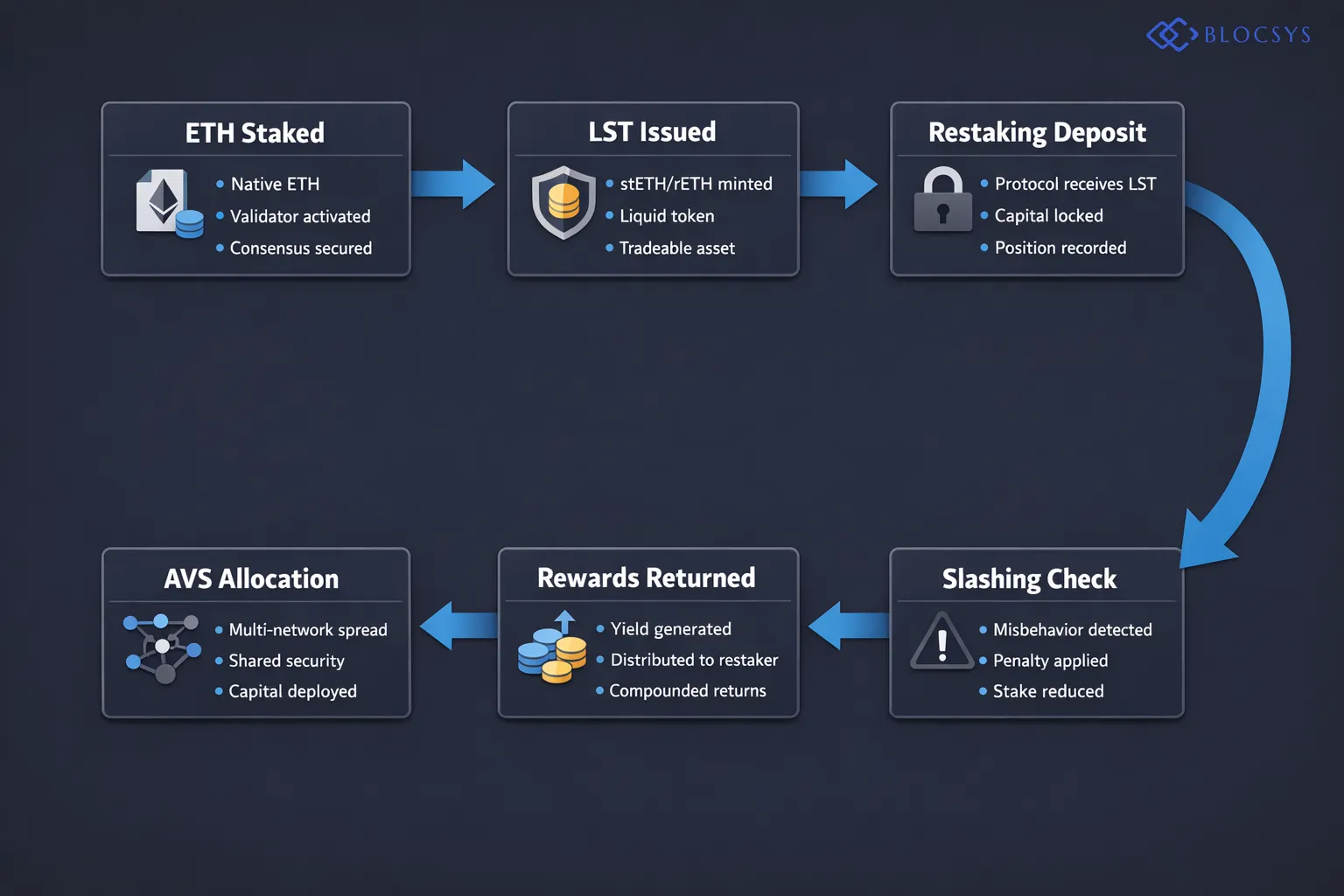
Furthermore, the rise of liquid staking tokens (LSTs) created the foundation restaking needed to emerge. LSTs like stETH or rETH represent staked ETH while remaining tradeable. Additionally, these tokens became essential building blocks for more advanced restaking mechanisms that followed.
Restaking Explained: Crypto’s Capital Efficiency Revolution
Restaking lets you pledge already-staked assets as economic security to additional networks or protocols simultaneously. Moreover, these additional networks — known as Actively Validated Services (AVS) — need trust and decentralized security to function reliably. Restaking provides that security without forcing each AVS to bootstrap its own separate validator set from scratch.
Therefore, a single pool of staked ETH can simultaneously secure Ethereum’s base layer and multiple AVS networks on top. Furthermore, restakers earn rewards from every network they help secure. However, they also accept additional slashing risks in exchange. Consequently, understanding those risks is critical before committing any capital.
Ethereum’s official staking documentation provides excellent foundational context on how base-layer staking operates, which directly underpins restaking mechanics.
How EigenLayer Pioneered Restaking
The EigenLayer Protocol
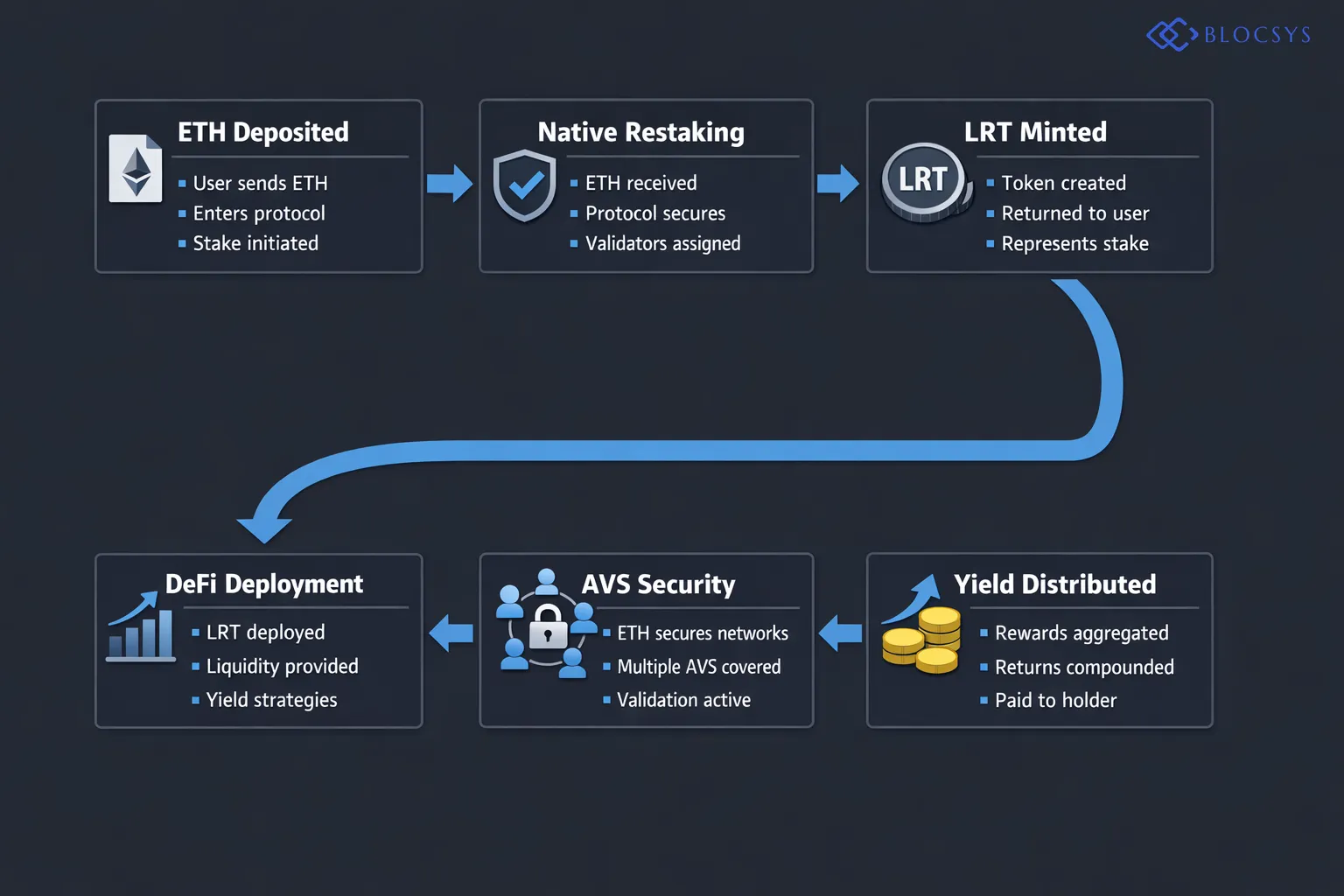
EigenLayer is the most prominent restaking protocol operating in the crypto ecosystem today. Moreover, it introduced the restaking concept to Ethereum and defined how AVS networks consume pooled security. Users deposit LSTs or native ETH into EigenLayer’s smart contracts. Consequently, those assets become available to secure multiple AVS networks simultaneously.
Additionally, EigenLayer functions as a marketplace connecting stakers with AVS operators. Therefore, node operators opt into specific AVS networks and take on validation responsibilities for each one. Furthermore, they share earned rewards with restakers who delegated assets to them. The EigenLayer technical documentation offers a thorough breakdown for participants wanting deeper protocol-level understanding.
Liquid Restaking Tokens (LRTs)
Just as liquid staking produced LSTs, restaking gave rise to Liquid Restaking Tokens (LRTs). These tokens represent an active restaked position while remaining freely tradeable. Moreover, they allow users to maintain liquidity without forfeiting restaking rewards. Protocols like EtherFi and Renzo issue popular LRTs across the ecosystem. Therefore, users no longer need to lock assets completely to participate in restaking.
Key Risks Every Restaker Must Understand
Restaking carries meaningful risks that every participant should evaluate carefully. However, understanding them clearly helps you make informed, confident decisions. The primary risks include:
-
Slashing risk: Validators who misbehave on an AVS can lose a portion of their underlying staked assets.
-
Smart contract risk: Bugs or exploits within restaking protocol code can directly expose deposited funds.
-
Concentration risk: Excessive ETH restaked to a single AVS creates dangerous centralization vulnerabilities.
-
Liquidity risk: LRT tokens may depeg from their underlying value during periods of acute market stress.
Furthermore, the Ethereum Foundation has publicly flagged concerns about restaking’s potential systemic impact on Ethereum’s consensus layer. Therefore, approaching restaking with a carefully calibrated risk tolerance is absolutely essential. Additionally, explore our DeFi yield strategies guide for complementary methods to generate returns on your crypto holdings.
Is Restaking Right for You?
Restaking suits experienced DeFi participants who already understand staking mechanics and are comfortable managing elevated risk exposure. Moreover, the additional yield can be highly compelling, especially when AVS demand is strong during bull market conditions. However, beginners should thoroughly master standard staking before attempting restaking protocols.
Additionally, always research the specific AVS networks an operator runs before delegating any capital. Consequently, this minimizes your exposure to poorly designed or insufficiently audited services. Furthermore, diversifying capital across multiple operators significantly reduces single-point-of-failure risk across your restaking portfolio.
The Future of Restaking in Crypto
Restaking remains in its early stages, yet it’s already reshaping how decentralized infrastructure gets secured and economically funded. Moreover, as more AVS networks launch and mature, restaking demand will likely accelerate substantially. Therefore, crypto capital efficiency is poised to reach levels previously unimaginable under traditional staking models.
Additionally, cross-chain restaking represents an exciting emerging frontier. Consequently, assets on networks beyond Ethereum may soon benefit from similar shared-security mechanisms. Furthermore, growing institutional interest in restaking signals that this innovation carries long-term staying power well beyond speculative cycles.
Restaking is one of crypto’s most significant structural innovations in recent years. However, like all DeFi advancements, it rewards participants who approach it with knowledge, patience, and caution. Therefore, keep learning, assess your risk honestly, and restake responsibly. The CoinMarketCap Academy restaking resource provides continuously updated educational material as the space rapidly evolves.