
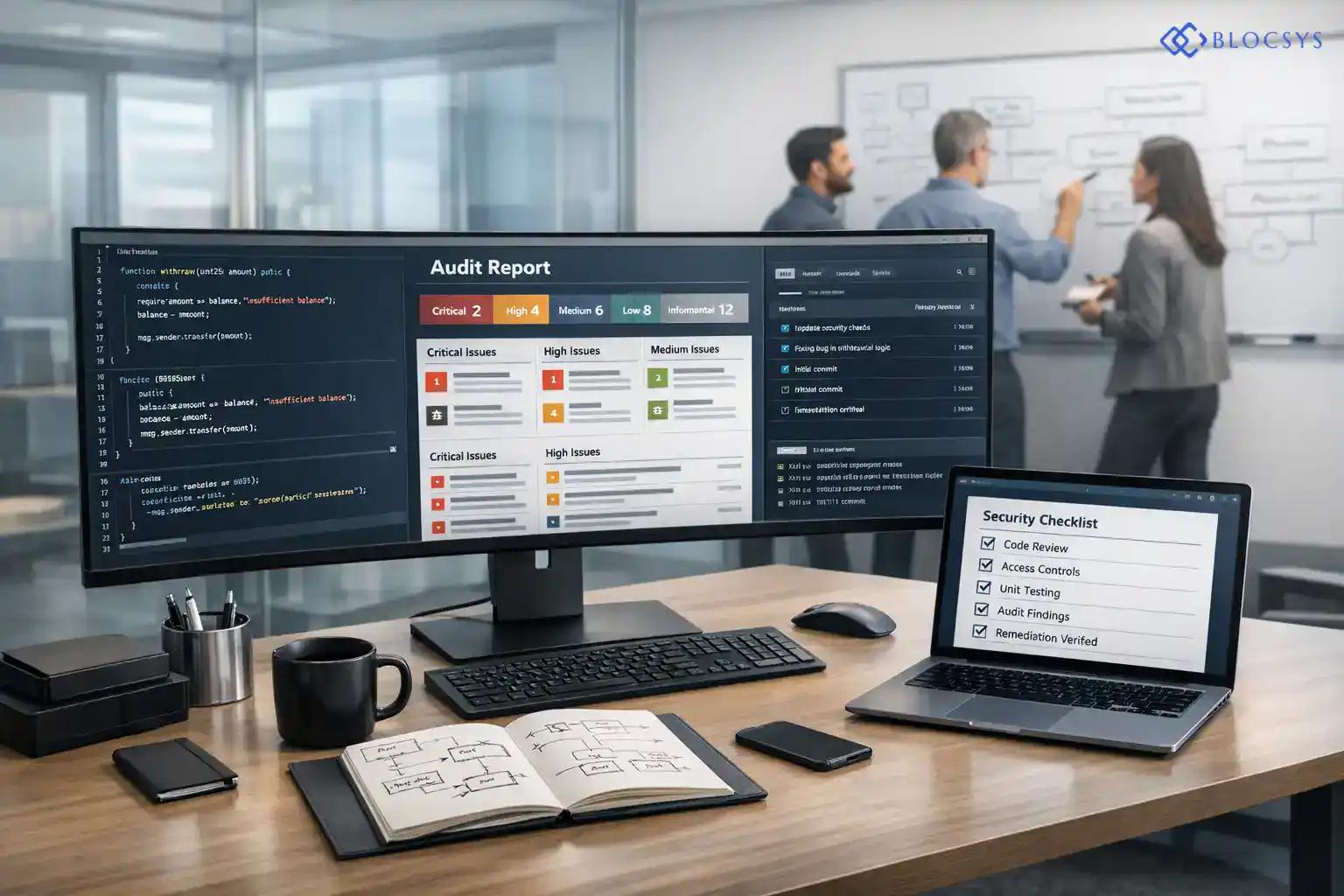
A smart contract audit is a comprehensive security analysis of a smart contract’s code, designed to identify vulnerabilities, logical errors, and inefficiencies before deployment on a blockchain. This process is for founders, developers, and project leaders in Web3, crypto, AI, and DeFi who need to secure digital assets and build user trust. This guide delivers a clear framework for understanding, choosing, and integrating smart contract audits to ensure your platform is secure, resilient, and ready for launch.
What is a Smart Contract Audit and Why is it Critical?

A smart contract audit is an in-depth, methodical inspection of a smart contract’s code, designed to find security flaws, errors, and inefficiencies before the contract is deployed. For founders and product teams building in DeFi, Real-World Asset (RWA) tokenization, and AI-driven crypto, this process isn’t just a best practice—it’s an absolute necessity. It is the critical step that prevents catastrophic financial losses, builds user trust, and secures high-value digital assets against sophisticated threats.
Smart contracts are immutable. Once deployed, their code is permanently recorded on the blockchain and cannot be easily changed. This immutability means any bug or vulnerability becomes a permanent, public invitation for attackers. The consequences of skipping a proper audit are severe and well-documented.
How do Financial and Reputational Risks Affect Projects?
The financial fallout from smart contract vulnerabilities can be devastating. Recent years have demonstrated that “good enough” security is no good at all. In just one six-month period, exploits tied to smart contracts resulted in over $2.2 billion in losses.
This staggering figure shows how catastrophic the consequences of inadequate security can be. It’s precisely why organizations building decentralized financial infrastructure must treat comprehensive audits as a top priority. A great audit also involves applying sound contract interpretation principles to ensure the code’s logic perfectly matches the real-world business agreement it’s supposed to execute, preventing scenarios where a contract behaves in unexpected ways.
How Does an Audit Build a Foundation of Trust?
An audit is far more than a technical checkbox; it’s a foundational pillar of trust and a powerful market signal. For investors, partners, and users, a professional audit report provides concrete assurance that a project is genuinely committed to security and protecting their funds.
A rigorous, independent audit transforms a brilliant idea into a trusted, resilient, and enterprise-ready platform. It’s the difference between building an experiment and building lasting financial infrastructure.
This process is especially vital for platforms dealing with complex logic, such as those that depend on external data feeds from oracles. To understand how these inputs add another critical layer of security considerations, see our guide on discovering the power of Chainlink oracles in blockchain. This guide helps you navigate the audit process effectively, safeguarding your platform from day one.
What are the Different Types Of Smart Contract Audits?

Not all smart contract audits are the same. The right approach depends on your project’s stage, complexity, and the value it’s designed to protect. Identifying the best methodologies for your needs is the first step toward building a security strategy that works for your users and investors. A comprehensive security assessment blends several techniques to create layered defenses, ensuring you catch both common and unique vulnerabilities before they can be exploited.
Manual Code Review: The Human Element
At the heart of any worthwhile smart contract auditing process is the manual code review. This is where seasoned security engineers meticulously comb through your codebase line by line. They aren’t just scanning for known bugs; they’re digging into the business logic, questioning economic assumptions, and scrutinizing the architectural design to find subtle, context-specific flaws that automated tools miss.
This human-centric approach is irreplaceable for several key reasons:
- Spotting Logical Flaws: It’s the only way to uncover errors in the contract’s intended behavior, like a broken incentive mechanism or an incorrect state transition.
- Understanding Business Context: An auditor can judge whether the code truly reflects the project’s business goals—a level of nuance beyond what software can do.
- Finding Novel Vulnerabilities: Skilled auditors have the creativity and experience to identify new attack vectors specific to your protocol’s unique design.
Understanding how to conduct proper secure code reviews is invaluable, as it details best practices and common pitfalls. Ultimately, this manual process is the bedrock of a robust audit.
Automated Analysis: For Speed and Scale
Automated analysis uses specialized tools to quickly scan code for common vulnerabilities and programming mistakes. These tools are incredibly fast, capable of analyzing large codebases in minutes, making them essential for maintaining security hygiene throughout the development cycle. They excel at flagging well-known issues like re-entrancy bugs, integer overflows, and improper access controls, freeing up human auditors to focus on more complex logical vulnerabilities.
Automated tools find the known unknowns—the common bugs we expect to see. Manual review finds the unknown unknowns—the unique flaws hidden in your project’s specific logic.
What are Advanced Security Methodologies?
For platforms that handle significant value or pioneer new financial mechanisms, a standard audit often isn’t enough. Advanced techniques provide a much higher degree of assurance for mission-critical systems.
Formal Verification
This is the most rigorous form of security analysis. It uses mathematical proofs to confirm that a smart contract’s behavior perfectly matches a pre-written formal specification. In simpler terms, it proves that your code will always do exactly what you intended, under all possible conditions, effectively eliminating entire categories of bugs. While time-consuming, it is the gold standard for core protocol components.
Penetration Testing (VAPT)
Often called ethical hacking, Vulnerability Assessment and Penetration Testing (VAPT) goes beyond smart contracts to simulate real-world attacks against your entire system—frontend, backend APIs, and all blockchain components. Testers actively try to exploit weaknesses to provide a clear picture of your overall security posture.
Bug Bounty Programs
Once live, a bug bounty program invites a global community of independent security researchers to continuously test your deployed code. By offering rewards for finding and responsibly reporting vulnerabilities, you create an ongoing, decentralized security force that helps protect your protocol long after the initial audit is finished.
What is the Smart Contract Audit Process?
A smart contract audit is a structured, collaborative journey with clear stages. Understanding this lifecycle demystifies the process, allowing your team to prepare properly and work smoothly with your security partner. Each phase builds on the last, creating a complete security narrative that proves your commitment to protecting user funds.
Phase 1: Scoping and Quotation
The audit journey begins by defining clear boundaries. You’ll work with the audit firm to specify which smart contracts are in-scope, provide access to the codebase (usually a private GitHub repo), and share technical documentation explaining the protocol’s architecture and business logic. A well-defined scope is critical for an accurate quote. Auditors assess complexity and lines of code to estimate the time and expertise needed, concluding with an agreement on deliverables, timeline, and cost.
Phase 2: Code Review and Analysis
This is the core of the audit. Security engineers perform a deep dive into your codebase, combining automated scanning with an exhaustive manual review. While automated tools catch common issues, the real value lies in the manual inspection where auditors scrutinize your code line-by-line, focusing on:
- Business Logic Flaws: Does the code actually do what your whitepaper says it does?
- Architectural Weaknesses: Are there design choices that could be exploited under unexpected conditions?
- Novel Attack Vectors: Could your protocol’s unique features be combined to create a new type of exploit?
Experience and a critical mindset are key here. An experienced auditor uncovers subtle issues automated tools miss. For insights on resilient architecture, our article on understanding proxy contracts in Solidity is a great resource.
Phase 3: Vulnerability Reporting
After analysis, the audit firm compiles its findings into a confidential, preliminary report for your team. It details every vulnerability, categorized by severity—from Critical and High down to Medium, Low, and Informational. Each finding includes a clear explanation, its potential impact, and actionable steps for fixing it, creating a precise roadmap for your development team.
Phase 4: Remediation
Armed with the report, your engineering team implements the recommended fixes. Open communication with the audit team is vital during this phase. It’s a collaborative effort where auditors provide guidance to ensure patches work without creating new problems. Research shows that businesses conducting detailed audits are 50% less likely to suffer serious security breaches, a crucial statistic for startups and enterprises. You can read the full research about these findings on Quest Glt to learn more.
The goal of remediation isn’t just to fix bugs. It’s to elevate the security posture of the entire codebase, turning audit findings into permanent improvements in your development practices.
Phase 5: Verification
After your team implements all fixes, the auditors perform a verification pass. They re-examine the patched areas to confirm every vulnerability has been successfully resolved without introducing unintended side effects.
Phase 6: Final Report Delivery
Once verification is complete, the audit firm issues the final, public-facing report. This document acts as a certificate of due diligence, summarizing the audit scope, process, initial findings, and the final state of the code. Publishing this report is a powerful act of transparency that builds immense trust with your community, investors, and partners.
How to Choose the Right Smart Contract Auditor
Picking a security partner is one of the most critical decisions for your project, directly shaping your platform’s resilience, user trust, and long-term reputation. The right smart contract auditor is a strategic partner who hardens your entire security posture, not just a code reviewer. A great audit delivers deep engineering insights, not just a checklist of common vulnerabilities.
Key Evaluation Criteria For Your Audit Partner
When vetting potential auditors, dig into their technical expertise, communication style, and industry reputation. A firm’s ability to grasp the specific nuances of your protocol—be it DeFi, RWA tokenization, or an AI integration—is critical.
Keep these core factors in mind:
- Reputation and Track Record: Look for a firm with a public history of high-quality audits for respected projects. Check their portfolio for protocols with similar complexity to yours.
- Technical Expertise: Do they have deep experience with your specific blockchain (e.g., Ethereum, Solana) and smart contract language (e.g., Solidity, Rust)? A specialist will always spot things a generalist will miss.
- Communication and Remediation Process: How do they report issues and collaborate on fixes? The best auditors work with your team during remediation.
- Cost Versus Long-Term Value: Don’t let price be your only guide. A cheap, surface-level scan offers a false sense of security and can cost you exponentially more after an exploit.
The global blockchain audit market is growing fast. On leading industry platforms, premier smart contract auditing firms stand out, with project costs typically ranging from $10,000 to over $49,000. Client reviews consistently cite expertise in complex smart contracts as the deciding factor. You can discover more insights about these market trends on Clutch.co.
This flowchart breaks down the typical journey of a smart contract audit.

As you can see, a proper audit is a structured process designed to methodically eliminate security risks before they can cause damage.
How do Startup Needs Differ from Enterprise Demands?
The “perfect” audit partner depends heavily on your organization’s size and maturity. An early-stage startup has vastly different priorities compared to an established enterprise, and your choice of auditor must reflect that reality.
A great auditor for a startup provides foundational security and builds investor confidence. A great auditor for an enterprise validates and hardens existing, complex systems at scale, ensuring regulatory and compliance alignment.
For startups, the goals are securing an MVP, moving fast, and proving due diligence to early investors. An agile, communicative auditor who gives clear, actionable feedback is a massive asset. For enterprises, the focus shifts to absolute rigor, bulletproof risk mitigation, and navigating complex compliance requirements. Their auditors must have a proven track record of handling massive codebases and securing high-value, mission-critical systems.
The table below breaks down how priorities shift, helping you focus on what matters most.
Auditor Evaluation Framework: Startups vs. Enterprises
| Evaluation Criteria | Startup Priority | Enterprise Priority |
|---|---|---|
| Cost & Budget | High. Often seeking maximum value for a lean budget. A key decision driver. | Medium. Focused on long-term value and risk mitigation over upfront cost. |
| Speed & Agility | High. Needs a partner who can move quickly to meet tight product deadlines. | Low. Prioritises thoroughness and rigour over speed. Timelines are more flexible. |
| Reputation & Brand | Medium. A well-known auditor boosts credibility with early investors and users. | High. Requires a top-tier, globally recognised firm to satisfy stakeholders and regulators. |
| Technical Specialisation | High. Needs deep expertise in their specific tech stack (e.g., a new L2 or language). | High. Requires broad expertise across multiple complex systems and integrations. |
| Remediation Support | High. Values a hands-on, collaborative partner to guide the dev team through fixes. | Medium. Has in-house security teams but values a partner for validation and second opinions. |
| Process & Documentation | Medium. Needs clear, actionable reports that are easy for a small team to digest. | High. Demands exhaustive, audit-trail-ready documentation for compliance and internal review. |
Ultimately, whether you’re a startup or an enterprise, you are paying for deep engineering experience that turns a simple code scan into a strategic security investment.
How to Integrate Audits Into Your DevSecOps Pipeline

A formal smart contract audit provides a critical security snapshot, but in a world of constant updates, security must be a continuous process. For engineering leaders, the goal is to build a culture of resilience by weaving security directly into the development lifecycle.
This modern approach is called DevSecOps, which is about “shifting left.” Instead of treating security as a final gate before deployment, you integrate it into the earliest stages of development. This allows you to catch potential vulnerabilities when they are small, cheap, and fast to fix.
Shifting Left With Automated Security in CI/CD
The best place to start is by integrating automated security tools directly into your Continuous Integration/Continuous Deployment (CI/CD) pipeline. These tools can automatically scan every code commit, acting as a first line of defense against common vulnerabilities.
When a developer pushes new code, the CI/CD pipeline instantly kicks off automated checks:
- Static Analysis (SAST): Tools like Slither or Mythril run automatically, hunting for known bugs like re-entrancy or integer overflows.
- Code Quality Checks: Linters and formatters enforce consistent style. Clean, readable code is less likely to hide errors.
- Dependency Scanning: The pipeline vets all third-party libraries for known security flaws, preventing supply chain attacks.
If any of these checks fail, the build stops, preventing vulnerable code from being merged and creating a powerful feedback loop for developers.
Building A Culture Of Continuous Security
Automated tools are a game-changer, but a true DevSecOps culture is a mindset shift. Security becomes a shared responsibility for the entire engineering team, not just a task for an external auditor.
Integrating security into every stage of development transforms it from a final gatekeeper into an ongoing accelerator. This approach not only reduces risk but also makes formal audits far more efficient, focusing expert attention on complex logic rather than common mistakes.
This culture is built on a foundation of security-focused practices that become part of your team’s daily rhythm, working alongside your CI/CD automation.
What are the Best Practices for Secure Development Lifecycles?
To embed security into your project’s DNA, you need a framework of continuous review and strategic planning that keeps security front-and-center.
-
Threat Modeling Sessions: Before writing code for a new feature, bring together developers, architects, and product managers to brainstorm potential attack vectors and security risks. This proactive exercise helps you design more resilient systems from the ground up.
-
Pre-Deployment Checklists: Maintain a living document as a final sanity check before any new contract goes live. This checklist should cover non-negotiables like correct state variable visibility, proper access controls, and hardening against the latest known exploits.
-
Peer Code Reviews: Enforce a strict policy that no code is merged without a security-focused review from at least one other developer. Encourage reviewers to actively hunt for logic flaws and vulnerabilities, spreading security knowledge across the team.
How Blocsys Engineers Secure and Audited Web3 Platforms
At Blocsys, we believe security isn’t just a final step; it’s the foundation of everything we build. Our security-first engineering approach is about architecting production-ready Web3 platforms designed from day one to withstand real-world threats. This philosophy is integrated into our entire delivery process, whether we’re building a decentralized ETF, an RWA tokenization platform, or a perpetuals trading engine. We don’t wait for an audit to think about vulnerabilities—we build to eliminate them from the start.
Our Integrated Security Framework
Our methodology weaves proven security practices directly into the development lifecycle, ensuring a defensible architecture. This proactive stance means that by the time a third-party auditor sees our work, the code has already passed through multiple layers of our internal scrutiny. This makes the formal smart contract auditing process far more efficient and effective.
Our approach includes:
- Proactive Threat Modeling: We map potential attack surfaces and economic exploits tailored to your protocol’s logic before coding begins, allowing us to design countermeasures into the system’s architecture.
- Compliance-Aware Design: We build with regulatory and operational security in mind, ensuring on-chain logic aligns with necessary compliance frameworks from the start.
- Continuous Security Testing: We run automated security checks and conduct rigorous internal code reviews throughout development to catch and fix potential issues early.
We believe a successful audit begins with exceptional engineering. Our goal isn’t just to pass an audit, but to deliver a platform so inherently secure that the audit simply serves as a final verification of the quality we’ve built in all along.
From Development to a Confident Launch
Our role extends beyond delivering secure code. We act as your strategic partner through the entire security validation journey, preparing your platform for top-tier third-party auditors and managing the whole remediation process for you. This hands-on management guarantees that any findings are addressed quickly and correctly, so you can launch with verifiable confidence.
This comprehensive process is central to how we build and scale secure Web3 platforms. For founders and product leaders, our detailed smart contract development service provides the deep expertise needed to navigate this complex environment securely.
Let us help you build a platform that isn’t just built to function, but engineered to endure.
Frequently Asked Questions
Here are clear answers to the most common questions we hear from founders and project leads about smart contract audits.
What Is The Main Goal Of A Smart Contract Audit?
The main goal of a smart contract audit is to identify and eliminate security vulnerabilities, logical flaws, and other bugs in your code before deployment. It provides independent, expert confirmation that your contract functions as intended, protecting user funds and your project’s reputation from costly exploits.
How Much Does A Smart Contract Audit Cost?
There’s no single price. Audit costs vary widely based on the protocol’s complexity, the amount of code, the clarity of technical documentation, and the auditor’s reputation. A simple token contract might cost a few thousand dollars, while complex DeFi platforms can easily exceed $50,000.
Think of a proper audit as an investment in security and trust, not just an expense. The cost is a fraction of what a single, preventable exploit could wipe out.
How Long Does An Audit Take?
The timeline is tied directly to the audit’s scope and complexity. A straightforward token contract might take a week. A sophisticated, multi-contract DeFi protocol could require a deep dive lasting four to six weeks or longer. This process includes the initial review, reporting, a remediation phase for your team, and a final verification pass.
What Happens If Vulnerabilities Are Found?
Finding vulnerabilities is the purpose of an audit, not a failure. When an auditor uncovers issues, they provide a private, detailed report categorizing each finding by severity (e.g., Critical, High, Medium). Your development team then implements fixes, and the auditors return to verify that every issue has been properly resolved.
Is One Audit Enough For A Project?
A single audit is an essential snapshot, but security is a continuous effort. Any significant updates or new features added to your smart contracts require a new audit for the updated code. For long-term resilience, successful projects also implement ongoing measures like bug bounty programs and real-time monitoring.
At Blocsys Technologies, we build with a security-first engineering mindset, ensuring your platform is resilient from the ground up. We don’t just prepare your systems for tough third-party audits; we manage the entire remediation process, so you can launch with total confidence.
Ready to build a secure, production-grade Web3 platform? Connect with our experts today to get started.
