
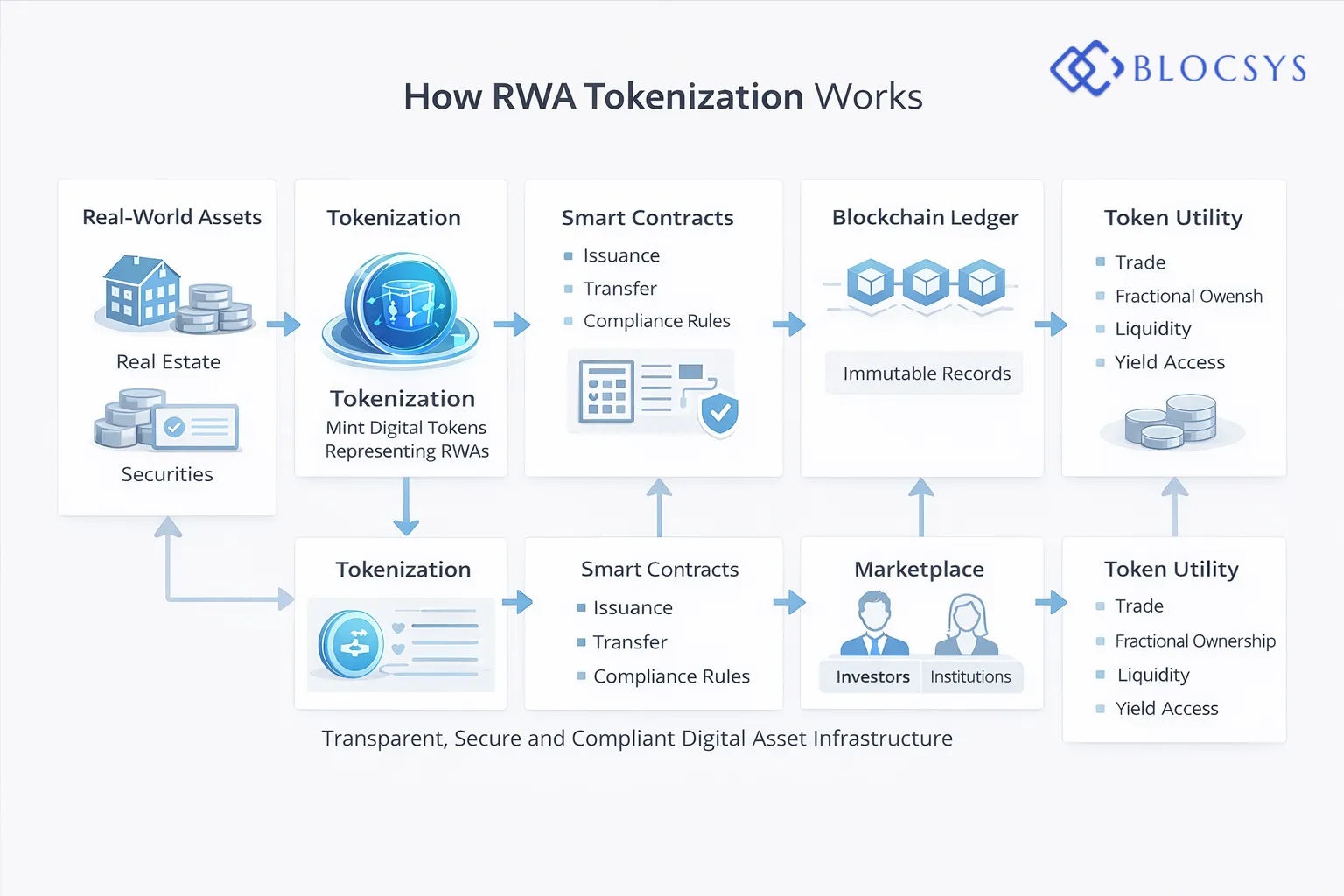
Real-world asset (RWA) tokenization is the process of converting ownership rights of a physical or financial asset into a digital token on a blockchain. This guide explains how RWA tokenization works for Web3 founders, enterprise leaders, and product teams, outlining the core technology, benefits, and strategic considerations for unlocking new liquidity and investment opportunities in sectors like finance, real estate, and carbon markets.
What RWA Tokenization Means for Modern Finance
At its core, RWA tokenization is about bridging the two worlds of traditional finance—filled with physical and financial assets—and the hyper-efficient, transparent infrastructure of the blockchain. It takes things that have always been slow and expensive to trade, like fine art, private equity, or commercial properties, and converts them into divisible, programmable digital units. The goal isn’t to reinvent the assets themselves but to revolutionise how we record, manage, and transfer their ownership.
Imagine trying to sell a small piece of a commercial building. Traditionally, you’d be buried in legal paperwork, dealing with multiple intermediaries, and facing high transaction costs. It’s an impractical process for most investors.
RWA tokenization is the conversion of rights to a real-world asset into a digital token on a blockchain. This process makes illiquid assets like real estate or private credit easily tradable 24/7 on global markets, dramatically lowering investment barriers and increasing market efficiency through fractional ownership and enhanced transparency.
What are the Key Benefits of Tokenizing Real-World Assets?
Moving assets on-chain delivers several fundamental upgrades over legacy systems. For builders and investors in Web3, crypto, and the carbon markets, understanding these advantages is the first step to spotting real market opportunities.
- Fractional Ownership: Tokenization allows a high-value asset, like a multi-million-dollar property, to be digitally split into thousands of smaller, more affordable shares. This opens the door for a much wider audience to invest in assets that were previously out of reach.
- Enhanced Liquidity: Illiquid assets, which can take months or even years to sell through traditional channels, become easily tradable on secondary markets. This ability to quickly buy and sell asset-backed tokens unlocks capital that was previously locked away.
- Increased Transparency and Efficiency: Every transaction gets recorded on the blockchain, creating a permanent and easily auditable history of ownership. This cuts out the need for expensive intermediaries and shrinks settlement times from days down to just minutes.
To better understand the shift, let’s compare the old way with the new.
Traditional Assets vs Tokenized RWAs: A Comparison
This table contrasts the characteristics of traditional real-world assets with their tokenized counterparts on the blockchain, highlighting the key advantages of RWA tokenization for both enterprise and startup decision-makers.
| Characteristic | Traditional Asset Management | RWA Tokenization |
|---|---|---|
| Ownership | Physical deeds, paper certificates, centralised ledgers | Digital tokens on an immutable blockchain ledger |
| Liquidity | Low; sales are slow and require intermediaries | High; tokens are tradable 24/7 on global secondary markets |
| Fractionalisation | Difficult and expensive; limited to high-net-worth investors | Simple and cost-effective; enables micro-investments |
| Transaction Speed | Slow; settlement can take days or weeks | Fast; settlement occurs in near real-time (minutes) |
| Transparency | Opaque; ownership records are private and fragmented | High; all transactions are publicly verifiable on the blockchain |
| Accessibility | Limited by geography and high minimum investments | Global and inclusive; lower barriers to entry for all investors |
| Intermediaries | High reliance on brokers, lawyers, and banks | Reduced need for intermediaries, lowering costs and complexity |
The advantages are clear: RWA tokenization offers a more efficient, accessible, and transparent way to manage and trade real-world value.
The market for this technology is expanding fast. In India, for instance, the asset tokenization market is projected to grow from USD 122.4 million in 2025 to USD 222.3 million by 2032, with real estate leading the adoption curve. This growth signals a strong demand for more modern and accessible asset management. You can learn more about the strategic implications of RWA tokenization in our comprehensive guide at https://blocsys.com/real-world-assets-rwa-blockchain-tokenization/.
The End-to-End RWA Tokenization Process
So, how does a physical or traditional financial asset actually get turned into a liquid, tradable digital token? It’s a structured, multi-stage journey that’s a careful blend of legal structuring, technical implementation, and market strategy. For any product manager or engineer looking to build a reliable platform, understanding this workflow is non-negotiable. The whole point is to make sure the on-chain token has a solid, legally enforceable link to its off-chain counterpart.
This visual flow breaks down the core stages of taking an asset from the physical world and making it a digital, blockchain-native format.

As you can see, the journey boils down to three key phases: asset selection, legal wrapping, and token creation. These are the foundational steps for any successful RWA project.
Phase 1: Asset Selection and Legal Structuring
The first, and arguably most critical, step is picking the right asset. This decision isn’t random; it’s driven by market demand, inherent value, and whether you can create a clear, undisputed ownership structure. Assets like commercial real estate, private credit, and precious metals are popular for a reason—they have stable value and strong investor interest.
Once an asset is selected, it goes through rigorous due diligence. This means valuation by independent experts, title verification to confirm clear ownership, and a full risk assessment. The goal here is simple: ensure the asset is unencumbered and its value is accurately represented.
After due diligence, a legal wrapper is created. This usually means placing the asset into a Special Purpose Vehicle (SPV) or a trust.
This legal entity serves a crucial purpose: it isolates the asset from the originator’s balance sheet, protecting investors from unrelated financial risks. The SPV becomes the legal owner of the asset, and the digital tokens represent ownership or economic rights in that SPV.
Phase 2: Securing the Asset and Issuing the Token
With the legal framework in place, the physical asset or its legal paperwork needs to be secured. This is where a qualified custodian—like a regulated bank, trust company, or a specialised vaulting service—comes in. The custodian’s job is to safeguard the underlying asset, giving investors confidence that their digital token is genuinely backed.
Next up is the technical implementation: token issuance. This phase involves a few key decisions:
- Blockchain Selection: Teams have to pick a blockchain that fits their needs for security, scalability, and cost. Ethereum is often the go-to for its robust security and massive ecosystem, while Layer 2 solutions like Polygon are great for keeping transaction fees low.
- Token Standard Selection: The choice of token standard defines what the token can do. While ERC-20 is common for fungible tokens, standards like ERC-3643 are gaining traction. They are designed specifically for permissioned tokens, embedding compliance rules right into the smart contract.
- Smart Contract Development: Developers write and deploy the smart contract that governs the token’s entire lifecycle. This code handles everything from minting (creating new tokens) and burning (destroying them) to transfers and compliance checks.
- Minting: Finally, the tokens are minted. The total supply directly corresponds to the value or units of the underlying asset sitting safely in custody.
Phase 3: Distribution and Secondary Market Liquidity
Once the tokens are created, they enter the primary distribution phase. This is where the initial investors buy the tokens directly from the issuer. This process demands robust Know Your Customer (KYC) and Anti-Money Laundering (AML) checks, ensuring every participant is verified and compliant. Usually, this is managed through a secure investor portal.
But a successful tokenization project doesn’t stop at the initial sale. The real goal is to create liquidity. You achieve that by listing the tokens on a secondary market, which could be a decentralised exchange (DEX) or a centralised trading platform that specialises in security tokens. Enabling secondary trading is what lets investors buy and sell the tokens freely, unlocking the true value of turning an illiquid asset into a liquid one.
This whole process brings massive efficiency gains. For example, when the Hong Kong government issued tokenized green bonds, blockchain cut the settlement time from five days (T+5) all the way down to the same day (T+0). The on-chain settlement itself took less than a minute, and underwriting fees dropped by 25.8%. It’s a powerful showcase of the economic benefits of this model.
The improvements are clear, but managing the token lifecycle requires specialised infrastructure. Building out a robust system is about more than just smart contracts; it demands a comprehensive token management system to handle compliance, investor relations, and corporate actions seamlessly.
Building the Core Technology for RWA Platforms
Turning a tokenization idea into a real, production-ready product is all about the technology stack you choose. For any development team, getting the architectural blueprint right is the key to building a platform that’s secure, compliant, and ready to scale. This means making smart decisions across several core components that work together to connect the real world with the blockchain.

Think of it like building a house. Each layer of your tech stack, from the foundation to the roof, solves a specific challenge in making real-world asset tokenization work on-chain.
Choosing the Right Blockchain Layer
The first and most fundamental decision is which blockchain to build on. This choice will define your platform’s security, cost structure, and how centralised it is. You have to weigh the trade-offs to find the perfect fit for your asset and your investors.
- Public Blockchains (e.g., Ethereum): These offer unmatched security and access to the largest pool of users, which is perfect if you’re targeting a broad, global audience. The downside? Transaction costs (gas fees) can be high, making them a tough sell for high-frequency trading or low-value assets.
- Layer 2 Solutions (e.g., Polygon, Arbitrum): Built on top of giants like Ethereum, L2s deliver much faster transactions at a fraction of the cost. They strike a great balance between scalability and security, which is why so many RWA projects are flocking to them.
- Private or Permissioned Ledgers (e.g., Hyperledger Fabric): If you’re building for institutions, this is often the way to go. Privacy, control over who can participate, and regulatory compliance are the top priorities here. You sacrifice some decentralisation, but in return, you get enhanced control and confidentiality.
Designing Smart Contracts for Asset Lifecycle Management
Smart contracts are the digital engines driving your RWA tokens. They aren’t just for minting tokens; they’re sophisticated scripts that automate the rules and logic for the entire lifecycle of an asset, from its creation to its eventual redemption.
A well-designed smart contract acts as a self-enforcing legal and operational agreement. It embeds compliance rules directly into the token, ensuring that only verified investors can hold it and that transfers adhere to jurisdictional regulations.
These contracts are programmed to handle key functions automatically:
- Issuance and Burning: Creating new tokens when an asset is brought on-chain and destroying them when it’s redeemed or taken off the platform.
- Compliance and Transfer Controls: Enforcing “whitelisting” rules, so only wallets that have passed KYC/AML checks can hold or trade the tokens.
- Corporate Actions: Managing events like dividend payouts, interest distributions, or shareholder votes by automatically sending funds or rights to the correct token holders.
Integrating Oracles for Reliable Off-Chain Data
Blockchains, by design, are closed systems. They can’t access outside information on their own. This is where oracles come in—they are absolutely essential. Oracles act as secure bridges, feeding critical off-chain data like asset valuations, interest rates, or audit reports directly to your smart contracts.
Imagine a tokenized real estate platform. It could use an oracle to pull quarterly property valuation data from a certified appraiser. That data then updates the on-chain price of the tokens, making sure they always reflect the asset’s true market value. Investor trust hinges on the reliability of this data.
If you’d like to explore this topic further, you can learn more about the power of Chainlink oracles in blockchain in our detailed article.
Implementing Identity and Custody Solutions
Finally, a complete RWA platform needs rock-solid solutions for two things: managing investor identity and securing the assets.
Identity solutions are all about integrating Know Your Customer (KYC) and Anti-Money Laundering (AML) checks. This process links every on-chain wallet to a verified, real-world person or entity. For any project aiming for regulatory compliance, this is non-negotiable.
Custody infrastructure, on the other hand, deals with security. This covers both the digital tokens and the underlying physical asset. For the tokens, you’ll likely need institutional-grade digital asset custody. For the physical asset, it means partnering with qualified custodians who can provide secure storage and perform regular audits.
The real challenge is balancing iron-clad security with easy accessibility. Get that right, and you’ll build a trustworthy platform that attracts and keeps serious investors.
Practical Examples of RWA Tokenization in Action
Let’s move beyond the theory and look at how real-world asset tokenization is already making its mark on major industries. These examples aren’t just hypotheticals; they show how the technology is actively unlocking liquidity and creating entirely new investment models for different types of assets. Each use case solves a unique problem, from making skyscrapers investable to cleaning up environmental markets.

The momentum here is undeniable. The global asset tokenization market is projected to skyrocket from USD 3.01 trillion in 2026 to USD 18.74 trillion by 2031. That’s a compound annual growth rate of 44.25%. While real estate currently leads the charge with a 30.12% market share, it’s the commodities sector that’s growing the fastest, proving just how widely applicable this technology is. You can discover more insights about this rapidly expanding market and its key trends.
Fractionalising Commercial Real Estate
Real estate has always been a cornerstone of wealth, but it’s famously illiquid. Tokenization tackles this problem head-on by enabling fractional ownership of high-value properties like office buildings, warehouses, and apartment complexes.
Instead of needing millions to buy a building outright, an investor can purchase tokens that represent a tiny slice of the ownership. This cracks open an asset class that was once exclusive to institutional giants and makes it accessible to a much broader audience. For property owners, it’s a new, streamlined way to raise capital without the baggage of traditional real estate investment trusts (REITs).
Making Private Credit Accessible to DeFi
Private credit—lending directly to companies—is a multi-trillion dollar market known for its strong returns. But it’s always been an exclusive club, shut off to most by high minimum investments and long lock-up periods.
Tokenization is flipping the script by bringing private credit on-chain. Platforms can originate or buy loans, secure them in a legal structure like an SPV, and then issue tokens representing a claim on the loan’s cash flows. This gives DeFi investors a chance to tap into high-yield, real-world debt, diversifying their portfolios away from purely crypto-native assets.
Bringing Precious Metals into the Digital Age
Gold, silver, and other precious metals are the original store of value, but holding them physically is a logistical nightmare filled with security and storage headaches. Tokenization provides a modern fix by creating digital tokens that are 1:1 backed by physically vaulted metals.
Each token represents direct ownership of a specific amount of metal, like one gram of gold, held securely by an audited custodian. This model unlocks several powerful benefits:
- Easy Transferability: Ownership can be sent anywhere in the world, instantly, on the blockchain.
- Enhanced Security: It eliminates the risks tied to storing and protecting physical assets yourself.
- Programmability: Tokenized gold can be plugged into DeFi, serving as collateral for loans or other financial instruments.
This creates an incredibly liquid and secure method for gaining exposure to precious metals, minus all the physical-world friction.
Creating Transparent Markets for Carbon Credits
With companies everywhere under pressure to decarbonise, the demand for carbon credits is exploding. The problem? The traditional carbon market is often a mess of opacity, double-counting, and clunky trading.
Blockchain-based tokenization cuts right through that noise. By representing a verified tonne of carbon reduction as a unique digital token, platforms create a completely transparent and auditable record of every credit’s journey—from its creation to its final retirement. This guarantees that each credit is used only once and provides a crystal-clear history, injecting much-needed trust and efficiency into the vital market for environmental assets.
Tokenization brings unique advantages to different asset classes, transforming them from illiquid, exclusive investments into accessible, programmable digital assets. The table below summarises how this plays out across some of the most prominent RWA categories.
Key RWA Categories and Their Tokenization Benefits
| Asset Class | Primary Benefit of Tokenization | Target Audience |
|---|---|---|
| Real Estate | Fractionalisation & Liquidity: Opens illiquid properties to a global investor pool. | Retail Investors, Real Estate Funds, Property Developers |
| Private Credit | Accessibility & Diversification: Brings high-yield debt instruments to DeFi. | DeFi Protocols, Family Offices, Accredited Investors |
| Precious Metals | Portability & Programmability: Creates a liquid digital version of a physical store of value. | Retail Savers, Institutional Investors, DeFi Users |
| Art & Collectibles | Fractionalisation & Provenance: Enables shared ownership and verifiable authenticity. | Art Collectors, Museums, Investment Syndicates |
| Carbon Credits | Transparency & Auditability: Prevents double-counting and builds trust in green markets. | Corporations, ESG Funds, Environmental Agencies |
| Private Equity | Liquidity & Secondary Markets: Lowers barriers to entry and allows for easier exits. | Venture Capital Firms, Startups, Accredited Investors |
Ultimately, the goal is consistent: to make valuable real-world assets more efficient, transparent, and available to a wider range of participants through the power of blockchain technology.
Navigating the Security And Regulatory Landscape
Security and compliance are the twin pillars of any real-world asset tokenisation project. You simply can’t have one without the other. This section breaks down how teams can tackle smart contract flaws, oracle risks, custody challenges, and the ever-shifting legal ground to build a system that lasts.
Key Insight: A robust risk management programme starts with understanding every attack vector and compliance requirement from day one. It can’t be an afterthought.
Smart Contract Security
Smart contract vulnerabilities aren’t just theoretical; they can lead to multi-million-dollar losses in minutes. Simple things like reentrancy bugs or poorly configured access controls are huge threats that hackers actively exploit.
Conducting regular, thorough security audits is absolutely non-negotiable.
Here’s a practical approach to hardening your code:
- Engage multiple, independent audit firms. A fresh set of eyes always helps.
- Run automated vulnerability scanners continuously, but pair them with manual code reviews.
- Implement formal verification for your most critical functions—the ones that handle the money.
Ensuring Oracle Reliability
Oracles are the bridge connecting your smart contracts to real-world data, but they also introduce a critical dependency. If you rely on a single data feed, you’ve just created a single point of failure. It’s a classic mistake.
The solution is to use decentralised and redundant oracles to validate any data coming on-chain. Best practices include:
- Multi-source feeds: Aggregate price feeds from at least three or more independent providers.
- On-chain dispute resolution: Build a mechanism that allows the community to challenge data they believe is incorrect.
- Watchdog contracts: These are automated circuit breakers that can pause token transfers if values suddenly deviate beyond a sane threshold.
Secure Asset Custody
Both physical and digital custody are foundational. They safeguard the underlying asset and the private keys controlling the tokens. Any failure in custody instantly undermines the token’s legitimacy and value.
Essential practices for custody include:
- Partner with regulated, audited vault operators for any physical assets like gold or real estate deeds.
- Use MPC (Multi-Party Computation) wallets for managing digital keys. This eliminates single points of failure.
- Schedule regular, third-party audits of the asset reserves to prove they exist and match the token supply.
Regulatory Considerations
The regulatory environment for tokenised assets is still being written, and it changes constantly. Misclassifying a token as a non-security when it has the characteristics of one can expose your entire project to massive fines or even a complete shutdown.
A structured compliance framework is your best defence. It should include:
- Mapping your tokens to local securities laws in every single jurisdiction you plan to operate in.
- Embedding transfer restrictions directly into the smart contracts to enforce jurisdictional compliance automatically.
- Proactively updating your policies and legal opinions as regulators publish new guidance.
To stay on top of the complex web of regulations that impact an RWA business, many teams find that leveraging managed compliance services is a practical necessity.
Building A Risk Management Programme
A truly comprehensive programme doesn’t just live in one department; it aligns your technical, legal, and governance efforts into a single, cohesive strategy. This framework helps teams get ahead of threats instead of just reacting to them.
Key elements include:
- Governance board: Clearly define roles, responsibilities, and the chain of command for when things go wrong.
- Incident response plan: Predefine the exact steps to take to isolate a breach, protect assets, and communicate with stakeholders. Don’t try to figure this out during a crisis.
- Continuous monitoring: Combine on-chain analytics with traditional security operations centre (SOC) practices.
Expert Quote: “Embedding compliance in code and governance in culture is the best defence against evolving threats,” says a leading blockchain auditor.
By following these guidelines, you can build a real-world asset tokenisation platform that is both secure and compliant. This allows your team to innovate with confidence, knowing a robust risk management strategy is in place.
Continuous Improvement Practices
A risk programme isn’t a “set it and forget it” document. It needs to be a living process.
Teams should regularly conduct:
- Quarterly exercises to simulate breaches and test the response plan.
- Biannual policy reviews with legal and security leads to adapt to new threats and regulations.
- Annual third-party penetration tests to uncover new, unforeseen vulnerabilities.
From Theory to Execution: Building with Blocsys
Knowing what RWA tokenization is and how it works is one thing. Actually building an institutional-grade platform that can handle real-world assets is a completely different challenge, demanding serious engineering and strategic foresight.
At Blocsys, we bridge that gap. We take the complex concepts laid out in this guide and turn them into tangible, production-ready solutions for both startups and established enterprises. We’re not just a vendor; we’re a dedicated partner, guiding organisations through every step of building robust RWA infrastructure that inspires investor confidence.
We Build End-to-End
A successful RWA platform isn’t just a set of smart contracts. It’s a complete ecosystem that needs to be architected holistically. Our process is designed to manage that complexity from the ground up, ensuring every component works together flawlessly.
- Product Strategy and Architecture: It all starts with a clear vision. We work with you to map out the system architecture and choose the right blockchain—whether that’s a public network like Ethereum for maximum reach or a private ledger for specific institutional needs.
- Legal and Compliance Frameworks: We help structure the necessary legal wrappers, like SPVs, and bake compliance directly into the token standards. Your platform needs to meet regulatory demands from day one, not as an afterthought.
- Secure Smart Contract Engineering: Our team develops and rigorously audits the smart contracts that manage the entire asset lifecycle. From issuance and compliance checks to dividend distributions and redemption, security is built in at the protocol level.
- Scalable Backend Systems: The on-chain part is only half the story. We build the resilient off-chain systems needed to handle user onboarding, data oracles, and custody integrations, ensuring the platform scales reliably as you grow.
Proven in the Trenches with Complex Assets
Theory is great, but hands-on experience with high-value, complex assets is what truly matters. We have a proven track record of engineering platforms for assets where security, compliance, and transparency aren’t just features—they’re absolute necessities.
Blocsys has successfully engineered platforms for tokenizing precious metals and carbon credits—two asset classes that demand rigorous verification, secure custody, and a transparent, auditable on-chain ledger. This hands-on experience gives us unique insight into solving the real-world challenges of RWA tokenization.
We understand that building in the RWA space is about creating more than just technology; it’s about building trust. Our obsessive focus on institutional-grade security, regulatory adherence, and fault-tolerant architecture makes us more than just developers. We are strategic partners, fully invested in your long-term success.
Got Questions About RWA Tokenization? We’ve Got Answers.
Here are some of the most common questions that come up when people first dive into tokenizing real-world assets. We’ve broken them down with clear, straightforward answers to help you get a better handle on the key concepts.
What’s the Difference Between RWA Tokenization and an NFT?
The core difference boils down to one word: fungibility. Most RWA tokens are fungible, meaning each token is identical and interchangeable, representing a divisible share of an underlying asset like real estate. In contrast, NFTs (Non-Fungible Tokens) are unique digital certificates of ownership for one-of-a-kind items, such as a specific piece of art or a collectible.
Which Blockchain Is Best for Tokenizing Real-World Assets?
There’s no single “best” chain—the right choice is all about the trade-offs that make sense for your specific project. It’s a balancing act between security, cost, and control.
- Ethereum is the heavyweight champion. It gives you unmatched security and direct access to the deepest pools of liquidity, but you’ll often pay a premium in transaction costs.
- Layer 2 solutions like Polygon or Arbitrum are built for speed and scale. They offer much lower fees and faster transaction times, which is a huge plus for projects that expect a lot of activity.
- Permissioned blockchains, such as Hyperledger Fabric, are the go-to for many institutions. They offer the privacy, control, and strict regulatory compliance needed for high-stakes enterprise use cases.
What Are the Biggest Legal Challenges with RWA Tokenization?
The biggest legal minefield is securities classification. Determining whether your token qualifies as a security is the first and most critical hurdle. If it does, you’re suddenly operating under a complex and often expensive set of regulations that will shape every aspect of your project.
Beyond that, you have to grapple with ensuring that token ownership is legally enforceable across different jurisdictions. Establishing a rock-solid, legally binding link between the digital token on the blockchain and the physical asset it represents is another major challenge. You absolutely need to bring in legal experts who live and breathe digital assets from day one.
How Do You Prove a Token Is Backed by a Real Asset?
Trust is built through a rigorous process called Proof of Reserve. It’s not just a technical solution; it’s a combination of legal structures, secure custody, and transparent verification.
This process usually starts by placing the asset into a special legal entity (like an SPV). From there, a qualified, independent custodian takes physical or legal control of it. Finally, regular, third-party audits are conducted to verify the asset’s existence and value. The audit reports are then published, giving everyone transparent proof that every token on-chain is fully backed by a real asset off-chain.
Ready to move from theory to execution? Blocsys provides the end-to-end engineering expertise needed to build, scale, and launch institutional-grade RWA platforms.
Whether you’re tokenizing precious metals, carbon credits, or private equity, our team has the deep experience to navigate the complexities of product strategy, secure smart contract development, and regulatory compliance.
Connect with our experts today to discuss your RWA tokenization project.
