Ethereum’s scalability challenge has driven enormous innovation in Layer 2 technology. Developers and investors constantly seek faster, cheaper alternatives to mainnet transactions. Understanding zkevm vs optimistic rollup explained gives you a critical advantage in navigating this rapidly evolving landscape. Moreover, selecting the right rollup architecture can define the success of your blockchain project.
Understanding Layer 2 Scaling Solutions
Layer 2 solutions process transactions off the Ethereum main chain. They then submit compressed transaction data back to Ethereum for security. Therefore, they inherit Ethereum’s battle-tested security guarantees while delivering far higher throughput. Furthermore, they significantly reduce gas fees for end users. Learn more about how Layer 2 scaling works and its broader impact on the Ethereum ecosystem.
Both ZK rollups and Optimistic rollups bundle multiple transactions together before submitting them on-chain. However, each approach verifies transaction validity in a fundamentally different way. Consequently, each offers distinct trade-offs across speed, cost, security, and developer experience. According to Ethereum.org, rollups represent the primary scaling strategy endorsed by the Ethereum Foundation today.
ZkEVM vs Optimistic Rollup Explained: Core Differences
How ZkEVM Works
ZkEVM stands for Zero-Knowledge Ethereum Virtual Machine. It uses cryptographic proofs — specifically ZK-SNARKs or ZK-STARKs — to verify transaction validity. Therefore, the Ethereum main chain accepts these proofs without re-executing every individual transaction. Additionally, ZkEVM achieves near-instant finality once a proof is submitted and verified on Layer 1.
This technology offers strong cryptographic guarantees. Invalid transactions simply cannot produce a valid proof. Moreover, modern ZkEVM implementations are fully EVM-compatible, letting developers port existing Solidity smart contracts with minimal friction. Consequently, migration from Ethereum mainnet to a ZkEVM Layer 2 has become far more accessible for development teams of all sizes.
How Optimistic Rollups Work
Optimistic rollups assume all submitted transactions are valid by default — hence the name “optimistic.” They do not generate cryptographic proofs upfront. Instead, they rely on a challenge period, typically lasting seven days. Therefore, anyone who detects a fraudulent transaction can submit a fraud proof during this window to reverse it.
If no challenge occurs, the transaction achieves finality automatically. However, this seven-day waiting period creates real delays for users withdrawing assets back to Ethereum Layer 1. Furthermore, optimistic rollups are generally simpler to implement, which explains their strong early adoption. Platforms like L2Beat track real-time TVL data for both Optimistic and ZK rollup networks comprehensively.
Speed, Cost, and Security Compared
Transaction Finality
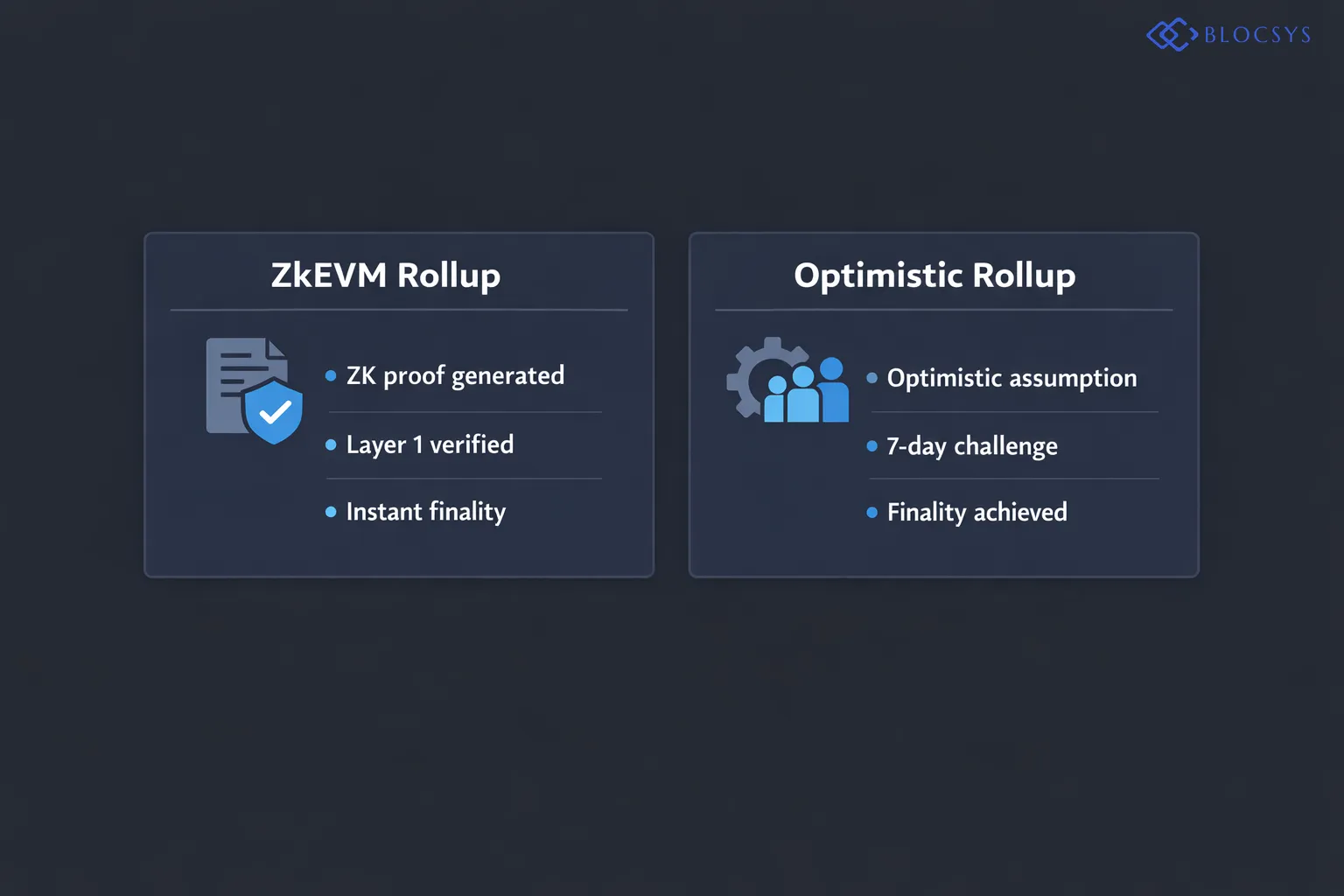
Finality time represents a critical difference between the two systems. ZkEVM achieves finality within minutes after proof generation and Layer 1 verification. Optimistic rollups, however, require a full seven-day challenge period before withdrawals settle on Layer 1. Therefore, liquidity-sensitive applications such as DeFi protocols strongly favor ZkEVM’s faster finality model.
Gas Fees and Computational Costs
Both rollup types reduce gas fees significantly compared to Ethereum mainnet. Optimistic rollups skip on-chain proof generation, which lowers their computational overhead considerably. Consequently, their per-transaction costs are sometimes marginally cheaper than ZkEVM solutions in certain scenarios. However, ZK proof generation costs continue to decrease rapidly as hardware acceleration improves. Furthermore, batching more transactions into each proof makes ZkEVM increasingly cost-competitive over time.
Security Models
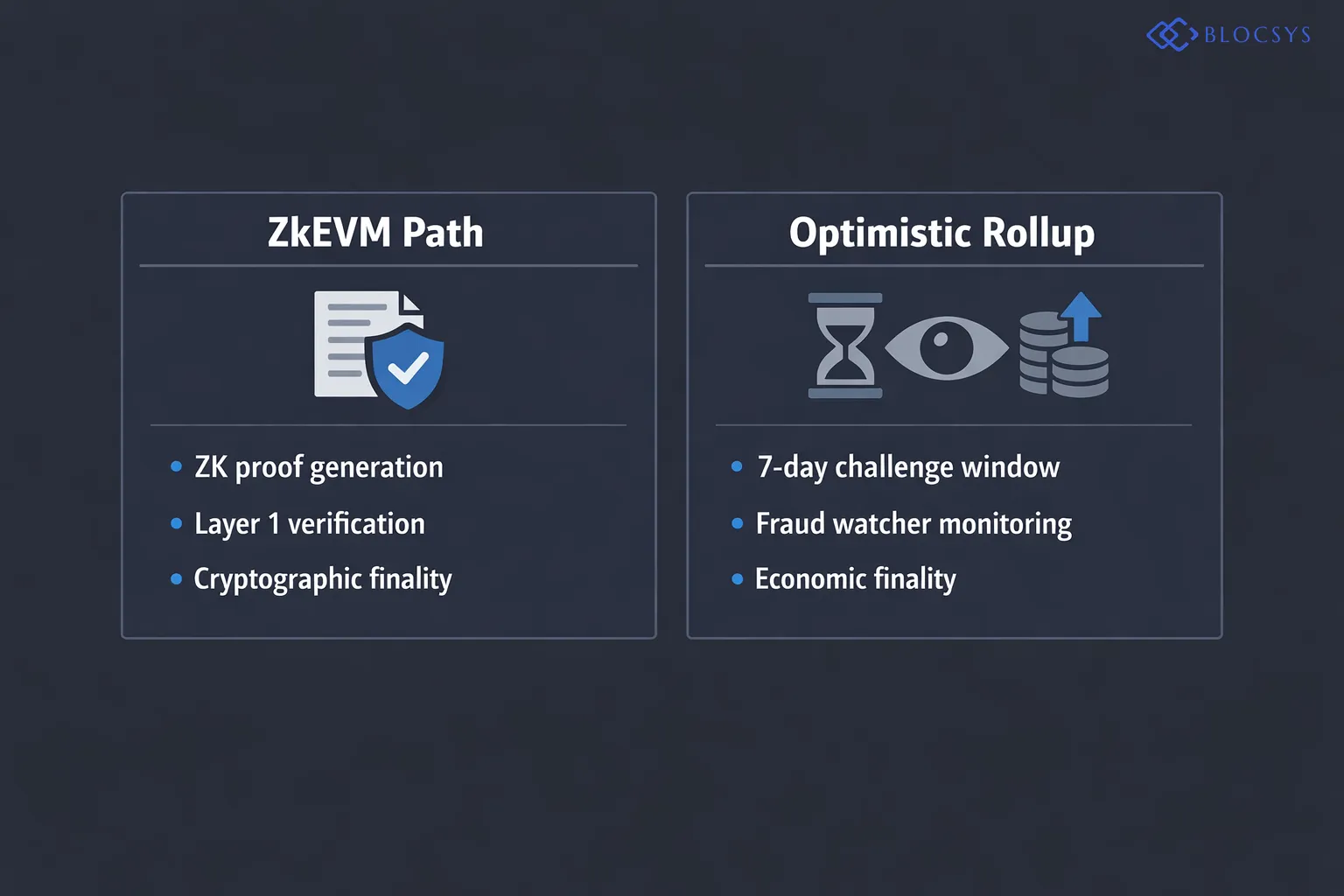
ZkEVM relies on mathematical guarantees — a valid proof simply cannot be forged. Therefore, it delivers the strongest cryptographic security model available in Layer 2 today. Optimistic rollups, however, depend on economic incentives and active fraud watchers monitoring the network. Consequently, their security model is partially social rather than purely mathematical. Moreover, the effectiveness of optimistic security depends on sufficient decentralization among monitoring participants.
Real-World Projects and Adoption
Several major projects represent each technology in active production. Polygon zkEVM, zkSync Era, and Scroll lead the ZkEVM category today. Additionally, Starknet provides a ZK-based solution using its custom StarkVM architecture. On the optimistic side, Arbitrum and Optimism command the largest market share by total value locked. Therefore, both approaches have proven themselves at significant scale in competitive environments.
Developer tooling for both ecosystems has matured considerably over recent years. Moreover, the choice between them increasingly depends on your application’s specific requirements rather than ecosystem readiness alone. Consequently, teams now have the luxury of evaluating both technologies purely on their technical merits. Explore the top Layer 2 projects by TVL to compare live performance metrics directly.
Which Rollup Technology Is Right for You?
Choosing between ZkEVM and optimistic rollups depends entirely on your project’s priorities. Therefore, begin by evaluating your need for fast withdrawals, cryptographic security strength, and EVM compatibility requirements. If your application demands instant finality and maximum trustlessness, ZkEVM is clearly the stronger choice. However, if developer simplicity and extensive existing tooling matter more right now, an optimistic rollup remains a solid and proven option.
Furthermore, the gap between the two technologies continues to narrow at a rapid pace. ZK proof generation is becoming faster and cheaper with each hardware and software advancement. Consequently, many blockchain experts predict ZkEVM will eventually dominate the rollup landscape long-term. Nevertheless, optimistic rollups will remain highly relevant for use cases where the seven-day challenge period imposes no practical limitation on the overall user experience.