
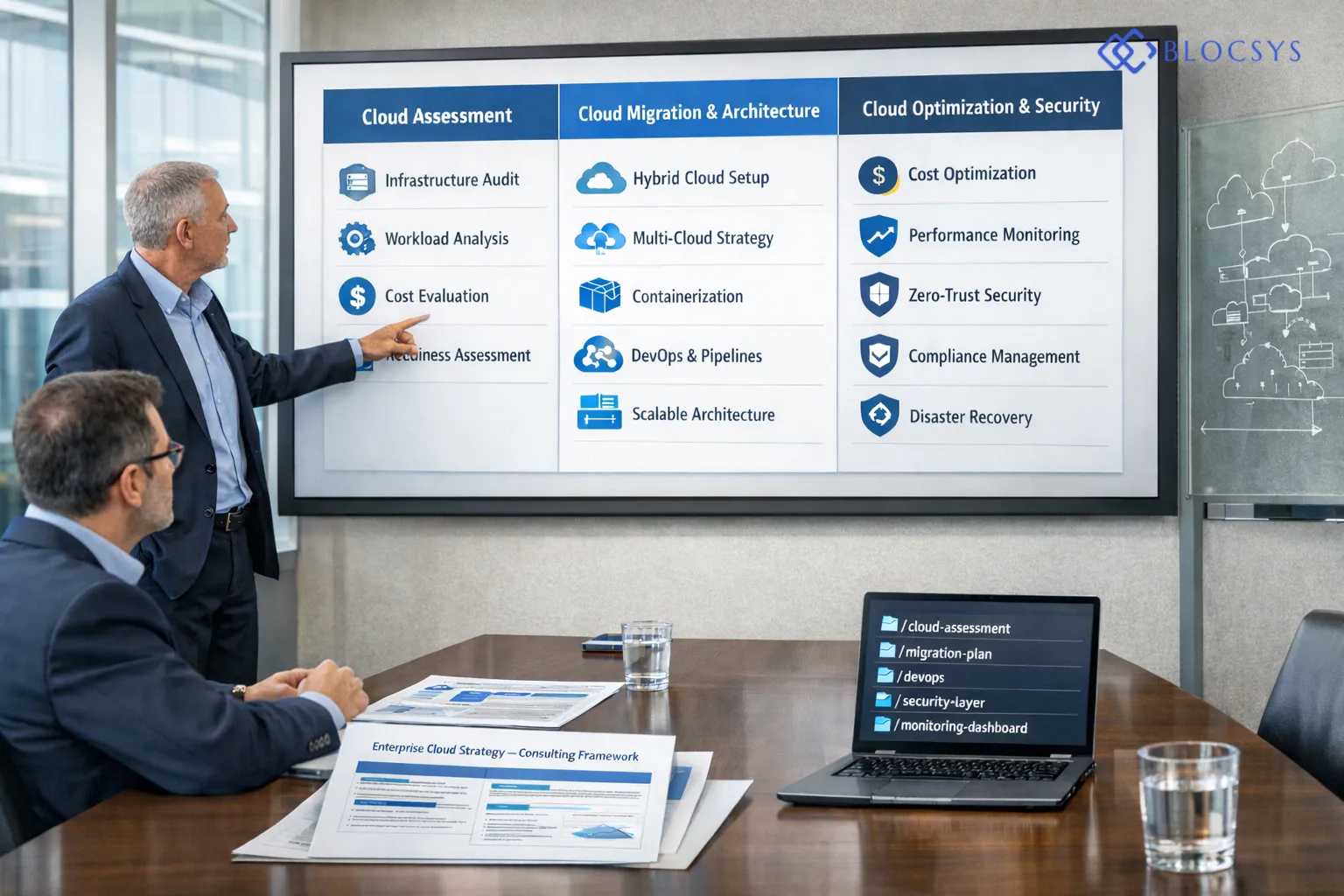
Cloud computing consulting isn’t just about managing servers. It’s a strategic partnership designed to turn your ambitious vision—whether it’s a decentralised finance platform, an AI-powered service, or a carbon tokenisation project—into a secure, scalable, and battle-tested reality. It goes far beyond generic IT support.
This guide is for founders and CTOs in high-stakes fields like Web3, AI, and carbon markets. We’ll provide a clear decision framework for selecting the right cloud strategy and partner, helping you build production-ready systems that solve the unique challenges of your industry and are ready for the future.
What is Cloud Computing Consulting in Web3 and AI?
In innovative spaces like Web3, AI, and carbon markets, the cloud is more than data storage; it’s the engine that powers your entire operation. Cloud computing consulting is the specialized expertise used to design, build, and fine-tune that engine. A consultant acts as an architectural co-founder, translating your business goals into a resilient technical foundation capable of handling the unique pressures of decentralised, data-intensive systems.
A true consulting partnership focuses on several core objectives:
- Architecting for Resilience: Designing infrastructure that anticipates and withstands the volatile loads and sophisticated security threats common in blockchain and financial applications.
- Ensuring Scalability: Building a system that can smoothly scale from its first ten users to millions without buckling—a frequent downfall of new trading platforms.
- Optimising Costs: Applying FinOps principles from day one to manage your cloud spend, ensuring your budget doesn’t spiral out of control as you grow.
- Integrating Security by Design: Embedding security and compliance into the architecture from the ground up. For anyone handling financial assets or sensitive data, this is non-negotiable.
To help you understand how these areas fit together, we’ve outlined the key domains a specialised cloud consultant will focus on.
Cloud Consulting Focus Areas for Modern Tech Stacks
The table below breaks down the specific challenges that Web3, AI, and carbon projects face and how expert consulting directly addresses them. It’s a roadmap for turning complex technical problems into business advantages.
| Domain | Key Challenge | Consulting Objective |
|---|---|---|
| Cloud Architecture | Generic architectures fail under the strain of decentralised loads and complex data pipelines. | Design bespoke, event-driven, or serverless architectures for resilience and low latency. |
| Security & Compliance | Handling digital assets and sensitive data requires navigating custody, audits, and regulations. | Implement a DevSecOps culture, secure key management, and ensure regulatory adherence. |
| Migration & Modernisation | Moving legacy systems or monolithic apps to a decentralised, cloud-native model is complex. | Develop a phased migration strategy that minimises downtime and de-risks the transition. |
| Performance Optimisation | Poorly configured infrastructure leads to slow transactions, high latency, and bad user experiences. | Fine-tune infrastructure, databases, and networks for peak performance and cost-efficiency. |
| Vendor Selection & RFP | Choosing the right cloud provider and third-party tools is overwhelming and has long-term consequences. | Create data-driven vendor scorecards and manage the RFP process to secure the best partners. |
Ultimately, a strong consulting partnership ensures that every technical decision is tied directly to a business outcome, from securing user assets to achieving global scale.
Future Outlook: 12–24 Months
Looking ahead, the convergence of AI, blockchain, and decentralised physical infrastructure networks (DePIN) will drive demand for even more specialised cloud solutions. We anticipate a greater need for architectures that support real-time AI model training, sovereign data management, and verifiable compute for carbon credit verification. A key part of navigating this landscape is understanding how to integrate powerful new technologies like Large Language Models (LLMs), which demand unique cloud configurations.
This guide will give you a clear framework for selecting the right cloud strategy and partner, moving you from basic IT support to solving the real, high-stakes challenges of building next-generation products. And if you’re just starting out, our primer on what is Web3 offers a great foundation for the journey ahead.
How to Design Your Cloud Architecture for Decentralised Systems
The success of any decentralised application rests squarely on its underlying architecture. Generic, one-size-fits-all cloud models don’t work for the unique demands of Web3, AI, and crypto. You wouldn’t use the same blueprints for a suburban house and a skyscraper; a DeFi platform similarly needs a rock-solid cloud architecture to manage high transaction volumes and constant security threats.
This is where the relationship between your technology stack and your infrastructure becomes critical.
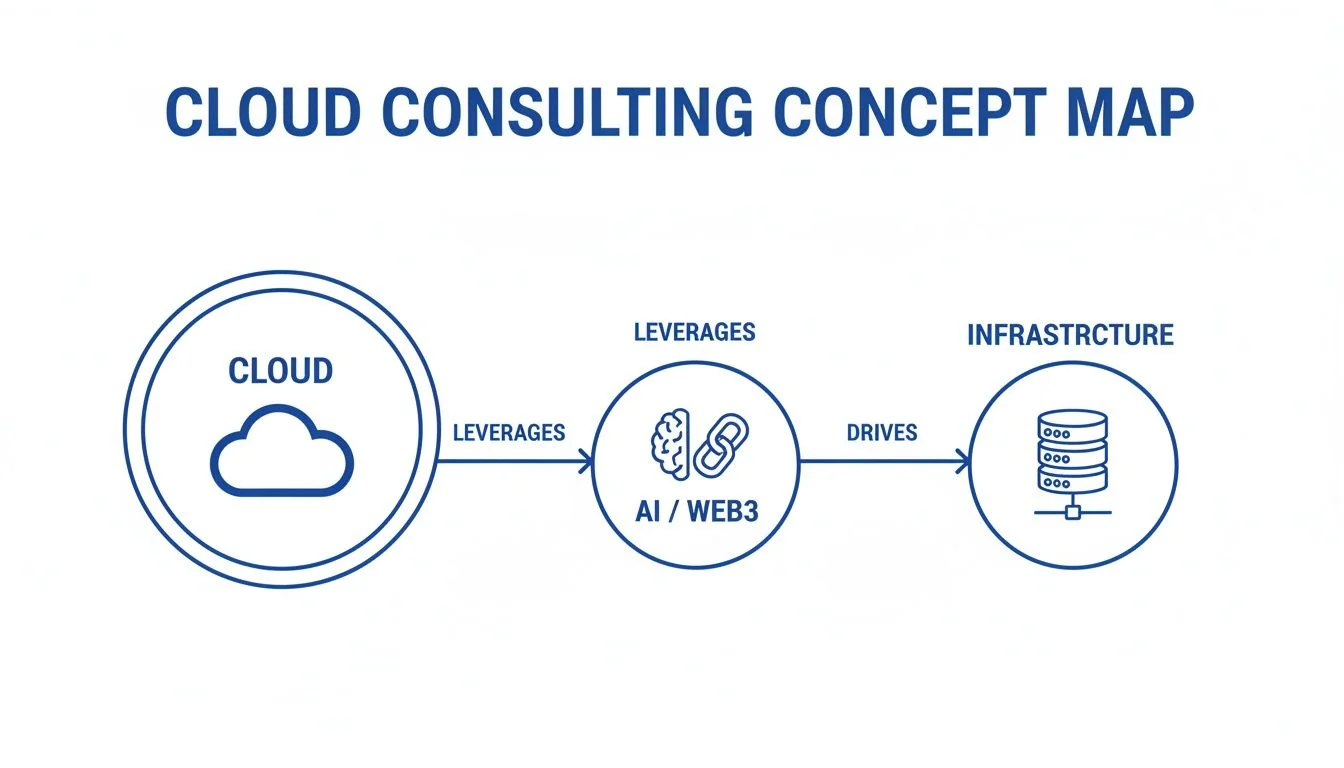
As you can see, specialised infrastructure isn’t an afterthought—it’s a direct consequence of the technologies you choose. Effective cloud computing consulting is all about building this specialised foundation from the ground up.
Which Architectural Pattern is Right for You?
For decentralised systems, standard architectural patterns need a serious rethink. A proof-of-stake blockchain, for instance, requires geographically distributed validator nodes to guarantee network integrity and resilience. On the other hand, a perpetual futures trading platform demands an ultra-low-latency setup to process thousands of orders per second without slippage. The architecture has to fit the mission.
The choice between a monolith and microservices isn’t just a technical detail; it’s a strategic business decision. It dictates how fast you can innovate, how resilient your platform will be, and how you’ll manage costs as you scale.
A monolithic architecture might seem faster to develop initially. But for a complex system like a multi-chain decentralised exchange (DEX), a microservices approach offers far greater flexibility and resilience by breaking the application into smaller, independent services.
Here’s a practical framework for making the right choice:
- For a nimble Telegram mini-app or a simple NFT minting site: A serverless architecture is often your best bet. It scales automatically with user traffic and cuts down on operational headaches, letting your team focus on the product.
- For a heavy-duty AI analytics engine or a high-frequency trading bot: You’ll need dedicated compute resources. These applications require the kind of predictable, sustained performance that serverless functions can’t always guarantee.
- For a growing DeFi protocol or a real-world asset (RWA) tokenisation platform: A microservices architecture is the clear long-term winner. It lets you scale or update individual components—like your pricing oracle or compliance module—without taking the entire application offline.
How to Ensure Consistency with Containerisation
No matter which architecture you land on, making sure your application runs reliably everywhere is paramount. This is exactly what containerisation technologies like Docker and Kubernetes were built for.
A container bundles your application with all its dependencies—libraries, frameworks, and config files—into a neat package that runs identically on a developer’s laptop, a testing server, or any public cloud like AWS, Google Cloud, or Azure. Kubernetes takes this a step further, acting as an orchestrator to automate deployment, scaling, and management, which is absolutely essential for maintaining uptime for critical infrastructure. For a closer look at how this applies to blockchain, you might find our guide on decentralised cloud for blockchain-powered data management useful.
How to Master Hybrid and Multi-Cloud Strategies
A single public cloud isn’t always the answer. For innovators in highly regulated sectors like fintech and those building mission-critical Web3 infrastructure, putting all your digital assets in one basket creates unacceptable risks. This is why mastering hybrid and multi-cloud strategies has become a core competency, moving beyond a simple preference to a strategic necessity for balancing security, scalability, and resilience.
This strategic pivot is essential for any serious player in the market.

Expert cloud computing consulting helps you architect a deployment model that fits your specific needs, rather than forcing your project into a generic mould.
When Should You Use a Hybrid Cloud?
A hybrid cloud model blends a private cloud (on-premises or hosted) with a public cloud, allowing data and applications to be shared between them. This is ideal for organizations that need to balance extreme security for sensitive data with the flexibility of the public cloud for less critical workloads.
For a decentralised trading platform, this could mean:
- Private Cloud: Housing sensitive operations like institutional-grade digital asset custody, private key management, and core compliance workflows. This environment offers maximum control and air-gapped security.
- Public Cloud: Running user-facing applications, trade execution engines, and data analytics dashboards. This provides the agility and scalability needed to handle fluctuating user demand without over-provisioning expensive private hardware.
The hybrid model isn’t just about security; it’s about intelligent resource allocation. It allows you to place workloads where they perform best and cost least, giving you both fortification and flexibility.
For projects in decentralised finance, this hybrid model is ideal for supporting secure infrastructures for crypto OTC trading and carbon tokenisation without exposing sensitive wallet data.
Why Do You Need a Multi-Cloud Strategy?
While a hybrid setup combines private and public clouds, a multi-cloud strategy involves using services from two or more public cloud providers, like AWS, Google Cloud, and Azure. The primary drivers here are avoiding vendor lock-in and building extreme resilience.
For critical infrastructure like a cross-chain bridge or a real-world asset (RWA) oracle, depending on a single provider creates a single point of failure. A multi-cloud architecture distributes your infrastructure across different vendors, so an outage at one provider won’t bring your entire system down. As you master these strategies, it is essential to understand the fundamental differences when evaluating options like a Multi-Cloud vs Hybrid Cloud setup.
Choosing the right cloud model is a foundational decision, directly impacting security, cost, and agility. The table below breaks down the most common deployment models to help you align your infrastructure with your strategic goals.
Cloud Deployment Model Comparison: Startup vs. Enterprise
| Model | Best For (Startup) | Best For (Enterprise) | Risk Profile |
|---|---|---|---|
| Public Cloud | Default choice for speed and low initial cost. Ideal for MVPs and dApps. | Non-sensitive workloads, dev/test environments, and scalable web applications. | Shared responsibility; risk of vendor lock-in and unpredictable costs. |
| Private Cloud | Rarely used due to high initial cost. Reserved for highly specific security needs. | Core banking systems, R&D, and data requiring strict sovereignty. | Higher operational overhead but full control over security posture. |
| Hybrid Cloud | Startups handling sensitive data (e.g., FinTech) needing public-facing scalability. | The dominant model for balancing legacy systems with modern cloud services. | “Best of both worlds” but adds architectural and operational complexity. |
| Multi-Cloud | Startups building mission-critical services needing 100% uptime (e.g., oracles). | Global enterprises seeking geo-resilience and avoiding vendor dependency. | Highest resilience but most complex to manage security and costs. |
Ultimately, there is no one-size-fits-all answer. The optimal choice depends entirely on your project’s specific requirements for security, compliance, performance, and cost management.
The Rise of Edge Computing and DePIN
Beyond the data centre, a new frontier is emerging: the edge. Edge computing brings computation and data storage closer to the sources of data to improve response times and save bandwidth. This is the foundation for Decentralized Physical Infrastructure Networks (DePIN).
Instead of sending raw data to a centralised cloud, processing happens on or near the device itself. This is particularly relevant for:
- IoT-Linked Carbon Tracking: Sensors in a rainforest or on industrial equipment can process data locally to verify carbon credits in real-time without massive data transfers.
- AI-Powered Prediction Markets: Edge devices can run lightweight AI models to analyse local event data instantly, feeding faster, more accurate insights into the market.
How to Implement Security and Compliance for Decentralised Finance
In the high-stakes world of Web3 and decentralised finance, security isn’t just a feature—it’s the absolute foundation. For any project handling digital assets, even a small vulnerability can trigger catastrophic losses. This is where expert cloud computing consulting becomes essential, helping you build a fortress around your infrastructure and move beyond basic security to implement institutional-grade, compliance-aware defences.
It all starts with a fundamental shift in mindset: treating security as a non-negotiable part of the development lifecycle, not an afterthought.

Building a Bulletproof DevSecOps Pipeline
Traditional DevOps prioritises speed, but for financial applications, that speed must be balanced with relentless security. This is where DevSecOps comes in. It’s a culture that integrates security testing and validation into every stage of your continuous integration and continuous delivery (CI/CD) pipeline.
Without this, your CI/CD process can accidentally become a backdoor for attackers. A consultant helps you forge a pipeline that includes:
- Static Application Security Testing (SAST): Automatically scanning your code for vulnerabilities before it’s even compiled.
- Dynamic Application Security Testing (DAST): Testing your running application for security flaws in a safe, staged environment.
- Software Composition Analysis (SCA): Identifying and flagging vulnerabilities lurking within the open-source libraries and dependencies your project relies on.
By embedding these checks directly into the workflow, you catch potential issues early, long before they ever see production.
Adopting Institutional-Grade Security Practices
For any platform managing financial assets—whether it’s a crypto OTC desk or a real-world asset tokenisation platform—standard security measures don’t cut it. You need institutional-grade, audited, and battle-tested practices. With worldwide cybercrime costs projected to hit $10.5 trillion annually by 2025, robust security is simply an economic necessity.
A key role for a cloud consultant is implementing these advanced security layers. This includes regular infrastructure audits and, critically, Vulnerability Assessment and Penetration Testing (VAPT). VAPT is a simulated cyberattack to find and exploit weaknesses, giving you a real-world stress test of your defences.
A clean security audit isn’t a one-time achievement; it’s the result of a continuous process of testing, hardening, and monitoring. In Web3, your reputation is built on your ability to protect user assets, and that protection is never static.
Designing for Digital Asset Custody and Compliance
Handling digital assets introduces unique hurdles around custody and compliance. Your cloud architecture must be designed from the ground up to tackle them. This means creating a secure, isolated environment for wallet architecture and private key management, often using a hybrid cloud model to wall off these critical functions.
Cloud-native solutions play a huge part here. A consultant can help you properly configure:
- Hardware Security Modules (HSMs): Cloud-based HSMs provide tamper-resistant hardware for generating, storing, and managing cryptographic keys, ensuring they are never exposed.
- Secure Multi-Party Computation (MPC): For wallets, MPC is a game-changer. It allows multiple parties to collectively sign a transaction without ever exposing the full private key, dramatically cutting the risk of theft from a single point of failure.
- Compliance-Aware Workflows: This involves designing automated workflows that enforce regulatory requirements, like KYC/AML checks, before any transactions are even processed.
A consultant also helps configure your infrastructure to head off risks from smart contract bugs and faulty on-chain/off-chain data synchronisation. This means setting up isolated sandboxes for smart contract testing, implementing robust monitoring to spot data discrepancies, and creating automated fail-safes that can halt operations if an anomaly is detected.
How to Evaluate Cloud Computing Consulting Partners
The right technology demands the right partner. Picking a cloud computing consulting firm is one of the most important decisions you’ll make, especially when your roadmap includes complex systems for Web3, AI, or crypto.
Get it wrong, and you’re looking at architectural dead ends, security holes, and blown budgets. Get it right, and that partner acts as a strategic multiplier. This isn’t about finding an order-taker; it’s about securing an engineering partner who understands the nuances of your world—from decentralised consensus mechanics to institutional-grade asset security.
Comparing Project Delivery and Staff Augmentation
Your first big decision is the engagement model. This usually boils down to two paths: handing over a full project or augmenting your existing team. The best choice depends on your in-house expertise, project timeline, and ultimate goals.
Project-Based Delivery: You scope a project and hand it to the consulting firm, who owns it from architecture to deployment. It’s perfect for building a complete, end-to-end solution, like a new perpetual trading platform. You get a cohesive team with proven workflows.
Staff Augmentation: The firm’s engineers embed directly into your team to plug specific skill gaps. This is a great fit if you have a strong internal tech lead but need specialised knowledge, like Rust development for a Solana project or complex AI workflow integration. It delivers flexibility and knowledge transfer. For a deeper dive into this approach, understanding the benefits of IT outsourcing services can offer valuable context.
So, what’s the verdict? A full project delivery partner like Blocsys brings end-to-end accountability. Staff augmentation, on the other hand, provides surgical expertise exactly where you need it most.
The Web3 and AI Request for Proposal (RFP) Checklist
When you draft an RFP for a cloud partner, generic IT questions won’t cut it. Your checklist needs to probe for the specific, non-negotiable expertise required to build high-stakes financial and decentralised infrastructure.
A consultant’s true value isn’t their familiarity with a cloud provider’s dashboard. It’s their proven ability to apply that technology to solve specific, difficult problems within your domain, like securing digital assets or scaling a matching engine.
Your RFP must rigorously test a firm’s capabilities across these mission-critical areas:
Technical & Protocol Expertise
- Smart Contract Engineering: Do they have battle-tested experience in Solidity (for EVM chains) and Rust (for chains like Solana or Polkadot)? Ask for code samples or public GitHub repositories.
- Scalable Backend Architecture: Can they point to examples of high-throughput backends they’ve built using frameworks like Node.js or Go? You’re looking for experience with order book systems and real-time data processing.
- AI Workflow Integration: Have they put AI/ML models into production cloud environments for things like analytics, prediction markets, or operational automation?
Process & Security Maturity
- Proven Security Record: Have they successfully passed third-party security audits and VAPT for financial applications? Request anonymised reports or client references to verify.
- Clear Documentation Practices: How do they document system architecture, APIs, and deployment processes? Vague documentation is a massive red flag.
- Transparent Communication: What tools and rhythms do they use for project updates? Look for a commitment to daily stand-ups, shared tracking boards (like Jira), and direct access to engineers.
A partner who aces these questions demonstrates the execution discipline needed to ship production-ready systems. A weak answer in any of these areas should be a deal-breaker.
How Blocsys Delivers Production-Ready Cloud Infrastructure
Turning an ambitious concept into a battle-tested, production-ready system is where theory meets execution. Blocsys operates as a specialised engineering and cloud computing consulting partner, focused on translating complex Web3 and AI visions into tangible, scalable infrastructure. Our job is to deliver concrete outcomes, not just architectural diagrams.
We’ve developed an end-to-end delivery model designed for the unique pressures that fintechs, startups, and enterprises face in decentralised markets. It’s a disciplined process that carries an idea from initial strategy all the way to live deployment, ensuring every component is built for serious performance and security from the start.
From Architecture to Execution
Our work begins with a deep dive into system architecture and protocol design. This lays a foundation that aligns with your long-term business goals. We don’t just apply generic templates; we architect solutions for specific use cases, whether it’s a high-frequency decentralised perpetuals platform or a real-world asset (RWA) tokenisation system for precious metals.
This initial phase covers:
- Smart Contract Engineering: We write clean, gas-optimised, and secure smart contracts in Solidity or Rust, depending on the target blockchain ecosystem.
- Scalable Backend Deployment: Our teams build robust backends with frameworks like Node.js to handle high-throughput transactions and real-time data processing without bottlenecks.
- Institutional-Grade Security: We integrate DevSecOps, infrastructure audits, and VAPT from day one to create a hardened security posture, not as an afterthought.
Our delivery model is built on execution discipline. We bridge the gap between brilliant ideas and operational reality, ensuring your platform is not only innovative but also reliable, secure, and ready for market adoption.
Specialised Expertise for Advanced Platforms
Our team brings direct, hands-on experience in building the next generation of on-chain products. We connect our expertise in hybrid-cloud strategies, compliance-aware workflows, and institutional security directly to projects that are defining the future of finance and technology.
This allows us to build sophisticated systems with confidence, including:
- Decentralised Equity-Traded Funds (dETFs): We architect the on-chain and off-chain components needed to manage complex financial instruments in a fully decentralised context.
- AI-Assisted Trading Systems: Our engineers integrate AI models and agents into cloud infrastructure to power predictive analytics and automate trade execution at scale.
- Carbon Tokenisation Platforms: We design the complete infrastructure for transparently measuring, verifying, and trading environmental assets on-chain.
We empower you to build, scale, and execute your vision with a proven partner at your side. Our goal isn’t just to launch your project—it’s to ensure it has the resilient foundation needed for sustained growth and long-term success in a competitive market.
Frequently Asked Questions
When building in Web3 or AI, founders and CTOs inevitably have practical questions about infrastructure and partnerships. This FAQ provides clear, concise answers to common concerns, optimized for both human readers and search engines, based on real-world project experience.
How Much Does Cloud Consulting Cost for a Web3 Project?
Cloud computing consulting costs for a Web3 project vary based on scope, security needs, and engagement model. A simple dApp costs less than a cross-chain exchange requiring a hybrid-cloud setup, institutional-grade security, HSMs, and multiple audits. Costs are driven by project complexity, security requirements, and whether you need a full project team or staff augmentation.
Can We Migrate an Existing App to a Decentralised Cloud?
Yes, you can migrate an existing app to a decentralised architecture, but it requires strategic re-architecting, not a simple “lift and shift.” An experienced consultant is vital for a smooth, secure transition. The process involves assessing your current app, designing a new decentralised blueprint (e.g., microservices), and executing a phased migration to minimize downtime and ensure data integrity.
What Is the Difference Between a Cloud Consultant and an MSP?
A cloud consultant is a strategic architect who designs and builds the right solution to solve a business problem, focusing on initial architecture, technology choices, and security. A Managed Service Provider (MSP) handles ongoing operations after launch, focusing on 24/7 monitoring, maintenance, and incident response. Think of the consultant as the architect and builder, and the MSP as the pit crew.
How Long Does It Take to Deploy a Secure DeFi Backend?
Deploying a production-ready, secure DeFi backend typically takes 4-6 months. This timeline reflects the disciplined process required to build trust and protect user assets. A typical project breaks down into four stages: Discovery & Architecture (2–4 weeks), Development & Integration (8–12 weeks), Security Audits & VAPT (4–6 weeks), and Deployment & Go-Live (2–4 weeks).
At Blocsys Technologies, we specialise in turning ambitious Web3 and AI concepts into production-ready reality. Our end-to-end delivery model, from architecture and smart contract engineering to scalable backend deployment, is designed for the unique demands of fintechs and enterprises. Connect with our experts to learn how we can help you build, scale, and execute your vision effectively. Schedule your free consultation with Blocsys today.
