
Real estate tokens are digital representations of fractional ownership in a physical property, managed on a blockchain. For enterprises, startups, and investors in the Web3, AI, and crypto sectors, they solve a critical problem: unlocking liquidity from high-value, illiquid assets. This guide provides a comprehensive framework for understanding, evaluating, and building the infrastructure needed to capitalize on this transformative market. We’ll cover the decision-making criteria, technical architecture, regulatory risks, and future outlook you need to succeed.
What Are Real Estate Tokens? A Concise Definition
Real estate tokens are digital securities that represent ownership shares in a physical property. A single asset, like an office building or logistics center, is placed into a legal entity (an SPV), which then issues blockchain-based tokens. Each token represents a direct, fractional ownership stake, making it possible to trade slices of high-value real estate like stocks.

This model re-engineers property investment by solving three core challenges:
- High Capital Requirements: Tokenization democratizes access. Instead of needing millions, investors can buy fractional shares for a few hundred or thousand dollars, opening the market to a global audience.
- Poor Liquidity: Traditional property sales take months. Tokens can be traded on secondary markets 24/7, offering a path to near-instant liquidity that transforms a static asset into a dynamic financial instrument.
- Operational Inefficiencies: Blockchain provides a single, immutable ledger for all transactions. This radical transparency reduces fraud, streamlines ownership transfers, and automates processes like dividend distribution via smart contracts.
To illustrate the paradigm shift, consider the difference between a traditional investment and a tokenized one.
How Do Real Estate Tokens Compare to Traditional Investing?
This comparison framework highlights the key differences for decision-makers evaluating both models.
| Evaluation Criterion | Traditional Real Estate | Tokenized Real Estate (RWA) |
|---|---|---|
| Minimum Investment | Extremely high; limits access to institutions and high-net-worth individuals. | Very low; enables fractional ownership and broad market participation. |
| Liquidity | Very low; asset sales are slow, costly, and can take months or years. | Potentially high; tokens can be traded on secondary markets 24/7. |
| Transaction Speed | Slow; burdened by extensive paperwork, legal delays, and manual processes. | Fast; transactions settle in minutes on the blockchain. |
| Ownership Structure | Direct, whole ownership, often with complex legal title arrangements. | Fractional, via digital security tokens representing a stake in an SPV. |
| Market Accessibility | Geographically restricted and limited to accredited or institutional investors. | Global; accessible to a wide range of retail and institutional investors. |
| Transparency | Opaque; ownership records are held in centralized, often inaccessible registries. | Fully transparent; ownership and transactions are on an immutable public ledger. |
| Management & Admin | Hands-on property management required, or significant third-party fees. | Passively managed by the platform; dividends are automated via smart contracts. |
As the table shows, tokenization makes property investing more efficient, accessible, and democratic.
Decision Framework: Is Tokenization Right for Your Asset?
For asset owners and developers, deciding whether to tokenize a property involves weighing strategic benefits against operational readiness. Use this framework to evaluate an asset’s suitability:
- Asset Quality & Income Potential: Is the property a high-quality, income-generating asset (e.g., Grade-A commercial, logistics hub) that is attractive to investors?
- Market Demand: Is there a clear investor appetite for fractional ownership of this type of asset in this geography?
- Legal & Regulatory Clarity: Can the asset be legally structured within an SPV in a jurisdiction with clear guidelines for digital securities (like GIFT City in India)?
- Capital & Cost: Do you have the capital for the upfront legal structuring, technical platform development, and marketing costs?
- Long-Term Vision: Is the goal to unlock liquidity, raise capital for new projects, or create a new investment product for a global audience?
If the answers point toward a clear strategic advantage, the next step is to understand the technical and legal execution process.
How Does the Property Tokenization Process Work?
Tokenizing a real-world asset is a multi-stage process that merges legal structuring with blockchain engineering. It is not simply “minting a token”; it is the creation of a regulated financial instrument from the ground up.
The process unfolds in three key phases:
- Legal & Financial Structuring: The property is legally prepared for tokenization. This involves creating a Special Purpose Vehicle (SPV), a distinct legal entity that holds the property title. This crucial step isolates the asset, protecting investors from the original owner’s other financial liabilities and creating a clean, investable structure.
- Technical Development (Tokenization): The tokenization platform develops a smart contract that defines the rules of the real estate tokens—how they can be issued, traded, and managed. Tokens representing ownership in the SPV are then minted on a blockchain like Ethereum or Polygon.
- Distribution & Trading: The tokens are offered to verified investors in a primary issuance (like an IPO). After the initial sale, tokens can be traded on a secondary market or alternative trading system (ATS), providing liquidity.
What Is the Role of Smart Contracts and Token Standards?
The smart contract is the digital engine of tokenization. It’s self-executing code that automates compliance, dividend distribution, and ownership rules. For regulated assets like real estate, a simple ERC-20 token is insufficient. Security token standards are required to enforce compliance on-chain.
Key standards include:
- ERC-1400: A complex security token standard designed for handling transfer restrictions and providing detailed error messages for failed transactions.
- ERC-3643 (T-REX): An increasingly popular standard focused on compliance. It integrates an on-chain identity system, allowing issuers to enforce transfer rules in real-time based on an investor’s verified credentials (e.g., KYC status, jurisdiction).
These standards are the foundation of a robust token management system, which is essential for any compliant tokenization platform. The system must also include secure digital wallets, a transparent order book for trading, and tools for automated dividend distribution to token holders.
What Are the Key Legal and Regulatory Considerations?
Navigating the regulatory landscape is the single most critical challenge for any real estate tokenization venture. Because these tokens are considered securities, they fall under the strict oversight of financial regulators. In India, this involves a multi-agency framework.
- Securities and Exchange Board of India (SEBI): As the primary market regulator, SEBI treats real estate tokens as securities. This means any offering must adhere to rules on public issuance, investor protection, and full disclosure, similar to a mini-IPO.
- Reserve Bank of India (RBI): The RBI governs capital flows and financial stability. It mandates strict Anti-Money Laundering (AML) and Know Your Customer (KYC) protocols for all participants to prevent illicit financial activities.
- Real Estate Regulatory Authority (RERA): RERA ensures the underlying asset is legitimate. It verifies property titles, project approvals, and construction compliance, protecting investors from fraudulent real estate projects.
Regulatory Checklist for Tokenization Platforms (Enterprise vs. Startup)
| Compliance Area | Enterprise Perspective | Startup Perspective | Regulating Body |
|---|---|---|---|
| Securities Law | Full compliance with issuance/disclosure norms (via an SPV) is non-negotiable. | Must structure tokens as securities from day one to avoid future penalties. | SEBI |
| Investor Verification | Integrate institutional-grade KYC/AML systems into core platform architecture. | Implement mandatory, automated KYC/AML checks to ensure scalability and compliance. | RBI, SEBI |
| Property Due Diligence | Establish a rigorous, multi-stage due diligence process for all onboarded assets. | Partner with legal and real estate experts to verify property title and compliance. | RERA |
| Technology Security | Mandate independent, third-party audits of all smart contracts and platform code. | Conduct security audits as a core part of the development lifecycle, not an afterthought. | Self-regulated (Best Practice), Cert-In |
| Investor Protection | Provide institutional-level risk disclosures, transparent pricing, and secure custody. | Focus on clear, simple risk disclosures and building user trust through transparency. | SEBI |
As this checklist highlights, compliance isn’t an add-on; it’s the architectural foundation. This is why many legal teams now use specialized legal AI tools for lawyers to manage the complex documentation and compliance workflows.
A significant development is GIFT City in Gujarat, India’s first International Financial Services Centre (IFSC). Regulated by the IFSCA, it serves as a regulatory sandbox, providing a clearer, more streamlined path for launching compliant fractional ownership and tokenization platforms. This is a crucial advantage covered in this SEBI guide overview.
To explore the global standards underpinning this, our guide to the universal RWA standard ERC-7943 provides further insight.
What Are the Benefits and Risks of Real Estate Tokens?
A balanced decision requires a clear-eyed evaluation of both the advantages and the inherent risks of this emerging asset class.

Benefits (The Upside)
- Enhanced Liquidity: The ability to trade property shares 24/7 on secondary markets is the primary benefit, transforming an illiquid asset into a more fluid one.
- Fractionalization & Accessibility: Lowers the investment barrier from millions to hundreds, opening the property market to a global pool of investors.
- Transparency & Trust: All ownership and transaction records are stored on an immutable blockchain, creating a verifiable and auditable history.
- Operational Efficiency: Smart contracts automate dividend payouts and administrative tasks, reducing overhead and human error.
Risks (The Downside)
- Market & Liquidity Risk: While tokenization enables liquidity, it doesn’t guarantee it. Secondary markets for many tokens are still thin, which can make it hard to sell without affecting the price.
- Smart Contract Vulnerabilities: A bug or exploit in the smart contract code could lead to a catastrophic loss of funds or ownership records. Rigorous, independent security audits are essential mitigation.
- Regulatory Uncertainty: The legal framework for digital securities is still evolving globally. A sudden regulatory change could impact a token’s legal status, tradability, and value.
- Valuation Complexity: Valuing a real estate token requires a dual analysis: assessing the underlying property’s value (using metrics like the calculate cap rate) and the supply/demand dynamics of the token itself.
Success requires managing these risks proactively, particularly through robust technical security and a compliance-first approach.
What Is the Future Outlook for Real Estate Tokens? (12-24 Months)
The market for real estate tokens is shifting from proof-of-concept to institutional adoption. The next 12–24 months will be defined by three key trends: the influx of institutional capital, the rise of specialized asset classes, and the integration of AI and DeFi.
Institutional capital is already poised to enter the market, driven by clearer regulatory frameworks. Projections show tokenized commercial real estate growing at a 21% CAGR, with the Asia-Pacific region leading this expansion. This detailed analysis from Trade Brains explains how new guidelines are paving the way for this shift.
Enterprise vs. Startup Perspective: Future Trends
| Future Trend | Enterprise Perspective | Startup Perspective |
|---|---|---|
| Institutional Capital | Focus on building institutional-grade platforms with regulated custody and deep liquidity to attract large capital pools. | Target niche, high-yield asset classes to prove the model and attract early-adopter institutional funds. |
| Asset Specialization | Prioritize Grade-A commercial offices, logistics hubs, and data centers—assets familiar to institutional investors. | Innovate with new asset types like carbon credit-generating forests or renewable energy projects to create unique investment products. |
| AI & DeFi Integration | Integrate AI for dynamic property valuation and risk analysis. Explore DeFi for yield generation on tokenized assets. | Leverage AI for predictive analytics on smaller datasets. Build lightweight DeFi integrations for collateralized lending. |
The future belongs to platforms that can provide institutional-grade security, transparency, and liquidity.
How Blocsys Can Help You Build, Scale, and Execute
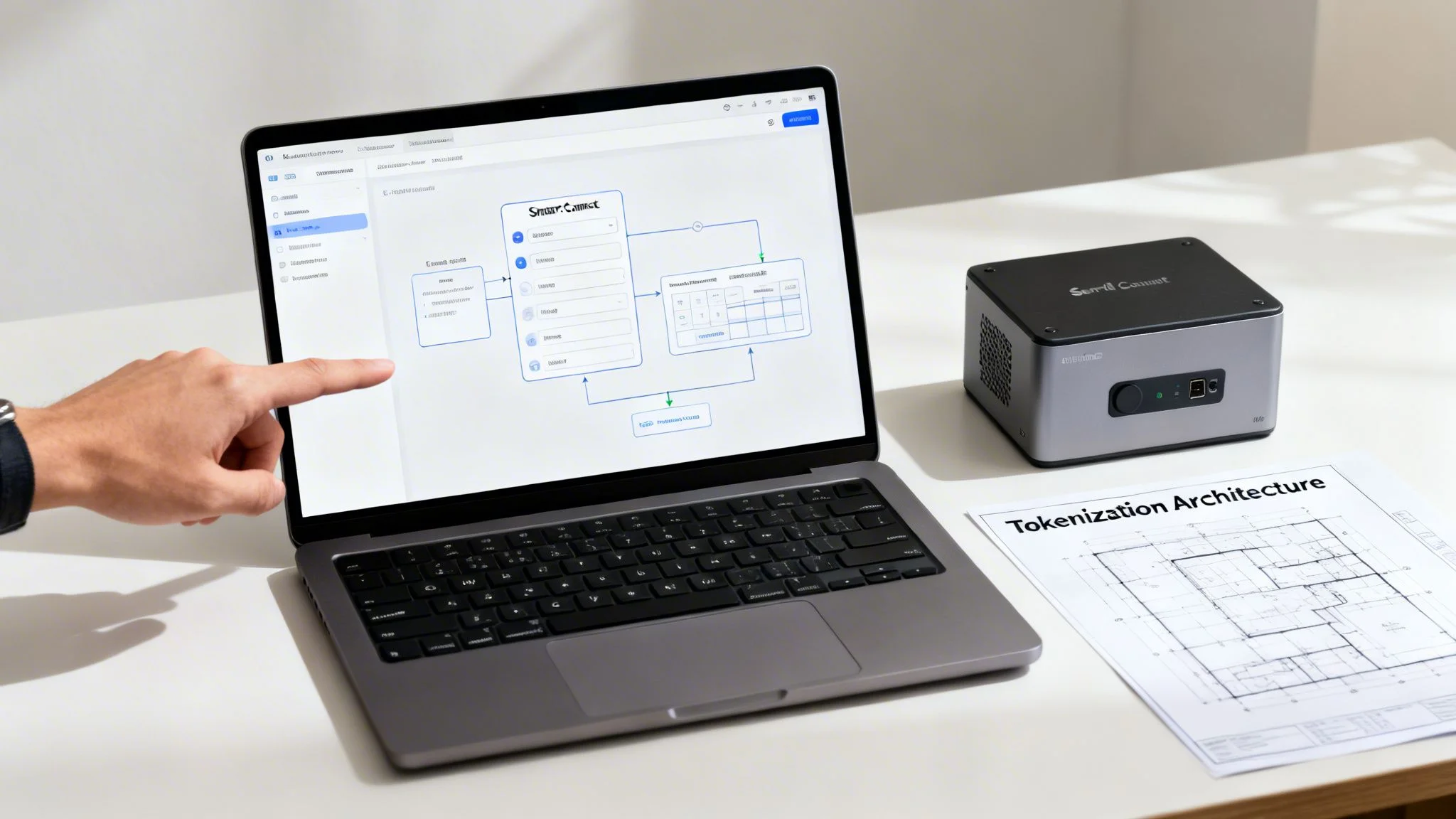
Understanding the market for real estate tokens is the first step. Executing a secure, compliant, and scalable tokenization platform is the real challenge. Blocsys is an expert engineering partner for organizations in the Web3, blockchain, and AI sectors, helping you translate complex financial models into production-ready infrastructure.
We don’t just provide off-the-shelf solutions; we deliver strategic engineering tailored to your business needs, ensuring you can build, scale, and lead in this competitive market.
Our core services are designed to address the key challenges of RWA tokenization:
- RWA System Architecture & Design: We architect the end-to-end technical blueprint for your platform, ensuring it is built for security, scalability, and regulatory compliance from day one.
- Institutional-Grade Smart Contract Development: Our experts build and rigorously audit the smart contracts that form the backbone of your tokenized assets. Our expertise in smart contract development services ensures your digital agreements are secure and optimized for performance.
- Secure Custody and Wallet Systems: We engineer robust custody solutions to protect investor funds and digital assets, building the trust necessary for institutional adoption.
- Scalable Backend and API Integration: We build the powerful backend infrastructure required to handle high transaction volumes, manage user data securely, and integrate with essential third-party services like KYC/AML providers.
If you are an enterprise or founder ready to build the next generation of financial infrastructure for real-world assets, the technical hurdles can be significant. Partner with Blocsys to navigate the complexity and execute effectively.
Frequently Asked Questions (FAQ)
Here are clear answers to the most common questions about real estate tokens.
Can I Get a Mortgage on a Tokenized Property?
No, traditional mortgages are not compatible with buying real estate tokens. A mortgage is secured against a property’s legal title. In a tokenized structure, the title is held by an SPV, not the individual token holders. However, the future of financing may involve using tokens as collateral for loans on DeFi protocols, offering a new form of liquidity.
Are Real Estate Tokens Considered Securities?
Yes, in almost all jurisdictions, tokens representing ownership in an asset with an expectation of profit are classified as securities. This subjects them to financial regulations, including mandatory KYC/AML, investor protection rules, and disclosure requirements. This regulatory oversight is what makes them a legitimate investment vehicle.
How Is a Tokenized Property’s Value Determined?
A token’s value is derived from the underlying real estate. Initially, an independent, professional appraisal establishes the property’s baseline value, which sets the token’s offering price. Post-issuance, the price is influenced by the property’s performance (e.g., rental income, market appreciation) and supply and demand dynamics on secondary trading markets.
What Happens If the Tokenization Platform Fails?
A properly structured tokenization model protects investors from platform failure. The property is held in a bankruptcy-remote SPV, legally separate from the platform operator. If the platform goes out of business, the token holders retain their ownership rights in the SPV and can collectively decide on the next steps, such as appointing a new manager or selling the asset.
At Blocsys Technologies, we specialize in engineering the secure, compliant, and scalable infrastructure required to launch a successful real estate tokenization platform. We transform complex financial models into production-ready systems built for the real world.
If you’re ready to build the next generation of financial infrastructure, connect with us to discuss how our expert engineering team can help bring your vision to life. Learn more and get in touch at Blocsys Technologies.
