
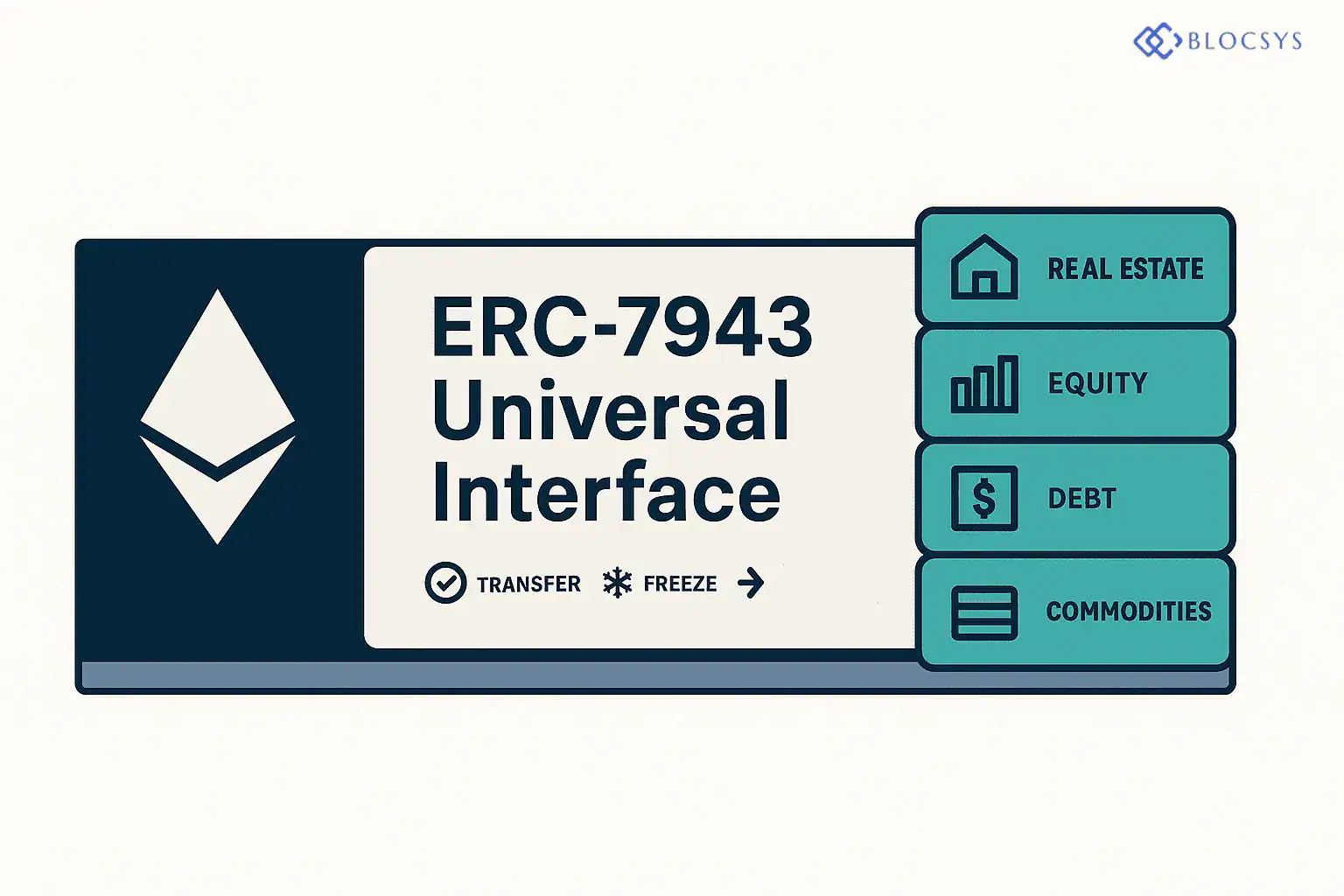
ERC-7943: A Guide To The New Ethereum Standard
ERC-7943 is a new Ethereum token standard built specifically for tokenized real-world assets (RWAs). Real estate, private credit, equities, and commodities are moving on-chain fast, and institutions need a shared compliance layer instead of custom code for every issuer. This guide explains what ERC-7943 is, how it compares to ERC-3643, and how developers can implement it. We also cover RWA tokenization use cases, account abstraction interplay, and the questions investors ask most.
What Is ERC-7943?
ERC-7943, also called the Universal Real-World Asset Interface (uRWA), is a minimal interface for tokenized real-world assets on Ethereum. It does not replace ERC-20, ERC-721, or ERC-1155. Instead, it layers compliance and control functions on top of them.
So what is ERC-7943 in practice? It is a small set of required functions, including canTransfer, forcedTransfer, and getFrozenTokens, that any compliant RWA token must expose. Developers decide how to implement the logic behind each function. The standard only fixes the interface, not the mechanism.
This matters because RWA issuers previously built proprietary compliance modules from scratch. Therefore, wallets, exchanges, and custodians had to learn a new integration for every platform. ERC-7943 removes that friction by giving everyone the same handful of functions to check against.
ERC Stands For: A Quick Primer
ERC stands for Ethereum Request for Comment, the process used to propose and standardize behavior on Ethereum. Every ERC number, including ERC-7943, ERC-20, and ERC-3643, refers to a specific improvement proposal. Understanding this naming convention helps explain why so many “ERC-” standards exist side by side rather than replacing one another outright.
Key Features Of The ERC-7943 Standard
The ERC-7943 Ethereum token standard is compact by design, yet it covers the controls institutions actually need. Below are its core capabilities.
- Minimal, implementation-agnostic design — it defines what a compliant token must do, not how.
- canTransfer / isUserAllowed — checks whether a transfer meets compliance rules before it executes.
- forcedTransfer — lets an authorized party execute a transfer, for example under a regulator or court order.
- getFrozenTokens / setFrozenTokens — supports freezes, lock-ups, escrow, and regulatory holds.
- Cross-standard compatibility — works with fungible, NFT, and semi-fungible tokens alike.
- Modular extensions — identity, metadata, and jurisdiction-specific rules can be added on top without breaking the base interface.
Because of this modularity, a single RWA tokenization platform can support multiple asset classes without maintaining separate compliance codebases for each one.
“Fragmentation, not lack of demand, has been the biggest blocker to institutional RWA adoption. A shared interface like ERC-7943 finally gives issuers and custodians a common language,” notes a Blocsys blockchain architect.
ERC-3643 vs ERC-7943: How Do They Compare?
ERC-3643 and ERC-7943 both target regulated, permissioned tokens, but they take different approaches. ERC-3643 is prescriptive: it bundles on-chain identity, permissioning, and compliance logic into one framework. ERC-7943, on the other hand, stays deliberately minimal and leaves identity and KYC implementation open.
| Aspect | ERC-3643 | ERC-7943 |
|---|---|---|
| Design philosophy | Prescriptive, full compliance framework | Minimal, implementation-agnostic interface |
| Identity/KYC logic | Built-in via identity registry | Left to the implementer as an optional extension |
| Base token compatibility | Primarily ERC-20-based | Layers on ERC-20, ERC-721, and ERC-1155 |
| Flexibility | Lower — structure is fixed | Higher — logic is pluggable |
| Best fit | Issuers wanting an out-of-the-box compliance stack | Platforms needing a shared interface across varied asset types |
In the ERC-3643 vs ERC-7943 debate, neither standard is strictly better. Instead, they solve different problems. Teams that want a ready-made compliance stack often prefer ERC-3643. Teams building multi-asset platforms that need interoperability across token types tend to favor ERC-7943.
ERC-7943 RWA Tokenization Use Cases
ERC-7943 RWA tokenization already fits several real-world scenarios. Here are the most common ones.
- Real estate tokenization — freeze and unfreeze logic protects escrowed investor funds during lock-up periods, while forcedTransfer supports exit events.
- Corporate debt and equity — issuers can restrict transfers to authorized holders and freeze tokens during a regulatory review.
- Commodities and alternative assets — art, carbon credits, and royalty streams share the same minimal compliance layer instead of custom logic per asset.
- Secondary markets and marketplaces — platforms can list any ERC-7943-compliant token, fungible or not, using one shared check.
Additionally, because the standard is asset-agnostic, a single tokenization platform build can serve real estate, private credit, and commodity clients simultaneously.
Implementation Guide: A Simple ERC-7943 Code Example
Developers implement ERC-7943 by extending an existing token contract with the required interface functions. A simplified Solidity sketch looks like this:
interface IERC7943 {
    function canTransfer(address from, address to, uint256 amount) external view returns (bool);
    function isUserAllowed(address user) external view returns (bool);
    function forcedTransfer(address from, address to, uint256 amount) external;
    function getFrozenTokens(address user) external view returns (uint256);
    function setFrozenTokens(address user, uint256 amount) external;
}

contract RWAToken is ERC20, IERC7943 {
    mapping(address => bool) private allowedUsers;
    mapping(address => uint256) private frozenBalances;

    function canTransfer(address from, address to, uint256 amount) public view returns (bool) {
        return isUserAllowed(from) && isUserAllowed(to) &&
               balanceOf(from) - frozenBalances[from] >= amount;
    }

    function isUserAllowed(address user) public view returns (bool) {
        return allowedUsers[user];
    }
}
Notice that identity checks, jurisdiction rules, and freeze thresholds are left to the developer. This is exactly the point: ERC-7943 fixes the interface, and your team controls the business logic. Our smart contract development team can help scope this work for enterprise issuers.
ERC-7943 And Account Abstraction
Account abstraction lets wallets execute custom transaction logic, such as gas sponsorship, multi-signature approval, or automated compliance checks. Paired with ERC-7943, account-abstracted wallets can automatically call canTransfer before submitting a transaction, blocking non-compliant transfers before they even reach the mempool.
Furthermore, institutions exploring stablecoin and RWA infrastructure, including firms like Paxos, have shown growing interest in combining account abstraction with compliance-first token standards. This pairing reduces failed transactions and improves the user experience for regulated asset holders, since the wallet itself enforces the rules rather than relying solely on the smart contract to reject a bad transfer after the fact.
Why ERC-7943 Matters For Business And Investment
For executives, investors, and platform builders, ERC-7943 offers several concrete advantages.
- Reduced fragmentation — one interface replaces dozens of proprietary compliance modules across the RWA market.
- Institutional-grade compliance — freeze, forced transfer, and permission checks arrive built in, rather than bolted on later.
- Market growth — tokenized RWAs already exceed roughly $28 billion on-chain, and that figure keeps climbing month over month.
- Build once, deploy many — service providers can reuse one compliant codebase across asset classes and jurisdictions.
- Investor signal — platforms that adopt ERC-7943 early often signal stronger institutional readiness to VCs and partners.
Blocsys Technologies Insights On The ERC-7943 Standard
Blocsys Technologies builds enterprise-grade tokenization, DeFi marketplace, and Web3 infrastructure for financial institutions and global enterprises. Our view: ERC-7943 is a meaningful step toward unified RWA compliance across the industry.
The minimal, implementation-agnostic design fits enterprise needs well, since institutions can integrate compliance controls without locking into one vendor’s proprietary system. Moreover, the standard’s freeze and forced-transfer hooks meet regulatory expectations that many enterprises already demand from RWA infrastructure. We recommend early adoption for issuers, exchanges, and asset managers positioning for institutional liquidity. Explore our DeFi marketplace development services to see how this fits your roadmap.
Key Metrics And Trends To Watch
- Growth rate of on-chain tokenized RWAs (currently around $28 billion)
- Number of live assets adopting the ERC-7943 interface
- Platforms and custodians officially supporting ERC-7943
- Regulatory signals shaping tokenized asset compliance frameworks
- Liquidity differences between ERC-7943-compliant tokens and non-standard tokens
Conclusion
ERC-7943 gives the RWA tokenization market something it has lacked: a shared, minimal, compliance-ready interface. Whether you are issuing tokenized real estate, building a multi-asset marketplace, or evaluating tokenization infrastructure as an investor, this standard offers a practical bridge between traditional finance and blockchain-native systems. Consequently, teams that adopt it early are better positioned for institutional partnerships and cross-platform liquidity.
Frequently Asked Questions
What is ERC-7943?
ERC-7943 is a minimal Ethereum interface for tokenized real-world assets. It defines compliance functions like canTransfer, forcedTransfer, and getFrozenTokens on top of ERC-20, ERC-721, or ERC-1155 tokens.
What does ERC stand for?
ERC stands for Ethereum Request for Comment, the formal process used to propose new standards for the Ethereum blockchain.
Is ERC-7943 already live?
ERC-7943 is currently in the Review stage of the Ethereum Improvement Proposal process. It is formally proposed and discussed but still open to refinement.
ERC-3643 vs ERC-7943: which should I use?
Choose ERC-3643 if you want a ready-made compliance framework with built-in identity logic. Choose ERC-7943 if you need a lightweight, flexible interface that works across multiple token types and asset classes.
What assets can use the ERC-7943 standard?
Real estate, corporate debt, equity, commodities, art, and other alternative assets can all use ERC-7943, provided they need transfer or regulatory control logic on-chain.
Ready To Build With ERC-7943?
If your team is exploring ERC-7943 for tokenized asset infrastructure, our tokenization experts can help. We assess your current architecture, guide the build of modular compliance layers, and map investor-friendly token structures. Contact our team to start the conversation and position your platform at the front of the tokenization market.
