
When you think of an AI chatbot, you probably picture a simple support agent answering FAQs. That model is outdated. AI chatbot development has evolved far beyond basic Q&A, especially in the complex, high-stakes worlds of Web3, blockchain, and fintech.
This guide is for founders, product leaders, and enterprise teams evaluating AI chatbot development services. We’ll show you how to move from a standard support bot to a sophisticated, custom-built on-chain agent that can execute transactions, interact with smart contracts, and solve deep business challenges. By the end, you’ll have a clear framework for building a solution that is secure, scalable, and ready for 2026.
What Are AI Chatbot Development Services?
AI chatbot development services are professional offerings that design, build, and deploy custom conversational AI agents. Unlike off-the-shelf platforms, these services focus on creating solutions tailored to specific business needs, integrating with complex systems like blockchains, and ensuring security and scalability for mission-critical applications in Web3, fintech, and carbon markets.
The Rise of On-Chain AI Agents in Web3 and Fintech
We’re seeing a fundamental shift in how AI is applied in decentralized finance (DeFi), carbon projects, and other Web3 verticals. Standard chatbots are no longer passive helpers; they are becoming active, intelligent participants—or agents. This evolution is driven by the urgent need for more intuitive user experiences and efficient operations in what are often highly technical environments.
Founders and product teams are turning to specialized AI chatbot development services to build these advanced solutions, particularly for projects involving:
- Decentralized equity-traded funds (dETFs)
- Real-world asset (RWA) tokenization
- Carbon credit trading platforms
- Prediction markets and decentralized gaming
Why Do Standard Chatbots Fail in Web3?
A generic chatbot from a plug-and-play platform simply can’t handle the unique demands of a blockchain application. It cannot securely interact with a user’s crypto wallet, query a smart contract for live data, or execute a trade on a decentralized exchange. This is where specialized development becomes non-negotiable.
The real goal is to build AI agents that solve tangible problems. For instance, a well-designed AI agent can walk a new user through the entire process of staking tokens in a DeFi protocol—a task that would otherwise require reading dense documentation and having a fair bit of technical know-how.
These intelligent agents act as a bridge, translating complex blockchain interactions into simple, conversational commands. This not only improves the user experience but also makes Web3 platforms more accessible to a broader audience.
To give you a clearer picture, here are some of the most impactful use cases we’re seeing for AI agents in the space.
Key Use Cases for AI Chatbots in Web3 and Fintech
This table showcases practical applications of AI chatbots across different Web3 and fintech domains, helping you quickly identify relevant opportunities for your project.
| Domain | Use Case Example | Business Value |
|---|---|---|
| DeFi & dETFs | An AI agent helps users build and rebalance a decentralized ETF portfolio by executing trades across multiple protocols based on natural language commands. | Simplifies complex trading strategies, increases user engagement, and drives higher transaction volume. |
| RWA Tokenization | A chatbot guides investors through the compliance and purchase process for tokenized real estate, verifying identity and facilitating on-chain transactions. | Streamlines investor onboarding, reduces administrative overhead, and enhances compliance and transparency. |
| Carbon Credits | An AI agent provides real-time data on carbon credit prices, verifies project authenticity via on-chain data, and helps businesses purchase and retire credits. | Improves market access and transparency, builds trust in green assets, and simplifies corporate ESG reporting. |
| Crypto Wallets | A conversational AI integrated into a wallet app explains transaction fees, warns of potential security risks (e.g., scam tokens), and automates swaps. | Enhances user security, reduces user error, and makes self-custody less intimidating for beginners. |
| Fintech Platforms | An agent assists users with loan applications by pulling data from both traditional financial APIs and on-chain credit histories, offering personalized product recommendations. | Accelerates the application process, provides hyper-personalized service, and integrates traditional finance with Web3 data. |
As you can see, the applications go far beyond simple customer support, delivering direct, measurable value to the business by automating complex, high-value interactions.
The Global Push Towards Conversational AI
This trend is backed by massive market momentum. Take India’s conversational AI market, which powers the backbone of AI chatbot development services. It skyrocketed to USD 653.24 million in 2025 and is projected to hit a staggering USD 5,907.5 million by 2034, growing at a compound annual growth rate of 25.61%. You can dig deeper into these findings about India’s conversational AI market from IMARC Group’s analysis. This signals an enormous business appetite for these solutions.
How Do You Plan an AI Chatbot Development Strategy?
Before your team even thinks about writing code, you need to lock down your strategy. It’s non-negotiable. Building a powerful AI agent without a solid plan is like starting a skyscraper without a blueprint—it’s just not going to work. A successful project always starts by defining one core business objective.
What specific problem are you actually trying to solve? Maybe the goal is to simplify the onboarding process for a new DeFi protocol and cut support tickets by 40%. Or perhaps it’s to automate compliance reporting for tokenized real-world assets (RWAs), saving your operations team dozens of hours every month. Whatever it is, get it down on paper.
Mapping User Journeys to Pinpoint Value
Once you have that primary objective, the next move is to map out the critical user journeys. This means walking through every single touchpoint a user has with your platform and identifying exactly where an AI agent can deliver real, tangible value. You need to get past broad goals like “improving user experience.”
Instead, focus on concrete outcomes. For a decentralized exchange (DEX), this might be an AI agent that walks a new user through their first token swap, from connecting their wallet all the way to confirming the transaction. For a carbon credit platform, it could be a bot that helps a corporate buyer find and purchase credits that meet very specific verification standards.
The key is to move from a “nice-to-have” feature to a core component that solves a real pain point. By focusing on specific, high-friction moments in the user journey, you ensure your AI chatbot development services deliver a measurable return on investment.
A critical part of defining your strategy is understanding the difference between a standard chatbot and a more autonomous agent. While a chatbot generally follows a script, a true agent can actually take action. This article on the differences between an AI Agent vs Chatbot is a great resource to help you decide what’s right for your business.
This process flow shows the typical evolution of a chatbot, starting as a simple support tool and growing into an intelligent, on-chain agent.
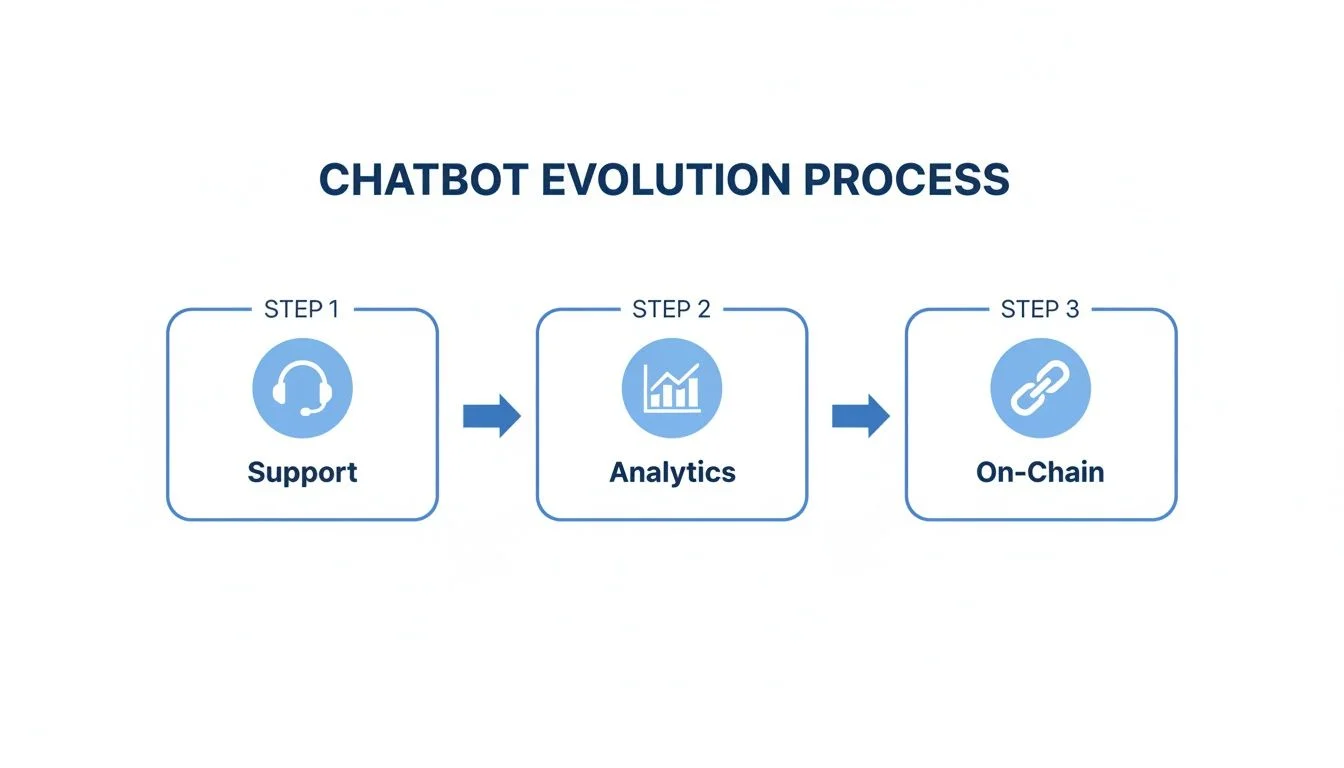
As you can see, a bot’s business value increases exponentially as its capabilities grow to include analytics and, eventually, direct on-chain actions.
Choosing Between On-Chain and Off-Chain Architecture
The choice of architecture is a massive decision for your project. This is where you’ll face real-world trade-offs between security, speed, cost, and decentralization. Your project’s specific needs will determine which path to take.
Off-Chain Agents: These agents run on centralized servers. They’re faster, cheaper to operate, and much easier to develop and update. They are brilliant for tasks like providing information, answering user questions, and performing data analysis. An off-chain agent is the perfect fit for a crypto wallet’s support bot or a bot that gives market analysis without executing trades.
On-Chain Agents: These agents operate directly through smart contracts on the blockchain. While they are more complex and costly to build, they deliver true trustlessness and decentralization. Every action is verifiable and completely tamper-proof. This architecture is essential for high-stakes operations, like autonomously rebalancing a decentralized ETF portfolio or executing trades in a prediction market based on oracle data.
For many Web3 projects, a hybrid approach genuinely offers the best of both worlds. This model uses a fast, responsive off-chain agent for the conversational front-end and user interaction. Then, when an action needs to be executed on-chain, the off-chain agent securely communicates with a dedicated smart contract to get the job done.
This separation of concerns creates a fluid user experience while maintaining the rock-solid security and integrity of on-chain transactions. For instance, a user could ask the chatbot, “What’s the current value of my tokenized gold?” (an off-chain query), then immediately follow up with, “Sell 10% of it” (an on-chain action). This kind of architectural flexibility is vital for building practical and secure Web3 applications. Exploring a provider’s approach to system design is a key part of choosing your AI integration service.
How to Choose and Train Your Large Language Model
The Large Language Model (LLM) is the brain of your AI chatbot. Your choice here will dictate its intelligence, running costs, and ultimately, the user experience it delivers. This decision isn’t about just picking a big name off a list.
For complex sectors like Web3, fintech, and carbon markets, the evaluation gets serious. You need to focus on performance metrics that directly affect your bottom line and operational integrity.
When you’re comparing the leading models from OpenAI, Google, and Anthropic, look past the marketing hype. Key factors are API latency—how fast the bot responds—and cost-effectiveness, as those API calls can quickly become a major operational expense. And for anything handling financial data, non-negotiable data privacy guarantees are table stakes.
What to Look for in an LLM for Web3?
In specialized domains like decentralized finance, the model’s grasp of complex financial and technical jargon is what separates a useful tool from a liability. A generic, off-the-shelf model will likely stumble over terms like “impermanent loss” or “smart contract ABI,” giving you inaccurate or completely useless answers.
This is where you start to see the real differences between the major players. Market dominance often sets the standard. In February 2024, for instance, ChatGPT held a staggering 75.85% market share among AI chatbots in India, while Google Gemini sat at 10.17% and Claude was just 1.14%. This shows how deeply OpenAI’s architecture has become the go-to for developers providing AI chatbot development services.
Data like this highlights a critical decision you’ll have to make. A solid understanding how Large Language Models work, including their built-in limitations, is the only way to make a smart choice and plan for effective training.
How Do General-Purpose and Fine-Tuned Models Compare?
Your next big decision is whether to stick with a general-purpose model or invest the resources to fine-tune a model on your own data.
General-Purpose Models (e.g., GPT-4, Gemini): These are incredibly powerful and versatile right out of the box. They are a great starting point for simple informational bots or assistants where deep, niche knowledge isn’t the main goal. This works for a startup but often falls short for enterprise needs.
Fine-Tuned Models: This involves taking a pre-trained model and giving it a specialized education with your own high-quality dataset. This is absolutely essential for any chatbot that needs to understand unique business logic, like interpreting carbon credit methodologies or providing support for a specific dETF protocol.
For institutional-grade financial applications, fine-tuning is not optional—it’s a necessity. A chatbot that provides financial guidance or interacts with on-chain assets must operate with the highest degree of accuracy and contextual awareness, which can only be achieved through specialized training.
How to Build a High-Quality Training Dataset
The success of your fine-tuning hinges entirely on the quality of your training data. For a Web3 or fintech project, that dataset should be a curated collection of your most valuable knowledge.
Think about including things like:
- Technical Documentation: Your project’s whitepaper, developer docs, and user guides.
- Smart Contract ABIs: This helps the model understand the functions and data structures it can interact with.
- Historical Support Tickets: Real questions from real users, paired with the correct answers.
- Simulated Conversations: Carefully scripted examples of ideal user interactions and outcomes.
This data has to be clean, accurate, and structured. Remember the golden rule of machine learning: garbage in, garbage out. The whole point is to create a dataset that teaches the model the specific language and logic of your world.
This focused training is also your best line of defense against model ‘hallucinations’—a critical risk in AI development. When a chatbot invents facts or provides dangerously incorrect information, the consequences in a financial setting can be disastrous. By fine-tuning the model on a trusted, verified dataset, you dramatically reduce its ability to generate false content, making it a reliable and accurate tool for mission-critical tasks.
How to Integrate Your Chatbot with On-Chain Systems

This is where the magic happens. After you’ve selected and fine-tuned your LLM, the next step is connecting your conversational AI to the blockchain’s core machinery. It’s what transforms your chatbot from a simple information source into a true Web3-native agent capable of executing on-chain actions.
This integration is all about bridging the gap between a user’s natural language command and a secure, verifiable blockchain transaction. When a user says something like, “swap 1 ETH for USDC,” a complex sequence of secure operations kicks off behind the scenes. Getting this right is a hallmark of expert AI chatbot development services.
How to Connect to Crypto Wallets for Secure Transactions
The first, and most critical, integration is with user wallets. Your on-chain AI agent needs to propose transactions on the user’s behalf, but it must never, ever have direct access to their private keys. This is a non-negotiable security principle.
We solve this with a process called delegated transaction signing. It’s a standard flow in modern Web3 apps that keeps the user firmly in control:
- The AI agent interprets the user’s request and constructs a transaction proposal.
- This proposal is sent to the user’s connected wallet, like MetaMask or Rabby Wallet.
- The user receives a clear prompt inside their wallet, detailing exactly what the agent wants to do.
- Only the user can approve and sign the transaction using their private key.
This architecture ensures the user always has the final say. The AI agent acts like a hyper-efficient assistant, preparing the necessary paperwork, but only the user can sign on the dotted line.
A crucial security layer here is intent-based validation. Your backend must rigorously check that the transaction the user is asked to sign perfectly matches the intent they stated to the chatbot. This prevents the agent from being manipulated into generating a malicious or incorrect transaction.
How to Read On-Chain Data with Smart Contract Integrations
For your chatbot to provide accurate, real-time answers, it needs the ability to read data directly from the blockchain. This is done by integrating with smart contracts, either through a direct RPC (Remote Procedure Call) node connection or by pulling indexed data from services like The Graph.
This connection allows the bot to answer context-aware questions instantly:
- “What’s the current APY on our main liquidity pool?”
- “Can you show me my portfolio balance in the dETF?”
- “Did my vote go through on the last governance proposal?”
Without this, your agent is just guessing. With it, the bot is pulling live, verifiable data straight from the source of truth—the blockchain itself. If you need to incorporate data from outside the blockchain (like real-world asset prices), you’ll need a reliable oracle network. You can discover the power of Chainlink oracles in blockchain to see how external data can be securely brought on-chain.
For example, a bot for a real-world asset (RWA) platform could read a smart contract to confirm the total amount of tokenized gold in a vault. Similarly, an agent for a carbon credit marketplace could query an on-chain certificate to verify a specific credit’s vintage and methodology.
How to Design for Regulatory Compliance and DevSecOps
In any project involving institutional DeFi, RWA tokenization, or regulated financial products, security and compliance are everything. Integrating your AI agent isn’t just a technical exercise; it’s a security and regulatory one.
You need to embed DevSecOps principles from day one, making security a continuous process, not an afterthought. Key practices include:
- Secure API Key Management: All API keys and credentials for interacting with blockchain nodes or other services must be stored in a secure vault, such as HashiCorp Vault or AWS KMS. They should never be hard-coded.
- Preventing Unauthorized Calls: Implement strict access controls and rate-limiting. Your agent should only be able to call pre-approved, audited smart contract functions. Any attempt to interact with an unauthorized contract should be blocked and trigger an immediate alert.
- Continuous Monitoring: Use real-time monitoring tools to watch the agent’s on-chain activity. Set up alerts for any unusual patterns, like an unexpectedly high number of transactions or interactions with suspicious addresses.
From a regulatory perspective, compliance logic must be hard-coded into the secure backend—not left to the LLM. For instance, an RWA platform’s agent must be programmed to respect jurisdictional rules, only offering products to verified investors in eligible regions. This ensures your compliance rules are always enforced, no matter what the user asks.
How to Assemble Your Team for a 2026 Launch

An ambitious idea for a Web3 AI agent is one thing; bringing it to production for a 2026 launch is another. Success hinges on assembling a highly specialized, multidisciplinary team. The talent needed to build a blockchain-native chatbot goes well beyond standard app development, demanding a precise blend of blockchain engineering, AI expertise, and user-centric design.
Getting the team structure right is your best insurance against costly delays, security gaps, and a final product that just doesn’t connect with users.
Who You Need on Your AI Chatbot Development Team
A winning Web3 AI project is built by a small, focused group of experts. Each role is distinct, yet they all need to work in lockstep to ensure the on-chain and off-chain pieces function as a secure, cohesive whole.
Your core team should include these key players:
- AI/ML Engineers: They are the masters of the Large Language Model (LLM). Their job is to select the right model, fine-tune it for your specific use case, and work relentlessly to minimize hallucinations and ensure the AI understands your domain’s unique language.
- Blockchain Developers: These are your on-chain experts, fluent in languages like Solidity or Rust. They build and audit the smart contracts the AI agent interacts with, focusing on security and gas efficiency above all else.
- Backend Engineers: They are the architects of the bridge connecting the AI to the blockchain. This role involves managing API integrations, implementing the logic for secure transaction signing, and building the robust infrastructure that powers the entire system.
- UX/Conversational Designers: These specialists make sure the chatbot is actually helpful and intuitive. They design the user journey from start to finish, script natural conversation flows, and create an interface that makes complex Web3 actions feel effortless.
The demand for these skills is surging. The Indian conversational AI market, which includes AI chatbot development services, is projected to rocket from USD 455.4 million in 2024 to USD 1,846.0 million by 2030. You can see the full analysis in this conversational AI market outlook from Grand View Research. This growth is largely fueled by businesses outsourcing the complex work of chatbot maintenance and scaling.
Structuring Your Team: In-House vs. Partnering
You have a few different paths to building this dream team. The right one for you will depend entirely on your current resources, budget, and how quickly you need to get to market.
Full In-House Team (Startup Perspective)
Hiring everyone internally gives you maximum control and helps you build deep, long-term institutional knowledge. The major drawback? Finding and retaining elite talent in both AI and blockchain is incredibly competitive and can seriously slow down your launch timeline.
End-to-End Development Partner (Enterprise Perspective)
Hiring a specialized firm that offers comprehensive AI chatbot development services is often the fastest way forward. They arrive with a pre-vetted, experienced team that has already solved the problems you’re about to face, making this ideal if you lack deep in-house expertise.
Staff Augmentation (Hybrid Model)
This is a flexible, hybrid model. It lets you surgically fill specific skill gaps on your existing team. For instance, you might have great backend developers but need to bring in a senior blockchain engineer and an AI specialist. Exploring IT staff augmentation services can give you a clearer picture of how this works in practice.
For many fintechs and even established enterprises, a hybrid approach or a dedicated partnership offers the best of both worlds. It lets you move fast while tapping into the specialized, hard-to-find skills required for building secure and scalable on-chain AI agents.
Planning for the Future: Scalable Architecture in 2026 and Beyond
Finally, the architecture you build today must be ready for tomorrow. The world of agentic AI is moving at a breakneck pace, and a system designed for today’s capabilities could be obsolete in 12–24 months. The only way to survive is by building a modular, scalable architecture.
In practice, this means designing your system so that individual components—like the LLM or the smart contract interaction layer—can be upgraded or even swapped out without a full-system rewrite. This forward-thinking approach ensures your AI chatbot can adapt to new agentic frameworks, more efficient models, and evolving blockchain standards, keeping your product ahead of the curve long after its 2026 launch.
How Blocsys Delivers on AI Chatbot Development
We’ve walked through the entire complex journey of building a secure, high-performance Web3 AI chatbot. Now, let’s talk about turning that knowledge into a production-ready system. At Blocsys, this is precisely where our expertise comes in.
We specialize in AI chatbot development services for the most demanding sectors—DeFi, RWA tokenization, and carbon markets. Our work bridges the gap between a great concept and a market-ready product that can handle institutional-grade demands.
Our process isn’t just theoretical. We begin with battle-tested protocol architecture and smart contract engineering, then move to the secure integration of AI agents. Every single component is built to meet the rigorous security standards expected in finance and blockchain. Our team has direct, first-hand experience building for the exact use cases covered in this guide.
From Strategy to Execution
A clear strategy is essential, but execution is what delivers results. We help define that strategy and then implement it with engineering precision. This means we don’t just follow best practices; our work often helps set them by merging advanced AI workflows with proven security protocols.
This isn’t a sales pitch. It’s a straightforward look at how our specialized skill set—combining deep blockchain engineering with advanced AI—solves the real-world challenges you’ll face building a next-generation Web3 application.
If you’re a founder, product leader, or enterprise team ready to build a secure and scalable AI-powered platform, our experience is designed to de-risk your launch and shorten your timeline. We bring the focused engineering discipline needed to transform your vision into a reliable, market-leading solution.
Your Top Questions Answered
Founders and product managers often have the same core questions when they start exploring AI agents for their Web3 projects. Based on our experience building these systems, we’ve pulled together some straight answers to help you scope your own implementation.
How Much Does It Cost to Build a Custom Web3 AI Chatbot?
The cost really depends on the chatbot’s complexity. For a simple informational bot, you might be looking at a starting point around ₹2,000,000.
However, for a sophisticated on-chain agent that can execute transactions and integrate with multiple protocols, the investment can easily climb into the ₹6,000,000 to ₹16,000,000+ range.
The main cost drivers are almost always:
- Smart Contract Integrations: The number of protocols your bot needs to talk to and the complexity of those interactions.
- Security Auditing: How deep the testing needs to go for any on-chain components. This is non-negotiable for transactional agents.
- LLM Fine-Tuning: The need to train a model on your proprietary data for specialized, domain-specific knowledge.
Remember to also plan for recurring operational costs. These include LLM API fees, infrastructure hosting, and the ongoing maintenance required to keep the agent secure and performing well.
What Are the Biggest Security Risks with On-Chain AI Agents?
The single biggest threat is unauthorized on-chain actions. If an AI agent with wallet permissions gets compromised, it could be used to drain user funds or wreak havoc on a protocol. This is the critical vulnerability, and it demands a security-first engineering mindset from day one.
Other significant risks we always plan for include:
- Smart Contract Vulnerabilities: The chatbot could inadvertently expose flaws in the underlying smart contracts it interacts with.
- Key Leakage: A breach that exposes the private keys or API keys used by the backend system to sign transactions.
- Data Privacy Breaches: Mishandling sensitive user data or conversation logs.
A multi-layered defense is the only way forward. This means rigorous code audits, strict access controls for all on-chain functions, and continuous, real-time monitoring to detect any unusual activity instantly.
Can an AI Chatbot Directly Interact with a Smart Contract?
Yes, but it’s crucial to understand it happens indirectly through a secure, layered architecture. The conversational AI and the on-chain execution layer must be kept completely separate.
Here’s how a secure flow works: the chatbot validates a user’s intent and passes it to a secure backend service. That service is then responsible for building, signing, and broadcasting the transaction to the blockchain. This separation is a fundamental security boundary—it ensures the Large Language Model never touches private keys.
Meanwhile, the bot can safely read on-chain data through an RPC node to provide users with up-to-date information.
On-Chain vs. Off-Chain Agent: Which Is Better?
There’s no single “better” option; the right choice is dictated entirely by your use case.
Off-chain agents are perfect for user support, data analysis, and informational queries. They offer more flexibility, faster response times, and lower operational costs.
On-chain agents, while more complex and costly to build, are essential when you need decentralization and trustlessness for executing critical functions directly on the blockchain.
In reality, many advanced projects end up with a hybrid model. They use an off-chain agent for the conversational front-end and a dedicated on-chain component for secure, verifiable actions like trades or governance votes.
Ready to transform your Web3 product with a secure, intelligent AI agent? At Blocsys Technologies, we specialize in building enterprise-grade AI chatbot solutions for DeFi, RWA tokenization, and carbon platforms. Let’s connect and discuss how we can bring your vision to life.
Frequently Asked Questions
What are AI chatbot development services?
AI chatbot development services are professional offerings that design, build, and deploy custom conversational AI agents tailored to specific business needs. Unlike off-the-shelf platforms, they focus on integrating with complex systems like blockchains and ensuring security and scalability for mission-critical applications in Web3, fintech, and carbon markets.
Why do standard chatbots fail in Web3 applications?
A generic chatbot from a plug-and-play platform can’t securely interact with a user’s crypto wallet, query a smart contract for live data, or execute a trade on a decentralized exchange. These unique demands of blockchain applications make specialized development non-negotiable.
What can a well-designed AI agent actually do for users in DeFi?
A well-designed AI agent can walk a new user through processes like staking tokens in a DeFi protocol, a task that would otherwise require reading dense documentation and having technical know-how. These agents act as a bridge, translating complex blockchain interactions into simple, conversational commands, improving user experience and making Web3 platforms more accessible.
What are some key use cases for AI chatbots in Web3 and fintech?
Key use cases include helping users build and rebalance decentralized ETF (dETF) portfolios, guiding investors through compliance and purchases for tokenized real estate, providing real-time carbon credit pricing and verification, enhancing crypto wallet security, and assisting with loan applications by combining traditional financial APIs with on-chain credit histories.
How much is the conversational AI market growing?
Market momentum is significant: India’s conversational AI market, which powers the backbone of AI chatbot development services, reached USD 653.24 million in 2025 and is projected to hit USD 5,907.5 million by 2034, growing at a compound annual growth rate of 25.61%.
How should you start planning an AI chatbot development strategy?
A successful project always starts by defining one core business objective, such as simplifying DeFi protocol onboarding to cut support tickets or automating compliance reporting for tokenized real-world assets. Building a powerful AI agent without a solid plan is compared to starting a skyscraper without a blueprint—it simply won’t work.
