
Automation in customer service is no longer about generic chatbots. For leaders in Web3, AI, crypto, and carbon sectors, it’s about architecting intelligent, secure systems that meet the extreme demands of 24/7 global markets. Traditional support models are failing, making automation a core requirement for operational survival and competitive advantage.

This guide is for founders, product managers, and engineering leads in Web3, blockchain, and AI. By the end, you’ll understand the decision frameworks for implementing automated support, the key risks involved, and the outcomes you can expect. You will have a clear blueprint for building a system that delivers instant, secure, and scalable user support, turning a cost center into a strategic asset.
The old model—relying on human agents for every ticket—is not built for markets that never sleep. The speed, complexity, and global scale of Web3 and high-growth tech demand a complete rethink of user support.
The Shift From Manual to Automated Operations
Automation offers instant, secure, and scalable solutions that build user trust where it matters most. It’s not about replacing your support team; it’s about augmenting them, freeing their time to focus on complex, high-value issues that genuinely require a human touch. To grasp the core ideas, it’s worth exploring what customer service automation means in a broader context.
This evolution is driven by key pressures specific to Web3, AI, crypto, and carbon sectors:
- 24/7 Market Operations: Crypto and global markets run nonstop. Your support must be equally available, not just during standard 9-to-5 business hours.
- Transaction Immutability: On-chain transactions are permanent. Support must be preventative and precise, as there is often no “undo” button.
- Complex Technical Queries: Users are troubleshooting smart contract interactions, verifying carbon credit provenance, or navigating sophisticated AI-driven trading interfaces, not asking about billing.
For platforms where a single delayed transaction or data error can mean significant financial loss or a breach of trust, automation isn’t a luxury—it’s a core risk management function. It transforms support from a cost center into a strategic asset that secures the platform and drives user retention.
Core Differences in Support Models
The contrast between legacy and modern support models highlights why this shift is critical. Traditional support cannot scale effectively or maintain the consistency required in high-stakes environments. Automated systems, however, are built for this from the ground up.
Here’s a breakdown comparing traditional support with an automated approach for demanding sectors like Web3, AI, and crypto.
Key Shifts From Traditional to Automated Customer Service
| Aspect | Traditional Support (Enterprise) | Automated Support (Startup/Scale-Up) |
|---|---|---|
| Availability | 9-to-5 or tiered shifts | Always-on, 24/7/365 |
| Response Time | Minutes to hours | Instantaneous to seconds |
| Scalability | Linear (hire more people) | Exponential (software scales globally) |
| Consistency | Varies by agent and training | Uniform and rule-based |
| Cost Model | High operational expense (OpEx) | Lower OpEx at scale (CapEx investment) |
| Focus | Reactive problem-solving | Proactive issue prevention & resolution |
This comparison clarifies how automated systems are engineered to handle the relentless pace of modern tech and finance, providing the speed and reliability that manual teams struggle to deliver.
Ultimately, automation in customer service is what enables Web3, AI, and fintech platforms to deliver the fast, reliable, and secure experiences their users demand.
Why Automation is Essential for Web3, AI, and Crypto
In the high-stakes worlds of Web3, AI, and crypto, customer service is a survival function. For platforms managing digital assets, AI model outputs, or verified carbon credits, a slow response can trigger catastrophic financial losses or irreparable damage to trust. Traditional, manual support models are fundamentally unsustainable in this reality.
The problem lies in the nature of user needs. Users are navigating intricate on-chain events, managing assets in volatile markets, or verifying the integrity of complex data sets. Here, a slow response isn’t an inconvenience; it can devastate a user’s portfolio, compromise a project’s credibility, and permanently damage your platform’s reputation.
How Does Automation Mitigate Market Volatility Risks?
Market volatility is the only constant in crypto and modern finance. A sudden price movement can set off a chain reaction of liquidations, margin calls, and a flood of urgent user tickets—all at once. Expecting a human-only support team to manage these surges is a blueprint for failure.
Automation is the only practical way to handle these demand peaks without hiring an army of support agents. A properly configured automated system can:
- Instantly identify and prioritize high-risk events, such as potential liquidations or anomalous AI model behavior.
- Proactively send notifications to users about market conditions or system updates affecting their positions.
- Manage thousands of simultaneous, repetitive questions about transaction statuses or collateral levels, freeing human agents for genuine emergencies.
This isn’t just about efficiency. It’s a crucial risk management function that safeguards both your users and your platform, ensuring your support infrastructure holds up when the market is in chaos.
The reality for Web3 and AI is that operational scalability must match market volatility. As a first-hand builder of these systems, I’ve seen that automation is the mechanism that disconnects support capacity from headcount, allowing platforms to handle massive user influxes without a corresponding explosion in operational costs.
How Can Automation Enhance Platform Security and Trust?
Beyond handling volume, customer service automation is a powerful instrument for tightening security and compliance. Manual processes are inherently vulnerable to human error, creating significant weak points—especially when dealing with sensitive financial data, user credentials, or proprietary AI models.
Automated workflows for KYC/AML checks, withdrawal requests, and account modifications ensure every step is executed consistently and logged immutably. This drastically reduces the attack surface for social engineering and costly internal mistakes. When users see that critical processes are handled with machine-like precision, their trust in the platform deepens—a decisive factor for retention in a cut-throat market.
The impact is clear and measurable. In India, a key global tech hub, customer service automation is already delivering major productivity gains. Recent data reveals AI agents are cutting customer support response times by 60-70% and reducing the ticket volume requiring human intervention by 40%. One company even scaled its support team from eight people down to three by letting AI manage 70% of routine queries. This aligns with a broader consensus where 84% of business leaders view automation as vital. You can explore more about how AI is reshaping Indian business operations to see the real-world impact. This isn’t theory—it’s about liberating your best engineers and support specialists to innovate instead of answering the same questions over and over.
Real-World Automation Use Cases in Action
The true power of automation in customer service isn’t theoretical; it’s proven through practical application. In Web3, AI, and fintech, where speed, security, and precision are non-negotiable, automated systems enable entirely new operational models. Let’s examine specific, battle-tested workflows solving major pain points in these advanced sectors right now.
These use cases show how automation directly tackles the unique challenges of decentralized and high-stakes digital environments, shifting from reactive problem-solving to proactive, intelligent system management.
What is an Example of AI-Powered KYC and AML Verification?
Onboarding is the first—and arguably most critical—user interaction. Traditional Know Your Customer (KYC) and Anti-Money Laundering (AML) processes are notoriously slow, manual, and prone to error. This friction, often taking days, is a primary driver of user drop-off.
AI-driven automation transforms this experience. Here’s how a modern workflow operates:
- Data Capture: A user submits identity documents and a live selfie through a secure portal.
- Automated Verification: AI algorithms instantly analyze the documents for authenticity, cross-reference data against global watchlists, and use facial recognition to match the selfie to the ID.
- Instant Decisioning: For most users, the process finishes in minutes, granting immediate platform access. Only flagged or ambiguous cases are routed to a human compliance officer for manual review.
The impact is massive. By automating this workflow, platforms can slash onboarding time by over 90%, significantly boost conversion rates, and maintain a consistent, auditable compliance process.
From my experience leading teams that build these systems, automating KYC/AML isn’t just about speed; it’s about building a scalable, secure foundation for user trust. This allows you to onboard thousands of users globally without creating a bottleneck in your compliance department.
How Does Automated On-Chain Dispute Resolution Work?
Decentralized applications, from prediction markets to DAOs, need reliable mechanisms to resolve on-chain disputes. Relying on manual intervention is slow, expensive, and introduces centralization risks. Smart contract-based automation offers a far more elegant solution.
Imagine a prediction market where an event’s outcome is contested. An automated system can:
- Trigger a Dispute Protocol: A user flags a disputed outcome, which immediately locks the associated funds in a secure smart contract.
- Initiate an Oracle Check: The system automatically queries a network of decentralized oracles to verify the real-world outcome, sourcing data from multiple trusted points.
- Execute Payout: Based on the oracle consensus, the smart contract automatically releases the funds to the rightful winner, closing the dispute without human involvement.
This workflow guarantees fairness and transparency while dramatically reducing the need for a centralized administrative body.
What is Intelligent Support for Complex Trading and AI?
The fast-paced worlds of DeFi, crypto trading, and AI platforms generate a constant stream of complex user queries. Leading platforms now deploy intelligent support bots on channels like Telegram and Discord, where their users are most active.
These are not basic FAQ bots. They are sophisticated AI agents that can:
- Access Real-Time Data: Answer specific questions like, “What is my current margin ratio?” or “Why did my last transaction fail?” by directly querying on-chain data and private backend systems.
- Guide Users Through Workflows: Provide step-by-step instructions for complex actions, such as adding collateral, bridging assets, or troubleshooting an AI model’s API connection.
- Escalate Intelligently: Recognize the limits of their knowledge and seamlessly hand the conversation to a human agent with the full context, ensuring a smooth user experience.
These agents act as a powerful first line of defense, resolving a huge volume of technical queries instantly. To understand how these automated systems function, learning more about how AI agents are the next frontier of intelligent automation offers a deeper perspective. Foundational technologies like Interactive Voice Response (IVR) systems also provide insight into the real-world applications that have set the stage for today’s AI.
How to Architect Your Automated Support System
Architecting an automated support system for a Web3, AI, or fintech platform requires a thoughtful blueprint connecting on-chain rules with off-chain intelligence. It’s not just about plugging in a chatbot; it’s about designing a resilient, multi-layered system where each component works in perfect sync.
The core idea is to create a modular system where each part has a distinct role. Think of these components as “bricks”: smart contracts, backend services, and event triggers that snap together to create a solid structure.
What Are the Core Components of a Modern Support Architecture?
A robust automated support architecture is built on three foundational pillars. They work together to receive, process, and resolve user queries with maximum efficiency.
- On-Chain Components (The Rulebook): These are the smart contracts that live on the blockchain. They act as the system’s unbreakable, transparent rulebook, governing actions like dispute resolution, fund transfers, or collateral management.
- Off-Chain Backend (The Brain): This is where the heavy lifting happens. Your backend services process user data, connect to databases, and run the AI models that power your system. This component provides the intelligence and processing power that on-chain systems can’t.
- Event Triggers (The Nervous System): These are the messengers connecting the on-chain and off-chain worlds. They listen for specific on-chain events—like a new transaction or a failed smart contract call—and trigger corresponding actions in your backend.
For instance, a blockchain oracle acts as a specialized event trigger. It’s a trusted messenger that securely brings external data, like a real-world asset price, onto the blockchain, allowing smart contracts to react to off-chain information without compromising decentralization.
Visualising the Automation Workflow
To understand how these pieces fit together, let’s walk through a typical automated workflow. The following diagram shows the journey of a user interaction through a well-architected system.
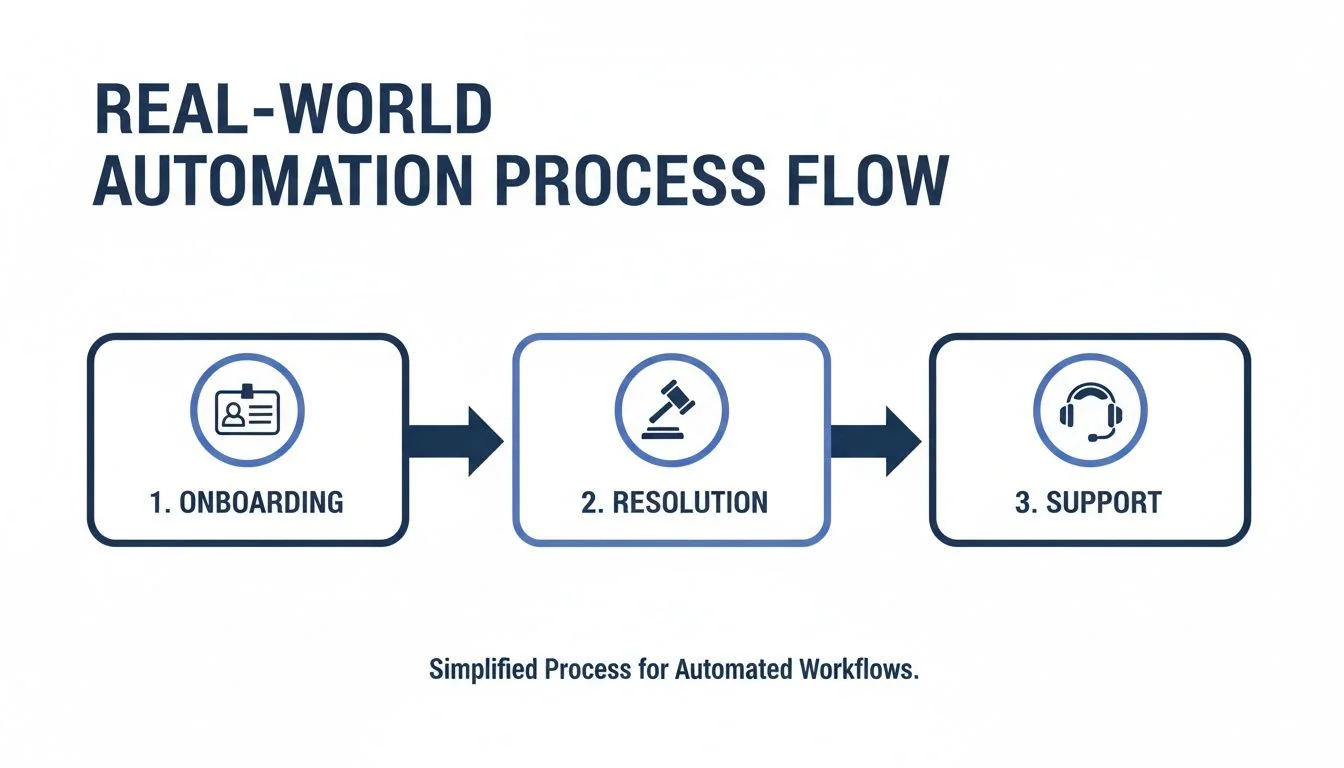
This process flow shows how automation streamlines key stages, from initial user onboarding to final issue resolution. This seamless integration is critical for maintaining user trust and ensuring a smooth experience.
Connecting the Front End to the Back End
The architecture must also include a user-friendly front end, such as a chat interface in your dApp or a Telegram mini-app. When a user submits a query, it travels through this architecture:
- A user reports an issue with a failed transaction via the chat interface.
- The backend system receives the query, uses natural language processing (NLP) to understand the user’s intent, and pulls the transaction hash.
- An event trigger queries the blockchain to check the transaction status.
- The backend analyzes the on-chain data, identifies the reason for failure (e.g., insufficient gas fees), and formulates a clear, actionable response.
- The AI agent delivers the solution to the user via the chat interface, resolving the issue in seconds.
This hybrid approach is becoming the standard, especially in regions with massive digital growth. In India, for example, the customer service landscape is being transformed by AI, projected to handle 50% of all inquiries by 2027. This shift is powered by agentic AI—autonomous systems managing routine cases end-to-end. With 90% of service representatives reporting seamless AI-to-human handoffs, this hybrid model proves its effectiveness daily. You can dive deeper into these Salesforce insights on AI’s impact in India to see just how it’s being implemented.
By architecting your system this way, you create a scalable, secure, and compliant foundation for your automation in customer service strategy. Our guide on how to integrate AI with RPA for better results provides further details on combining different automation technologies.
Navigating the Toughest Implementation Challenges
Having the right tools is one thing; making them work is another. Too many organizations fall into the “implementation gap”—they acquire powerful automation in customer service tools but fail to integrate them into daily operations. This is where the real work begins.
Success demands a sharp strategy for security, user adoption, and managing workflow changes. Only then will your investment pay off. The next 12-24 months will see a divergence between firms that simply buy AI tools and those that successfully embed them into their core operations, with the latter gaining a significant competitive edge.
What is the AI Implementation Gap and How to Bridge It?
One of the biggest hurdles, especially in fast-growing global markets, is the AI integration gap. While a massive 88% of contact centers have AI solutions, a mere 25% have actually integrated automation into their day-to-day work. This creates a staggering 75% gap, revealing a simple truth: buying tools is easy, but making them integral to how you operate is hard.
Security concerns often widen this gap, causing nearly 50% of service leaders to pause or scale back AI projects. But pushing through these challenges brings huge rewards. Getting AI integration right can slash call-related costs by up to 19% and improve feedback loops by 28%. You can explore more on these customer service automation statistics to build a rock-solid business case.
How Do You Secure Automated Systems in Decentralized Environments?
In Web3 and fintech, security is the foundation of trust. Automated systems, particularly those interacting with on-chain assets or sensitive data, introduce a unique attack surface. A proactive, multi-layered security plan is non-negotiable from day one.
To guard user data and fend off exploits, your implementation must include:
- Rigorous Smart Contract Audits: Before deployment, all smart contracts driving automated processes must be independently audited to find and fix vulnerabilities.
- Secure Off-Chain Infrastructure: Your backend systems are just as critical. They must be hardened against common web attacks, with iron-clad access controls and fully encrypted data pathways.
- Continuous Monitoring and Anomaly Detection: Real-time monitoring must be set up to catch unusual activity—like a sudden flood of automated transactions or a spike in failed logins—so you can shut down threats instantly.
As an engineer who has built these systems, my core principle is “secure by design.” Security must be woven into every layer of your architecture, from the smart contract logic to the front-end interface, not bolted on as an afterthought.
How to Empower Human Agents Through Phased Rollouts?
True success with automation in customer service isn’t about replacing your team; it’s about augmenting them. A common mistake is a “big bang” rollout that creates chaos and resentment. A phased approach works far better.
Start small. Automate a few high-volume, low-complexity tasks first. This gives your team a low-risk way to get comfortable with the new tools. As they gain confidence, you can progressively roll out automation for more sophisticated workflows.
This method achieves two critical goals. First, it smooths the transition and secures team buy-in. Second, it transforms your human agents into expert users who can handle complex escalations and provide priceless feedback for refining the automation, turning your support team into a strategic powerhouse.
How Blocsys Helps You Build Production-Ready Automation

Theory and concepts are a good starting point, but execution is what separates a live, production-grade system from a whitepaper. Blocsys specializes in transforming advanced automation strategies into enterprise-grade infrastructure for the Web3, AI, crypto, and carbon sectors.
We are not just consultants; we are builders. Our team has direct, first-hand experience architecting the secure and scalable automated systems that power today’s most demanding financial and data-driven platforms. We partner with you from initial product strategy and system architecture through to the final implementation of AI-driven workflows, ensuring your project succeeds where others fail.
From Blueprint to Live System
Building for Web3 and AI requires more than just code. It demands a deep understanding of security, compliance, and scalability from day one. Our expertise is grounded in delivering real-world systems for dETFs, perpetual trading platforms, RWA tokenization projects, and AI-driven data verification.
This hands-on experience means we’ve already navigated the technical complexities and security risks you will face. We help you design and implement the robust automation in customer service that your platform needs to operate reliably, including:
- Custom Smart Contract Engineering: We build the secure, on-chain logic that governs automated processes like dispute resolution, collateral management, and asset transfers.
- Scalable Backend Infrastructure: Our team designs and deploys the off-chain systems needed for data processing, AI model execution, and seamless integration with your core services.
- Compliance-Aware Workflows: We integrate automated KYC/AML checks and reporting mechanisms that satisfy global regulatory standards without disrupting the user experience.
Our focus is on disciplined execution. We help you build a serious platform with automation at its core, enabling you to manage risk, build user trust, and scale globally. We handle the technical complexities so you can focus on growth and innovation.
Your Dedicated Engineering Partner
Blocsys operates as a dedicated engineering partner, providing the specialized talent needed to bring your vision to life. Whether you require an end-to-end delivery team or expert staff augmentation for your existing team, we provide the disciplined execution needed to launch and scale effectively.
For a closer look at our specific capabilities, you can learn more about our AI chatbot development services and how they apply to complex financial and data-intensive products.
We build the systems that work, integrating AI-assisted agents, Telegram mini-apps, and secure on-chain components into a cohesive whole. If you are ready to move from concept to a live, production-ready system, we are the team to help you build it.
Frequently Asked Questions
Leaders in Web3, AI, and fintech often ask about the practical side of customer service automation. Here, we address the key questions around cost, security, and integration that decision-makers are asking.
How Long Does It Take to Implement an Automated Support System?
The timeline for implementing automation in customer service is directly tied to a system’s complexity, typically ranging from 2 to 6 months. A phased approach is the best strategy, starting with an MVP to deliver value quickly. A foundational system handling common queries can often be deployed in 2–3 months. More advanced workflows involving smart contracts and complex backend integrations may take 4–6 months to allow for rigorous security audits and testing.
Is Automation Secure Enough for Financial Transactions?
Yes, provided it is architected with security as the core principle. In our experience, a well-designed automated system is often more secure than a manual one because it systematically removes the risk of human error from sensitive financial operations. Our multi-layered security model includes rigorous smart contract audits, secure off-chain processing with end-to-end encryption, and continuous monitoring with real-time anomaly detection to protect system integrity around the clock.
What Is the Typical ROI on Customer Service Automation?
The return on investment (ROI) from automation is substantial, going beyond simple cost savings. Our clients typically see a 40–60% reduction in support-related operational costs within the first year. Strategically, the ROI is even more compelling, manifesting as increased user trust and retention, enhanced scalability to handle global growth without a proportional increase in headcount, and an improved brand reputation for efficiency and reliability.
At Blocsys Technologies, we specialize in transforming complex automation concepts into production-ready, enterprise-grade realities for the Web3, AI, crypto, and carbon industries. Our team has first-hand experience building the secure, scalable, and compliant infrastructure that powers today’s leading platforms. If you are ready to build a serious platform with automation at its core, connect with Blocsys for expert guidance.
