

Global product teams usually arrive at this decision after a familiar pattern. Payments move across entities, partners, and jurisdictions too slowly. Reconciliation depends on spreadsheets and middleware. Audit trails exist, but they’re fragmented across systems that were never designed to share a single source of truth.
That’s where custom blockchain development services stop being a speculative technology purchase and become an infrastructure decision. If you’re responsible for a fintech platform in the USA or UK, a tokenization product in the UAE or Singapore, or a logistics workflow spanning Europe and Germany, a key question isn’t whether blockchain is interesting. It’s whether a generic platform can support your operating model, regulatory posture, and performance requirements without forcing compromises into the core of your business.
From an enterprise architecture standpoint, custom blockchain work is about designing systems around business constraints first. Settlement logic, permissioning, compliance controls, smart contract risk, interoperability, and operating cost all need to fit together. The firms that get this right don’t just launch faster. They build infrastructure they can govern, evolve, and defend.
The Enterprise Challenge with Legacy Infrastructure
Most legacy systems fail in the same place. They weren’t built for multiparty coordination where each participant needs the same record, but not the same level of access. Banks, brokers, custodians, suppliers, exchanges, and regulators all touch the workflow, yet each relies on separate databases, delayed handoffs, and manual exception handling.
In cross-border environments, that creates three business problems quickly:
- Settlement friction: Funds and assets move through too many intermediaries.
- Limited transparency: Teams can’t see the same status, history, or exception path.
- High operational overhead: Reconciliation, reporting, and compliance become labour-intensive.
A custom blockchain architecture addresses those issues by moving shared state, transaction logic, and validation rules into a controlled ledger environment. That matters for enterprise blockchain development in Europe and Germany where multi-entity coordination is common, and for fintech teams in the USA, UK, UAE, Dubai, and Singapore where regulated digital asset workflows are becoming more complex.
Practical rule: Don’t start with “Where can we use blockchain?” Start with “Which workflow breaks because no party fully trusts the others’ records?”
The strongest business cases usually involve processes that are both high-value and dispute-prone. Post-trade operations, tokenized assets, stablecoin settlement, compliance reporting, and supply chain provenance sit in that category. In each case, the blockchain layer isn’t replacing every system. It’s acting as the trust and execution layer that legacy infrastructure lacks.
What Are Custom Blockchain Development Services
Custom blockchain development services are the design, engineering, and deployment of blockchain-based systems built around a company’s own business logic, performance needs, and regulatory requirements. That can include a private or permissioned network, smart contracts, token models, APIs, wallet flows, compliance modules, and integrations with existing enterprise software.
What makes it custom
Custom doesn’t mean writing code from scratch. It means making explicit choices on architecture and control points:
- Network design: public, private, permissioned, or hybrid
- Consensus model: selected for throughput, governance, and trust assumptions
- Smart contract logic: designed for your exact transaction and compliance rules
- Integration layer: connected to ERP, CRM, custody, KYC, payment, or reporting systems
- Operational controls: auditability, role-based access, upgrade paths, and monitoring
For enterprise buyers, that’s the difference between software that fits the process and software that forces the process to adapt.
How it differs from generic blockchain tooling
Off-the-shelf platforms can be useful when the requirement is narrow. A pilot, a simple token, or a low-risk proof of concept may not need bespoke infrastructure. But once the workflow includes regulated users, treasury movement, asset servicing, or institution-grade controls, a generic stack tends to expose limits in governance, data segregation, and integration depth.
That’s why many organisations choose custom blockchain solutions rather than relying entirely on standard templates. In India, which has become a significant market for custom blockchain work, the blockchain market reached approximately USD 474 million in 2023 and is projected to grow to USD 23.4 billion by 2032, with a 40.5% CAGR, according to Grand View Research’s blockchain technology market analysis. For enterprise strategists, that growth matters less as a headline and more as a signal that specialised implementation demand is moving from experimentation to execution.
What the business is actually buying
When a company hires a blockchain development company for a custom build, it’s usually buying one or more of these outcomes:
- Control over critical infrastructure
- Compliance-ready workflow design
- Lower dependency on third-party product limits
- A scalable base for tokenization, settlement, or dApp operations
- A system that can be integrated into existing operating models
That’s why the term often overlaps with enterprise blockchain development, blockchain consulting services, smart contract development services, and blockchain infrastructure development. They’re different labels for one core objective. Build a ledger-based system that reflects how the business works.
The Core Components of a Custom Blockchain Solution
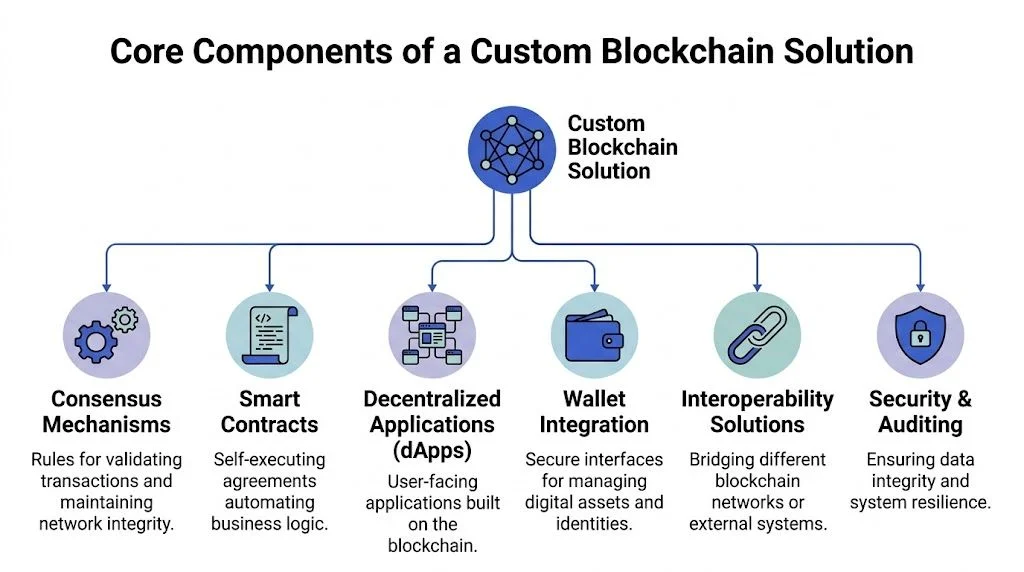
A blockchain system only creates value when its parts work as a coordinated whole. Enterprises often focus first on the visible layer, such as a token, a wallet, or a dApp. The harder architectural work sits underneath. Consensus, contracts, data flow, identity, interoperability, and controls determine whether the platform will survive real operating conditions.
Consensus and ledger design
Consensus is not a theoretical choice. It determines how transactions are validated, how quickly finality is reached, and how much trust the network places in participants. A permissioned financial network has very different needs from a consumer token project.
Architects usually evaluate:
- Validation model: who can submit, verify, and approve transactions
- Governance rights: who can upgrade rules or admit new participants
- Data visibility: what each node can see and what stays private
- Failure handling: how the network behaves during outages or disputes
For some business systems, a blockchain should look less like a public crypto network and more like a governed shared ledger with cryptographic guarantees.
Smart contracts and business logic
Smart contracts are where policy becomes execution. If the business needs conditional settlement, issuance controls, transfer restrictions, fee routing, or lifecycle events, that logic belongs in contracts designed for the use case rather than copied from generic repositories.
This is also where risk concentrates. India-specific audit data is instructive here. Techzarinfo’s analysis of custom blockchain development solutions states that India-specific smart contract auditing detects 85% more vulnerabilities pre-deployment using formal verification tools such as Certora, and connects that need to exploits that caused ₹1,200 crore losses in Indian DeFi hacks. The takeaway for any enterprise client is simple. Audit depth is not a final checkbox. It is part of architecture.
Security failures in blockchain rarely come from the idea. They come from contract logic, permission design, and upgrade assumptions that were never modelled under stress.
Application layer and integration surface
User-facing software decides whether the platform is usable. That includes dashboards, admin consoles, onboarding flows, custody interactions, and API access for external systems. A strong dApp or enterprise interface isn’t separate from the chain design. It reflects how identities, permissions, approvals, and events move through the full workflow.
Many teams also need to rethink data architecture here. Blockchain stores state differently from conventional application databases, and high-throughput systems often use off-chain services for search, analytics, and operational reporting. For teams evaluating data patterns alongside ledger design, this guide to non-relational database principles is useful background because many blockchain-adjacent applications rely on flexible, distributed data models rather than a single relational core.
Wallets, interoperability, and controls
Enterprises often underestimate wallet design. In practice, wallet architecture determines who can sign, under what conditions, with what recovery model, and under which compliance rules. The answer will differ for retail users, treasury teams, admins, and institutional counterparties.
A mature custom blockchain solution usually includes:
- Wallet integration: embedded, custodial, non-custodial, or MPC-aligned flows
- Interoperability: bridges, messaging layers, oracle connections, and API gateways
- Monitoring and observability: event tracking, anomaly alerts, transaction tracing
- Security operations: audit pipelines, key management, and release controls
For a useful reference on composing these pieces into a scalable system, this Blocsys article on modular blockchain architecture captures the design logic behind separating execution, data, and integration responsibilities.
Custom Development vs Off-the-Shelf Platforms
Buying a blockchain platform is easier than building one. That doesn’t make it the right decision.
Off-the-shelf BaaS products can accelerate experimentation. They reduce early infrastructure work and give teams a familiar environment for prototypes. But enterprise programmes usually hit limits when they need custom permissioning, specific transaction logic, internal integrations, or jurisdiction-specific controls. That’s the point where the speed advantage of prebuilt tooling can turn into architectural debt.
Where the trade-off becomes real
A generic platform works well when the use case is narrow and the consequences of compromise are low. It works poorly when the blockchain is part of core operations.
Custom blockchain development is usually the stronger fit when the business needs to protect proprietary process logic, support multiple participant classes, or enforce workflows that don’t map cleanly to standard vendor templates. That’s common in blockchain development services in the USA and UK for fintech operations, and in enterprise blockchain adoption across Europe and Germany where data governance and system integration tend to be more complex.
Comparison framework
| Criterion | Custom Blockchain Development | Off-the-Shelf BaaS Platform |
|---|---|---|
| Business fit | Designed around your workflow, asset model, and governance structure | Adapted to vendor-defined patterns |
| Intellectual property | Core logic and architecture remain under your control | Important logic may depend on vendor abstractions |
| Compliance flexibility | Controls can be engineered around internal and regulatory requirements | Compliance options are limited to supported features |
| Integration depth | APIs, identity, reporting, and middleware can be shaped to enterprise systems | Integrations are available, but often constrained |
| Performance tuning | Network design and transaction flows can be optimised for the use case | Performance depends on shared platform capabilities |
| Operational control | Strong control over upgrades, node policy, and release process | Vendor controls part of the operating environment |
| Time to pilot | Longer upfront architecture phase | Faster to launch a proof of concept |
| Long-term adaptability | Better suited to evolving products and regulated workflows | Can become restrictive as requirements grow |
The hidden cost question
The wrong comparison is build cost versus subscription cost. The correct comparison is total cost of ownership under future complexity. A lower-cost platform can become expensive if your team has to work around missing features, maintain brittle middleware, or redesign the product once regulation tightens.
Decision lens: If the blockchain layer will carry value, enforce policy, or support regulated users, optimise for control and adaptability, not for the shortest path to demo day.
That’s especially relevant for teams building tokenization platforms in the UAE and Singapore, or cross-border systems serving the USA, UK, and Europe. In those environments, legal interpretation, counterparty onboarding, and asset servicing usually evolve after launch. Infrastructure needs room to evolve with them.
A practical way to decide
Custom development is often justified when three conditions exist at the same time:
- The workflow is operationally important.
- The business logic is differentiated.
- Compliance or governance cannot be outsourced to platform defaults.
If only one of those conditions applies, a BaaS route may still make sense. If all three apply, a generic product can lock the business into compromises that are costly to unwind later.
Your Development Journey The Engagement Process
The strongest blockchain engagements don’t begin with coding. They begin with narrowing the business problem until architecture becomes obvious. That usually means deciding what belongs on-chain, what stays off-chain, who validates state changes, and how the platform will be governed once it’s live.

Discovery and architecture
This phase should produce more than a requirements document. It should produce a technical-commercial model of the system. Teams define participants, asset flows, trust boundaries, ledger design, integrations, and compliance assumptions.
Typical outputs include:
- Target architecture
- Protocol and stack recommendation
- Smart contract scope
- Risk register
- Roadmap split between MVP and production
A serious partner will also pressure-test whether blockchain is needed at all. Sometimes the correct answer is a more conventional distributed system with selective cryptographic auditability.
Product design and implementation
Once the architecture is stable, product design starts translating the system into real user actions. Admin operations, end-user wallets, custody flows, transfer approvals, reporting, and exception handling should all be mapped before development accelerates.
This is also where performance choices begin to matter. In India’s blockchain ecosystem, Appinventiv’s overview of blockchain application development notes that custom blockchain development services for DeFi platforms can achieve up to 40% reduction in transaction costs versus Ethereum mainnet by using Layer-2 solutions such as Polygon or Optimism. For enterprise buyers, the broader lesson is that infrastructure choices made early have direct operating cost consequences later.
A useful explainer on delivery workflow sits below.
Audit, launch, and post-launch operations
Launch should never be treated as the end of delivery. In blockchain systems, go-live is where governance, monitoring, and maintenance become real. Contract upgrades, validator management, key rotation, incident response, and analytics all need ownership.
The engagement model often includes these roles:
- Blockchain architect: decides protocol, trust model, and system boundaries
- Smart contract engineer: implements and tests execution logic
- Full-stack developer: connects chain logic to web, mobile, and admin interfaces
- DevOps or platform engineer: manages environments, deployment, and observability
- Security specialist: runs audit processes and release checks
- Project or product lead: keeps business priorities aligned with technical delivery
For some organisations, full-cycle delivery is the right route. Others prefer to retain internal ownership and add capacity through specialist engineers. Both can work if responsibilities are explicit from day one.
Real-World Use Cases Driving Enterprise Adoption
The best way to evaluate blockchain solutions for business is to ignore generic examples and look at where controlled shared ledgers solve a costly coordination problem.
Fintech platforms and digital settlement
In the USA and UK, custom blockchain development services are often tied to payment orchestration, post-trade workflows, tokenized asset issuance, and stablecoin-based settlement. These aren’t “crypto products”. They’re infrastructure plays aimed at reducing delay, fragmentation, and reconciliation burden between institutions and counterparties.
A custom design matters because regulated finance rarely fits standard DeFi assumptions. Identity checks, transaction restrictions, treasury controls, and reporting obligations all need to be embedded into the product from the start.
Supply chain and multi-party operations
In Europe and Germany, enterprise blockchain development tends to be stronger where provenance, handoff integrity, and shared visibility matter. Logistics, industrial supply chains, and cross-entity document trails all benefit when multiple parties can rely on the same event history without surrendering full database control to one participant.
That’s also where permissioned blockchain solutions often outperform public-chain-first thinking. Enterprises usually need selective transparency, not universal exposure.
Tokenization and digital asset hubs
In the UAE, Dubai, and Singapore, the high-value use cases are increasingly tied to digital asset infrastructure. Tokenized real-world assets, private market instruments, treasury workflows, and regulated exchange infrastructure all require custom controls around issuance, access, transferability, and lifecycle events.
One of the most overlooked design issues in these environments is compliance localisation. Geniusee’s discussion of blockchain development highlights an underserved angle in custom blockchain development services: regulatory compliance for DeFi and tokenization platforms aligned with SEBI and RBI guidelines, noting that generic service pages often mention AML and KYC while missing local regulatory nuance. The broader insight applies globally. A serious blockchain development agency shouldn’t bolt compliance onto the edge of the platform. It should express compliance in architecture, permissions, and operational logic.
The more regulated the asset or workflow, the less useful broad blockchain claims become. What matters is whether the platform can express actual legal and operational constraints.
For organisations assessing implementation patterns across sectors, Blocsys has published practical examples in its guide to enterprise blockchain solutions and implementation architecture. It’s a useful reference for mapping business workflows to the right ledger model.
Why Enterprises Choose Custom Blockchain for 2026 and Beyond
The strategic value of custom blockchain infrastructure becomes clearer when you look beyond launch. In the next operating cycle, the winners won’t be the firms that merely “use blockchain”. They’ll be the firms that control the transaction layer behind tokenized assets, digital payments, and machine-readable compliance.
Three shifts are driving that change.
Tokenization is moving toward operational depth
A token is easy to issue. A tokenized system is harder to run. Asset servicing, transfer restrictions, approvals, reporting, and lifecycle automation all sit outside the headline concept and inside the operating model. That’s why custom blockchain solutions are becoming more relevant to enterprises in the UAE, Singapore, Europe, Germany, the UK, and the USA. Tokenization is no longer just about representation. It’s about enforceable infrastructure.
Compliance is becoming product architecture
In mature programmes, compliance won’t live in policy PDFs and manual reviews. It will increasingly live in smart contract constraints, identity rails, oracle logic, and permissioned access layers. Firms that own their architecture can adapt those controls when regulators, market structure, or counterparties change.
AI and blockchain will intersect at the workflow layer
The meaningful intersection between AI and blockchain isn’t marketing. It’s operational automation. When software agents make decisions, trigger transactions, or monitor exceptions, the underlying system needs deterministic rules, clear audit trails, and tightly bounded permissions. Blockchain is useful there because it creates an execution and evidence layer that other participants can verify.
Owning core blockchain infrastructure is less about decentralisation ideology and more about reducing dependency on external product limits at the exact moment your business model becomes more complex.
That’s the business case for 2026 and beyond. Not novelty. Control.
How to Choose Your Custom Blockchain Development Partner
Most buyers evaluate blockchain vendors the wrong way. They compare feature lists, chain familiarity, or hourly rates. Those matter, but they don’t tell you whether the partner can design a system that survives audit, scale, and regulatory scrutiny.
Evaluate architecture judgement, not just engineering capacity
A capable provider should be able to explain why your use case belongs on a specific stack, and equally, why parts of it may not belong on-chain at all. Look for fluency across permissioned networks, smart contract platforms, integration architecture, key management, and release governance.
Questions worth asking include:
- Can they justify protocol choice in business terms?
- Do they design for upgrades, not only first release?
- Can they model failure paths and operational exceptions?
- Have they built for regulated workflows, not just public dApps?
Review delivery model and team composition
Blockchain projects often fail because the staffing model doesn’t match the work. You may need a compact senior architecture team, not a large generic development bench. In some cases, internal product leadership paired with external specialist staff works better than full outsourcing.
If you’re comparing global staffing options as part of delivery planning, resources on distributed hiring models such as Hire LATAM developers can help frame how nearshore or specialist augmentation fits broader engineering strategy. The key is still role fit. Smart contract review, protocol design, and compliance-sensitive implementation need niche experience.
Look for evidence of decision-quality
The strongest blockchain consulting partners leave traces of how they think. That can show up in architecture notes, implementation guides, audit posture, and the questions they ask before proposing scope. One practical reference is Blocsys’s guide on how to choose the right blockchain consulting partner, which aligns vendor selection with architecture, compliance, and delivery risk.
A reliable shortlist usually shares these traits:
- Security-first process
- Clear ownership of audit and QA
- Experience with enterprise integrations
- Comfort across USA, UK, Europe, UAE, Dubai, Germany, and Singapore market needs
- Ability to work as a delivery team or as specialist augmentation
Engineer Your Blockchain Infrastructure with Blocsys
For teams building tokenization systems, trading infrastructure, DAO tooling, or compliance-sensitive payment rails, the implementation partner needs to understand more than smart contracts. It needs to understand operating models.
Blocsys Technologies focuses on designing and engineering blockchain infrastructure for production use. That includes tokenization systems, trading workflows, and intelligent compliance layers for digital asset businesses that need secure, scalable execution rather than generic app development. Organisations exploring custom blockchain solutions often need a mix of architecture design, smart contract implementation, interoperability planning, and staff augmentation for specialised Web3 roles.
That combination is relevant for startups and enterprises alike. A startup may need to move quickly without hard-coding avoidable platform constraints. An enterprise may need governance, controls, and integration depth before anything reaches production. In both cases, the value comes from aligning the ledger architecture with the commercial model, not from adding blockchain for its own sake.
Frequently Asked Questions about Custom Blockchain Projects
How does custom blockchain development work
A custom blockchain project usually starts with business process mapping, then moves into architecture, smart contract design, interface design, integration work, security review, and launch planning. The goal isn’t to “put everything on-chain”. It’s to place trust-sensitive logic on-chain and keep the rest in systems that are cheaper and easier to operate.
What does a blockchain development company actually deliver
Depending on the scope, a provider may deliver network architecture, smart contracts, tokenization logic, wallet integration, dApp interfaces, APIs, admin tooling, audit support, and post-launch maintenance. In enterprise blockchain development, the most important deliverables are often the invisible ones. Governance rules, permission models, monitoring, and upgrade paths.
How long does an enterprise blockchain project take
Timeline depends on system complexity, integration depth, and compliance requirements, so it’s better to estimate by phases than by a single fixed number. Discovery and architecture can move quickly when the use case is narrow. Production systems take longer because security review, user acceptance, and operational readiness often matter more than code completion.
How should buyers think about project cost
Cost should be evaluated against risk, operating overhead, and future adaptability. A cheaper build that can’t support permissioning, auditability, or regulatory change often becomes more expensive later. The important distinction is between a pilot budget and infrastructure that will carry real value, users, or institutional processes.
Is custom development better than white-label blockchain solutions
It depends on what you’re building. White-label tools can be useful for narrow launches, internal testing, or low-differentiation use cases. Custom development is usually the better path when you need unique workflow logic, deeper control over compliance, or infrastructure that can evolve into a strategic asset.
When is staff augmentation better than full-cycle outsourcing
Staff augmentation works well when you already have product ownership in-house and need specific blockchain expertise in areas such as Solidity, protocol integration, security review, or interoperability. That matters because niche talent shortages are real. Codora’s discussion of blockchain development notes a 45% developer gap in specialised skills like Solidity for decentralised equity funds, which is why many firms combine internal leadership with specialist external engineers.
What are the biggest risks in custom blockchain projects
The biggest risks are usually poor use case selection, weak smart contract design, under-scoped compliance work, and assuming launch is the finish line. Technical risk and operating risk are tightly connected in blockchain systems. If governance, keys, upgrades, and monitoring aren’t designed early, the platform becomes fragile even if the code compiles.
What should enterprises ask before hiring blockchain developers
Ask how they choose between public, private, and permissioned models. Ask how they handle smart contract audits and release controls. Ask what stays on-chain and what doesn’t. Ask how they support regulated operations across markets such as the USA, UK, Europe, Germany, UAE, Dubai, and Singapore. Good answers will be architectural, not promotional.
If you’re planning a blockchain platform, tokenization product, exchange workflow, or compliance-sensitive dApp, Blocsys Technologies can help you evaluate the architecture, delivery model, and technical trade-offs before you commit to build. Connect with the team for an architecture discussion grounded in real business constraints, not generic blockchain hype.
