
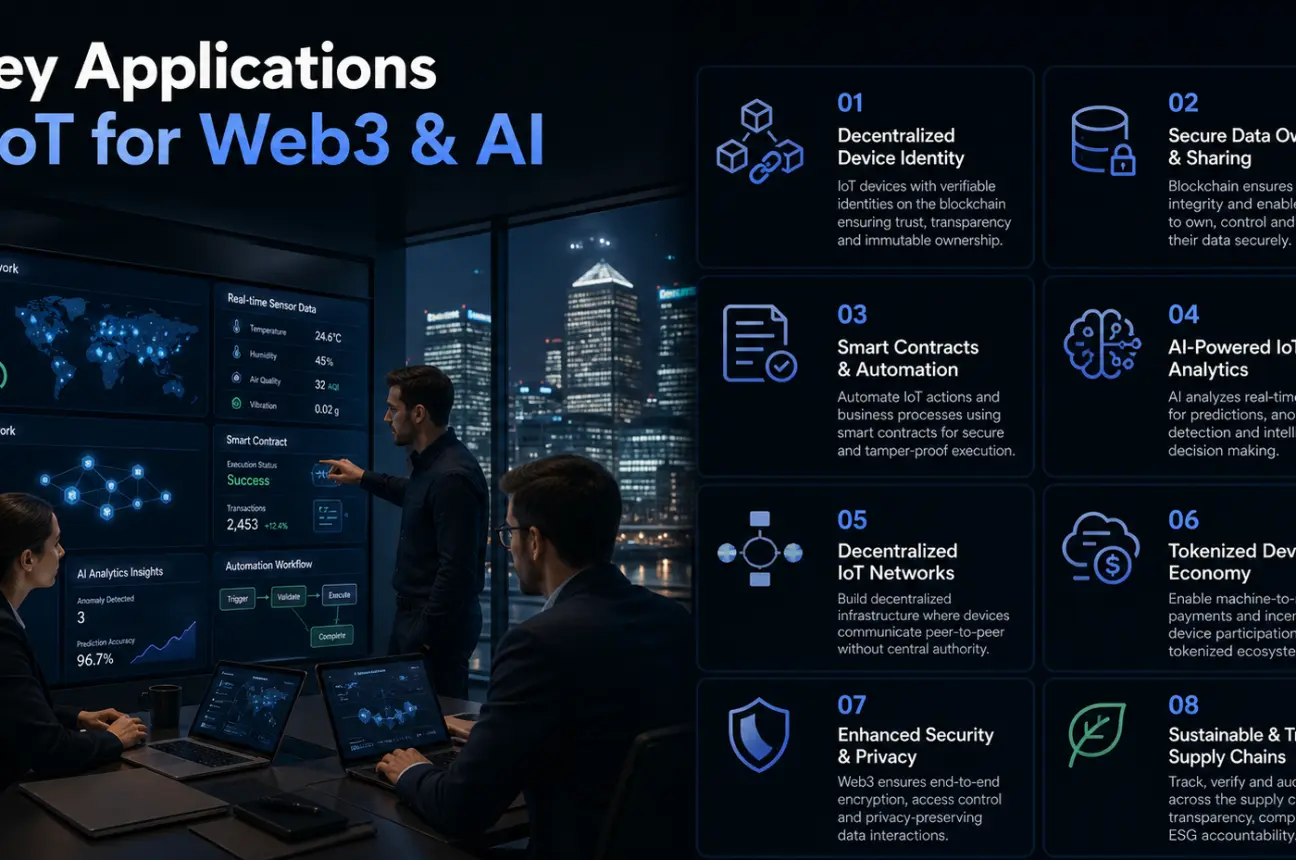
Beyond the smart fridge, the strategic value of connected devices sits in a harder problem. Turning physical events into trusted digital signals. The mainstream conversation around applications of IoT still leans on consumer gadgets and generic automation, yet the more important enterprise shift is happening in systems that feed AI models, trigger smart contracts, and document real-world activity with machine-readable evidence.
That shift matters most in sectors where trust, auditability, and timing affect revenue. Web3 platforms need credible off-chain inputs. Fintech systems need operational telemetry that can support controls, not just dashboards. Climate and carbon products need field data that can stand up to verification. Existing IoT coverage focuses heavily on operational use cases, while leaving a visible gap around security, governance, and financial-grade compliance for blockchain and fintech contexts, as noted in this review of IoT infrastructure applications and limitations.
For enterprise teams, IoT is becoming the data layer between physical operations and automated decision engines. That can mean vault sensors triggering custody workflows, smart meters feeding settlement logic, or environmental devices producing evidence for carbon accounting. It can also mean practical experience from adjacent sectors. Even something as everyday as streamlining driveway gate control for residents shows the same design principle at work. Sensors and connected controls create machine-actionable events only when identity, access, and timing are handled well.
This guide takes that enterprise lens. It looks at eight applications of IoT that matter for Web3, AI, crypto, and carbon-focused businesses. Not as novelty use cases, but as architecture decisions with implications for security, settlement, governance, and product design.
Table of Contents
- 1. 1. IoT for Tokenized Asset & Precious Metal Tracking
- 2. 2. IoT Smart Meters for DeFi Energy Trading
- 3. 3. IoT & Smart Contracts for Verifiable Carbon Credits
- 4. 4. IoT Hardware Wallets for Secure Crypto Trading
- 5. 5. IoT Monitoring for DEX & Trading Infrastructure Security
- 6. 6. AI-Enhanced IoT for Automated Compliance Monitoring
- 7. 7. IoT Data Feeds for Prediction Market Resolution
- 8. 8. IoT Data Bridges for Cross-Chain Asset Verification
- 8-Point Comparison of IoT Applications in Web3
- From Concept to Production Building Your IoT-Powered Platform
1. 1. IoT for Tokenized Asset & Precious Metal Tracking
Tokenized gold, silver, and other vaulted assets only work when digital ownership maps cleanly to physical custody. That’s where one of the strongest enterprise applications of IoT emerges. Sensors can document where an asset sits, whether storage conditions remain within policy, and whether a custody event happened as declared.

A token ledger can record transfers perfectly and still fail commercially if the underlying bar, batch, or sealed unit isn’t monitored well enough. GPS isn’t enough on its own. Teams usually need a mix of tamper detection, environmental sensing, access logging, and signed event transmission into a blockchain-compatible middleware layer. That combination creates a stronger chain of custody than paper certificates and periodic manual checks.
A practical signal for this market is user demand for simpler precious metal access. Consumer-facing products such as digital silver investment for Indians show why asset-backed digital products keep expanding, even though the harder engineering question remains institutional verification.
Why tokenization fails without physical assurance
Most tokenization projects spend too much time on issuance logic and not enough on evidence design. If a vault operator updates the ledger after the fact, investors still need to trust the operator. If sensors publish signed events close to the moment of custody, movement, or inspection, the trust model improves because the evidence trail gets harder to alter unnoticed.
Examples often discussed in this category include vault tracking systems used for bullion custody, smart monitoring in high-security storage, and sensor-assisted proof of reserve models. The strategic value isn’t the sensor itself. It’s the reduction in ambiguity between “stored”, “verified”, and “available for transfer”.
Practical rule: Treat every vault event as a financial event. If a door opens, a seal changes state, or environmental conditions fall outside policy, route that signal into the same control plane that governs settlement and alerts.
Architecture choices that reduce trust gaps
The strongest design pattern uses edge processing before blockchain submission. Devices collect frequent readings, an on-site gateway filters noise and signs event summaries, and only material state changes move on-chain. That keeps costs and latency manageable without losing forensic depth.
Use a layered control model:
- Redundant sensing: Pair tamper sensors with environmental and access-control feeds so one compromised device doesn’t become the single source of truth.
- Smart contract gating: Let high-risk events pause transferability until a human operator or multi-signature workflow clears the exception.
- Separation of duties: Keep vault access approval, sensor administration, and token issuance under different credentials and teams.
For founders building tokenized real-world assets, this is the essential moat. Not prettier token dashboards. Better evidence.
2. 2. IoT Smart Meters for DeFi Energy Trading
Energy markets are unusually well suited to IoT because electricity already depends on continuous measurement. Smart meters turn physical generation and consumption into timestamped records. Blockchain systems can then use those records for peer-to-peer settlement, green attribute accounting, and programmable energy products.
Where smart meters create market structure
Projects such as Power Ledger and Brooklyn Microgrid are widely cited because they point to a structural change. Small producers can participate in energy exchange if metering, settlement logic, and market rules are coordinated tightly enough. A rooftop solar owner doesn’t just generate power. They generate verifiable data about production windows, export volumes, and delivery conditions.
That distinction matters for DeFi-style energy trading. A token shouldn’t represent vague renewable potential. It should map to a measurable event, governed by clear issuance and retirement logic. Smart meters supply that event layer.
The broader IoT pattern is already visible in utility and smart grid deployments discussed by Digi, where connected measurement and control systems support real-time energy management and distributed resource coordination in municipal and grid settings, as outlined in Digi’s overview of IoT smart city and utility applications.
Design the settlement logic before the token
Many teams start with token design because it’s legible to investors. They should start with meter integrity. If the meter clock drifts, if firmware updates aren’t controlled, or if local outages create gaps, settlement disputes follow quickly.
The best implementations usually include a few operating rules.
- Time synchronisation: Match all devices to a trusted time source so generation and consumption windows are defensible during reconciliation.
- Dispute workflows: Define what happens when household devices, aggregator data, and utility records disagree.
- Market boundaries: Decide early whether the platform settles only within a microgrid, across a utility territory, or through a licensed intermediary.
Accurate metering isn’t just a technical requirement. It’s the market constitution for any tokenised energy system.
AI adds another layer. It can forecast generation, detect anomalous export patterns, and optimise when to route energy into storage versus trade execution. But AI only works if the sensor layer is stable. In energy trading, bad telemetry doesn’t merely reduce model accuracy. It can create settlement errors, compliance exposure, and reputational damage in a single cycle.
3. 3. IoT & Smart Contracts for Verifiable Carbon Credits
Carbon products suffer from a persistent credibility problem. Issuers describe impact. Buyers ask whether the impact happened, whether it was counted correctly, and whether someone else can claim it too. Consequently, advanced applications of IoT become strategically important for climate platforms.
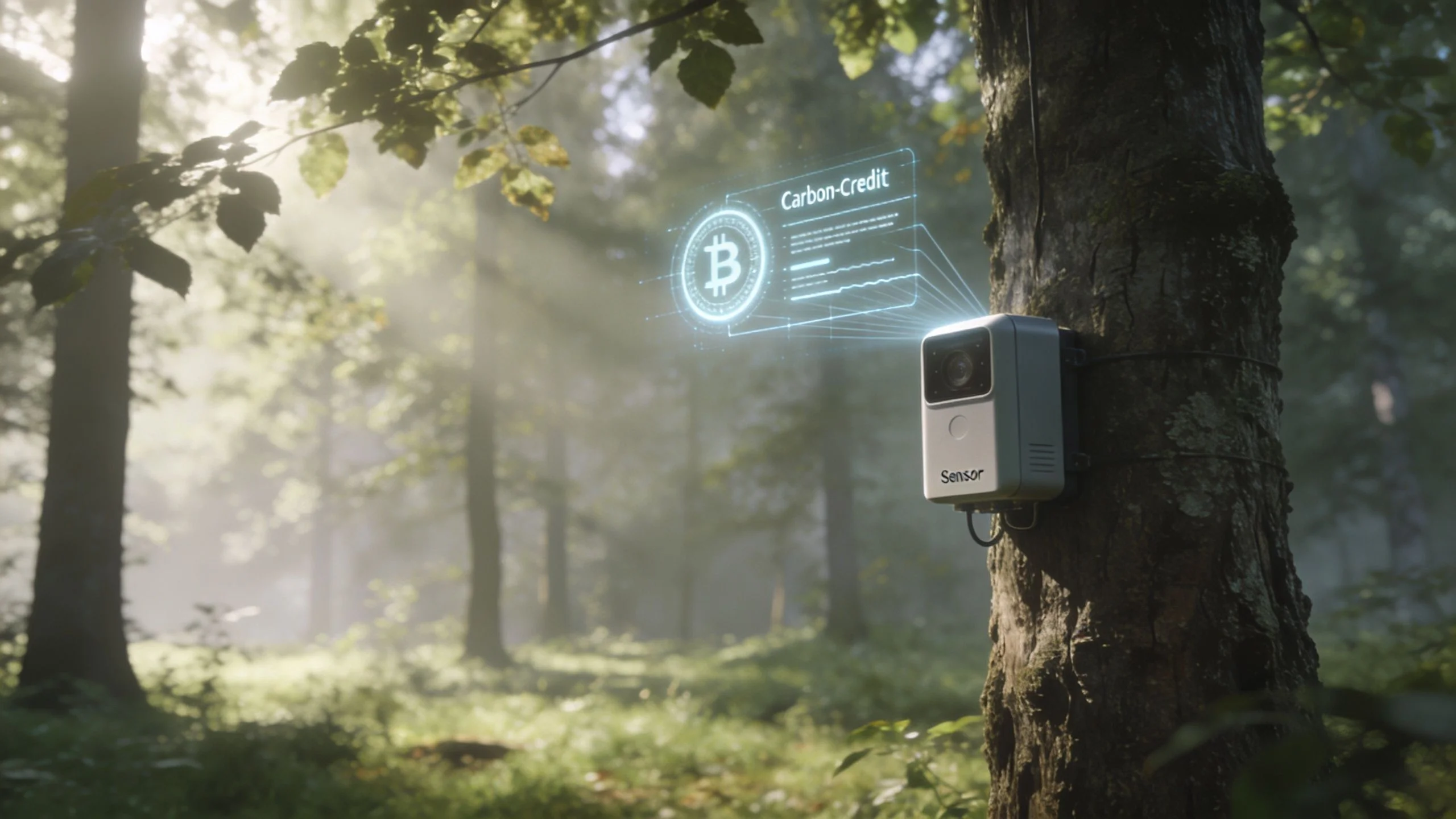
Environmental sensors can document variables such as site conditions, equipment status, emissions signals, and project activity. Smart contracts can then use validated inputs to govern issuance, retirement, and transfer restrictions. The value isn’t full automation for its own sake. It’s reducing the space between environmental reality and financial representation.
Carbon markets need evidence, not narratives
Projects in reforestation, soil carbon, industrial capture, and renewable generation all face the same design challenge. How much field evidence should flow into a digital registry, and how much should remain in off-chain verification systems? Push too little on-chain and transparency suffers. Push too much and systems become expensive, noisy, and hard to govern.
The right answer usually sits in a hybrid model. Sensors capture raw data continuously. Verification services aggregate and assess that data. The blockchain records the validated state change, the methodology reference, and the retirement history. That gives market participants enough transparency to evaluate claims without putting every noisy datapoint on-chain.
How to make sensor data usable on-chain
Most failures happen at the translation layer. Sensors emit operational data. Markets need compliance-grade statements. Bridging those worlds requires governance, not just infrastructure.
A disciplined operating pattern often includes:
- Methodology alignment: Match each sensor stream to a recognised measurement logic before token issuance rules are written.
- Redundant evidence paths: Combine field sensors with satellite, manual, or equipment-level records so a single broken stream doesn’t invalidate the project.
- Oracle controls: Validate what enters the contract, when it enters, and who can challenge it.
No India-specific IoT case study data appears in the available research corpus, which mostly points to global examples and not local benchmarks, as noted by IoT Analytics in its summary of major IoT use cases. For teams building carbon products in India or other fast-growing regional markets, that gap matters. Local project conditions, registry standards, and validator expectations can differ sharply from global examples.
The strategic implication is simple. Carbon tokenisation platforms shouldn’t market “real-time verification” unless they can prove how raw sensor readings become auditable claims.
4. 4. IoT Hardware Wallets for Secure Crypto Trading
The phrase “IoT hardware wallet” can sound contradictory. Good wallet design limits exposure, while IoT implies connectivity. Yet in institutional trading environments, controlled device telemetry can improve security when it’s tightly scoped and never allowed to expose key material.
Security starts with the device boundary
A modern trading terminal can use biometric inputs, secure elements, tamper sensors, and attestation routines to decide whether a signing request should proceed. That doesn’t mean a wallet should behave like a chatty consumer gadget. It means the device can verify its own integrity, the user context, and the execution environment before any approval path opens.
Ledger and Trezor popularised hardware-first custody for crypto users. Institutional variants push the concept further. They add managed fleets, policy engines, and role-based approval flows. In that model, IoT-style telemetry isn’t for convenience. It’s for state verification.
A useful pattern is local-first verification. Biometric confirmation, enclosure integrity checks, and firmware attestation happen on-device. Only signed status outputs move to the policy engine. Private keys remain isolated.
Institutional patterns differ from retail patterns
Retail wallet design often optimises for portability and user autonomy. Institutional device design optimises for recoverability, policy enforcement, and operational resilience. That changes the architecture.
- Multi-signature integration: Large transfers should require distributed approvals, not a single device event.
- Secure provisioning: Devices need authenticated enrollment and supply-chain validation before they join a fleet.
- Recovery design: Loss, theft, and hardware failure must be governed through formal recovery policies, not improvised support workflows.
A secure trading device shouldn’t “connect to everything”. It should prove a small number of facts, on demand, with minimal disclosure.
The under-discussed opportunity here is AI-assisted risk scoring at the edge. If a wallet detects unusual location context, enclosure interference, repeated failed biometric attempts, or an unauthorised accessory profile, it can raise friction before a trade is signed. That turns the hardware layer into a participant in transaction risk management, not just a passive signing tool.
5. 5. IoT Monitoring for DEX & Trading Infrastructure Security
Crypto teams often talk about smart contract exploits as if infrastructure were secondary. It isn’t. Exchanges, custody services, and market-making systems still depend on physical environments, server health, power quality, and facility access. That makes operational telemetry one of the most practical applications of IoT for trading infrastructure.
Physical telemetry belongs in security operations
A data centre rack overheating isn’t just an operations issue when it hosts pricing engines, key management services, or order-routing components. A failed cooling unit, power anomaly, or unauthorised cabinet opening can cascade into degraded service, forced failover, or emergency key rotation.
Mature operators pull these signals into the same security operations view as network events. Environmental and physical alerts become part of incident response, not a separate building-management feed that no one checks during a market event.
This matters even more in digital asset environments because the available research highlights a broader gap. Mainstream IoT coverage documents operational gains in sectors like healthcare and smart cities, but leaves security frameworks, financial data governance, and regulatory-grade controls largely unaddressed for fintech and blockchain use cases. That gap is described qualitatively in the earlier-cited review of IoT infrastructure limitations.
What mature teams monitor
The right telemetry set depends on architecture, but several categories recur in serious trading environments.
- Power integrity: Monitor mains quality, UPS status, battery condition, and generator transfer events around critical systems.
- Environmental drift: Watch temperature, humidity, airflow, and liquid detection in cabinets and cage spaces.
- Physical access: Log doors, locks, cages, and maintenance activity with identity-linked approvals.
- Hardware state: Track device restarts, fan failures, port status changes, and out-of-band management access.
A common mistake is treating these as facilities metrics. They are security controls because they document whether the environment remained within the assumptions your software and custody policies require.
For decentralised exchanges, the phrase sounds awkward because “decentralised” suggests no infrastructure edge. In practice, teams still run validators, indexers, API gateways, monitoring systems, and custody-adjacent services. Someone owns the racks. Someone controls access. Someone responds when the environment shifts.
6. 6. AI-Enhanced IoT for Automated Compliance Monitoring
Compliance programmes often break because firms document events after operations happen. IoT and AI change that sequence. They allow firms to capture access, movement, device state, and workflow context as activity unfolds, then route those signals into risk and review engines.
Compliance becomes continuous when telemetry is structured
For exchanges, fintech platforms, and tokenised asset systems, compliance isn’t only about transaction screening. It includes who entered a secure area, which device approved an action, whether a custody condition changed, and how exceptions were resolved. IoT can capture those operational facts. AI can classify and prioritise them.
That doesn’t eliminate KYC or AML obligations. It strengthens the surrounding evidence model. A suspicious transfer review becomes more meaningful if investigators can correlate wallet approvals, operator presence, vault access, and infrastructure status in one audit trail.
The opportunity is significant because the available research specifically notes a lack of mainstream IoT coverage on encryption, authentication across distributed networks, data integrity for immutable ledgers, and compliance workflows relevant to financial applications. For Web3 firms, that means the market still lacks enough implementation guidance.
What to automate and what to keep human
Not every alert deserves a human queue. Not every regulated decision should be delegated to a model. The strongest operating design separates detection, triage, and judgment.
- Automate detection: Let systems flag unusual combinations of access events, device anomalies, and transaction timing.
- Automate enrichment: Attach logs, identity metadata, and prior incidents so reviewers aren’t reconstructing context manually.
- Keep human approval for material actions: Account restrictions, reporting decisions, and irreversible freezes still need accountable operators.
A practical adjacent example is the growing appetite for AI tooling in crypto operations, visible in products highlighting CoinStats AI features. The lesson isn’t that a portfolio tool solves compliance. It’s that users increasingly expect AI to summarise complexity, detect anomalies, and surface actionable signals fast.
Operating principle: Use AI to compress investigative workload, not to replace accountable judgment where regulators or counterparties will ask who decided and why.
For founders, this category often becomes the hidden differentiator. Many platforms can ingest transactions. Fewer can produce coherent, multi-layer evidence when an auditor, banking partner, or enterprise client asks for it.
7. 7. IoT Data Feeds for Prediction Market Resolution
Prediction markets fail when market resolution becomes political, manual, or endlessly disputable. IoT offers a path around part of that problem by supplying authenticated event data from the physical world. Not for every market, but for the ones where measurable events can be instrumented clearly.
Reliable resolution depends on event design
Weather-linked markets are the cleanest example. If a contract settles on a threshold of rainfall, temperature, or wind activity at a defined location and time, calibrated sensor networks can provide the event basis. Sports and logistics markets are more complex because they often rely on mixed data sources, but the same principle holds. Resolution improves when the event definition is precise enough for machines to evaluate consistently.
The strategic issue isn’t “Can a sensor answer the question?” It’s “Can the product team define a question a sensor can answer without ambiguity?” Many market designers skip that step. They launch broad contracts that sound engaging but depend on interpretation.
Dispute handling is part of the product
No single feed should own resolution in high-value markets. IoT-based resolution works best with consensus across multiple feeds, challenge windows, and explicit fallback logic. If devices disagree, the contract should know what happens next.
Useful design choices include:
- Independent data sources: Use separate device operators or providers so one failure doesn’t control the result.
- Time-locked publication: Prevent opportunistic updates after participants can infer settlement outcomes.
- Fallback hierarchy: Define whether disputes route to a human committee, an oracle network, or a market refund path.
Some decentralised prediction platforms already rely on structured external data and community resolution processes. IoT can narrow the dispute surface further, especially in logistics, weather, industrial output, and location-based event markets. But it doesn’t remove governance. It formalises it.
A good prediction market team thinks like an exchange operator and a measurement engineer at the same time. That combination is still rare, which is why many otherwise clever market products struggle after launch.
8. 8. IoT Data Bridges for Cross-Chain Asset Verification
Cross-chain architecture solves digital interoperability. It doesn’t solve physical verification. If an asset exists in warehouses, vehicles, vaults, or field installations, a bridge still needs an evidence layer connecting physical reality to multi-chain state. That’s one of the least discussed yet most important applications of IoT for real-world asset systems.
Cross-chain trust still needs a physical anchor
Consider a tokenised commodity moving between chains for liquidity, collateralisation, or settlement. The blockchain side can prove wrapped issuance and redemption logic. It can’t prove the asset stayed in approved custody, remained in acceptable condition, or arrived where the transfer model assumes it did. Sensors can document those facts.
That creates a bridge architecture with three trust zones. The first is the physical asset and its sensors. The second is the middleware or oracle layer that validates and signs state changes. The third is the destination chain logic that updates token status, transferability, or collateral position. There is a tendency to focus heavily on the third zone and underinvest in the first two.
Verification needs redundancy across systems
A strong cross-chain verification design usually relies on overlapping controls rather than a single canonical feed.
- Threshold signing: Require multiple approved verifiers or gateways to sign asset-state updates before bridge actions finalise.
- Verification windows: Delay final settlement briefly when condition or custody changes need reconciliation.
- Cross-system logging: Preserve a linkable record across warehouse systems, sensor gateways, oracle services, and chain events.
This architecture matters for tokenised trade finance, metals, agriculture, and carbon-linked instruments. It also matters for any future system where assets move between public chains, private ledgers, and enterprise systems. The more chains involved, the more valuable a consistent physical evidence model becomes.
The larger strategic point is simple. Interoperability isn’t complete when chains can talk to each other. It’s complete when chains can trust the same version of the physical world.
8-Point Comparison of IoT Applications in Web3
| Solution | Implementation Complexity 🔄 | Resource Requirements 💡 | Expected Outcomes 📊⭐ | Ideal Use Cases ⚡ | Key Advantages ⭐ |
|---|---|---|---|---|---|
| 1. IoT for Tokenized Asset & Precious Metal Tracking | High 🔄🔄🔄, hardware, vault integration, on‑chain links | High, sensors, secure storage, edge compute, integration teams | Transparent custody, instant verification, reduced fraud ⭐⭐⭐ | Tokenized precious metals, collateralized DeFi, custodial platforms | Immutable audit trails; anti‑counterfeit; faster settlements |
| 2. IoT Smart Meters for DeFi Energy Trading | Medium‑High 🔄🔄, grid integration, standards work | Medium, smart meters, grid interfaces, token platforms | Enables P2P energy markets and green credits, new revenue streams ⭐⭐⭐ | Prosumer marketplaces, local microgrids, renewable credit issuance | Direct P2P settlement; transparent carbon accounting |
| 3. IoT & Smart Contracts for Verifiable Carbon Credits | Medium 🔄🔄, sensors, oracles, verification protocols | Medium, environmental sensors, oracle services, auditors | Verifiable offsets, automated issuance, fraud reduction ⭐⭐⭐ | Carbon offset tokenization, climate finance, compliance reporting | Transparent verification; automated compliance and auditing |
| 4. IoT Hardware Wallets for Secure Crypto Trading | Medium 🔄🔄, device security, biometric integration | Medium, secure hardware, firmware updates, manufacturing | Strong private‑key protection; secure on‑chain transactions ⭐⭐⭐ | Individual/institutional secure trading, custody-lite solutions | Tamper detection; secure enclave; reduced exchange exposure |
| 5. IoT Monitoring for DEX & Trading Infrastructure Security | High 🔄🔄🔄, distributed sensors, AI analytics | High, sensors, HSMs, monitoring stack, ops teams | Reduced downtime, real‑time breach detection, improved uptime ⭐⭐⭐ | Exchanges, data centers, high‑availability trading infra | Proactive threat detection; automated failover; compliance support |
| 6. AI‑Enhanced IoT for Automated Compliance Monitoring | High 🔄🔄🔄, ML models, explainability, regulated workflows | High, labeled data, continuous retraining, sensor networks | Automated AML/KYC detection, audit trails, fewer manual reviews ⭐⭐⭐ | Regulated DeFi, compliance automation, large trading platforms | Real‑time anomaly detection; defensible audit evidence |
| 7. IoT Data Feeds for Prediction Market Resolution | Medium 🔄🔄, multi‑source aggregation, oracle design | Medium, distributed sensors, signing, aggregation protocols | Trustless event resolution, faster payouts, fewer disputes ⭐⭐ | Prediction markets, decentralized betting, automated settlements | Transparent event verification; reduced central manipulation |
| 8. IoT Data Bridges for Cross‑Chain Asset Verification | Very High 🔄🔄🔄🔄, cross‑chain coordination, cryptographic thresholds | Very High, multi‑chain integration, threshold crypto, redundancy | Secure cross‑chain asset transfers, lower settlement risk ⭐⭐⭐ | Cross‑chain swaps with real‑world collateral, multi‑chain tokens | Physical verification layer for atomic swaps; reduces bridge reliance |
From Concept to Production Building Your IoT-Powered Platform
The enterprise story behind applications of IoT is no longer about connecting devices for visibility alone. It is about building a trustworthy event layer for systems that automate money movement, ownership changes, market resolution, compliance review, and sustainability claims. That shift changes both product strategy and system design.
For Web3 and digital asset teams, the immediate lesson is that off-chain data quality now sits closer to core product value than many token architectures do. A tokenised metal platform without reliable vault telemetry remains a branding exercise. A DeFi energy product without defensible meter logic becomes a dispute engine. A carbon marketplace without evidence discipline struggles to earn institutional trust. In each case, the competitive advantage sits in how well the platform translates physical events into verifiable digital records.
The same pattern applies to AI. Models don’t create trust by themselves. They classify, forecast, and prioritise based on the integrity of the telemetry they receive. If the underlying device layer is noisy, spoofable, or poorly governed, AI accelerates weak decisions. If the telemetry is signed, contextualised, and routed through clear controls, AI becomes useful for anomaly detection, operational optimisation, and compliance triage.
That leads to a more practical implementation sequence than is often employed. Start with the event model. Decide which physical events matter commercially or regulatorily. Then define how those events are sensed, validated, signed, disputed, and stored. Only after that should you finalise smart contract logic, token economics, or analytics layers. This order feels slower at the start, but it prevents expensive redesign later when legal, operations, and security teams discover that the platform can’t prove what it claims.
Three priorities usually separate pilots from production systems:
- Security architecture first: Device identity, provisioning, encryption, attestation, and zero-trust communication shouldn’t be retrofit work.
- Governance at every layer: Teams need explicit rules for data quality, exception handling, operator permissions, and audit retention.
- Hybrid system design: The best enterprise platforms don’t force every reading on-chain. They combine edge processing, off-chain validation, and selective on-chain anchoring.
The available research also points to an important market gap. Mainstream IoT material covers operations well, but often under-serves financial, blockchain, and compliance-heavy use cases. That creates an opening for firms that can design systems across all layers at once. Not just device fleets. Not just smart contracts. The whole path from physical signal to business action.
That’s where Blocsys Technologies is relevant for organisations building in fintech, exchanges, tokenisation, trading infrastructure, AI, and carbon-linked products. Blocsys helps teams design production-ready blockchain and AI-powered platforms, including tokenization systems, trading infrastructure, and intelligent compliance workflows. In projects where IoT data must become secure, monetisable, and auditable application logic, that convergence matters. It is the difference between a connected prototype and an operating platform.
The next 12 to 24 months will likely favour teams that treat IoT as part of transaction architecture, not just operational plumbing. Buyers, auditors, counterparties, and regulators are asking harder questions about provenance, controls, and evidence. Platforms that can answer those questions cleanly will be easier to scale, easier to partner with, and harder to displace.
If your roadmap depends on trusted real-world data, the implementation challenge isn’t whether IoT belongs in the stack. It does. The core question is whether your architecture can turn that data into something secure, verifiable, and commercially usable.
If you’re building a platform where physical data must drive on-chain logic, settlement, compliance, or AI workflows, Blocsys Technologies can help you shape the architecture and execution plan. Connect with Blocsys to discuss tokenization systems, trading infrastructure, or intelligent compliance workflows for a production-ready build.
Frequently Asked Questions
What does “applications of IoT” mean in a Web3 and AI context?
Beyond consumer gadgets, it means using connected devices to turn physical events into trusted, machine-readable digital signals. These signals feed AI models, trigger smart contracts, and document real-world activity for systems where trust, auditability, and timing directly affect revenue.
Why do existing IoT resources fall short for blockchain and fintech use cases?
Most existing IoT coverage focuses heavily on operational use cases like automation and consumer convenience. This leaves a visible gap around security, governance, and financial-grade compliance needed for blockchain and fintech contexts.
Why does tokenization of assets like gold or silver fail without physical assurance?
A token ledger can record transfers perfectly, yet still fail commercially if the underlying bar, batch, or sealed unit isn’t monitored well. Tokenization projects often over-invest in issuance logic while under-investing in evidence design, so if a vault operator updates the ledger after the fact, investors still have to trust the operator rather than verifiable data.
What kind of sensor setup is needed for reliable precious metal tracking?
GPS alone isn’t enough. Teams typically need a mix of tamper detection, environmental sensing, access logging, and signed event transmission into a blockchain-compatible middleware layer, which creates a stronger chain of custody than paper certificates and periodic manual checks.
What architecture pattern reduces trust gaps in vault-to-blockchain systems?
The strongest pattern uses edge processing before blockchain submission: devices collect frequent readings, an on-site gateway filters noise and signs event summaries, and only material state changes move on-chain. This is paired with a layered control model covering redundant sensing, smart contract gating for high-risk events, and separation of duties.
What is the practical rule for treating vault events in this system?
Every vault event should be treated as a financial event. If a door opens, a seal changes state, or environmental conditions fall outside policy, that signal should route into the same control plane that governs settlement and alerts.
