
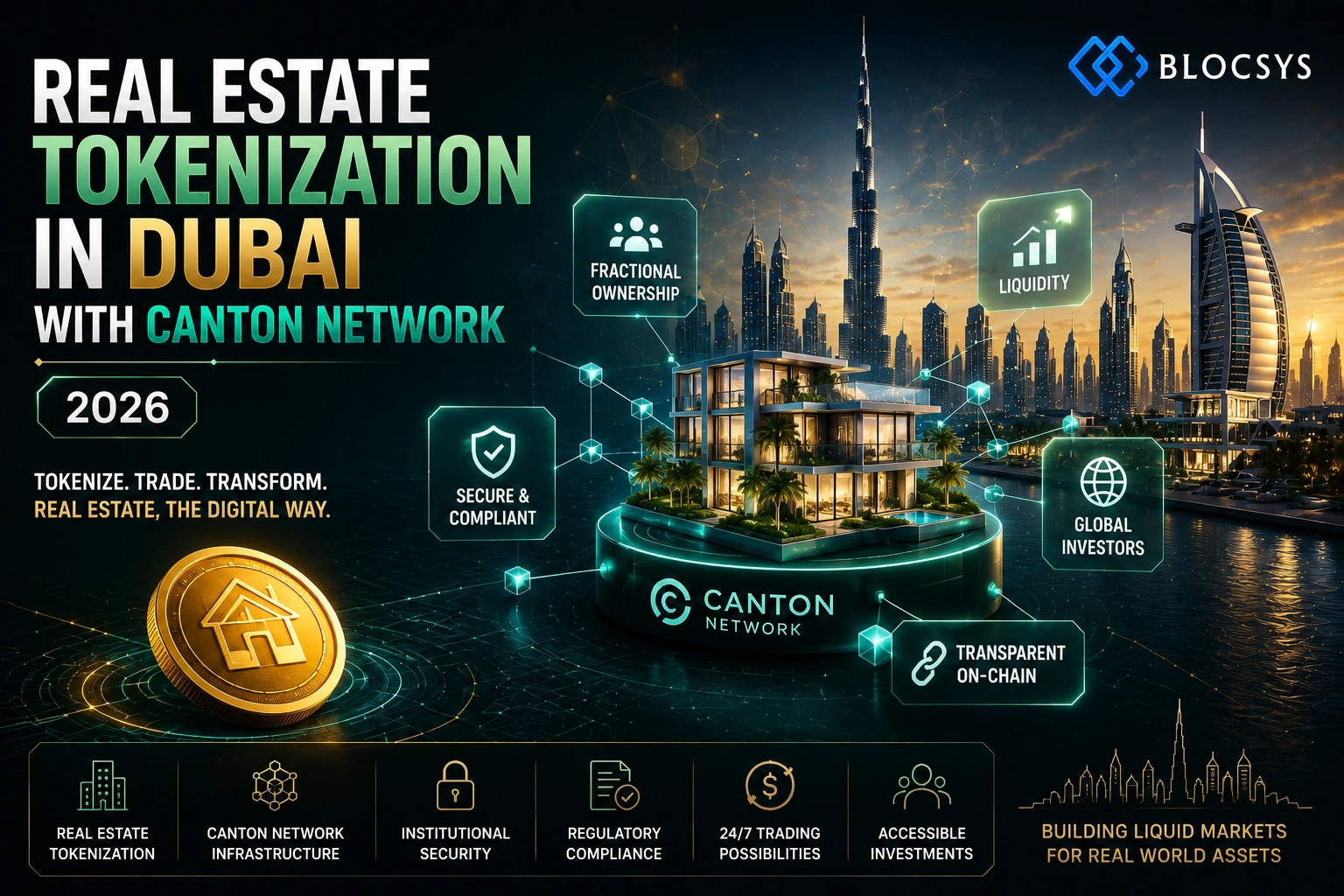
For decades, owning a piece of Dubai’s iconic skyline was a privilege reserved for those with immense capital. The city’s real estate market, known for its ultra-luxury properties, has historically been one of the world’s most exclusive. But that’s changing in 2026. Real estate tokenization in Dubai is fundamentally restructuring this model, converting property ownership rights into tradable digital tokens on a blockchain. As a leading blockchain development company, Blocsys has the proven expertise to engineer these complex systems.
This innovation makes it possible to buy fractional shares of high-value properties, dramatically lowering the barrier to entry and introducing a new level of liquidity to a traditionally illiquid asset class. This guide is for real estate investors, property developers, and enterprise CTOs exploring how blockchain-based fractional ownership, powered by institutional-grade infrastructure like the Canton Network, is transforming property investment in Dubai and globally.
Table of Contents
- The New Reality for Dubai Real Estate Investment
- How Dubai Is Engineering a Tokenised Property Market
- The Role of the Canton Network in Institutional-Grade Tokenisation
- The Anatomy of a Tokenized Property Platform in 2026
- Who Can Participate in Dubai’s Tokenisation Ecosystem?
- How Blocsys Can Build Your Real Estate Tokenization Platform
- FAQs on Real Estate Tokenization in Dubai
- What is real estate tokenization in Dubai?
- How does fractional ownership work using blockchain technology?
- What is Canton Network and why is it important for asset tokenization?
- How can investors buy tokenized real estate assets?
- Is real estate tokenization legal in the UAE?
- What are the benefits of tokenized property ownership?
- How secure is blockchain-based property investment?
- How can Blocsys build real estate tokenization platforms for enterprises?
The New Reality for Dubai Real Estate Investment
What if you could invest in a prime Dubai skyscraper with the same ease as buying a share of stock? That’s the reality taking shape today, thanks to the adoption of real estate tokenization. This approach dismantles the old, capital-intensive investment model by turning physical property rights into secure, divisible, and tradable digital assets. For a preliminary estimate of what it takes to build such a platform, our Software Development Cost Estimator provides a useful starting point.
While the traditional market dynamics remain important—and the World Property Investor’s Dubai guide offers an excellent primer—this technological layer is creating entirely new opportunities on top of that foundation.
This shift is opening doors for a whole new class of market participants, including:
- Global investors who want direct access to the lucrative Dubai property market without needing millions in upfront capital.
- Property developers aiming to unlock new funding sources and improve the liquidity of their portfolios.
- Institutional funds that need secure and efficient ways to trade and manage real-world assets in a regulated environment.
- Fintech founders and CTOs building the next wave of investment platforms that require robust, private blockchain infrastructure.
This guide will walk you through how real estate tokenization in Dubai actually works, with a focus on the role of institutional-grade platforms like the Canton Network. You’ll get a clear picture of the mechanics, benefits, and future of this fast-growing market.
By breaking down high-value assets into smaller, digitally-native units, tokenization creates a more democratic and dynamic investment environment. It’s not just about technology; it’s about fundamentally restructuring access to wealth creation.
Successfully navigating this new terrain requires a partner who deeply understands both the technology and the market. To get a better sense of the mechanics, you can learn more about our comprehensive approach to real world asset tokenization.
How Dubai Is Engineering a Tokenised Property Market
The tokenisation of Dubai’s property market isn’t some far-off concept; it’s a strategic, government-backed reality unfolding right now. The emirate is methodically executing a plan to establish itself as a global leader in RWA tokenization in Dubai, completely overhauling how property is owned, managed, and traded.
This isn’t just about plugging in new technology. It’s about engineering an entirely new market infrastructure from the ground up.
At the core of this shift is the Real Estate Evolution Space Initiative (REES). This isn’t a small-scale pilot programme. REES is a live, operational system built to integrate property ownership directly with blockchain technology. It represents a coordinated effort between several powerful entities working together to create a secure and regulated ecosystem for digital property investment.
The Regulatory Bedrock of Tokenisation
Dubai’s entire approach is anchored by a strong regulatory framework, which delivers the trust and security necessary to attract both institutional and retail investors. This foundation is a joint effort by a coalition of key government bodies:
- Dubai Land Department (DLD): As the official registry for all real estate transactions, the DLD provides the legal finality for tokenised titles. This ensures a digital token representing ownership is just as valid as a traditional paper deed.
- Virtual Assets Regulatory Authority (VARA): VARA is the dedicated watchdog for the digital asset landscape. It provides clear rules for token issuance, trading, and custody, ensuring strict compliance and robust investor protection.
- Central Bank of the UAE: Its involvement is crucial. It signals the integration of tokenised assets into the wider financial system, guaranteeing monetary stability and alignment with national financial policies.
- Dubai Future Foundation: This organisation pushes the innovation agenda, making sure the entire project stays at the forefront of technological and economic development.
This collaborative model is already setting a global benchmark. Dubai has launched a groundbreaking project enabling fractional ownership starting at just AED 2,000, dramatically lowering the barrier to entry for blockchain property investment. Launched under REES and backed by the DLD, VARA, and the Central Bank, this initiative marks a pivotal moment for blockchain property investment.
The goal is to completely transform property ownership, with tokenised assets projected to reach a valuation of approximately $16 trillion globally by 2030. You can get a deeper dive into how the UAE is winning the RWA race on LinkedIn.
By architecting this robust legal and technological framework, Dubai isn’t just permitting real estate tokenization in Dubai—it is actively engineering its success. This gives investors, developers, and technology providers a clear, secure path to participate in the future of property. As this market matures, understanding how to raise capital becomes vital. Check out our guide on the best platforms for crypto fundraising in the UAE to learn more.
The Role of the Canton Network in Institutional-Grade Tokenisation
With Dubai’s government-backed vision for a tokenised property market taking shape, the conversation has shifted from why to how. How do you build a financial system that connects competing institutions securely, allowing them to transact on real-world assets without ever exposing confidential data? The answer isn’t a general-purpose blockchain, but purpose-built infrastructure. This is where the Canton Network real estate solutions come in.
Canton is a privacy-enabled distributed ledger network engineered specifically for the demands of institutional finance. It was created to solve the core conflict that slowed enterprise blockchain adoption for years: the need for firms to share a common ledger without also sharing their private business information.
The Institutional-Grade Foundation for Real World Assets
When dealing with high-value, regulated assets like Dubai real estate, certain technological features are non-negotiable. The Canton Network blockchain is built around three core principles that make it the ideal backbone for enterprise-grade property tokenization platforms.
- Privacy by Design: Canton gives participants granular control, letting them share data only with those who have a right to see it. Unlike public blockchains where all transaction data is open, Canton ensures the details of a property deal between a bank and an investor remain completely confidential.
- Seamless Interoperability: The network allows different applications, built by various institutions, to connect and interact flawlessly. A property developer’s platform can communicate with a wealth manager’s system and a regulator’s compliance tool, all operating on the same synchronised ledger.
- Proven Scalability: It was built from the ground up to handle the transaction volumes of global financial markets. Canton can support the massive scale required for a city-wide real estate tokenisation initiative right out of the box.
This specific combination of features is exactly what institutional investors, wealth management firms, and property developers in Dubai have been waiting for. It provides a secure environment where fierce competitors can finally collaborate without compromising their commercial interests.
Canton Network delivers a “network of networks” where financial institutions can maintain their sovereignty while still achieving the synchronisation and automation benefits of a distributed ledger. This is the key to unlocking institutional capital in tokenised markets.
By providing this institutional-grade foundation, the Canton Network transforms the vision of a liquid and secure Dubai property market into a technological reality. If you want to go deeper on its local impact, check out our article on why Dubai banks are adopting Canton Network for their enterprise infrastructure.
The Anatomy of a Tokenized Property Platform in 2026
Building a property tokenization platform for real estate tokenization in Dubai isn’t just about launching a website—it’s about engineering an entire financial ecosystem. For founders and CTOs, this means architecting a system that masterfully weaves together legal frameworks, blockchain technology, and strict investor management protocols.
The journey starts long before a single line of code is written. It begins with meticulous property appraisal and due diligence, where assets are rigorously vetted. The best platforms use powerful software for deal analysis and risk assessment. For a closer look at the tools available, explore this in-depth guide to AI real estate underwriting.
Once a property is approved, it’s legally secured within a Special Purpose Vehicle (SPV). This is a dedicated legal entity created for the sole purpose of holding the property title, isolating it from other assets and risks.
From Legal Entity to Digital Token
With the legal structure locked in, the real technical work begins. This is where the property’s value is converted into a digital, tradable format. The core components include:
- Token Issuance: Digital tokens representing fractional ownership blockchain are minted on a secure network like Canton Network. Each token acts as a verifiable, tradable claim on a piece of the underlying property held within the SPV.
- Smart Contract Infrastructure: These self-executing contracts are the engine of the entire platform. They are programmed to automatically handle critical functions like distributing rental income to token holders and managing governance rules with complete transparency.
- Investor Onboarding (KYC/AML): To comply with VARA regulations, the platform must integrate rigorous Know Your Customer (KYC) and Anti-Money Laundering (AML) workflows. This ensures every investor’s identity and eligibility are thoroughly verified before they can participate.
The global tokenised real estate market, which stood at $2.5 trillion in 2024, is projected to skyrocket to $16 trillion by 2030. Dubai’s pilot initiative is a massive catalyst for this growth, integrating title deeds directly with the blockchain to enable fractional ownership and fluid secondary trading.
Finally, the most critical feature is the secondary trading market. This is an integrated exchange where investors can freely buy and sell their property tokens. It provides the liquidity that truly sets tokenisation apart from traditional real estate investment. For a detailed breakdown of the process, check out our guide on how to tokenise real-world assets.
A successful platform isn’t just a marketplace; it’s a full-stack financial service. It combines the legal certainty of traditional property ownership with the efficiency and accessibility of modern digital finance.
Who Can Participate in Dubai’s Tokenisation Ecosystem?
Dubai’s move into real estate tokenisation isn’t just a tech upgrade; it’s a deliberate effort to open one of the world’s most dynamic property markets to a global audience. The entire system is designed to tear down the old walls that made real estate investing exclusive, creating new avenues for practically anyone to get involved.
What this means is that everyone, from small-scale individual investors to large financial institutions, can now find a seat at the table. Of course, for those looking at international property, it’s always wise to get a handle on the tax side of things. For example, you can find a good breakdown of the Australian tax rules for expats here, which highlights the kind of financial planning required.
A Wide Range of Participants
The beauty of this model is how broad its appeal is. Through initiatives like Dubai’s Real Estate Evolution Space Initiative (REES), the door is open for multiple investors to co-own a single property. This shatters the barrier to entry, with investments starting from as little as AED 2,000 through a digital wallet. Suddenly, owning a piece of prime real estate doesn’t require millions. You can read more about this groundbreaking project in the official Dubai Land Department announcement.
The ecosystem primarily caters to four key groups:
- Individual Retail Investors: For the first time, everyday investors across the globe can add a fraction of a high-end Dubai property to their portfolios. It’s a powerful way to achieve a level of diversification that was once completely out of reach.
- Institutional Investors & Funds: These larger players now have access to a brand-new liquid asset class. Tokenisation makes it far easier to rebalance portfolios and gain exposure to high-value properties within a regulated and transparent system.
- Proptech and Fintech Startups: This is a massive opportunity for innovators. Founders and tech companies can build the next wave of investment platforms, compliance tools, and secondary trading markets on top of this newly laid infrastructure.
- Property Developers: Developers can finally unlock a global pool of capital. By offering fractional ownership directly to investors, they can fund projects and improve liquidity without being solely reliant on traditional bank financing.
This infographic breaks down the essential flow for building a platform that serves all these participants.
The process illustrates how a physical property is transformed into tradable digital tokens, outlining the critical legal and technical steps involved along the way.
How Blocsys Can Build Your Real Estate Tokenization Platform
Turning a vision for a real estate tokenization platform in Dubai into a fully operational system is a massive undertaking. It requires a deep understanding of both advanced blockchain engineering and complex financial regulations. This isn’t a DIY project; it demands a partner who has already mastered these challenges.
Choosing an expert like Blocsys, an experienced real estate tokenization development company, is what separates a great idea from a successful launch. We specialise in building and deploying enterprise-grade digital asset platforms. Our job is to turn your business goals into a robust, secure, and compliant technological reality from day one.
From Architecture to Execution
A successful launch isn’t a single event—it’s the result of several critical engineering and compliance workstreams running in parallel. Blocsys manages the entire project lifecycle, end-to-end.
- Secure Smart Contract Development: We write and audit the smart contracts that govern everything from dividend distributions to token transfers and governance rules. This ensures they are tamper-proof and perform exactly as designed on networks like Canton.
- VARA-Compliant Architecture: We design platforms with Dubai’s regulatory framework at their core. This means integrating KYC/AML workflows and building the reporting mechanisms necessary to meet VARA’s strict standards.
- Scalable Secondary Markets: Liquidity is everything. We build the integrated trading venues that allow investors to seamlessly buy and sell property tokens within a secure, regulated environment.
Partnering with a specialist de-risks your entire project. It ensures that you’re not just building a product, but a trusted financial instrument that meets the high expectations of institutional and retail investors alike.
Ultimately, turning the promise of fractional ownership blockchain into a market-leading platform requires a team that has been there before. For a deeper look into selecting the right team, you can review our guide on choosing a blockchain consulting partner.
FAQs on Real Estate Tokenization in Dubai
Here we’ll answer some of the most common questions about the growing market for real estate tokenisation in Dubai. The answers are designed to give you a clear, practical understanding of this new investment frontier.
What is real estate tokenization in Dubai?
Real estate tokenization in Dubai is the process of converting ownership rights in a physical property into digital tokens on a blockchain. This allows a high-value asset, like a skyscraper or luxury villa, to be divided into smaller, fractional shares that can be bought and sold by multiple investors, making it more accessible and liquid.
How does fractional ownership work using blockchain technology?
Fractional ownership uses blockchain to create a secure and unchangeable digital ledger of who owns each share of a property. A property’s title is held in a legal entity (SPV), which issues a set number of digital tokens. Each token represents ownership, and smart contracts automate processes like distributing rental income, ensuring transparency and security for all investors.
What is Canton Network and why is it important for asset tokenization?
The Canton Network is a privacy-focused distributed ledger designed for institutional finance. It’s crucial for real estate tokenization because it lets regulated firms (banks, asset managers) transact securely without exposing sensitive data. Its privacy, interoperability, and scalability make it the ideal foundation for building enterprise-grade tokenized real estate Dubai platforms.
How can investors buy tokenized real estate assets?
Investors can buy tokenized real estate assets through specialized online platforms. After completing a mandatory KYC/AML verification process to comply with regulations, investors can browse available properties, purchase digital tokens representing fractional ownership, and manage their portfolio through a secure digital wallet integrated with the platform.
Is real estate tokenization legal in the UAE?
Yes, real estate tokenization is legal and actively promoted in the UAE, particularly in Dubai. The process is supported by the Dubai Land Department (DLD) and regulated by the Virtual Assets Regulatory Authority (VARA). This robust legal framework ensures that transactions are secure, legally binding, and provide recognized ownership rights to token holders.
What are the benefits of tokenized property ownership?
The main benefits of tokenized property ownership are lower entry barriers (investing with smaller amounts), increased liquidity (ability to trade tokens on secondary markets), enhanced transparency through the blockchain, and access to a diversified global real estate portfolio that was previously accessible only to high-net-worth individuals and institutions.
How secure is blockchain-based property investment?
Blockchain-based property investment offers a high degree of security. Transactions are cryptographically secured and recorded on an immutable ledger, making them tamper-proof. Paired with regulated platforms that follow strict KYC/AML protocols and use institutional-grade networks like Canton, it creates a transparent and secure environment for blockchain real estate investment.
How can Blocsys build real estate tokenization platforms for enterprises?
Blocsys provides end-to-end services to build secure, compliant, and scalable real estate tokenization platforms. Our expertise includes designing the architecture, developing and auditing smart contracts for networks like Canton, integrating VARA-compliant KYC/AML workflows, and building secondary trading markets, ensuring your platform is institutional-grade and ready for the Dubai market.
Ready to build the future of real estate investment in 2026? Blocsys has the deep expertise to help you engineer a secure, compliant, and scalable real estate tokenization platform. Whether you are a property developer, fintech founder, or enterprise exploring Canton Network, our team can guide you from concept to launch.
Contact us today to discuss your project with our blockchain experts.
The Growing Role of Blockchain Applications in Enterprise Digital Transformation
As digital transformation accelerates across industries, blockchain applications are becoming essential for building secure, transparent, and efficient business ecosystems. Organizations are increasingly adopting blockchain to strengthen data integrity, automate workflows, and create tamper-proof records that improve trust among customers, partners, and regulators. Beyond cryptocurrency, modern blockchain applications support secure document verification, digital identity management, supply chain traceability, asset tokenization, smart contract automation, and real-time audit trails. When integrated with emerging technologies such as artificial intelligence (AI), cloud computing, and the Internet of Things (IoT), blockchain enables organizations to reduce operational costs, improve regulatory compliance, and streamline complex business processes. Enterprises across finance, healthcare, logistics, government, and manufacturing continue to invest in blockchain-powered solutions to enhance security, increase operational efficiency, and accelerate digital innovation. As enterprise adoption continues to grow, blockchain applications are expected to play a central role in creating scalable, trusted, and future-ready digital infrastructure for businesses worldwide.
The Growing Role of Blockchain Applications in Enterprise Digital Transformation
As digital transformation accelerates across industries, blockchain applications are becoming essential for building secure, transparent, and efficient business ecosystems. Organizations are increasingly adopting blockchain to strengthen data integrity, automate workflows, and create tamper-proof records that improve trust among customers, partners, and regulators. Beyond cryptocurrency, modern blockchain applications support secure document verification, digital identity management, supply chain traceability, asset tokenization, smart contract automation, and real-time audit trails. When integrated with emerging technologies such as artificial intelligence (AI), cloud computing, and the Internet of Things (IoT), blockchain enables organizations to reduce operational costs, improve regulatory compliance, and streamline complex business processes. Enterprises across finance, healthcare, logistics, government, and manufacturing continue to invest in blockchain-powered solutions to enhance security, increase operational efficiency, and accelerate digital innovation. As enterprise adoption continues to grow, blockchain applications are expected to play a central role in creating scalable, trusted, and future-ready digital infrastructure for businesses worldwide.
Tokenizer Technology: The Foundation of Secure Digital Asset Ownership
A tokenizer is the core technology that converts ownership rights of real-world assets into secure digital tokens on a blockchain. In real estate, a tokenizer enables property owners and developers to digitize assets, create fractional ownership opportunities, and simplify the issuance, management, and transfer of tokenized property shares. By automating asset token creation, ownership tracking, compliance, and smart contract execution, a tokenizer enhances transparency, security, and operational efficiency. As enterprises increasingly adopt blockchain for real-world asset (RWA) tokenization, a robust tokenizer is becoming an essential component for building scalable, compliant, and future-ready digital real estate investment platforms.
