Challenge
Enterprises issuing critical documents — degrees, offer letters, medical reports, contracts, QA certificates, insurance policies — had no cryptographic way to prove authenticity, no on-chain timestamp, no tamper-detection mechanism, and no centralized verification path for third parties. Forged PDFs, altered scans, and disputed issuance dates were costing enterprises legal exposure and operational delays.
Solution
Fully automated, blockchain-anchored document verification platform with cryptographic hash generation, Merkle-batched on-chain proof anchoring, multi-tenant issuer registry, EIP-712 signed attestations, and a public verification portal that confirms authenticity, integrity, issuance time, and issuing organization in under 2 seconds.
Results
2.4M+ documents anchored on-chain in the first 9 months across 38 enterprise tenants, average verification time reduced from 3–7 business days to under 2 seconds, zero successful forgery attempts post-deployment, and full audit trail across every issued document.
The Problem
Enterprises across education, HR, healthcare, legal, supply chain, and insurance issue millions of critical documents every year — and almost none of them carry a cryptographic guarantee of authenticity. Verification is still done by phone calls, signed letters, email confirmations, and manual database lookups. Forgery is trivial — a PDF can be edited in minutes, a scan can be re-printed with altered fields, and the issuing organization is rarely contactable for instant confirmation.
Our client, an enterprise document authority operating across multiple regulated verticals, partnered with Blocsys Technologies to build the cryptographic verification infrastructure the market needed.
Key Issues:
- Manual verification of degrees, offer letters, and compliance certificates created 3–7 business day turnaround times for every third-party request — slowing down hiring, admissions, loan disbursement, and onboarding pipelines
- No cryptographic integrity layer — once a PDF or image left the issuing system, there was no way to detect whether even a single byte had been altered before reaching the verifier
- Forgery detection was reactive and visual — verifiers relied on watermarks, seals, signatures, and stylistic cues that are routinely defeated by modern editing tools, with no programmatic guarantee of authenticity
- No timestamp integrity — disputes over issuance dates (employment start dates, certificate validity windows, contract execution timestamps) had no cryptographically anchored source of truth, exposing both issuers and recipients to legal risk
- No unified issuer registry — verifiers had no canonical way to confirm that a document was issued by a legitimate organization versus a fraudulent entity using a similar name or domain
- Document storage was fragmented across email, cloud drives, and legacy DMS systems — with no immutable proof of the original version and no way to detect later tampering during storage or transmission
- Multi-tenant issuance across legal entities, subsidiaries, and partner organizations required separate manual processes per tenant with no unified branding, no role-based issuance permissions, and no consolidated audit log
- Existing document verification vendors offered centralized SaaS databases — leaving enterprises dependent on a single vendor's uptime, integrity, and continued operation, with no decentralized fallback if the vendor disappeared or was compromised
Our Solution
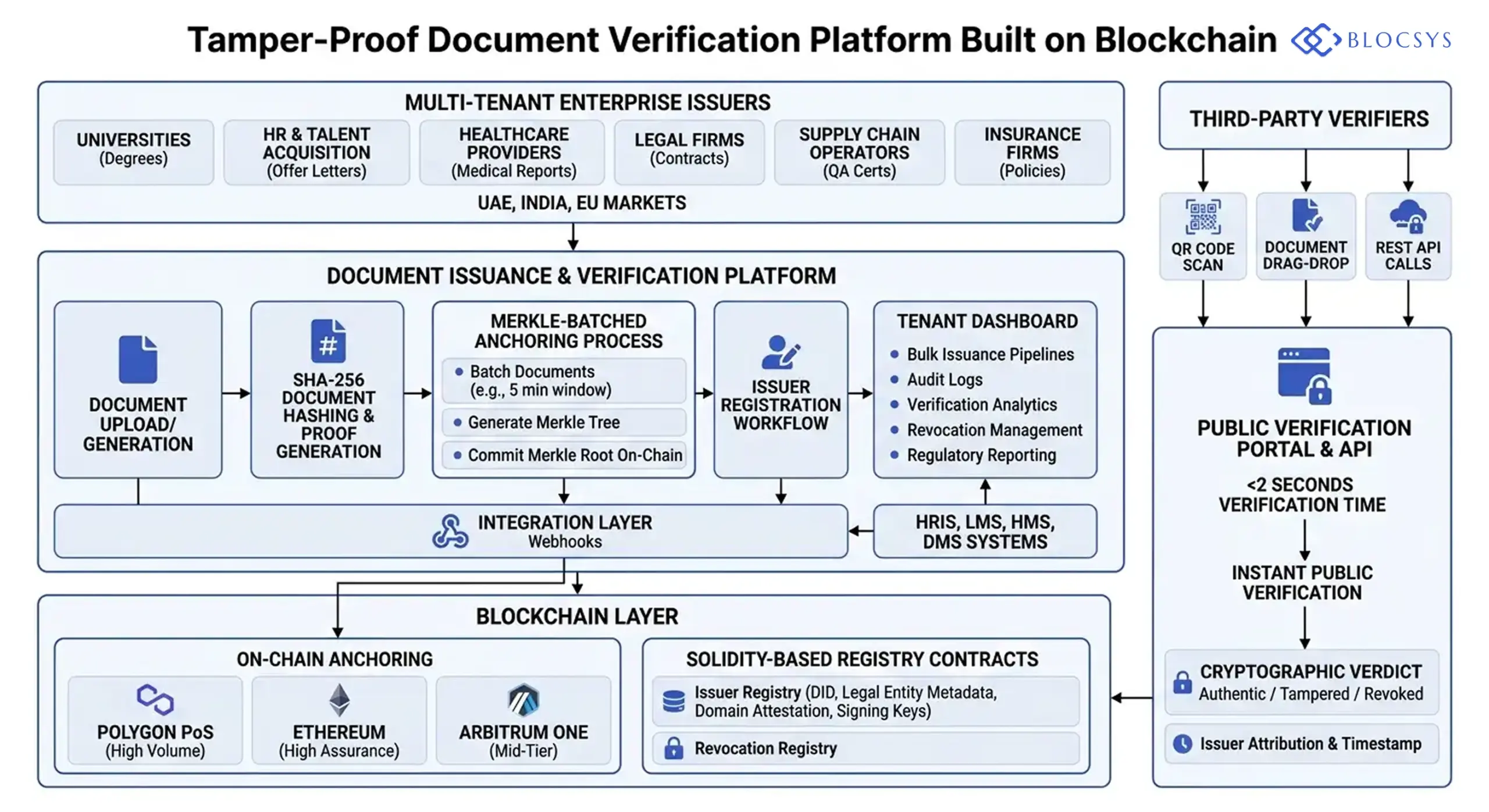
Blocsys Technologies designed and delivered a production-grade tamper-proof document verification platform that automates the full document lifecycle — from issuance and cryptographic proof generation through on-chain anchoring, public verification, and revocation management. The platform eliminates manual verification entirely while introducing blockchain-level integrity guarantees and a complete issuer audit trail.
What It Does:
- Generates a SHA-256 cryptographic fingerprint for every document at the moment of issuance, binding the file's exact contents to an immutable on-chain proof — any subsequent change of even a single byte produces a different hash and fails verification
- Anchors document hashes to public blockchain via Merkle tree batching — thousands of documents are committed in a single on-chain transaction, reducing per-document gas cost to fractions of a cent while preserving individual proof verifiability
- Onboards enterprise tenants through a structured issuer registration workflow with domain verification, legal entity attestation, EIP-712 signing key provisioning, and on-chain issuer registry entry
- Provides a public verification portal accessible via direct URL, QR code, or REST API where any third party can drag-drop a document and instantly receive a cryptographic verdict — authentic / tampered / revoked — along with issuer identity and issuance timestamp
- Issues optional W3C Verifiable Credentials and ERC-721 credential tokens for documents that benefit from holder-controlled presentation (degrees, professional certifications, KYC attestations) without revealing the underlying document contents
- Supports document revocation via on-chain revocation registry — issuers can invalidate a previously issued document (e.g., terminated employment, revoked license) with an on-chain transaction that immediately reflects in all future verifications
- Provides a tenant dashboard with bulk issuance pipelines, issuance audit logs, verification analytics, revocation management, and exportable regulatory-format reports
Key Features & Technical Specifications:
- Hashing & proof generation — SHA-256 cryptographic hashing performed client-side and server-side; canonicalization layer normalizes PDF metadata, embedded timestamps, and signature blocks before hashing to produce stable, reproducible fingerprints across platforms
- Merkle tree batching — documents issued within a configurable window (default 5 minutes) are batched into a Merkle tree; only the Merkle root is anchored on-chain, with per-document inclusion proofs generated and stored for verification — reducing gas cost per document by ~99% versus naive one-document-one-transaction models
- On-chain anchoring — primary anchoring on Polygon PoS for cost-optimized high-volume issuance; Ethereum mainnet anchoring available for high-assurance documents (legal contracts, regulatory filings); optional Arbitrum One settlement for mid-tier use cases
- Multi-tenant issuer registry — Solidity-based registry contract storing issuer DID, public signing key, legal entity metadata, domain attestation, and revocation authority; each issued document carries an EIP-712 signature from the registered issuer key, cryptographically binding the document to a verified organization
- Verifiable Credentials layer — W3C VC Data Model 2.0 compliant credential issuance with optional JSON-LD context, BBS+ selective disclosure for privacy-preserving verification, and DID-based holder identity
- Public verification API — REST endpoint accepting document upload or hash; returns issuer identity, issuance timestamp, on-chain transaction hash, Merkle inclusion proof, revocation status, and integrity verdict in under 2 seconds; rate-limited public tier and authenticated enterprise tier with 99.95% SLA
- QR code verification — every issued document optionally embeds a QR code linking to a verification URL with the document hash and issuer ID pre-populated; verifiers scan and receive instant confirmation on mobile without any login
- SERVER-backed issuer keys — issuer signing keys provisioned in Server keys or HashiCorp Vault with hardware-backed key storage; signing operations performed via authenticated API calls with per-request authorization policies
- Webhook & integration layer — outbound webhooks on issuance, verification, and revocation events; pre-built integrations for HRIS (Workday, BambooHR), LMS (Moodle, Canvas), HMS (Epic, Cerner), and DMS (DocuSign, NetDocuments) systems
Results
2.4M+
Documents anchored on-chain across 38 enterprise tenants in the first 9 months of live operations spanning education, HR, healthcare, legal, and supply chain verticals
Under 2s
Average verification time reduced from 3–7 business days of manual confirmation
Zero
Successful forgery or tampering events recorded post-deployment
~$0.0008
Average per-document on-chain anchoring cost via Merkle batching on Polygon PoS
<24 Hours
Enterprise tenant onboarding reduced from 3–4 weeks of manual setup
100%
Issued documents produced immutable on-chain proof and issuer attestation
38
Enterprise tenants onboarded across 6 regulated verticals
85%
Verification ops headcount requirement reduced for high-volume issuers
Long-Term Benefits:
- On-chain document anchoring permanently eliminates the document forgery risk category from the enterprise's operational risk register — a structural integrity guarantee no watermark, seal, or centralized database can replicate
- Public verification infrastructure removes the issuer from the verification loop entirely — third parties verify documents independently 24/7 without phone calls, email confirmations, or manual lookups, freeing internal teams from a permanent operational burden
- Multi-tenant issuer registry with cryptographic attestation creates a defensible standard for document authenticity — positioning the platform ahead of UAE Federal Decree-Law on Electronic Transactions, EU eIDAS 2.0, India DPDP Act audit requirements, and emerging W3C Verifiable Credentials adoption mandates — compliance infrastructure is already built, not retrofitted