
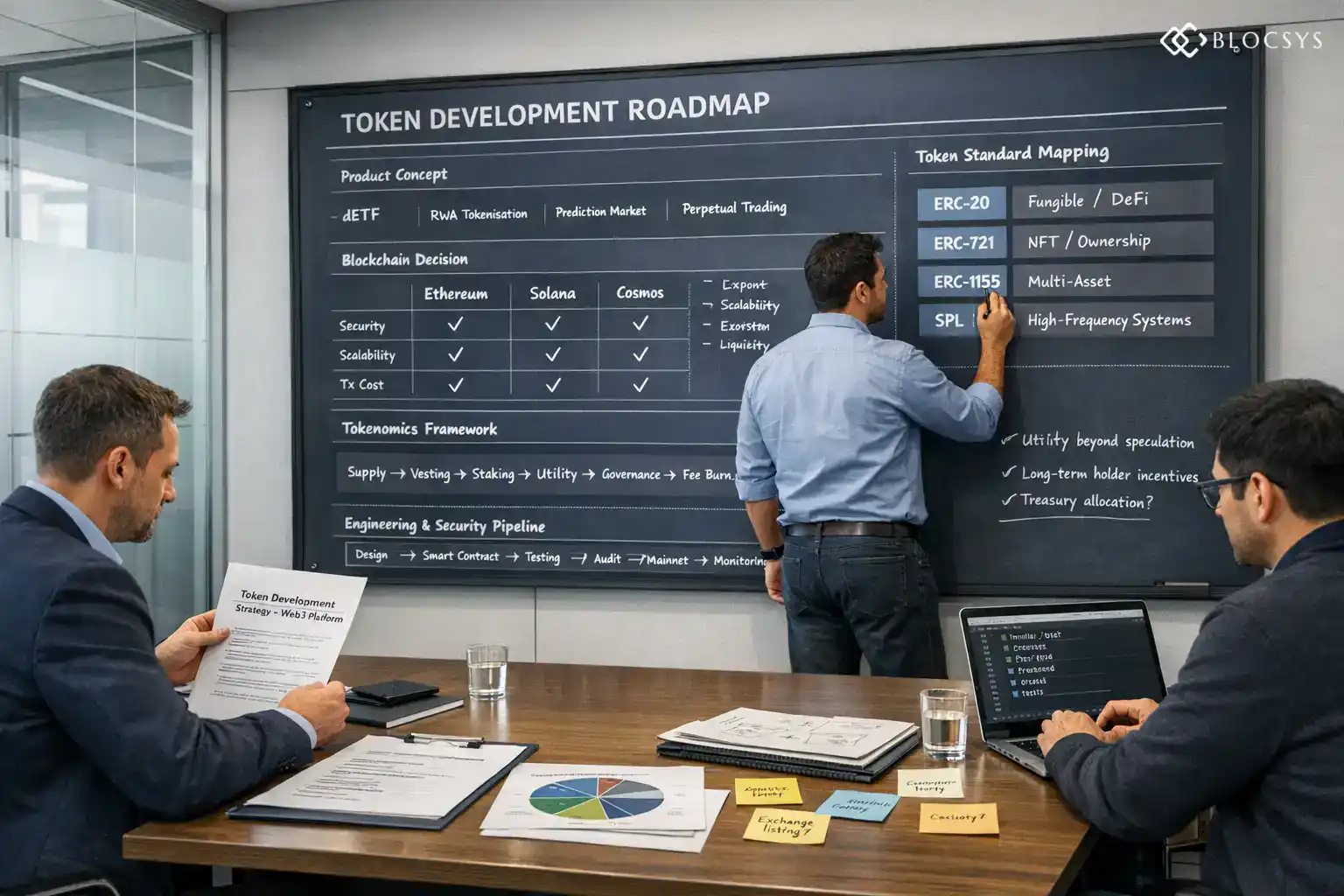
Crypto token development is the process of creating digital assets that operate on a blockchain. These programmable tokens can represent anything from a stake in a decentralized venture to a key that unlocks a digital service, enabling new financial products, platforms, and economies. This guide provides a strategic roadmap for founders, project leads, and enterprises in Web3, AI, and DeFi who are ready to build real-world value.
What is Crypto Token Development?

Crypto token development is the end-to-end process of designing, engineering, and launching a digital token on a blockchain. A token is more than just code; it’s a programmable asset that can unlock new business models, automate complex processes, and create decentralised economies. Understanding its purpose is the first step towards building a successful project.
This guide provides a clear framework for founders and decision-makers in Web3, DeFi, and AI. We’ll cut through the technical jargon to deliver a strategic plan for creating tangible value, whether you are launching:
- A decentralised equity-traded fund (dETF)
- A real-world asset (RWA) tokenisation platform
- A new perpetual trading system or prediction market
Our goal is to walk you through the entire journey, from refining your initial concept and designing sustainable tokenomics to engineering secure smart contracts and planning an impactful launch.
From Niche Concept to Global Industry
The token landscape has exploded. In July 2022, there were about 21,555 cryptocurrencies. Today, that number has rocketed to over 2.5 million. This global trend is particularly strong in markets like India, which are becoming innovation hubs for next-generation on-chain products.
With the introduction of a 30% tax on crypto gains in 2022 and ongoing regulatory conversations, the Indian market is maturing fast, attracting both nimble start-ups and established companies looking to build compliant, scalable infrastructure. You can explore this growth with this in-depth research on the Indian crypto market.
This rapid growth creates massive opportunities but also significant complexities. Navigating these challenges often requires specialised guidance, as highlighted by the Nyce Crypto Advisory launch.
A token is more than just code; it’s a programmable asset that can unlock new business models, automate complex processes, and create decentralised economies. Understanding its purpose is the first step towards building a successful project.
Ultimately, successful crypto token development is about transforming a powerful idea into a secure, functional, and valuable digital asset that users can trust. This guide will show you exactly how to achieve that.
Which Blockchain and Token Standard is Right for You?

Choosing a blockchain and its corresponding token standard is the most critical architectural decision you will make. This choice defines your token’s speed, security model, transaction costs, and compatibility within the broader digital economy. It’s a strategic move that must align perfectly with your project’s long-term vision and use case.
How to Evaluate Blockchains Using the Trilemma Framework
Every blockchain platform balances three core properties: security, scalability, and decentralisation. This trade-off, known as the “blockchain trilemma,” means that most platforms excel in two areas by compromising on the third. This framework is the first filter to narrow your options.
For instance, a project tokenising high-value real estate would prioritise the battle-tested security and decentralisation of Ethereum. In contrast, a decentralised prediction market requiring thousands of transactions per second would gravitate toward a platform built for scalability and speed, like Solana.
What are the Major Token Standards?
Once you’ve aligned on your blockchain priorities, you must select a token standard. Each standard is a technical blueprint dictating how tokens are created, issued, and managed on-chain. This choice determines what your token can do and which ecosystem it can interact with.
A Strategic Comparison of Popular Token Standards
This table breaks down the most popular token standards to help founders and developers choose the right foundation based on project goals, performance needs, and ecosystem compatibility.
| Token Standard | Blockchain | Type | Primary Use Case | Key Advantage |
|---|---|---|---|---|
| ERC-20 | Ethereum | Fungible | Utility tokens, governance tokens, stablecoins | The industry standard; vast ecosystem support |
| ERC-721 | Ethereum | Non-Fungible | Digital art, collectibles, unique assets (NFTs) | Guarantees true digital ownership and uniqueness |
| ERC-1155 | Ethereum | Multi-Token | Gaming assets, batch minting of NFTs | Manages multiple token types in one smart contract |
| SPL | Solana | Fungible/NFT | High-frequency DeFi, gaming, payments | Extreme speed and ultra-low transaction fees |
| CW-20 | Cosmos | Fungible | Cross-chain applications, community tokens | Native interoperability across different blockchains |
Choosing the right standard is about more than its technical features; it’s about joining an ecosystem. Your decision dictates which wallets, exchanges, and DeFi protocols your token can interact with, so it’s crucial to align your choice with your long-term growth strategy.
Here’s a closer look at the key platforms:
-
ERC Standards (Ethereum): As the original smart contract platform, Ethereum’s ecosystem is unmatched in maturity and liquidity. ERC-20 is the gold standard for fungible tokens, while ERC-721 powers the NFT world. ERC-1155 offers a flexible hybrid standard for managing fungible and non-fungible tokens in a single contract.
-
SPL (Solana Program Library): Built for high performance, the SPL standard on Solana is designed for applications where speed is paramount. Its low transaction fees and near-instant settlement make it a top choice for decentralised exchanges (DEXs), crypto gaming, and systems requiring high throughput.
-
CW-20 (Cosmos): The CW-20 standard resides within the Cosmos ecosystem, often called the “internet of blockchains.” Its defining feature is interoperability. Through the Inter-Blockchain Communication (IBC) protocol, CW-20 tokens can move across different sovereign blockchains, making it a powerful choice for projects that need to bridge various Web3 ecosystems.
Choosing a token standard is not just about technical features. It’s about joining an ecosystem. Your choice determines which wallets, exchanges, and DeFi protocols your token will be compatible with from day one.
The maturity of developer tools, user base size, and available liquidity are just as important as the blockchain’s raw transaction speed.
How to Make the Final Decision for Your Project
Map your project’s non-negotiable requirements directly to a platform’s strengths. A decentralised ETF platform, for instance, demands robust security and deep liquidity, making an Ethereum ERC-20 token a natural starting point. Conversely, a carbon credit tokenisation project targeting global reach might find the cross-chain capabilities of Cosmos essential.
While cross-chain bridges offer flexibility, migrating a live token from one blockchain to another is a monumental task. It pays to get this foundational decision right the first time. To go deeper, explore newer, specialized standards, such as our guide on the universal RWA standard ERC-7943, which breaks down how standards are evolving for specific asset classes.
How to Design Tokenomics for Sustainable Value
If the token standard is your project’s foundation, tokenomics is its economic engine. It’s the set of rules governing the supply, demand, and flow of your token, ultimately deciding whether it creates lasting value or fades away. This involves building a sustainable, self-reinforcing economy.
Effective tokenomics requires a deep understanding of how to model supply and demand to incentivise behaviours that benefit the entire ecosystem. The core question you must answer is: why should anyone hold your token beyond pure speculation?
How to Build Genuine Utility Into Your Token
The answer is utility. A token’s value is directly tied to the real-world functions it performs within its ecosystem. Without tangible use cases, a token is merely a speculative asset.
Key drivers of utility include:
- Governance Rights: Empowering token holders to vote on protocol upgrades, treasury spending, or key parameter changes creates a vested interest in the project’s long-term success.
- Staking Rewards: Allowing users to lock up their tokens to help secure the network or provide liquidity in exchange for rewards reduces circulating supply while rewarding committed participants.
- Access to Services: Tokens can act as a key to unlock exclusive features, secure reduced fees on a trading platform, or access premium data within your application.
A well-designed token economy aligns the incentives of every participant—users, developers, and investors—towards a common goal. When the community wins, the token’s value naturally follows.
For a DeFi startup, utility might mean giving liquidity providers a larger share of trading fees. For an enterprise-grade Real-World Asset (RWA) platform, utility could be tied to rights over a fraction of a tokenised asset, such as receiving a share of rental income from a property.
How to Manage Supply and Create Scarcity
Managing the supply side of the equation is just as critical as creating demand. The goal is to create a predictable and often deflationary economic environment that rewards long-term holders.
Mechanisms like token burns are key. A token burn is the process of permanently removing tokens from circulation, effectively reducing the total supply. This can be achieved by burning a portion of transaction fees or other protocol revenue, creating deflationary pressure that can increase the value of the remaining tokens.
Another critical component is the vesting schedule for team and investor tokens. A long-term schedule, where tokens are released gradually over several years, signals a deep commitment to the project and prevents large-scale sell-offs that could destabilise the market post-launch.
The rapid growth of the digital asset space underscores the importance of getting this right. By 2026, India’s cryptocurrencies market is projected to hit US$10.5 billion in revenue, driven by over 93.5 million owners. This sophisticated user base demands projects with robust economic models. You can explore the full projections and market dynamics to understand this landscape.
For a firm like Blocsys, which engineers everything from DeFi trading platforms to precious metal RWA systems, designing strong tokenomics is foundational. Properly modeling supply, demand, and incentive structures is a core part of successful crypto token development and a key to capturing market share.
What is the Engineering Process for a Crypto Token?
This phase is where strategy becomes reality. Your tokenomics and blockchain choice are translated into a functional, secure digital asset. Understanding the engineering lifecycle is critical for project leaders to oversee development, manage timelines, and ensure the final product matches the vision.
At the heart of every token is its smart contract—a self-executing piece of code deployed on the blockchain. It contains all the rules governing your token, and once live, it functions as an immutable digital agreement.
How to Choose Your Development Language
The programming language is largely determined by your chosen blockchain. This decision influences developer availability, security tooling, and your token’s ultimate performance.
- Solidity: The dominant language for Ethereum and other EVM-compatible chains. Its massive developer community and extensive documentation make it a reliable choice for tapping into the largest DeFi ecosystem.
- Rust: The go-to language for high-performance blockchains like Solana. Known for its memory safety and speed, it is ideal for applications that process thousands of transactions per second, such as perpetual trading platforms.
What are the Core Architectural Decisions?
A successful token is supported by a robust on-chain and off-chain architecture. These components must work in harmony to deliver a seamless user experience and ensure operational integrity. This map illustrates how different elements connect to create sustainable value.

As you can see, true value is the result of carefully engineered utility, scarcity, and incentives—all of which are coded into existence during the engineering phase.
Key System Components to Integrate
Building a production-ready system requires integrating several key components that support your smart contracts:
-
Secure Custody and Wallet Systems: How will users store tokens safely? Options range from browser extension wallets to institutional-grade custody using multi-party computation (MPC). MPC eliminates single points of failure by splitting private key fragments. Learn more about building a robust token management system.
-
Order-Book and Liquidity Mechanisms: To enable trading, you need a way to match buyers and sellers. This could be a traditional order-book system or an automated market maker (AMM) liquidity pool, both of which are engines for price discovery.
-
Oracle Integrations: If your token’s function relies on real-world data (e.g., an RWA token pegged to a commodity price), you need oracles. These are secure services that bridge external data to your smart contracts.
-
Backend Infrastructure and User Interfaces: You need scalable backend servers to manage data and communicate with the blockchain, plus a front-end UI, which could be anything from a sophisticated web app to a simple Telegram mini-app.
The Indian crypto exchange market demonstrates this integration effectively. The sector’s success is fuelling demand for advanced crypto token development, especially for white-label perpetual trading platforms and RWA tokenisation. By combining AI-integrated workflows and MPC custody, firms are delivering institutional-grade security for startups building complex products like dETFs and prediction markets. You can read the full research on the Indian crypto market to see how these engineering trends are shaping the industry.
Engineering isn’t just about writing code. It’s about architecting a complete, interconnected system where every component—from the smart contract to the user interface—is secure, scalable, and built for its intended purpose.
How to Secure Your Project from Day One
In Web3, security is the absolute bedrock of your project’s survival. A single smart contract vulnerability can lead to catastrophic fund loss, destroy your reputation, and end your project. Security cannot be an afterthought; it must be a relentless process woven into every stage of your crypto token development lifecycle.
This institutional-grade mindset starts long before code is deployed. It begins with scrutinizing every architectural decision for potential attack vectors. Embracing this philosophy is the only way to build a project that earns and retains user trust.
Why You Must Integrate Security into Your Development Pipeline
Modern software development integrates security directly into the workflow, a practice known as DevSecOps (Development, Security, and Operations). Instead of waiting until the end to find flaws, security becomes an automated, routine part of the build process.
This means using static analysis tools that scan code for common vulnerabilities as it’s being written. This proactive stance catches potential issues early when they are cheap and easy to fix. For any serious project, it’s essential to implement comprehensive software testing best practices from the start to ensure your token’s underlying code is robust and battle-hardened.
What is the Role of Third-Party Audits?
While internal testing is crucial, it’s not enough. An independent, third-party smart contract audit is a non-negotiable step before launching on mainnet. Think of it as hiring a team of elite ethical hackers to try and break your system before malicious actors do.
These specialized firms bring a fresh perspective and deep expertise, often spotting complex vulnerabilities an internal team might miss. A successful audit report not only identifies problems but also provides a clear, actionable roadmap to fortify your code. Publicly sharing this report has become the gold standard for proving your commitment to security.
In an industry where trust is everything, a comprehensive and transparent security audit is one of the most powerful signals you can send to your community and potential investors. It shows you’ve done the work to protect their assets.
Learn more about what’s involved in our detailed guide on smart contract auditing.
What are the Key Ongoing Defence Strategies Post-Launch?
Launching your token is a milestone, not the finish line. Security is an ongoing battle that demands constant vigilance and rapid adaptation to new threats.
Key post-launch security measures include:
- Penetration Testing (VAPT): This goes beyond the smart contract. Vulnerability Assessment and Penetration Testing stress-tests your entire infrastructure—web servers, APIs, and front-end applications—to find weak points.
- Bug Bounty Programs: Inviting the global community of white-hat hackers to find and report vulnerabilities for a reward is a cost-effective way to crowdsource your security.
- Continuous Monitoring: You need eyes on the chain 24/7. Implementing real-time monitoring tools to watch for suspicious on-chain activity can provide an early warning of a potential exploit, buying your team precious time to react.
By embracing this multi-layered security strategy, you shift from a reactive to a proactive posture. It’s this comprehensive approach that will ultimately protect user funds, help you navigate compliance, and build a project with long-term resilience.
How Blocsys Delivers End-to-End Token Solutions
We’ve walked through the complex, multi-stage roadmap for launching a successful crypto token. Now, it’s time to connect that strategy to execution. At Blocsys, we are the dedicated engineering partner that turns ambitious on-chain concepts into production-ready platforms. We don’t just advise; we build.
Our specialisation is in engineering the very systems discussed in this guide. We’ve built everything from decentralised ETFs and perpetual trading platforms to complex real-world asset (RWA) tokenisation for commodities like gold. Our teams bring deep, hands-on technical expertise to the table. This is where your vision meets our disciplined execution.
From Architecture to Deployment
We operate as a direct extension of your team, embedding our expertise at every single stage of the project lifecycle. This integrated approach ensures your strategic goals translate directly into technical realities, built from day one for security and scale.
Our partnership model is built on a few core pillars:
- Protocol and System Architecture: We design the foundational blueprint for your platform. The goal is simple: ensure it’s secure, scalable, and perfectly aligned with your business objectives.
- Smart Contract Engineering: Our deep expertise in Solidity and Rust allows us to build robust, efficient, and fully audited smart contracts. These form the core of your tokenised ecosystem.
- Institutional-Grade Security: We bring a relentless security posture to every project. This means integrating DevSecOps, mandating third-party audits, and implementing continuous monitoring to protect your platform and user assets.
- Scalable Backend Infrastructure: Great projects go beyond just smart contracts. We build the critical off-chain infrastructure—from high-performance order-book systems to secure custody solutions—needed for a flawless user experience.
At Blocsys, we build serious decentralised infrastructure, not experiments. Our focus is on execution discipline, transparent communication, and delivering systems that are ready for real-world use and long-term growth.
For founders and enterprises ready to move from a great idea to a live, scalable system, the next step is aligning your vision with an engineering team that can deliver. Our focus on execution ensures your crypto token development journey is not just successful, but sets a new standard for what’s possible on-chain.
Crypto Token Development FAQs
Here are direct answers to the most common questions founders and project leads ask when planning their token development journey.
How Much Does Crypto Token Development Cost?
The cost of crypto token development depends entirely on the project’s complexity. A standard ERC-20 token can be created for a few thousand dollars. However, a sophisticated DeFi protocol with custom tokenomics, complex smart contracts, and multiple third-party audits requires a significant investment, typically ranging from $50,000 to over $250,000. This higher range reflects the deep engineering and exhaustive security needed to protect user funds and build a production-ready system.
How Long Does It Take To Create A Crypto Token?
The timeline for creating a crypto token is a function of its complexity. A basic token can be launched in a few weeks. However, a professional, full-scale project—including detailed tokenomics design, smart contract engineering, UI development, and external security audits—typically takes 4 to 9 months from kickoff to a secure mainnet launch. Rushing security audits, which can take several weeks, is a common mistake that puts the project and its users at risk.
What Is The Difference Between A Coin And A Token?
The key difference between a coin and a token lies in their technical foundation. A coin (e.g., Bitcoin, Ether) is the native asset of its own independent blockchain and is used to secure the network. Creating a coin requires building an entire blockchain from the ground up. A token, on the other hand, is built on an existing blockchain like Ethereum or Solana, leveraging its security and infrastructure. This allows developers to focus on building their application without reinventing the underlying network.
What Happens After The Token Is Launched?
A token launch is the starting line, not the finish. The real work of building long-term value and driving adoption begins post-launch. Key ongoing responsibilities include managing liquidity on exchanges, executing the project roadmap, engaging with the community on platforms like Discord and X, and performing continuous security monitoring and upgrades to adapt to new threats.
At Blocsys Technologies, we’re the engineering partner that guides you through every single stage of this journey, from the first architectural sketch to post-launch growth. We don’t just build; we build secure, scalable, and production-ready decentralised infrastructure that stands the test of time.
Ready to transform your vision into an on-chain reality? Connect with our experts today and let’s talk about your project.
