
Building reliable, tamper-resistant outcome verification sits at the heart of decentralized prediction market oracle design. Moreover, as blockchain-based prediction markets grow in complexity, the systems feeding them real-world data must evolve accordingly. Therefore, understanding how oracles function—and how to architect them correctly—is essential for any serious protocol developer or market participant today.
Core Components of Decentralized Prediction Market Oracle Design
Oracles serve as the critical bridge between on-chain smart contracts and off-chain reality. Furthermore, they gather, validate, and deliver outcome data that determines how prediction market funds are distributed. Without a well-designed oracle layer, even the most sophisticated market mechanism will ultimately fail participants.
Data Aggregation Mechanisms
Effective oracles aggregate data from multiple independent sources. Additionally, this redundancy reduces the risk of manipulation or single points of failure. Decentralized oracle networks like Chainlink employ node operators who stake collateral, directly aligning their financial incentives with honest reporting behavior.
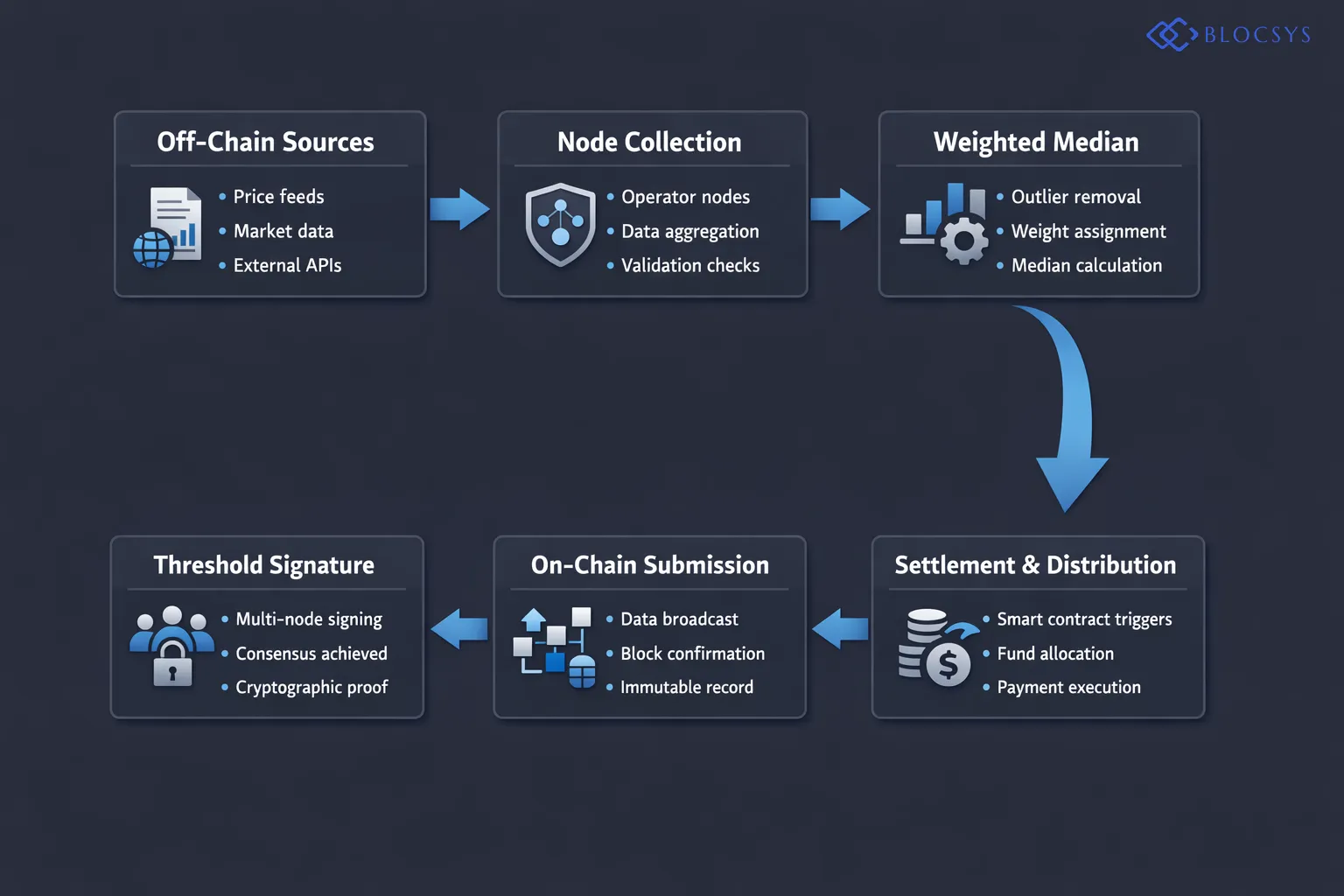
Data aggregation typically follows three core steps:
- Source identification and whitelisting
- Weighted median or mean calculation across independent nodes
- On-chain submission with cryptographic attestation
Furthermore, some protocols implement threshold signature schemes. These approaches require a minimum quorum of nodes to co-sign a result before it reaches the blockchain. Consequently, no single actor can unilaterally manipulate an outcome or inject false data into the feed.
How Oracle Architecture Shapes Market Integrity
The architectural choices made during oracle design directly impact market fairness. Therefore, developers must carefully select between centralized, decentralized, and hybrid reporting models. Each trade-off affects latency, cost, and resistance to adversarial attacks from sophisticated actors.
Centralized oracles are fast but introduce a single point of trust. Additionally, they remain vulnerable to censorship and manipulation by the controlling entity. Decentralized alternatives spread trust across many participants. However, they introduce coordination complexity and higher operational gas costs that teams must budget for carefully.
Dispute Resolution Protocols
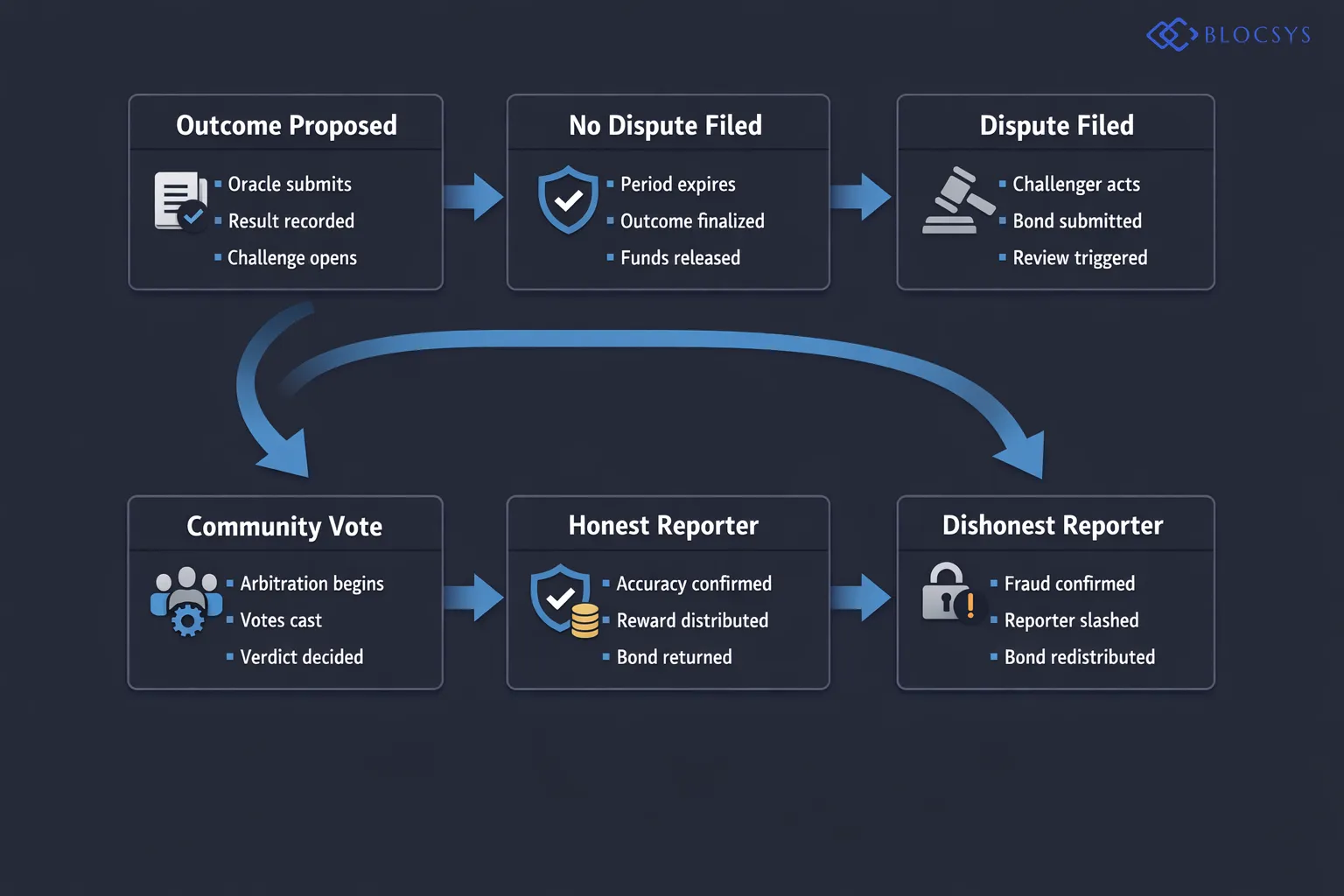
Robust dispute resolution is a hallmark of mature oracle design. For example, UMA Protocol uses an optimistic oracle model where outcomes are proposed and then contested within a defined challenge window. Moreover, economic incentives punish dishonest reporters through automatic slashing mechanisms built directly into smart contracts.
A well-structured dispute system generally includes these phases:
- An initial outcome proposal phase with a required bond deposit
- A public challenge window where any participant can contest
- A final arbitration layer using token-weighted community voting
Consequently, participants who submit false data risk losing their staked collateral entirely. This financial deterrent makes honest reporting the dominant strategy for rational actors operating within the system.
Advanced Techniques in Oracle Systems for Prediction Protocols
As prediction markets tackle increasingly nuanced questions, oracle design must grow more sophisticated. Furthermore, subjective outcomes—such as political events or complex sports results—require layered verification systems that go beyond simple automated data feeds and price oracles.
Incentive Structures and Token Economics
Token-based incentive design anchors oracle honesty to economic self-interest. Additionally, staking mechanisms ensure that reporters have genuine skin in the game. Protocols like Augur use native tokens to govern dispute resolution and reward accurate reporters over time.
However, tokenomics alone does not guarantee integrity. Therefore, developers should complement token incentives with on-chain reputation systems. Over time, reporters with strong accuracy records earn greater influence—and greater rewards—within the network, creating a virtuous cycle of reliability.
Cross-Chain Compatibility
Modern prediction markets increasingly operate across multiple blockchains. Consequently, oracle systems must support cross-chain data delivery without sacrificing security or decentralization. Bridge protocols and light client verification schemes effectively enable this expanded functionality across ecosystems.
Moreover, cross-chain oracles must handle asynchronous finality risks carefully. Different chains achieve consensus at different speeds, so oracle designs must account for potential confirmation delays. Therefore, building in buffer periods and finality checks represents a non-negotiable architectural requirement for production-grade systems.
For a deeper look at how smart contracts interact with oracle data, explore our guide to smart contract architecture. Additionally, you can learn more about mechanism design in our prediction market mechanisms overview.
Building Resilient Oracle Infrastructure for the Future
Decentralized prediction markets will only reach their full potential if oracle infrastructure keeps pace with growing market complexity. Therefore, teams must invest deeply in oracle research, adversarial testing, and incentive design before launching any live protocol with real capital at stake.
Furthermore, the broader field benefits enormously from open collaboration. Sharing oracle design patterns, audit findings, and governance experiments accelerates progress across the entire ecosystem. Consequently, the most successful protocols will be those that treat oracle design not as an afterthought, but as the foundational pillar underpinning every market they operate.
Frequently Asked Questions
What is the role of an oracle in a decentralized prediction market?
Oracles act as the critical bridge between on-chain smart contracts and off-chain reality, gathering, validating, and delivering outcome data that determines how prediction market funds are distributed. Without a well-designed oracle layer, even the most sophisticated market mechanism will ultimately fail participants.
How do oracle networks aggregate data to prevent manipulation?
Effective oracles pull data from multiple independent sources, reducing the risk of manipulation or single points of failure. Aggregation typically follows source identification and whitelisting, weighted median or mean calculation across independent nodes, and on-chain submission with cryptographic attestation. Some protocols also use threshold signature schemes requiring a quorum of nodes to co-sign a result before it reaches the blockchain.
What is the difference between centralized, decentralized, and hybrid oracle models?
Centralized oracles are fast but introduce a single point of trust and remain vulnerable to censorship and manipulation by the controlling entity. Decentralized alternatives spread trust across many participants but introduce coordination complexity and higher operational gas costs. Developers must weigh these trade-offs across latency, cost, and resistance to adversarial attacks.
How does dispute resolution work in oracle design?
A robust dispute system generally includes an initial outcome proposal phase with a required bond deposit, a public challenge window where any participant can contest, and a final arbitration layer using token-weighted community voting. For example, UMA Protocol uses an optimistic oracle model where outcomes are proposed and then contested within a defined challenge window, with automatic slashing punishing dishonest reporters.
Why are token incentives and reputation systems important for oracle honesty?
Token-based incentive design anchors oracle honesty to economic self-interest, with staking mechanisms ensuring reporters have genuine skin in the game, as seen in protocols like Augur. However, tokenomics alone does not guarantee integrity, so developers should complement token incentives with on-chain reputation systems that reward reporters with strong accuracy records over time.
What challenges do cross-chain prediction markets create for oracle systems?
Modern prediction markets increasingly operate across multiple blockchains, so oracle systems must support cross-chain data delivery without sacrificing security or decentralization, often via bridge protocols and light client verification schemes. Because different chains achieve consensus at different speeds, oracle designs must also account for asynchronous finality risks by building in buffer periods and finality checks.
