
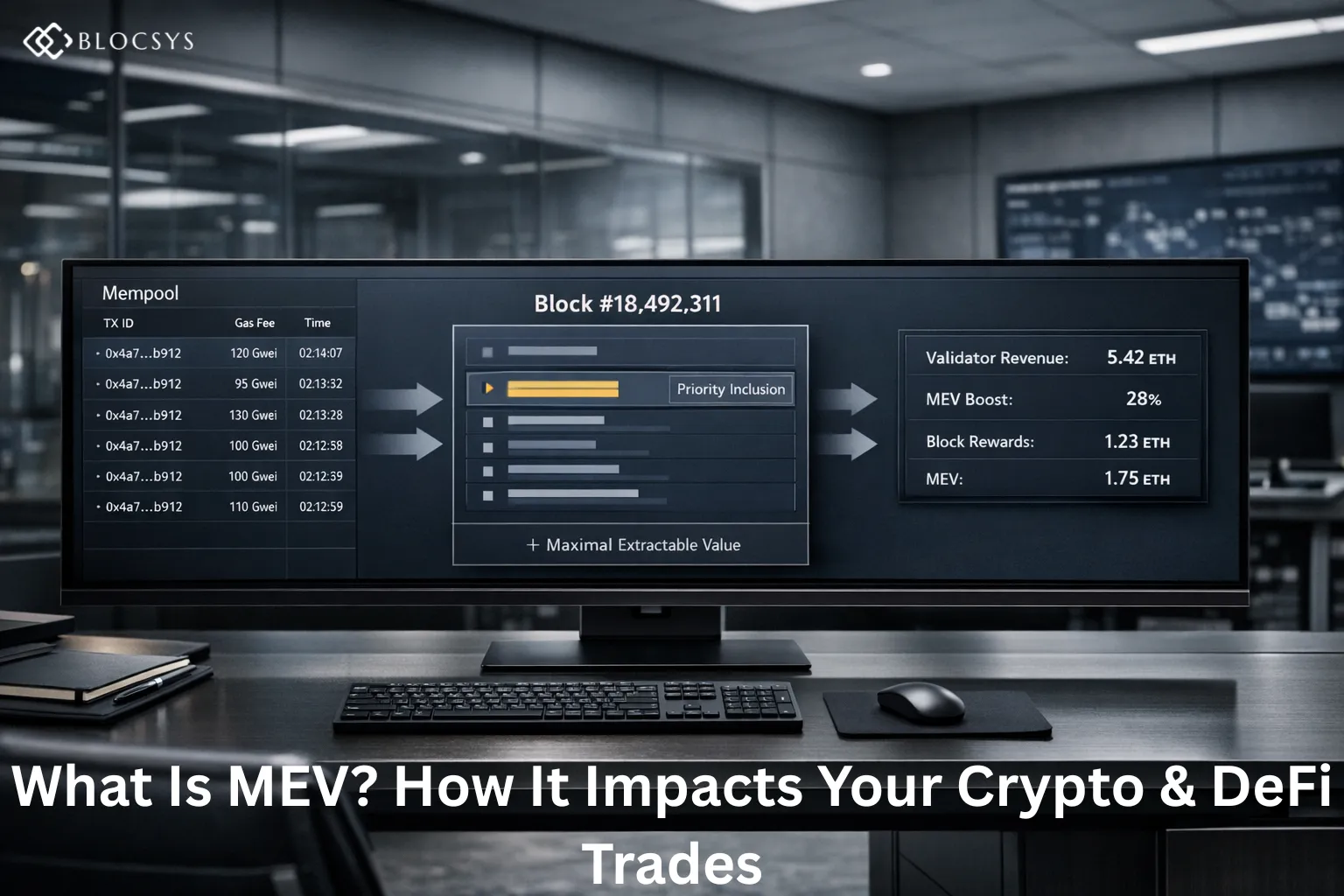
Maximal Extractable Value (MEV) is the invisible profit captured by reordering, inserting, or censoring transactions within a blockchain block. For developers, traders, and enterprises in Web3, understanding MEV is critical for building fair, secure applications and protecting trades from what many call a “dark forest” on-chain. This guide explains what MEV is, how it’s generated, its risks, and how to build solutions that mitigate its impact.
What is Maximal Extractable Value (MEV)?
Maximal Extractable Value, or MEV, isn’t a bug; it’s an economic reality of blockchains. It represents the maximum profit a block producer (a miner or validator) can extract by manipulating the order, inclusion, or exclusion of transactions within a block. This power to sequence transactions creates a hidden, high-stakes market that directly impacts users.
This value exists because the people who create blocks—miners in Proof-of-Work systems or validators in Proof-of-Stake—hold the ultimate power to decide which transactions make it in and in what order. For anyone building in Web3, from DeFi protocols to enterprise platforms, understanding MEV is absolutely critical for building fair, secure, and usable applications.
The Mempool: A Profitable Waiting Room
Every time you send a transaction on a network like Ethereum, it doesn’t go straight into a block. Instead, it lands in a public waiting area called the mempool (short for memory pool). Here, it sits alongside thousands of other pending transactions, all waiting to be picked up by a block producer.
What is MEV? Maximal Extractable Value (MEV) is the total value that can be extracted from block production beyond the standard reward and fees. Block producers capture this profit by including, excluding, and reordering transactions in a block. It is a measure of the economic power wielded by those who finalize transactions on-chain.
This public visibility is where the MEV game truly begins. Specialised bots, run by actors known as “searchers,” relentlessly scan the mempool for profitable opportunities. They can see your pending trade on a decentralised exchange (DEX) and use that information to their advantage before your transaction is ever confirmed. This turns the mempool into a high-stakes arena where bots race to extract value, often at the expense of regular users. The evolution of Web 3 provides a broader context for how these on-chain dynamics came to be.
Why Does MEV Impact Every Blockchain User?
Whether you’re a developer, a DeFi trader, or an enterprise launching a tokenisation platform, MEV has a direct and tangible impact on your operations and profitability. Its effects ripple across the network and manifest in several key ways:
- Higher Transaction Costs & Slippage: You might experience what’s called “slippage,” where the price you get for a trade is worse than you initially expected. This is a classic sign of MEV at play, directly reducing your returns.
- Failed Transactions: Predatory MEV activity can front-run your transaction, causing it to fail. You’re left with wasted gas fees and a terrible user experience, undermining confidence in the platform.
- Network Congestion & High Gas Fees: The fierce competition for MEV often leads to “priority gas auctions” (PGAs). Bots start bidding up gas prices to get their transactions included first, making the entire network more expensive for everyone and degrading overall performance.
How Is MEV Generated Inside a Blockchain?
To truly grasp MEV, you must follow a transaction’s journey from your wallet to its final confirmation on the blockchain. This path reveals how a standard blockchain process becomes a high-stakes arena for profit extraction. The entire mechanism hinges on transaction visibility and the power to control sequencing.
This process kicks off the moment you send a transaction, like swapping a token on a decentralised exchange. Your signed transaction doesn’t just zap directly onto the blockchain. First, it lands in a public waiting room.
Step 1: Transaction Submission and the Mempool
This waiting room is called the mempool. It’s a shared, public database of every single unconfirmed transaction. Think of it as a completely transparent auction house where every pending bid is visible to everyone, in real-time. This total transparency is the key ingredient that makes MEV possible.
Specialised bots, run by operators known as ‘searchers’, are constantly scanning this mempool. They’re programmed to hunt for profitable patterns—like a massive trade that’s about to move a token’s price, creating a perfect setup for arbitrage or another money-making strategy.
The mempool is often called the “dark forest” of crypto, a term popularised by researchers. It signifies a dangerous environment where visible transactions (like yours) are immediately spotted and can be preyed upon by sophisticated bots before they are ever finalised.
This relentless surveillance means that the second your transaction hits the mempool, its potential profitability has already been analysed by countless automated systems. These bots are built to act faster than any human, positioning themselves to snatch up any value that’s up for grabs.
Step 2: Transaction Selection by Block Producers
The next crucial player in this game is the block producer—these are the miners in Proof-of-Work (PoW) systems like Bitcoin or the validators in Proof-of-Stake (PoS) systems like Ethereum. Their job is to pick transactions from the mempool and bundle them into the next block.
Here’s the catch: they have absolutely no obligation to process transactions in the order they arrived. Their main motivation is to maximise their own profit. This gives them the ultimate power to reorder, insert, or even completely ignore transactions based on the fees attached.
This flowchart shows the journey a transaction takes, from the moment you send it to its final place in a block.

As the diagram shows, the mempool is the critical battleground where searchers analyse transaction data and try to influence block producers. This is the exact point where MEV opportunities are found and exploited.
Step 3: Value Extraction Through Ordering
Armed with the power to order transactions, block producers can arrange the sequence inside a block for maximum financial benefit. They often do this through something called a Priority Gas Auction (PGA).
In a PGA, a searcher who has spotted a juicy MEV opportunity will essentially bribe the block producer by paying an outrageously high transaction fee (gas). This big payment gives the producer a huge incentive to place the searcher’s transaction exactly where it needs to go—usually right before or after a user’s trade—to guarantee they can extract their profit.
- Front-running: A searcher pays a high fee to get their transaction placed before a user’s large trade.
- Back-running: A searcher places their transaction immediately after a specific event to capture the resulting arbitrage.
- Sandwiching: A combination of both, where a searcher’s transactions “box in” a user’s trade to guarantee a profit.
This ability to control the sequence is precisely why MEV is an inherent part of most blockchains. It’s also useful to understand the potential size and value of these blocks, which you can explore with tools like a block calculator. In the end, the block producer finalises the block with their chosen transaction order, confirms it on the chain, and collects their standard block reward plus any extra MEV profits they made along the way.
What Are Common MEV Strategies and Their Impact?
Maximal Extractable Value isn’t just an abstract theory; it manifests as specific, often predatory, strategies that directly impact traders and undermine DeFi markets. Understanding these strategies is the first step toward spotting them and building defenses. Each one is a different angle searchers use to exploit the transaction ordering game for profit.
These methods range from simple to highly complex, but they all share one thing: they exploit the public nature of the mempool. As we’ve covered, this waiting area is the perfect hunting ground for bots to sniff out and pounce on profitable trades before they ever get confirmed on-chain.

Front-Running: Simple Transaction Interception
Front-running is the most straightforward flavour of MEV. Picture this: you’re about to place a large buy order for a token on a decentralised exchange (DEX). A searcher bot spots your pending transaction in the mempool and instantly knows your purchase is going to nudge the token’s price upward.
To cash in, the bot fires off its own buy order for the same token, but with a higher gas fee. That little bribe ensures the block producer puts the bot’s transaction just before yours. The bot snags the token at the current, lower price. Then, your larger trade goes through, pushing the price up, and the bot immediately sells its holdings for an instant, risk-free profit. You, the original trader, get stuck paying a slightly higher price than you should have.
Back-Running: Capitalising on Market-Moving Events
Back-running is the mirror image of front-running. Instead of trying to get in front of a transaction, a searcher places a trade immediately after a major market-moving event.
A classic example is a big oracle price update or a massive swap that opens up a new arbitrage opportunity. For instance, if a huge trade on Uniswap makes a token’s price drift away from its price on SushiSwap, a back-running bot will instantly execute a trade to buy the token on the cheaper exchange and sell it on the more expensive one, pocketing the difference. This is a very common type of MEV that actually helps keep prices consistent across different markets. If this area interests you, our deep dive on building a crypto arbitrage bot is a great next step.
Sandwich Attacks: The Most Damaging Strategy
A sandwich attack is a brutal combo of front-running and back-running that zeros in on a single user’s trade. It’s one of the most notorious and harmful forms of MEV for everyday DeFi users, representing a direct extraction of value from their trades.
Here’s the play-by-play:
- Spot the Victim: A searcher bot detects your significant buy order for a token sitting in the mempool.
- Front-run the Trade: The bot slams in a buy order for the same token right before yours, pushing the price up just a bit.
- The Squeeze: Your trade finally executes, but at this new, artificially inflated price. This is what’s known as getting hit with high slippage.
- Back-run for Profit: The bot immediately sells the tokens it just bought, profiting from the price mess it created entirely at your expense.
You are literally “sandwiched” between the bot’s two transactions. This guarantees you get the worst possible execution price while the attacker walks away with a guaranteed profit, directly extracted from your trade.
To give a clearer picture of how these tactics differ, here is a quick comparison of the most common MEV strategies you’ll encounter in the wild.
Comparison of Common MEV Strategies
| Strategy | Description | Primary Victim | Market Impact |
|---|---|---|---|
| Front-running | Placing a transaction just before a known future transaction to profit from the price impact. | The user who placed the original transaction. | Negative. It leads to worse execution prices (slippage) for users. |
| Back-running | Placing a transaction immediately after a large trade or event to capture a new opportunity. | The market in general, not a specific user. | Often positive. It helps with price discovery and efficiency (e.g., arbitrage). |
| Sandwich Attack | A combination of front-running and back-running targeting a single trade for guaranteed profit. | A specific user making a large trade on a DEX. | Highly negative. It directly extracts value from users and creates a hostile trading environment. |
| Liquidation | Racing to be the first to liquidate an undercollateralised loan to earn a fee. | Borrowers on lending platforms. | Neutral to positive. It’s a necessary function for protocol stability, though predatory. |
| DEX Arbitrage | Exploiting price differences of the same asset across different DEXs. | The market itself; traders on inefficient exchanges. | Positive. It corrects price inefficiencies and stabilises markets. |
As the table shows, not all MEV is created equal. While some forms like arbitrage contribute to market health, others like sandwich attacks are purely extractive and harmful to the ecosystem.
Other Notable MEV Strategies
Beyond these core examples, MEV pops up in several other forms across the DeFi landscape:
- DEX Arbitrage: As touched on with back-running, this is all about exploiting price differences for the same asset across multiple decentralised exchanges. While it’s a form of MEV, it also performs the useful market function of price stabilisation.
- Liquidations: In lending protocols like Aave or Compound, bots fiercely compete to be the first to liquidate loans that have become undercollateralised. The winner earns a fee, which creates a frantic race to trigger these liquidations the moment an account becomes eligible.
The financial fallout from these strategies is massive. One startling analysis revealed that MEV accounted for nearly half of all Ethereum DEX volumes in recent years—a staggering USD 328 billion out of USD 666 billion. Individual traders feel this directly, as arbitrage bots can siphon off 15-20% of potential profits on some platforms.
What Are the Hidden Risks of MEV Centralisation?
Beyond the direct financial hit to individual traders, the relentless pursuit of Maximal Extractable Value creates systemic risks that threaten the health and decentralisation of blockchain networks. The intense competition for MEV profit starts a cascade of negative effects, beginning with poor network performance and spiraling into foundational threats against decentralisation.
The most immediate impact is on network usability. The constant battle between searcher bots, often through Priority Gas Auctions (PGAs), drives up transaction fees for everyone. This digital bidding war for block space makes the network congested and expensive, pricing out regular users and small-scale applications that simply can’t afford to compete.

The Rise of a New Centralised Elite
More critically, MEV fosters a dangerous trend toward centralisation. The game is heavily skewed in favour of a small group of highly resourced players known as ‘searchers’. These outfits run powerful, low-latency infrastructure co-located with validators, giving them a massive speed advantage in spotting and capturing MEV opportunities.
This creates an uneven playing field where a handful of elite operators dominate the market, undermining blockchain’s core promise of a permissionless and open system. The barrier to entry for new searchers becomes incredibly high, concentrating both power and profit into fewer and fewer hands.
The MEV market is a power-law-driven economy. A small fraction of sophisticated players with superior technology and capital consistently captures the vast majority of the profits, creating a new form of centralisation within the supposedly decentralised ecosystem.
This concentration of power extends beyond searchers to the block producers themselves. As searchers develop more effective MEV strategies, they can offer larger bribes (or ‘tips’) to validators. Over time, this economic pressure can lead validators to favour specific searchers or relays, further centralising control over who gets to order transactions.
From Centralisation to Transaction Censorship
The most alarming risk stemming from MEV centralisation is the potential for transaction censorship. In a hyper-competitive MEV environment, a validator might be economically incentivised to ignore or delay transactions that aren’t part of a profitable MEV bundle.
If a transaction offers no direct MEV opportunity, a profit-maximising validator could simply choose to exclude it in favour of more lucrative ones. While subtle, it’s a huge departure from the core principle of neutral transaction processing. It risks creating a two-tiered system where high-value, MEV-rich transactions get priority, while others are left pending.
- Economic Censorship: Transactions aren’t blocked because of their content, but are just ignored because they aren’t profitable enough for the validator to include.
- Active Censorship: In a more extreme scenario, a powerful, centralised group of validators could actively refuse to process transactions from specific addresses or applications for political or competitive reasons.
The market data already paints a clear picture of this concentration. Flashbots data revealed that after the Ethereum Merge, the bulk of MEV earnings shifted to validators. On networks like Polygon, this has led to significant validator MEV accrual, projected to reach USD 1.1 billion through 2026. Analysis also shows that the top 20% of MEV operations captured 72% of all revenue, highlighting the stark inequality in the market.
You can explore a detailed policy analysis of these trends to understand the broader implications. Ultimately, this centralisation makes networks more fragile, introduces single points of failure, and attracts unwanted regulatory scrutiny.
How Can We Engineer Solutions to Mitigate MEV?
Knowing what causes MEV is one thing; building systems to actually fight it is a whole different ball game. For developers and enterprises, this is where theory hits the road. It means adopting specific design patterns and technologies to create fairer, more secure applications that neutralize predatory MEV.
Let’s be clear: the goal isn’t to eliminate MEV entirely. Some forms, like simple arbitrage, are actually healthy for the market. The real mission is to neutralise its predatory and extractive side.
This requires a deliberate architectural mindset. Fortunately, the Web3 ecosystem is already churning out a powerful toolkit of solutions. These range from deep, protocol-level changes to user-friendly applications, all designed to shield transactions and level the playing field.
Proposer-Builder Separation (PBS)
One of the biggest architectural shifts to tame MEV is Proposer-Builder Separation (PBS). This model completely redesigns how blocks are created on Proof-of-Stake networks like Ethereum, fundamentally changing the power dynamics.
In a traditional setup, a single validator does it all: they pick the transactions and assemble the block. PBS splits this into two distinct jobs:
- Builders: These are specialised actors, almost like block-crafting artisans. They compete to create the most profitable block possible from the transactions floating in the mempool, running complex algorithms to find the perfect ordering.
- Proposers (Validators): The validator’s role becomes much simpler. They don’t have to get their hands dirty with complex MEV strategies. Instead, they just pick the most profitable, pre-packaged block offered up by the competing builders and propose it to the network.
By separating these duties, PBS reduces the immense computational burden on validators and mitigates the centralising pressures of MEV. Validators no longer need elite, low-latency hardware to compete, which helps democratise participation in securing the network.
Practical Tools and Services for MEV Mitigation
While PBS is a long-term fix at the protocol level, there are several practical tools developers and users can start using today to protect themselves. Think of these services as creating private tunnels that shield transactions from the public mempool’s “dark forest.”
Key MEV Mitigation Services:
- MEV-Boost: An open-source implementation of PBS from the team at Flashbots, MEV-Boost lets validators source blocks from a competitive marketplace of builders. This not only increases validator rewards but also promotes decentralisation by giving them access to sophisticated MEV strategies without having to run the infrastructure themselves.
- Private Relays and Transaction Services: Platforms like Flashbots, CowSwap, and 1inch Fusion offer private mempools. When you submit a trade through them, it’s sent directly to a closed network of searchers and builders, completely bypassing the public mempool where predatory bots are waiting. This effectively hides your transaction until it’s already included in a block, stopping front-running and sandwich attacks in their tracks.
Of course, these solutions aren’t a silver bullet. A worrying trend shows that centralised builders and relays now control 70-80% of the MEV flow in regions like APAC, which could pressure validators toward geographic centralisation.
But the positive impacts are undeniable. Benign arbitrage MEV boosts market liquidity, closing price gaps between exchanges by an average of 4.2%. Solutions like MEV-Boost are also vital for bringing fairness to emerging applications like decentralised prediction markets. You can dive into the complete analysis on MEV’s market implications from ESMA for the full picture.
Advanced Cryptographic and Design Techniques
Looking beyond today’s tools, the next frontier in MEV resistance lies in cutting-edge cryptography and application design. These techniques focus on hiding transaction details until the very last moment, making it impossible for bots to find and exploit them.
One promising method is Threshold Encryption, which involves encrypting user transactions so they can only be decrypted by a group of nodes after consensus is reached on their order. Another powerful approach is using Fair Ordering Services (FOS), which enforce a “first-in, first-out” (FIFO) rule for transactions.
At the application layer, using sealed-bid auctions or batching transactions into larger, aggregated settlements can obscure individual trade details, making them less attractive targets for MEV bots. By combining these architectural, practical, and cryptographic solutions, developers can start building DeFi platforms that are more resilient, secure, and genuinely fair for everyone.
How Blocsys Builds MEV-Aware Blockchain Solutions
Understanding MEV theory is one thing; engineering production-ready financial infrastructure that actively counters it is the real challenge for enterprises. At Blocsys Technologies, we move beyond theory and into execution, designing and constructing robust Web3 solutions where MEV-awareness is baked into the core architecture from day one.
Our expertise is proven in the systems we deliver for startups and enterprises globally. For clients building decentralised perpetual trading platforms, dETFs, or Real-World Asset (RWA) tokenisation platforms, we treat MEV not as an afterthought but as a primary architectural consideration. This practical, engineering-first approach ensures the platforms we build are fair, secure, and ready for real-world market pressures.
From Architecture to Execution: Our Approach
We architect systems designed to neutralise the most damaging forms of MEV right out of the box. This often means going beyond off-the-shelf solutions and implementing custom components tailored to a specific use case, whether it’s for institutional asset management or high-frequency trading.
Our proficiency in this domain includes:
- Custom Order-Book Systems: We design and build proprietary order-book and matching engine systems that incorporate MEV-resistant features, offering a powerful alternative to standard AMM models that are notoriously vulnerable to common attacks.
- Secure Cross-Chain Mechanisms: For platforms needing to operate across multiple blockchains, we engineer secure cross-chain swap and messaging protocols. These are explicitly designed to minimise value leakage and shield transactions from cross-domain MEV extraction.
- AI-Powered Monitoring: We integrate AI-driven workflows that analyse on-chain data in real-time. These systems are trained to spot patterns indicative of predatory behaviour, like sandwich attacks, and can trigger automated defensive measures to protect users and preserve market integrity.
At Blocsys, we believe the most effective way to combat MEV is through superior engineering. Our job is to translate complex mitigation strategies into functional, battle-tested code that protects our clients’ platforms—and their users—from value extraction.
Building for the Future of Finance
For any ambitious startup or enterprise, launching a platform in the DeFi space means confronting the reality of MEV head-on. Our teams provide the end-to-end expertise needed to navigate this complex environment successfully. We focus on building systems that are not only resilient today but are also engineered to adapt as MEV strategies and mitigation techniques inevitably evolve.
This forward-looking approach is critical for platforms handling significant value, like our work in precious metal tokenisation or decentralised capital markets. By building MEV-aware infrastructure from the ground up, we help organisations launch products that inspire user confidence, ensure fair market conditions, and stand up to the rigorous demands of a live production environment. This is how we turn MEV education into a concrete, defensible solution for our clients.
Frequently Asked Questions About MEV
As you dive into the world of MEV, a few questions tend to pop up again and again. Let’s tackle them head-on to clear up any confusion and solidify your understanding.
Is All MEV Bad for the Ecosystem?
No, not all MEV is inherently bad. While predatory strategies like sandwich attacks are clearly harmful, some forms of MEV are beneficial or at least a neutral side effect of market mechanics. For example, arbitrage helps keep the price of a crypto asset consistent across different decentralised exchanges. This activity improves overall market efficiency, which is a good thing for everyone. The real challenge is curbing extractive MEV while preserving the types that make the ecosystem healthier.
How Can I Protect Myself from MEV as a Trader?
As a regular user, you’re not powerless. You can take a few smart steps to minimise your exposure to the dark side of MEV. A great starting point is using decentralised exchanges (DEXs) and aggregators that have built-in MEV protection, like CowSwap or 1inch’s Flashbots integration. These platforms work by routing your trades through private channels instead of broadcasting them to the public mempool. Another tip is to set a low slippage tolerance (e.g., 0.5%) in your DEX settings to avoid being the victim of a sandwich attack.
Does MEV Exist on Blockchains Other Than Ethereum?
Absolutely. MEV isn’t just an Ethereum problem; it’s an inherent property of any blockchain where someone gets to decide the order of transactions. While Ethereum’s massive DeFi ecosystem made MEV famous, it’s a phenomenon that exists across the board. Blockchains like Solana, BNB Chain, and Avalanche all have their own unique MEV landscapes. The specific strategies and extraction methods might differ due to each chain’s unique architecture, but the core principle remains the same.
At Blocsys Technologies, we design and build decentralised financial infrastructure where MEV resilience is a core architectural pillar, not an afterthought. We partner with ambitious startups and enterprises to construct secure, scalable, and fair platforms for dETFs, RWA tokenisation, and advanced trading systems.
If you are building the next generation of financial products and need an expert engineering partner to navigate the complexities of MEV, connect with Blocsys today to discuss your vision.
