
Searching for “AI ML development services”? You’re likely a decision-maker in a fast-moving industry like Web3, fintech, or carbon markets, looking to build a system that provides a durable competitive advantage. You don’t just want code; you need a strategic partner to architect, build, and deploy an intelligent solution that delivers measurable ROI.
This guide is for you. We will break down exactly what these services include, how to choose the right partner, and what it truly takes to transform an AI concept into a production-ready, value-generating asset. We’ll cover key evaluation criteria, common risks, and the future outlook for AI in your sector.
This guide is for:
- Founders and Executives in Web3, fintech, and carbon sectors evaluating AI for a competitive edge.
- Product Leaders and Managers tasked with integrating intelligent features into their platforms.
- Technical Decision-Makers responsible for selecting partners to build scalable, production-grade AI systems.
What are AI ML development services?
AI ML development services are end-to-end partnerships focused on building custom intelligent systems that learn from data to automate decisions or predict outcomes. Unlike off-the-shelf software, these services deliver solutions tailored to your specific business data, operational needs, and strategic goals, moving beyond simple automation to create proprietary intelligence.
This demand for specialised expertise is driving massive market growth. For instance, the India artificial intelligence market, which generated USD 22,848.3 million in 2025, is projected to hit USD 325,344.5 million by 2033. That’s a compound annual growth rate of 38.1%, with services becoming the fastest-growing segment.
Moving Beyond Simple Automation
A true development partner offers much more than just code; they guide you through the entire modern lifecycle of AI software development. This journey starts with initial strategy and extends all the way to long-term maintenance and model refinement.
A common misconception is that AI development is a one-time project. In reality, it’s a continuous process of building, deploying, monitoring, and refining models to ensure they remain accurate and effective as market conditions and data evolve.
This lifecycle ensures the final system doesn’t just work technically but delivers tangible, measurable business value. An expert partner also guarantees that the integration into your existing platforms is seamless, secure, and aligned with your long-term vision.
To see how these systems fit into your current infrastructure, check out our guide on effective AI integration strategies.
What Do AI ML Development Services Actually Include?
When you engage an AI ML development services partner, you are commissioning a specialized team to architect an intelligent system that creates tangible value. The process moves a concept from a whiteboard strategy to a fully operational asset within your organization.
So, what do you actually get? The services cover a complete lifecycle, starting with a clear strategy, moving to building the core technology, and finishing with deployment and maintenance for long-term success, especially for projects in Web3, crypto, and the carbon markets.
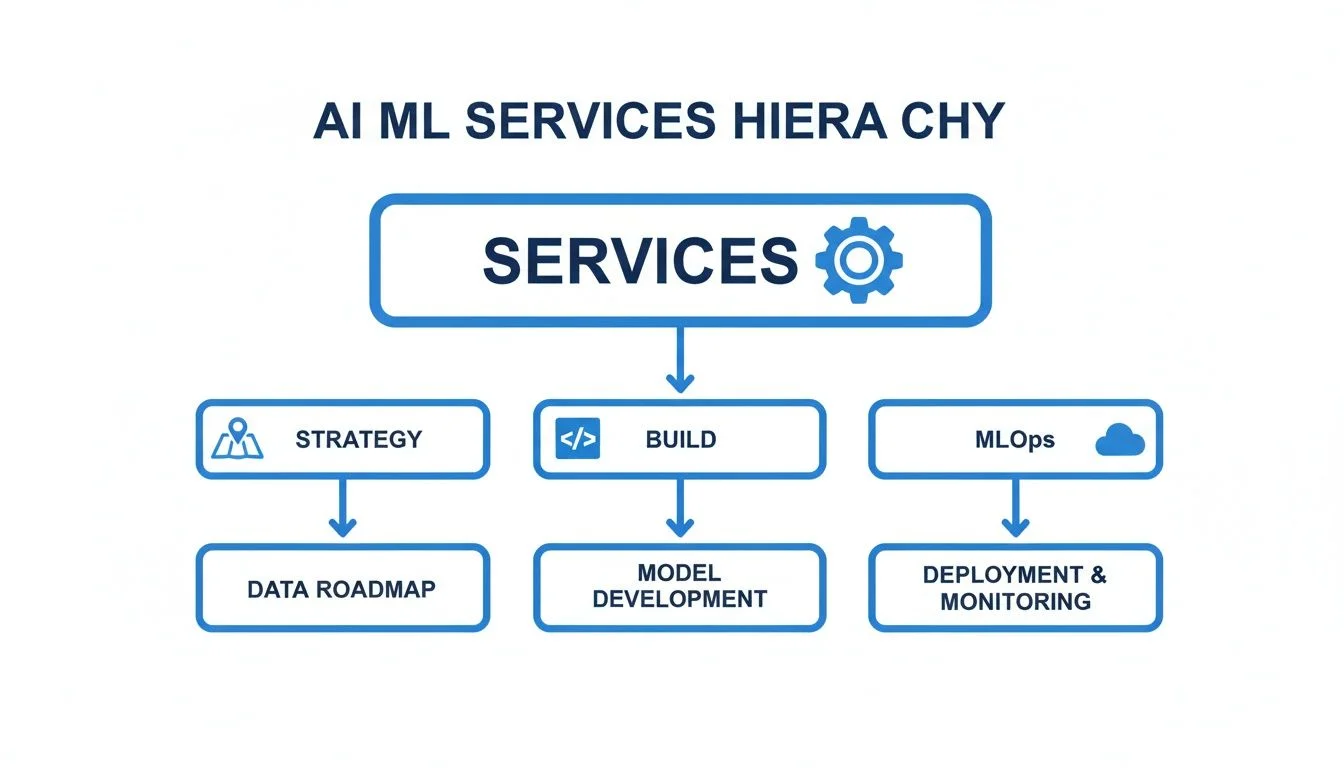
This diagram shows how it all fits together—from high-level planning right through to building and managing models in a live environment. A successful AI initiative isn’t a one-off project; it’s a continuous loop of strategy, building, and operations.
Custom Model Development
Custom model development is like commissioning a bespoke engine for a Formula 1 car instead of using a standard one. It’s an algorithm engineered from the ground up to solve your specific, high-stakes problem, giving you a proprietary advantage your competitors cannot easily replicate.
For a DeFi platform, this could be a model trained to predict crypto market volatility with superior accuracy. For a carbon credit marketplace, it might be an algorithm that analyses satellite imagery to independently verify afforestation claims. This service is essential when off-the-shelf solutions can’t handle the unique complexity of your data.
MLOps and Infrastructure Management
If a custom model is your high-performance engine, then MLOps (Machine Learning Operations) is the mission control center and operational backbone that deploys, monitors, and maintains it. This service ensures your models run reliably, securely, and at scale in a live production environment.
MLOps is to AI what CI/CD (Continuous Integration/Continuous Deployment) is to software development. It automates the entire lifecycle—from training and testing to deployment and monitoring—ensuring that your AI models can be updated and improved seamlessly, much like a smart contract is flawlessly updated on a blockchain.
Without solid MLOps, even the best model is vulnerable to issues like “model drift,” where its accuracy decays over time. This service is non-negotiable for any serious, scalable AI application.
AI Agent Development
AI agent development involves creating autonomous actors that can execute complex tasks and make decisions on your behalf, often operating directly on-chain or interacting with decentralized applications (dApps). These agents are the digital workforce of a truly automated organization, executing strategies 24/7 without direct human intervention.
A prime example is an autonomous bot built to automatically rebalance a DeFi portfolio based on pre-set risk parameters and live market data. You might be interested in how these differ from simpler automated systems in our article on AI chatbot development services.
Data and Predictive Analytics
Data and predictive analytics is the strategic intelligence service that transforms raw data—whether it’s on-chain activity, market feeds, or satellite imagery—into clear, actionable insights that drive high-value decisions.
The explosive growth in this area speaks for itself. For example, India’s AI market, which hit USD 5.10 billion in 2025, is on track to reach a staggering USD 45.00 billion by 2031. This surge is fuelled by demand for specialised capabilities like custom AI, generative AI, computer vision, and predictive analytics. You can find more insights about the rise of AI development in India on innovationm.com.
For a firm tokenising Real-World Assets (RWAs), predictive analytics can assess an asset’s financial health and future value before it ever hits the blockchain. In crypto, it can sift through on-chain data to spot sophisticated fraud patterns a human analyst would miss.
How to Choose an Engagement Model
Choosing the right partner is only half the battle. How you structure that partnership—the engagement model—is equally critical for success. Get it right, and you accelerate your roadmap. Get it wrong, and you face friction, budget overruns, and missed deadlines.
The two primary models are Staff Augmentation and End-to-End Project Delivery. Each solves a different organizational need and aligns with different project goals. Understanding the distinction is key to setting up your partnership for success from day one, especially for complex Web3 or carbon tech projects.
Staff Augmentation: Filling a Niche Skill Gap
Staff Augmentation is like bringing in a specialist surgeon for a single, complex operation. Your internal team leads the project, but you need specific, high-level expertise that you don’t have in-house. This model is ideal when you have a strong project plan and internal management but a critical skill gap.
Staff Augmentation works best when you need to:
- Integrate a specialist: Your team is building a crypto sentiment analysis tool but needs an NLP expert for three months.
- Accelerate an existing project: Your team is capable but behind schedule on a critical launch and needs extra expert developers to meet the deadline.
- Maintain full control: You want to keep all architectural and project management decisions firmly within your own team.
With this model, you remain in the driver’s seat, and the specialists integrate directly into your existing workflows.
End-to-End Project Delivery: For Turnkey Solutions
End-to-End Project Delivery is like hiring a general contractor to build a house from the ground up. You provide the vision and a clear set of business outcomes, and the partner firm takes complete ownership of planning, building, and delivering the final product.
This is the ideal model when you need an entire platform built but lack the internal AI team or management bandwidth to oversee a complex technical project. It’s a turnkey solution that allows you to focus on your core business while the partner handles execution.
This approach shifts the responsibility for project outcomes from your team to the development partner. It’s built on a foundation of shared goals and defined deliverables, making it ideal for complex projects where the path to success isn’t entirely clear from the start.
End-to-End Delivery is the clear choice when you need a finished product—like a new DEX with an AI-powered risk engine—and you don’t want to build an entire AI division from scratch to get there.
Decision Framework: Staff Augmentation vs. End-to-End Delivery
Which path is right for your project? The decision depends on your internal capabilities, project complexity, and strategic goals. This framework breaks down the key differences to help you align your needs with the right model.
| Factor | Staff Augmentation | End-to-End Project Delivery |
|---|---|---|
| Project Ownership | You retain full control and management. | Partner takes responsibility for delivery. |
| Best For | Filling skill gaps in a well-defined project. | Building a complete product from an idea. |
| Team Integration | Specialists embed directly into your team. | Partner works as a self-contained unit. |
| Management Overhead | High for your internal managers. | Low; managed by the partner. |
| Ideal Scenario | Your Web3 team needs a computer vision expert for a 3-month contract. | You need to build a new DeFi lending platform with AI risk scoring. |
| Risk Profile | You assume execution risk. | Partner assumes execution risk. |
| 12-24 Month Outlook | Good for short-term acceleration. | Better for long-term strategic partnerships. |
Making the right choice here is a fundamental strategic decision that will define the success of your partnership.
Real-World AI Use Cases in Web3 and Carbon Markets

The true power of AI/ML development services becomes clear when you see them solving specific, high-value problems in markets like Web3 and carbon finance. This is where abstract algorithms translate into measurable ROI and a real competitive edge. These use cases show how tailored AI solutions are tackling the unique challenges and opportunities in these innovative sectors.
Intelligent DeFi Trading and Liquidity Provision
In the fast-paced world of decentralized finance (DeFi), insight and speed are everything. An intelligent DeFi trading platform uses predictive AI to gain an advantage far beyond what simple automated market makers (AMMs) can achieve.
- The Business Problem: Efficiently executing cross-chain swaps and providing liquidity is a complex task. Manual strategies cannot keep up with market volatility, leading to impermanent loss and missed profits.
- The AI Solution: A custom machine learning model is trained on vast volumes of historical on-chain data, social media sentiment, and order book information to predict short-term price movements and identify arbitrage opportunities across different DEXs.
- The Measurable Outcome: The platform’s AI agents automatically execute complex trades moments before the market shifts, delivering significantly higher returns for users and slashing slippage, creating a more profitable trading environment.
AI-Powered RWA Tokenisation and Valuation
Tokenising Real-World Assets (RWAs) like commercial real estate unlocks liquidity, but accurately and dynamically pricing these unique assets is a major hurdle. AI provides the solution.
AI-powered valuation is the key to unlocking the true potential of RWA tokenisation. It replaces slow, subjective, and costly manual appraisals with a dynamic, data-driven system that builds trust and transparency for investors on the blockchain.
This approach ensures the digital token representing an asset always reflects its true real-world value.
- The Business Problem: Manual appraisal of unique assets is slow, expensive, and subjective, creating a bottleneck for tokenization platforms and risking pricing errors that erode investor confidence.
- The AI Solution: An AI/ML development service builds a sophisticated model that analyzes thousands of data points for an asset class (e.g., local market trends, rental yields, property condition data). The model produces a real-time valuation and a confidence score.
- The Measurable Outcome: The platform can price and tokenize assets in a fraction of the time and cost, accelerating deal flow by over 50%. This provides investors with a transparent, constantly updated valuation, boosting market trust.
Automated Carbon Credit Verification
The integrity of the voluntary carbon market depends on the verifiable quality of its credits. AI is introducing a new level of trust and efficiency to this process, especially for nature-based projects like reforestation.
- The Business Problem: Verifying that one carbon credit represents one tonne of genuine CO₂ removal is a manual, slow, and expensive process. This lack of scalability and transparency has held the market back.
- The AI Solution: A computer vision model is trained to analyze high-resolution satellite and drone imagery over time. It can accurately measure tree growth, detect illegal logging, and assess project health against its original promises. You can learn more about how technology is revolutionising this space in our guide on carbon tokenisation platform development.
- The Measurable Outcome: This automated process radically cuts verification time and cost, shrinking cycles from months to days. This gives buyers unprecedented transparency and confidence, unlocking greater investment in high-quality climate projects.
Vendor Selection Checklist for AI ML Development Services
Choosing the right partner for AI ML development services is a critical decision. It’s not about finding the cheapest coder; it’s about identifying a strategic partner who understands your niche and can navigate the technical and security realities of Web3, crypto, or carbon markets. A great partner brings your vision to life; a bad one burns your budget.
Use this checklist to cut through sales pitches and vet potential partners for the capabilities that truly matter.
Technical Expertise and Domain Knowledge
The first filter is simple: can they actually build what you need? In specialized fields like DeFi or environmental tech, generic AI skill is not enough. You need a team that is fluent in both AI and your specific industry.
What to look for (Startup vs. Enterprise):
- For Startups: Look for partners with proven experience connecting AI models to smart contracts or using on-chain data for training. Ask for a portfolio of relevant projects in DeFi, RWA tokenization, or environmental analytics.
- For Enterprises: In addition to the above, demand a security-first mindset. Ask about their security protocols, smart contract audit experience, and how they secure sensitive data for model training. A vague answer is a major red flag.
A partner’s ability to discuss the nuances of model drift during crypto market volatility, or how to use computer vision for fraud detection in carbon credit verification, is a clear sign of real expertise. This is the level of depth you should be looking for.
Understanding Deliverables and Timelines
A professional partner is transparent. You need to know exactly what you’re getting at every stage. Vague promises like “a working model” are unacceptable. Insist on a detailed breakdown of deliverables to ensure accountability and track progress against concrete milestones.
Key Deliverables to Expect:
- Discovery & Strategy Report: Outlines business goals, success metrics (KPIs), proposed tech stack, and identified risks.
- Model Architecture Document: The technical blueprint explaining the algorithms, data pipeline, and infrastructure.
- Proof of Value (PoV): A small-scale, working model that proves the core concept with your data.
- Deployed API or Integrated Module: The final, production-ready model, available via a secure API or integrated into your platform.
- MLOps Dashboard: A live dashboard for monitoring model performance, accuracy, and data drift.
A good partner can provide a realistic timeline. For example, building a predictive analytics engine from discovery to a deployed API typically takes 4-6 months.
Demystifying Pricing and Engagement
You need a crystal-clear picture of the cost. A trustworthy vendor will walk you through their pricing structure without hesitation. If a team is cagey about costs, it’s a warning sign.
Common Pricing Models:
- Hourly/Daily Rates: Common for staff augmentation. Best when scope is fluid and you need an expert for a set time.
- Fixed-Cost Project: Standard for end-to-end delivery with a locked-in scope. Offers budget predictability but is less flexible.
- Retainer for MLOps & Maintenance: An ongoing monthly fee covering monitoring, model retraining, and support post-launch.
Your goal is a partner whose success is tied to yours. They should justify costs based on the value they create, not just the hours they clock.
How Blocsys Delivers Enterprise-Grade AI Solutions
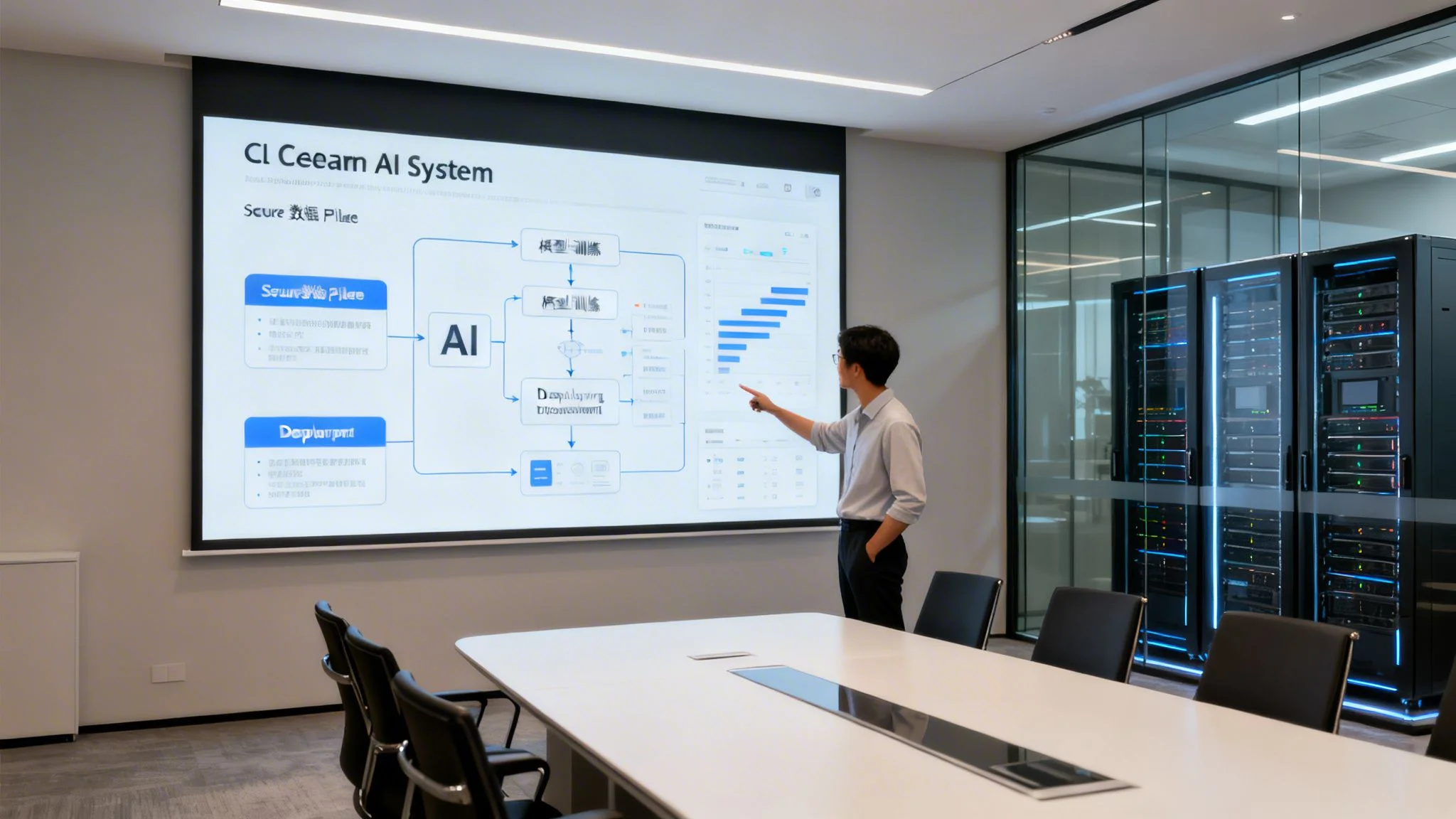
The frameworks in this guide aren’t just theory—they are the exact principles we use to execute complex projects for leaders in fintech, digital assets, and Web3. At Blocsys Technologies, we specialise in transforming ambitious ideas into production-ready platforms that perform under pressure.
We don’t just write code. We architect secure, scalable, and intelligent systems engineered to solve high-value problems. Our entire approach to AI ML development services is built on deep, practical experience in these demanding sectors.
A Focus on High-Stakes Environments
Our specialization is unambiguous: we build for high-stakes environments where security, uptime, and compliance are non-negotiable. This means architecting sophisticated tokenisation systems, building high-performance trading infrastructure, and deploying AI-powered compliance workflows that stand up to regulatory scrutiny.
We have a native understanding of the operational risks and regulatory nuances of decentralised markets. That domain expertise allows us to build solutions that are not just technically robust but also commercially and strategically viable in the Web3 ecosystem.
Blocsys acts as a force multiplier for your technical team. We combine battle-tested blockchain architecture with a pragmatic AI implementation model, delivering platforms built for enterprise-grade security and scale from day one.
Our process is built on collaboration. We align with your team to establish clear commercial objectives and measurable KPIs, ensuring the final product generates tangible business value.
Engineering Your Vision into Reality
Whether your roadmap includes a predictive analytics engine for a new DeFi protocol, an automated valuation model for Real-World Assets, or an intelligent fraud detection system for your exchange, our team has the direct experience needed to deliver.
Our core delivery commitments include:
- Security-First Architecture: Every system we build is architected with security as a primary feature, from smart contract logic to data pipelines, hardening your platform against threats.
- Scalable MLOps: We implement resilient MLOps practices so your AI models can be monitored, retrained, and improved continuously, ensuring long-term performance and accuracy.
- Pragmatic Innovation: We target AI where it creates maximum impact—driving efficiency, mitigating risk, or opening new revenue streams—and steer clear of solutions that don’t deliver a clear ROI.
This is how our focused methodology delivers the enterprise-grade AI solutions required to build, scale, and execute your vision. Think of it as your next step, turning the insights from this guide into a real-world partnership. If you are ready to build what’s next, Blocsys is ready to help you get there.
Frequently Asked Questions
Here are direct answers to the questions we hear most often from founders and product leaders who are ready to build with AI ML development services.
How Much Does Building a Custom AI Model Cost?
The investment depends on data complexity, model goals, and required accuracy. A focused proof-of-concept can start in the low five figures, but a production-grade, enterprise system often runs well into six figures. The biggest cost drivers are data preparation effort and the intensity of the R&D phase.
What Is the Difference Between AI Development and Data Science?
Think of it like this: a data scientist is a strategist who finds valuable insights in data (the ‘what’ and ‘why’). An AI developer is an engineer who builds the system to act on those insights automatically (the ‘how’). A data scientist might find a profitable trading pattern; an AI developer builds the bot that executes it.
How Long Does a Typical AI Project Take?
Timelines are tied directly to the project’s scope. A tightly focused discovery and proof-of-concept can be completed in just 4-8 weeks.
From there, building and deploying a full-scale, production-ready model typically takes 3-6 months. For more complex, enterprise-wide systems, projects can extend beyond a year, especially since they often involve continuous improvement and monitoring through MLOps. If you have more general questions, these common AI development FAQs are a great resource.
Ready to move beyond theory and build an intelligent platform that delivers real-world value? Blocsys Technologies specialises in engineering enterprise-grade AI and blockchain solutions for the fintech, Web3, and digital asset sectors. Connect with our experts today to discuss your vision and chart a clear path from concept to a secure, scalable reality.
