

The blockchain technology market reached USD 31.28 billion in 2024 and is projected to reach USD 1,431.54 billion by 2030, with a 90.1% CAGR from 2025 to 2030 according to Grand View Research’s blockchain technology market analysis. That changes the conversation. Technology blockchain is no longer a niche topic for innovation teams. It’s an infrastructure decision for firms that move money, manage digital assets, coordinate counterparties, or need a tamper-resistant system of record.
For CTOs, product leaders, and enterprise architects, the useful question isn’t “what is blockchain?” It’s “where does it fit, what breaks in production, and what architecture can survive compliance, scale, and integration pressure?” That’s the lens that matters in fintech, exchanges, tokenization platforms, AI-assisted compliance systems, and regulated digital products.
Most content stops at definitions. That’s not enough for teams deciding whether to use Ethereum, Hyperledger Fabric, Corda, or a hybrid stack, or for firms trying to connect on-chain workflows with trading engines, KYC systems, treasury controls, and audit processes. Practical implementation lives in those details.
Table of Contents
- The Enterprise Imperative for Blockchain Technology
- Understanding Blockchain Core Concepts for Business
- Choosing Your Architecture Blockchain Patterns for Business
- The Enterprise Trade-Offs Scalability Security and Privacy
- Key Applications Tokenization Smart Contracts and AI Integration
- Enterprise Use Cases and Future Outlook 2026-2028
- Partnering with Blocsys Building Your Blockchain Solution
The Enterprise Imperative for Blockchain Technology
USD 31.28 billion in 2024, with forecasts pointing far higher by 2030. The exact growth curve matters less than what it signals. Blockchain has moved out of innovation labs and into enterprise architecture reviews, budget cycles, and operating model decisions across capital markets, digital assets, and regulated data-sharing environments.

For a CTO, the question is not whether blockchain is important in the abstract. The question is whether it solves a coordination problem that conventional architecture handles poorly. In practice, blockchain becomes relevant when several organisations need a common transaction record, shared process rules, and verifiable history, but no single party should control the system of record.
That shows up in predictable places. Post-trade workflows, asset tokenization, intercompany reconciliation, collateral operations, transfer agency, and compliance reporting all involve multiple parties, competing incentives, and expensive exceptions. In those settings, the cost is often not transaction execution itself. The cost sits in reconciliation, dispute handling, duplicated controls, fragmented audit trails, and slow operational handoffs between firms and systems.
The trade-off is straightforward. Blockchain can reduce cross-party friction and improve auditability, but it also introduces design constraints around privacy, governance, integration, and legal accountability. A conventional database remains the better choice when one trusted operator owns the workflow, latency requirements are tight, and shared write access across institutions is unnecessary.
A sound evaluation starts with architecture, not hype. Assess trust boundaries, data classification, settlement finality requirements, identity model, operational support expectations, and how the ledger will connect to trading platforms, custody systems, risk engines, and AI-driven monitoring tools. Teams that skip those questions usually end up with pilots that prove technical feasibility but fail operational adoption.
Practical rule: Use blockchain where shared state, controlled transparency, and coordinated execution create measurable business value.
For a broader view of blockchain enterprise adoption and business innovation, the adoption pattern is clear. Enterprise blockchain works best as a coordination layer across existing platforms, not as a wholesale replacement for them. Security teams also need to raise the baseline around key management and protocol review. Even foundational reading such as these cryptography books for security audit readiness can help frame the control questions that surface early in enterprise design.
Understanding Blockchain Core Concepts for Business
A business team doesn’t need protocol trivia. It needs a working mental model. Blockchain is best understood as a shared transaction and state layer where approved participants can verify what happened, in what order, and under which rules.
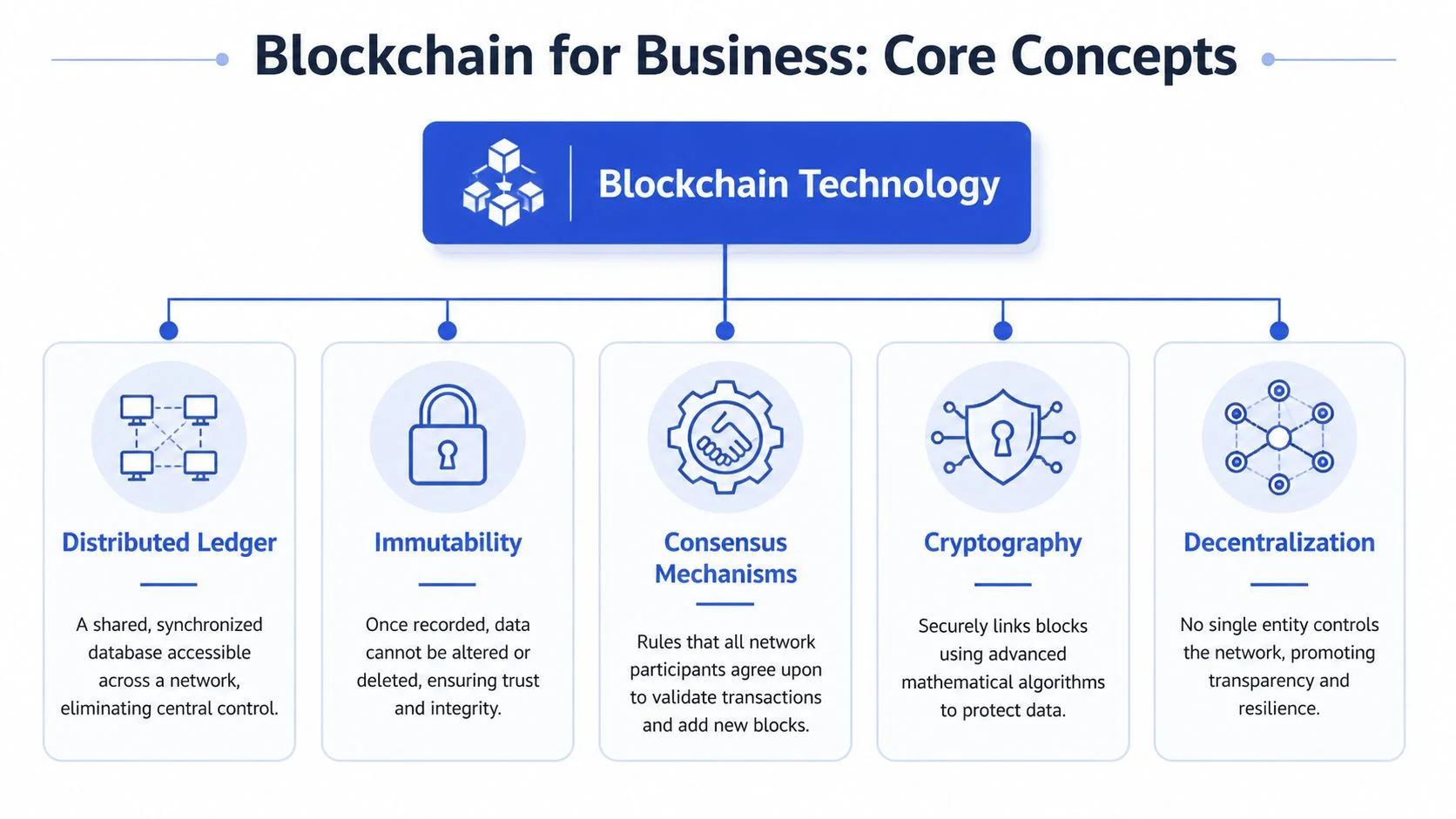
What a blockchain ledger actually changes
In a conventional architecture, each party keeps its own database and spends time reconciling with everyone else. In a blockchain model, participants work from a synchronised ledger. That doesn’t remove every dispute, but it sharply reduces arguments about record versions, event timing, and transaction lineage.
For business operations, that changes three things:
- Shared visibility: Participants see the same authorised state instead of exchanging exports, files, and emails.
- Audit continuity: Every approved action leaves a trace that’s harder to manipulate after the fact.
- Rule enforcement: Transactions can be validated against network policies before they’re accepted.
This matters in environments where back-office friction creates cost and delay. Exchanges, issuers, custodial workflows, and supply chain consortia all run into this problem.
Why consensus and cryptography matter in operations
Consensus is the process the network uses to agree on valid transactions. Different blockchains use different methods, but the business implication is simple. Consensus determines who can submit, validate, reject, or finalise records. It affects speed, governance, resilience, and cost.
Cryptography protects the integrity of records and the identity of actors interacting with the network. That doesn’t mean a blockchain deployment is automatically secure. It means the ledger itself has strong mechanisms for proving authenticity and detecting tampering. Teams that need a stronger foundation in these mechanics often benefit from reviewing cryptography books for security audit readiness, especially when architects and security leads need a common vocabulary before design reviews.
Good blockchain design starts with trust assumptions. Who is allowed to write? Who validates? Who can see what? Most implementation mistakes trace back to vague answers to those questions.
The common confusion is treating decentralisation as an absolute virtue. In enterprise settings, that’s rarely how decisions are made. Most firms want selective decentralisation. They want enough distribution to reduce single-party dependence, but enough control to meet legal, operational, and security obligations.
What smart contracts are in business terms
A smart contract is code that executes predefined business rules on the blockchain. The useful way to think about it is not “a digital contract” in the legal sense. It’s an automated control mechanism.
Examples include:
- Asset issuance rules that prevent transfers unless wallet checks pass.
- Settlement logic that releases value only when both sides meet conditions.
- Compliance gates that stop transactions from moving into restricted states.
- Revenue or fee distribution that executes according to predefined formulas.
The trade-off is rigidity. Smart contracts are excellent at deterministic rules and poor at subjective judgment. If your process depends on discretion, exception handling, or frequent ad hoc changes, put those controls off-chain and connect them carefully.
For teams comparing deployment models, Blocsys’ guide to public vs private blockchain is a practical reference. That choice affects almost every design decision that follows, from access control to observability to regulatory posture.
Choosing Your Architecture Blockchain Patterns for Business
Architecture choice drives success more than enthusiasm does. Public, private, and consortium models all solve different coordination problems. Teams get into trouble when they pick a chain because it’s popular rather than because its governance model matches the business.
How to choose the right operating model
Start with five decision filters.
- Governance fit: If no single party should control the system, public or consortium models usually make more sense.
- Privacy needs: If transaction details, participants, or business logic must remain tightly restricted, private or permissioned models are often easier to govern.
- Integration burden: Public chains offer ecosystem reach. Private stacks often integrate more cleanly with enterprise identity, policy, and approval workflows.
- Performance consistency: Permissioned environments usually offer more predictable operational behaviour because the validator set and network policies are controlled.
- Ecosystem dependency: Public networks bring wallets, liquidity, standards, and external composability. They also bring third-party dependency and variable operating conditions.
A lot of buyers frame this as decentralised versus centralised. That’s too crude. The decision is how much control you’re willing to trade for openness, interoperability, and external network effects.
Comparison of Blockchain Architecture Patterns
| Attribute | Public Blockchain (e.g., Ethereum) | Private Blockchain (e.g., Hyperledger Fabric) | Consortium Blockchain (e.g., Corda) |
|---|---|---|---|
| Governance | Open or broadly distributed | Controlled by one organisation | Shared across selected organisations |
| Access | Typically open participation or public visibility at protocol level | Restricted membership | Restricted to approved participants |
| Privacy | Harder by default, often requires additional design layers | Easier to enforce through permissioning | Stronger than public, with shared governance |
| Ecosystem reach | Strong for wallets, token standards, DeFi, and external integrations | Limited to internal or partner ecosystem | Moderate, depending on consortium scale |
| Operational control | Lower direct control over network conditions | High control over policies and change management | Medium, subject to consortium agreements |
| Best fit | Open asset ecosystems, public tokenization, interoperable applications | Internal workflows, enterprise coordination, sensitive records | Multi-party industry networks with shared incentives |
Where hybrid designs usually win
The most practical enterprise architecture is often hybrid. Keep sensitive logic, internal approvals, and regulated data in controlled systems. Put attestations, settlement events, token states, or proofs on-chain where shared verification matters.
That pattern works well in cases such as:
- Tokenized asset platforms where ownership state is on-chain but investor files and compliance reviews stay off-chain.
- Trading infrastructure where the matching engine remains off-chain for performance, while settlement or proof records are anchored on-chain.
- Inter-company workflows where documents stay private but milestone confirmations are shared across a consortium ledger.
Hybrid architecture is also where modular design becomes important. Teams need clean boundaries between smart contracts, integration services, identity controls, event pipelines, and reporting layers. Blocsys’ view of modular blockchain architecture for scalable networks in 2026 aligns with that reality. The architecture that survives production is usually the one that separates concerns early instead of treating the chain as the whole application.
The Enterprise Trade-Offs Scalability Security and Privacy
Blockchain discussions often collapse into slogans about the trilemma. That’s not useful in design meetings. Enterprise teams need to know where performance degrades, where security responsibility sits, and how privacy constraints affect architecture choices.
Why throughput headlines mislead buyers
The first mistake is buying on theoretical throughput. Production systems fail on edge conditions, not on vendor slides. In India’s DeFi ecosystem, Polygon processes over 3 million daily transactions, yet it has faced latency spikes exceeding 10 seconds during peak trading, with 15% failed transactions during surges attributed to state bloat and gas limit exhaustion on its EVM-compatible network, as noted by IBM’s blockchain topic coverage. That’s a better lesson than any abstract benchmark. High activity can expose weaknesses in execution environment, gas constraints, and application design.
For a CTO, this means capacity planning has to include more than TPS claims. You need to model transaction types, contract complexity, mempool behaviour, failure recovery, and what happens when users retry aggressively under load.
If the business case depends on predictable execution during volatility, test the chain at its worst moments, not its marketing moments.
A practical review should include:
- Finality assumptions: How long before the business treats a transaction as settled.
- Failure handling: What the application does when transactions stall, revert, or become uneconomic.
- Operational observability: Whether the team can trace events across wallets, contracts, relayers, queues, and off-chain services.
Security is broader than chain security
A secure blockchain doesn’t create a secure product by itself. Most enterprise failures happen at the edges. Bad key management, weak role design, poorly reviewed smart contracts, vulnerable APIs, and rushed admin tooling cause more pain than the underlying chain.
The minimum security stack usually includes:
- Key governance: Clear signing authority, approval thresholds, recovery policies, and environment separation.
- Contract assurance: Review for access control errors, upgrade risk, oracle dependencies, and unsafe assumptions.
- Infrastructure hardening: Protection for nodes, integration middleware, admin consoles, and observability pipelines.
Security leaders who need a non-blockchain-specific checklist can pair their application review with practical network protection for businesses. That’s useful because blockchain systems still rely on ordinary enterprise infrastructure, and that layer remains attackable.
Privacy design has to happen early
Privacy is where many promising blockchain projects get redesigned. Public visibility, immutability, and data minimisation obligations don’t naturally align. If teams put sensitive personal or commercially confidential data on-chain, they can create long-term legal and operational problems.
That’s why mature architectures usually do three things:
- Store sensitive data off-chain. Keep personal records, documents, and rich business metadata in controlled systems.
- Anchor proofs on-chain. Use hashes, references, or attestations rather than raw underlying content.
- Separate identity from activity where possible. Even in permissioned systems, access boundaries need to be explicit.
Privacy also shapes governance. Someone has to own participant onboarding, permissions, legal agreements, and dispute handling. The technology blockchain decision is never only technical. It’s also an operating model choice.
Key Applications Tokenization Smart Contracts and AI Integration
Enterprise blockchain projects create value when they improve a specific control point in the operating model. In financial services and digital asset environments, three patterns account for most of the serious work: tokenizing rights, automating deterministic actions with smart contracts, and using blockchain as an auditable event layer alongside AI-driven decision support. That framing matters because CTOs are rarely choosing a chain in isolation. They are deciding how new ledger components will fit with custody, trading, compliance, data platforms, and model governance.

Tokenization works when rights and workflows are defined
Tokenization succeeds when the token has a precise legal and operational meaning. Minting is the easy part. The harder work is specifying the claim or entitlement, the transfer rules, the role of custodians or issuers, the exceptions process, and the systems of record that remain off-chain.
Many enterprise programmes experience delays. Teams start with token standards and wallets, then discover later that redemption logic, investor eligibility, servicing events, and reporting obligations were never mapped cleanly. For real-world assets such as fund interests, commodities, private credit, or carbon-linked instruments, that gap creates operational risk fast.
The design review should answer a few concrete questions:
- What right does the token represent? Ownership, beneficial interest, access, collateral claim, redemption right, revenue share, or another enforceable position.
- Who authorises lifecycle events? Issuance, burns, freezes, transfers, substitutions, and corporate actions need named control owners.
- Which systems stay off-chain? Custody records, investor files, payment operations, legal documents, and disputes usually remain in controlled enterprise systems.
- How are exceptions handled? Lost keys, court orders, sanctions screening failures, and transfer reversals need operating procedures before launch.
Teams that treat tokenization as a business architecture exercise tend to avoid expensive redesign later. A useful starting point is Blocsys’ RWA tokenization checklist for asset tokenization projects, especially for firms working through issuance design, compliance controls, and settlement dependencies before contracts are deployed.
Smart contracts automate control points
Smart contracts are best used to enforce rules that are stable, testable, and repeatable. They reduce manual handling in places where execution quality matters more than human discretion. Transfer gating, escrow release, fee allocation, coupon processing, collateral movements, and approval logging fit this model well.
They fit poorly where policy changes frequently or where the source input is subjective. Credit judgement, complex fraud review, and disputed corporate actions usually need an off-chain decision process with the contract enforcing the approved outcome. That split is common in enterprise systems for a reason. It keeps code narrow, auditable, and easier to govern.
A practical architecture often places smart contracts in the middle of a wider workflow. Upstream systems handle onboarding, screening, case management, and document validation. The contract then enforces the resulting permissions or state changes. Downstream systems consume events for accounting, reporting, reconciliation, and surveillance.
A short explainer is useful here:
Where AI and blockchain fit together
AI and blockchain address different layers of the stack. AI helps classify, predict, summarise, and detect anomalies. Blockchain records approved state transitions, applies deterministic rules, and preserves a shared audit history. The combination is useful in regulated operations, but only when the handoff between inference and enforcement is explicit.
The strongest pattern is simple. AI recommends. Humans or policy engines approve. Blockchain records and enforces the resulting state.
| Component | Blockchain role | AI role |
|---|---|---|
| KYC and AML workflow | Record approvals, restrictions, and audit events | Classify risk, detect anomalies, prioritise review |
| Trading operations | Log settlement states and permissions | Analyse patterns, monitor market behaviour, support surveillance |
| Tokenization platform | Enforce issuance and transfer rules | Review documents, extract fields, flag inconsistencies |
That architecture avoids a common mistake. Teams let opaque model outputs drive irreversible on-chain actions before they have reliable controls for confidence thresholds, exception handling, retraining, and accountability. In practice, most firms should keep AI outputs advisory until governance is mature enough to support automated action in tightly bounded cases.
Blocsys Technologies is one example of a provider working in this combined space, building blockchain and AI-enabled platforms for fintech and digital asset firms. The practical value is not the pairing itself. It is the ability to integrate tokenization, trading workflows, and compliance automation into one operating stack instead of stitching together disconnected products.
Enterprise Use Cases and Future Outlook 2026-2028
The strongest evidence of maturity is deployment in ordinary operational settings. SQ Magazine’s blockchain statistics compilation notes that 47% of global enterprises report blockchain in active deployment as of 2025, and that government initiatives span over 71 countries across areas such as digital identity, voting, and related public systems. That’s not a signal of universal success. It is a signal that the technology has moved beyond lab status.

Where deployment is already real
A few use cases keep recurring because they fit the strengths of blockchain rather than fighting them.
First, digital asset issuance and tokenized ownership. This works when the business needs a clear lifecycle record, controlled transferability, and auditable rights management.
Second, shared records across institutions. Multi-party environments benefit when no single participant should maintain the definitive ledger alone.
Third, government and regulated registries. Where traceability, tamper resistance, and controlled access matter, blockchain can provide a durable coordination layer if the governance model is sound.
The common trait is narrow scope with clear responsibility boundaries. Systems fail when teams try to “put the whole business on-chain.” They work when they target one painful coordination problem and integrate with existing operating systems cleanly.
What to prepare for next
The next 12 to 24 months will likely separate serious operators from symbolic adopters. The near-term winners will focus on execution quality in a few areas:
- Layered architectures: More teams will keep computation, identity checks, and confidential data off-chain while using blockchain for settlement, proofs, and shared state transitions.
- Stronger policy integration: Compliance, treasury, and legal teams will move closer to protocol and product design rather than reviewing after build decisions are made.
- Institutional-grade tokenization: Buyers will demand clearer controls around issuance rights, transfer restrictions, reporting, and exception handling.
- AI-assisted operations: Firms will use AI around blockchain data for triage, monitoring, and review support, but with tighter human governance.
Enterprise adoption doesn’t reward the most decentralised design. It rewards the design that can survive audit, scale, and operational handover.
For CTOs, the planning question through 2028 isn’t whether blockchain will exist in the stack. It’s which functions deserve it, and which ones absolutely don’t.
Partnering with Blocsys Building Your Blockchain Solution
Execution is where strategy gets exposed. Many teams can produce a prototype wallet flow or smart contract demo. Far fewer can deliver a system that handles permissions, upgrades, monitoring, incident response, integration with legacy services, and the day-two realities of regulated operations.
What an implementation partner should actually do
A useful partner shouldn’t start with chain preference. They should start with business constraints. That means clarifying asset model, participant roles, workflow boundaries, compliance controls, latency requirements, and integration points before locking architecture.
The work usually spans:
- Platform design: chain selection, smart contract boundaries, identity and custody model, and environment separation.
- Systems integration: connecting wallets, matching engines, payment rails, KYC vendors, reporting layers, and internal approval workflows.
- Operational readiness: testing failure modes, defining upgrade paths, access governance, support processes, and audit evidence collection.
If a provider can’t explain how off-chain systems and on-chain controls interact, they’re not solving the full enterprise problem.
Where specialist execution matters most
The complexity rises quickly in fintech and digital asset products. Cross-chain swaps, tokenized instruments, prediction markets, exchange operations, and AI-assisted compliance all require disciplined engineering choices. Small mistakes in permissions, settlement logic, or event handling can become expensive operational problems.
For teams evaluating partners, Blocsys’ guide to choosing a blockchain consulting partner in 2026 is a practical starting point. The criteria are straightforward. Look for experience in tokenization, trading infrastructure, and compliance-sensitive workflows. Look for architectural discipline. Look for a team that treats blockchain as one part of the system, not the whole system.
The right implementation approach is usually conservative in the right places. Keep governance explicit. Keep sensitive data controlled. Automate only what can be specified precisely. Design the operating model before scaling the product.
If you’re evaluating how Blocsys Technologies can support a blockchain initiative, the relevant question is whether your team needs help turning a concept into production architecture. Blocsys works with fintechs, exchanges, and digital asset businesses on tokenization systems, trading infrastructure, and AI-powered compliance workflows. If that matches your roadmap, connect with the team to discuss architecture choices, delivery scope, and next steps.
Frequently Asked Questions
How big is the enterprise blockchain market expected to become?
The blockchain technology market reached USD 31.28 billion in 2024 and is projected to reach USD 1,431.54 billion by 2030, growing at a 90.1% CAGR from 2025 to 2030, according to Grand View Research’s analysis. This growth signals that blockchain has moved out of innovation labs and into enterprise architecture reviews, budget cycles, and operating model decisions across capital markets, digital assets, and regulated data-sharing environments.
When does blockchain actually make sense for an enterprise?
Blockchain becomes relevant when several organisations need a common transaction record, shared process rules, and verifiable history, but no single party should control the system of record. This shows up in post-trade workflows, asset tokenization, intercompany reconciliation, collateral operations, transfer agency, and compliance reporting, where cost sits in reconciliation, disputes, duplicated controls, and fragmented audit trails rather than in transaction execution itself.
When is a conventional database still the better choice?
A conventional database remains the better option when one trusted operator owns the workflow, latency requirements are tight, and shared write access across institutions is unnecessary. Blockchain reduces cross-party friction and improves auditability, but it also introduces design constraints around privacy, governance, integration, and legal accountability that aren’t worth taking on without a genuine coordination problem.
What should a CTO evaluate before adopting blockchain?
A sound evaluation starts with architecture, not hype: trust boundaries, data classification, settlement finality requirements, identity model, operational support expectations, and how the ledger will connect to trading platforms, custody systems, risk engines, and AI-driven monitoring tools. Teams that skip these questions usually end up with pilots that prove technical feasibility but fail operational adoption.
What does a blockchain ledger actually change for business operations?
Instead of each party keeping its own database and reconciling separately, participants work from a synchronised ledger, which sharply reduces arguments about record versions, event timing, and transaction lineage. Concretely, it delivers shared visibility into the same authorised state, audit continuity through traces that are harder to manipulate after the fact, and rule enforcement by validating transactions against network policies before acceptance.
Is enterprise blockchain meant to replace existing systems?
No. The adoption pattern shows enterprise blockchain works best as a coordination layer across existing platforms, not as a wholesale replacement for them. It is intended to sit alongside trading engines, KYC systems, treasury controls, and audit processes rather than displace them.
