

This guide is for Web3 founders, product managers, and enterprise leaders in blockchain, AI, crypto, and carbon sectors who need to understand how to merge artificial intelligence with blockchain technology. We will explore high-value use cases, architectural patterns, and a future outlook to help you build and scale next-generation platforms. You will leave with a clear roadmap for integrating AI into your blockchain projects, covering decision-stage needs, evaluation criteria, and real-world outcomes.
What is the relationship between AI and blockchain?
The relationship between AI and blockchain is symbiotic: blockchain provides a secure, immutable ledger for data, which AI models can use to generate transparent and trustworthy insights. In return, AI provides the intelligent automation and analytical power needed to make blockchain networks more efficient, dynamic, and capable of handling complex, real-world decisions.

The real magic here lies in how their strengths perfectly complement each other. Blockchain offers a bedrock of trust and verifiable data—exactly what AI models need to generate reliable and transparent results. In return, AI provides intelligent automation and decision-making capabilities, making blockchain networks far more dynamic and efficient.
This relationship also shores up the biggest weaknesses of each technology when used alone. AI systems, for instance, often feel like “black boxes,” making it difficult to trust their conclusions. Blockchain cracks this open by creating a permanent, auditable trail of the data and logic the AI uses, ensuring every action is both transparent and verifiable.
How do AI and blockchain technologies reinforce each other?
At its heart, this partnership is all about trust and intelligence. Blockchain provides a tamper-proof environment for data, and AI delivers the analytical engine to make sense of that data and act on it.
This dynamic is especially game-changing in industries that demand high levels of security and accountability. Take India’s booming fintech sector, for example. The India Fintech Blockchain Market, valued at USD 0.35 billion in 2024, is on a sharp upward trajectory, projected to hit USD 1.87 billion by 2030. That’s a compound annual growth rate (CAGR) of 32.10%, fuelled by innovations like AI-powered smart contracts and predictive analytics that are reshaping trading infrastructure. For a deeper dive into how these technologies are being applied in finance, this guide to AI crypto investing offers a solid primer.
To help you quickly grasp how these two technologies reinforce one another, here’s a simple breakdown. Think of blockchain as the unbreachable fortress and AI as the brilliant strategist inside.
AI and Blockchain Synergy at a Glance
| Capability | Blockchain’s Contribution (The Fortress) | AI’s Contribution (The Brain) |
|---|---|---|
| Data Integrity | Provides an immutable, verifiable ledger for all data and transactions. | Analyses data to detect anomalies and ensure its quality before it’s recorded. |
| Automation | Executes pre-defined rules through smart contracts automatically. | Enables “smart” contracts to handle complex, dynamic decisions based on real-time data. |
| Security | Secures the network through decentralisation and cryptography. | Proactively identifies and mitigates threats by analysing network behaviour. |
| Trust | Creates a transparent, auditable record of all activities and decisions. | Makes its own decision-making processes transparent and verifiable by logging them on-chain. |
As the table shows, each technology fills a critical gap for the other, creating a system that is greater than the sum of its parts.
What are the key benefits of combining AI and blockchain?
When founders and product teams truly understand this combination, they can design platforms that have a serious competitive edge. Here are the main advantages:
- Enhanced Data Security: AI models can continuously analyse network activity on a blockchain, proactively identifying and neutralising security threats in real-time before they cause damage.
- Intelligent Automation: Smart contracts become genuinely “smarter.” Instead of just following simple, pre-set rules, they can integrate AI to execute complex, data-driven actions.
- Increased Trust and Transparency: By creating an immutable record of AI-driven decisions on a blockchain, the entire process becomes fully auditable and trustworthy for every participant involved.
- Efficient Data Management: AI can help optimise how data is stored and managed on a blockchain, improving overall efficiency and reducing the computational load.
By creating a system where AI’s decisions are recorded on an immutable ledger, you build a foundation of verifiable trust. This is critical for applications in finance, supply chain, and compliance, where every action must be auditable.
This powerful pairing isn’t just theoretical; it’s already creating entirely new business models. You can learn more about how AI and blockchain are paving the way for a decentralised, intelligent future in our detailed article on the synergy of AI and blockchain. For any team aiming to build the next generation of decentralised applications, mastering this partnership is the essential first step.
What are high-value use cases for AI in blockchain?
Moving from theory to practice, the combination of AI and blockchain is already creating real-world value in a few key areas. For founders and product managers, knowing where this fusion is gaining traction is crucial for spotting genuine market opportunities. Let’s dig into the applications that are not just concepts but active fields of development set to define the market by 2026.
These aren’t just ideas on a whiteboard. They are areas where AI’s predictive power and blockchain’s built-in trust are coming together to solve major business headaches. The momentum is global, with some of the most significant adoption happening in fast-growing markets.
Take India, for example, which now ranks 2nd globally in enterprise AI use. This is acting as a massive catalyst for more advanced blockchain applications. Between June and December 2025 alone, Indian enterprises processed a staggering 82.3 billion AI/ML transactions, which accounted for 46.2% of all activity in the APAC region. The charge was led by the Tech & Communication (31.3 billion) and Finance & Insurance (12.2 billion) sectors, proving there’s a strong appetite for integrating smart systems into secure, decentralised frameworks. You can read more about India’s AI adoption on economictimes.com.
Intelligent DeFi Trading and Analytics
Decentralised Finance (DeFi) is a natural fit for AI. Most DeFi platforms today run on fixed algorithms and need manual oversight, which is just too slow and clunky for today’s volatile crypto markets. AI brings a much-needed layer of dynamic intelligence to the table.
AI-driven trading bots can sift through huge volumes of on-chain and off-chain data—everything from social media chatter to wallet transaction histories—to get ahead of market movements. This unlocks automated, high-frequency trading strategies that can execute complex arbitrage or manage liquidity pools with a precision that humans simply can’t match.
- Problem Solved: Getting past the limits of rigid DeFi protocols and slow human reaction times in fast-paced crypto markets.
- Business Outcome: Better capital efficiency, higher returns for liquidity providers, and more resilient automated market makers (AMMs). For companies, this translates to building more profitable and stable DeFi products.
Advanced Prediction Markets
Prediction markets run on two things: accurate information and trust. Blockchain delivers the transparent, tamper-proof backbone, but it’s AI that sharpens the quality of the predictions themselves.
AI models can analyse participant behaviour to spot and flag potential market manipulation or outright fraud. Even more powerfully, AI can pull in and weigh data from countless sources to generate its own probability scores. This gives human traders a valuable benchmark and makes the entire market’s outcomes more accurate and reliable.
By using AI to assess risk and verify information continuously, prediction markets become more than just betting platforms. They evolve into powerful forecasting tools for business and finance.
Real-World Asset (RWA) Tokenization
Tokenizing real-world assets like real estate, art, and private equity can unlock incredible liquidity. The big challenge, however, has always been valuation and risk assessment. AI is the answer.
Machine learning models can chew through historical sales data, market trends, and an asset’s unique features to produce accurate, dynamic valuations. This is critical for setting the initial price of a tokenised asset and for its ongoing price discovery. AI can also assess a borrower’s creditworthiness or a property’s risk profile, automating the due diligence for asset-backed lending protocols built on-chain.
- Startup View: A startup could build a niche platform for tokenizing vintage cars, using an AI model to provide verifiable valuations that give investors confidence.
- Enterprise View: A major financial institution could use AI to automate risk assessment for a multi-billion dollar portfolio of tokenised commercial real estate loans.
Carbon Credit Verification and Analytics
The carbon credit market has long been hobbled by fraud and double-spending. Blockchain provides a transparent ledger to track credits from the moment they’re created to when they’re retired, but proving the underlying carbon-offsetting projects are legitimate is a huge hurdle.
Here, AI—teamed up with satellite imagery and IoT sensor data—can independently verify project claims. For instance, an AI model could analyse satellite photos over time to confirm that a forestation project is actually growing trees as claimed. Once verified, this data can be locked onto the blockchain, creating a “gold standard” for carbon credits that buyers can trust completely. These developments are closely linked to how AI integrates with smart contracts, a topic we cover in our article on AI in smart contracts driving automation’s future.
What are the architectural patterns for integrating AI and blockchain?
Actually connecting AI and blockchain isn’t just about APIs and code; it demands a clear architectural plan. For the developers, architects, and product leaders building these systems, understanding how to bridge these two powerful technologies is the most critical step. The right pattern depends entirely on your project’s specific needs for security, performance, and cost.
There are three primary architectural models for integrating AI for blockchain applications. Each offers a different balance of trade-offs between on-chain trust and off-chain efficiency. Choosing the correct one is fundamental to your project’s success.
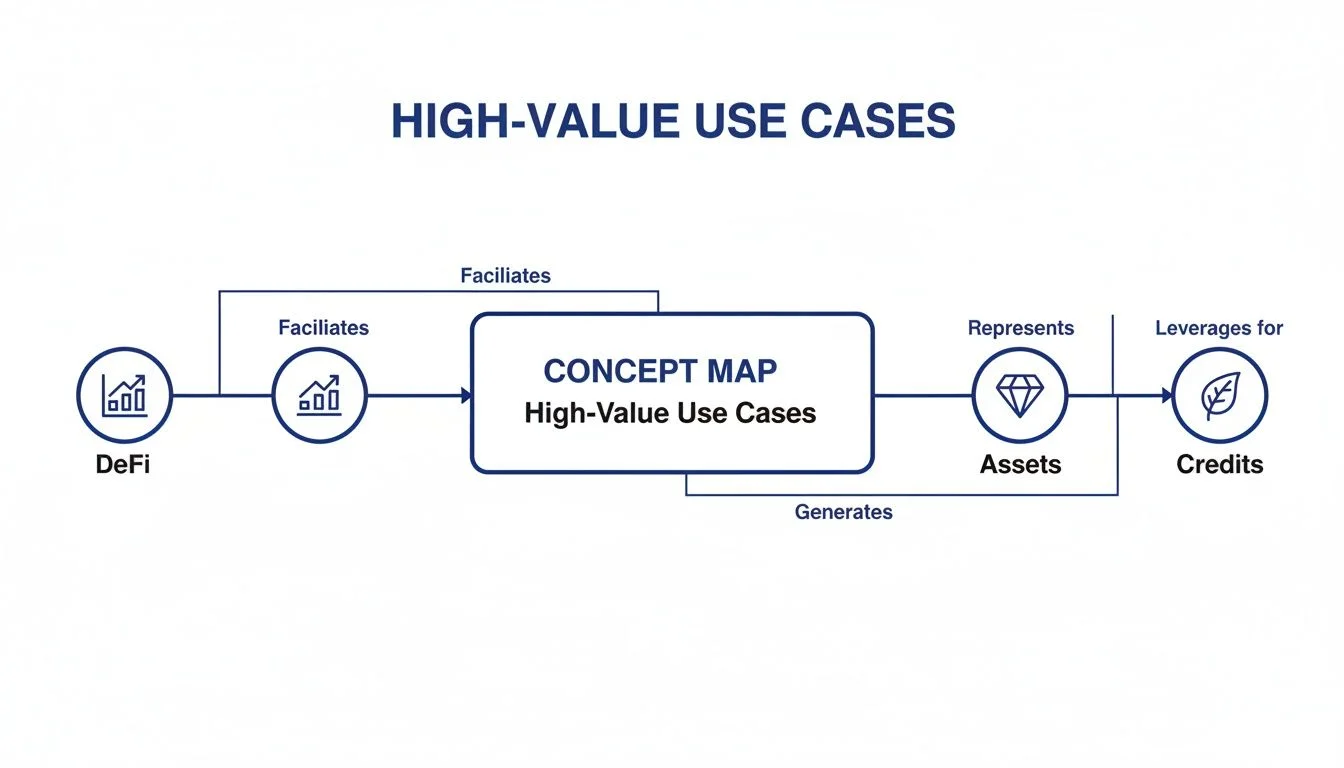
This concept map illustrates how core use cases—like DeFi, asset tokenisation, and carbon credits—rely on these underlying architectural patterns.
While the applications differ, they all depend on a secure flow of data between the AI model and the blockchain ledger. Let’s break down how that happens in practice.
Off-Chain AI with On-Chain Triggers
The most common and practical approach today is to run AI models off-chain and use oracles to feed the results to smart contracts. Think of an AI model running on a standard server, analysing market data to predict a price movement. When it identifies a key event, it triggers an oracle.
The oracle, a trusted third-party service, then validates this data and securely writes it onto the blockchain. This action is what triggers a smart contract, which might execute a trade or adjust a lending rate automatically.
- How it Works: All the heavy computational work of the AI happens in a flexible, low-cost off-chain environment.
- Best For: Applications that need real-time data processing and complex AI analysis without the high gas fees and slow transaction times of on-chain computation. DeFi trading bots and risk assessment engines are perfect examples.
- Key Challenge: This pattern introduces the “oracle problem”—you must trust the oracle network not to tamper with the data it feeds to your smart contract.
On-Chain AI Models with zkML
A more decentralised—but technically demanding—pattern involves running AI models directly on-chain. This has always been difficult because blockchain environments are deliberately constrained and not built for intensive computation. However, recent breakthroughs in zero-knowledge machine learning (zkML) are finally making this a reality.
With zkML, an AI model generates a tiny cryptographic proof of its computation off-chain. This proof is then submitted to the blockchain for verification. Instead of re-running the entire model on-chain, the smart contract simply verifies the proof, confirming the AI’s output is correct and hasn’t been tampered with.
zkML allows for verifiable on-chain intelligence. It proves that a specific AI model produced a specific result without revealing the model or its data, delivering both trust and privacy in one go.
Advanced Cryptography with MPC
When data privacy is paramount, especially during the AI model training phase, Multi-Party Computation (MPC) offers a powerful solution. MPC allows multiple, separate parties to jointly train an AI model on their combined datasets without any single party ever having to reveal its private data to the others.
Each participant’s data remains encrypted while it contributes to the training process. The resulting model benefits from a richer, more diverse dataset, leading to more accurate predictions without ever compromising confidentiality.
This pattern is ideal for creating industry-wide fraud detection models in finance or for collaborative medical research where patient data must remain private. Building these systems requires a deep understanding of complex data flows, which is why a well-designed data pipeline architecture is so crucial for success.
How do you build an AI-powered blockchain system?

Turning an ambitious concept into a functioning, AI-driven blockchain system isn’t magic; it’s a process. A structured plan is your best defence against the common pitfalls that sink projects before they even get started.
This roadmap breaks the journey down into four manageable stages. It provides a clear path from your initial idea all the way to a secure, market-ready product, helping your team build with purpose and confidence. An AI-powered product development roadmap can provide a solid framework, ensuring your AI and blockchain components are perfectly aligned with business goals from day one.
Stage 1: Define Your Business Case and Use Case
Before a single line of code gets written, you have to anchor your project in real-world value. What specific business problem can the combination of AI for blockchain uniquely solve? Don’t just chase the technology.
Maybe you’re looking to slash fraud in a DeFi protocol, automate the valuation of tokenised assets, or create a tamper-proof system for verifying carbon credits. Whatever it is, get specific.
A strong business case clearly states the problem, your proposed solution, and the measurable outcome you expect. Once you have that, select a high-impact use case that directly addresses the business need.
- Actionable Tip: Start small and focused. Instead of trying to build a massive, all-encompassing DeFi ecosystem, begin with a single, potent feature. For example, create an AI-powered tool for managing liquidity for just one specific asset pair. This lets you iterate, validate, and learn much faster.
Stage 2: Select Your Technology Stack
With a clear use case in hand, it’s time to choose your tools. This is where you’ll make critical decisions about both the blockchain platform and the AI frameworks you’ll use. These choices will have a direct and lasting impact on your system’s scalability, security, and operational cost.
H3 Blockchain Platform
The choice of blockchain is a major fork in the road. Building on an Ethereum Layer 2 (L2) like Arbitrum or Optimism gives you access to Ethereum’s massive ecosystem and battle-tested security, but with much lower fees.
On the other hand, a framework like the Cosmos SDK gives you more sovereignty and customization, allowing you to build an application-specific blockchain from the ground up.
H3 AI Frameworks and Tools
Your AI stack will depend entirely on your chosen architecture. If your model will run off-chain, standard frameworks like TensorFlow or PyTorch are proven, excellent choices.
But if you’re aiming for on-chain verifiable intelligence, you’ll need to dive into the emerging world of tools built for zero-knowledge machine learning (zkML).
Your technology stack should be a direct reflection of your use case. A high-frequency trading application has vastly different scalability and latency requirements than a carbon credit verification platform. Match the tools to the task at hand.
AI for Blockchain Technology Stack Comparison
Choosing the right technology stack is one of the most critical decisions in the development lifecycle. The following table provides a comparative analysis of popular technology stacks for building AI-integrated blockchain applications, helping teams evaluate options based on key decision criteria.
| Stack Component | Option A (e.g., Ethereum L2 + Off-Chain AI) | Option B (e.g., Cosmos SDK + On-Chain zkML) | Evaluation Criteria (Scalability, Cost, Security) |
|---|---|---|---|
| Blockchain | Arbitrum/Optimism on Ethereum | Custom App-Chain via Cosmos SDK | Scalability: L2s offer high throughput, but can be congested. App-Chains offer dedicated resources. Cost: L2s are cheaper than Ethereum L1, but App-Chains can optimize fees further. Security: L2s inherit Ethereum’s security. App-Chains rely on their own validator set. |
| AI Processing | Off-chain via TensorFlow/PyTorch | On-chain via zkML frameworks | Scalability: Off-chain is highly scalable. On-chain is computationally intensive and less scalable. Cost: Off-chain is cheaper. On-chain proof generation is expensive. Security: Off-chain relies on oracles. On-chain is cryptographically verifiable and trustless. |
| Data Bridge | Oracles (e.g., Chainlink) | Direct on-chain data or IBC | Scalability: Oracles are scalable but add latency. IBC is fast within the Cosmos ecosystem. Cost: Oracle fees can add up. IBC transaction fees are typically lower. Security: Oracles introduce a point of trust. On-chain data is inherently secure. |
This comparison highlights the fundamental trade-offs. Option A is often faster and cheaper to implement for many use cases, while Option B provides maximum decentralization and verifiability at a higher cost and complexity.
Stage 3: Manage Data and Model Lifecycles
Managing data and AI models in a decentralized world brings its own unique set of challenges. Your roadmap must account for the entire journey, from how data is gathered to how the model is deployed, monitored, and updated.
- Data Sourcing and Integrity: How will you get data to your AI model securely? If you’re using an oracle, what systems are in place to ensure that data is accurate and hasn’t been tampered with before it triggers your smart contract?
- Model Training and Deployment: For off-chain models, a standard MLOps pipeline works well. For on-chain models, the process is different; you need a way to generate and verify cryptographic proofs (like zk-SNARKs) to guarantee the model’s integrity without revealing its inner workings.
- Continuous Monitoring: AI models aren’t static. Their performance can degrade over time as real-world data shifts—a phenomenon known as “model drift.” You need a robust system to continuously monitor your model’s accuracy and retrain it as needed, even in a decentralized setting.
Stage 4: Navigate Security, Privacy, and Compliance
Security and privacy can’t be bolted on at the end. They must be core principles baked into your system’s design from the very first day. The fusion of AI and blockchain introduces new attack surfaces that require proactive defence.
- Smart Contract Security: All smart contracts must undergo rigorous, independent audits to root out vulnerabilities. When an AI’s output can trigger a contract, you also have to secure the entire data pipeline that feeds it. One weak link can compromise the whole system.
- Data Privacy: If your application handles sensitive user data, using privacy-preserving techniques is non-negotiable. This could mean using advanced cryptography like Multi-Party Computation (MPC) to train models on encrypted data or using zero-knowledge proofs to verify user credentials without ever exposing the raw data itself.
- Regulatory Compliance: The regulatory landscape for both crypto and AI is a moving target. Your roadmap must include a plan for ongoing legal and compliance reviews to ensure your platform adheres to all relevant regulations, especially those concerning data protection, financial services, and consumer rights.
What is the future of AI and blockchain (12-24 month outlook)?
Looking ahead, the intersection of AI and blockchain is moving past basic integrations and into a new phase of advanced, autonomous applications. The next 12-24 months will be defined by trends that make on-chain systems not just smarter, but truly proactive and agent-driven.
For founders and product teams, understanding these shifts is crucial for building platforms that will lead the market. The focus is shifting from simple automation to genuine on-chain intelligence. We are about to see the first practical wave of systems where AI agents operate with significant autonomy inside decentralised frameworks, all made possible by maturing tech that finally solves the core challenges of trust, privacy, and real-world data integration.
The Rise of On-Chain Autonomous Agents
The next major leap for AI for blockchain will be the emergence of on-chain autonomous agents. These aren’t just smart contracts triggered by external data feeds; they are AI-powered entities that can own assets, execute complex multi-step strategies, and interact with other protocols directly on the blockchain.
Think of a DeFi agent that doesn’t just rebalance a portfolio based on a price tick. Instead, it actively discovers new yield farming opportunities, assesses their risk profiles using its own models, and deploys capital—all without any direct human input.
- What to Watch: The development of agent-focused protocols and AI-native blockchain architectures that give these agents the tools and gas fee allowances they need to operate independently.
- Impact: This will unlock a new class of “agent-native” dApps capable of managing complex jobs, from decentralised asset management to supply chain logistics, with minimal human supervision.
Generative AI for Smart Contract Development
Generative AI is set to completely reshape how smart contracts are built and secured. While AI code assistants are available today, the next generation of tools will be far more specialised for the Web3 environment.
These platforms will allow developers to describe a contract’s intended logic in plain English, with the AI generating secure, optimised, and auditable code in Solidity or Rust. Just as importantly, these systems will also be able to simulate thousands of potential attack vectors, spotting vulnerabilities long before deployment.
By embedding formal verification methods directly into the workflow, generative AI will serve as a co-pilot for developers. This will dramatically lower the risk of costly exploits and make secure smart contract development far more accessible.
DePINs Fuelling Verifiable Real-World Data
Decentralised Physical Infrastructure Networks (DePINs) are on track to become a primary data source for AI-blockchain systems. These networks use token incentives to encourage individuals and businesses to deploy sensors, cameras, and other hardware to collect verifiable data from the physical world.
- Example: A DePIN designed for environmental monitoring could use thousands of community-owned sensors to provide hyper-local air quality data.
- How it Connects: An AI model could then analyse this live data. If a pollution threshold is breached, an on-chain action is triggered automatically—perhaps issuing a public alert or releasing funds from a treasury for clean-up initiatives.
This setup creates a direct, verifiable bridge between the physical world and blockchain logic. It neatly solves the data sourcing problem for use cases like carbon credit verification and parametric insurance. The combination of DePIN data with verifiable AI models is poised to create a new gold standard for trust in real-world applications.
How Blocsys helps you build and scale with AI for blockchain
Turning a powerful concept like AI for blockchain into a secure, scalable platform that actually works is where most projects stall. It demands a rare blend of specialised expertise. At Blocsys, we don’t just talk theory; we execute. Our entire process is built from our first-hand experience designing and deploying complex systems where decentralised trust meets machine intelligence. We take teams straight from the whiteboard to building real, tangible results.
Our approach is grounded in practicality. We’re not here to chase trends. We build solutions that solve specific business problems, whether that means engineering a sophisticated tokenization platform or designing an intelligent compliance workflow for a DeFi protocol. We understand the critical trade-offs between on-chain and off-chain architectures and guide our partners to the pattern that delivers the most value for their goals.
From Concept to Live System
One of the biggest hurdles for ambitious projects is the talent gap. Finding proven developers skilled in both blockchain engineering and applied AI is a massive challenge for any organisation. Our staff augmentation services solve this directly by providing pre-vetted experts who integrate into your team and immediately accelerate your development timeline.
This means you get builders who genuinely understand the nuances of:
- Designing RWA Tokenization Platforms: We architect systems that use AI for dynamic, transparent asset valuation, giving investors confidence and ensuring market integrity from day one.
- Engineering Intelligent DeFi Workflows: Our teams build and implement AI-driven risk models and compliance checks that operate on-chain, strengthening security and automating regulatory adherence.
- Developing Custom Trading Infrastructure: We create high-performance trading platforms that incorporate predictive AI for everything from deep market analysis to automated liquidity management.
The success of any AI and blockchain project hinges entirely on the quality of its execution. A brilliant idea is only as good as the team building it. Our focus is on providing the raw engineering power needed to turn ambitious roadmaps into enterprise-grade reality.
We work side-by-side with founders and product leaders across Web3, crypto, and finance to design systems built for secure, scalable operations. Whether you are building decentralised capital markets, a next-generation crypto game, or a platform for precious metal tokenization, our developers have the practical skills to deliver.
Let’s Build Your Platform
Understanding the concepts is the first step. Taking decisive action is what comes next. If you are ready to move from the planning phase to building a robust AI and blockchain solution, our team is structured to help you execute with precision and speed. We provide the expert developers and strategic guidance needed to build, scale, and launch with confidence.
Connect with Blocsys today to discuss your project. Let’s explore how our expert staff can help you build a groundbreaking platform that stands out in a crowded market.
Frequently Asked Questions
We get a lot of questions about making AI and blockchain work together. Here are some of the most common ones, with straightforward answers to clear things up.
What is the biggest challenge when integrating AI with blockchain?
The biggest challenge when integrating AI with blockchain is the “oracle problem.” Blockchains are isolated and cannot access external data, so they need a secure bridge, known as an oracle, to feed them AI model outputs. Ensuring this bridge is trustworthy and not a single point of failure is a critical hurdle.
Beyond that, performance and cost are huge factors. Running computations directly on a blockchain is notoriously slow and expensive compared to standard off-chain processing. This makes it unfeasible to run complex AI models on-chain without using specialized solutions like zkML (Zero-Knowledge Machine Learning).
Can AI make my blockchain application more secure?
Yes, AI can significantly enhance blockchain security by acting as an intelligent monitoring system. It excels at real-time anomaly detection, identifying fraudulent transaction patterns, suspicious network behavior, or potential smart contract vulnerabilities before they are exploited, providing a dynamic security layer that static, rule-based systems cannot match.
By continuously monitoring on-chain activity, AI acts as a vigilant security guard, proactively identifying threats that could compromise the integrity of a decentralised application.
How do I get started with an AI for blockchain project?
Start with a clear business problem, not the technology. Pinpoint a specific process where AI’s intelligence combined with blockchain’s trust can deliver measurable value, like automating risk assessment or verifying asset authenticity. Then, build a small Proof of Concept (PoC) to validate the core idea with minimal investment.
A great first step is to build an off-chain AI model that feeds data to a smart contract on a testnet via an oracle. This lets you validate the core idea and iron out the kinks with minimal investment before you commit to a full-scale build. Bringing in experts early on will help you define the right scope and architecture from day one, saving you significant time and resources down the line.
Building a production-ready AI and blockchain platform requires deep, specialised expertise. Blocsys Technologies provides the expert staff augmentation to help you design, build, and scale secure, enterprise-grade systems.
Connect with Blocsys today to discuss your project and learn how our developers can help you execute your vision.
