
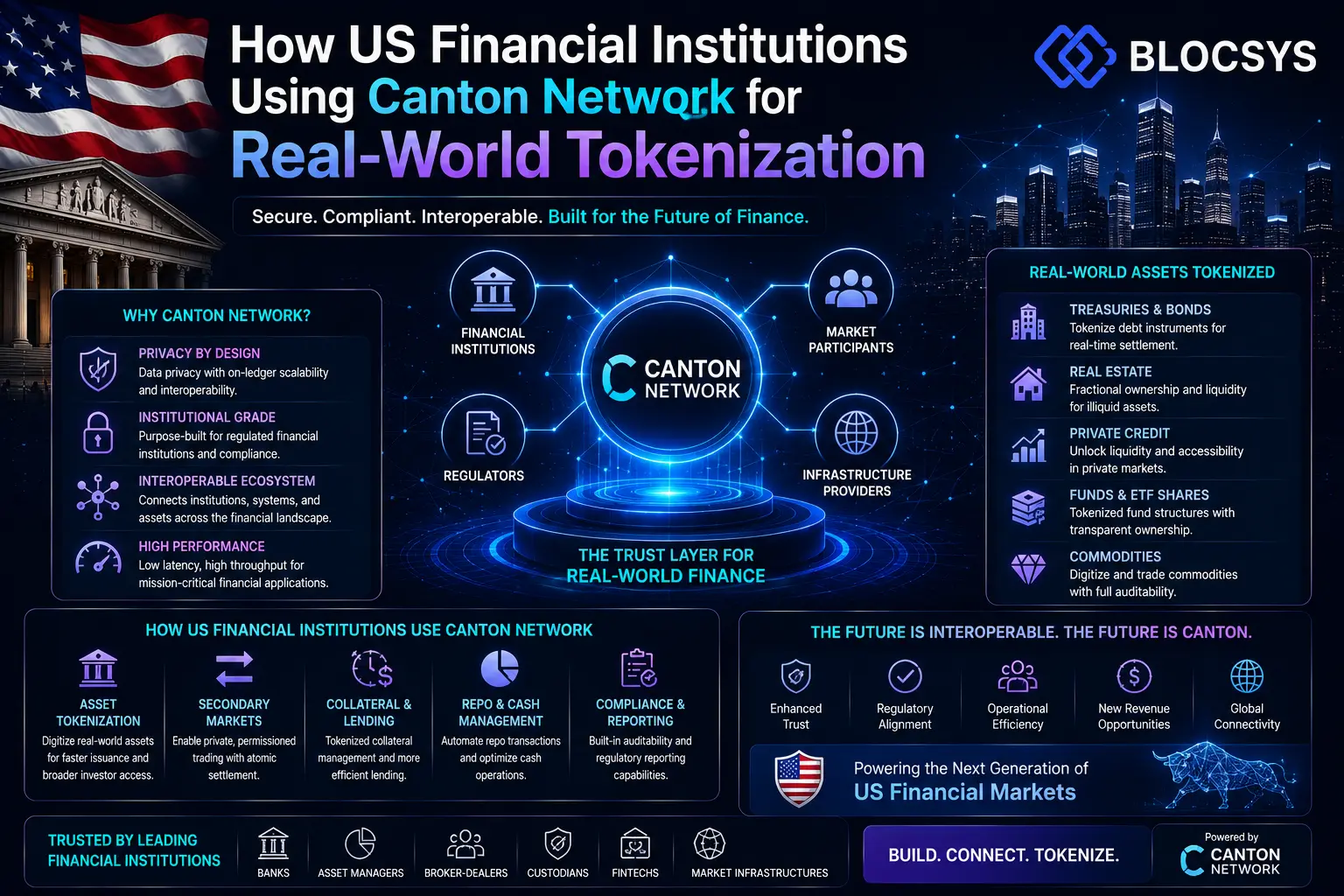
Canton Network is no longer a concept-stage discussion for regulated finance. By October 2025, it had grown to more than 600 active validator nodes, with daily transaction counts above 600,000 and peaks above 1 million, while the network reported roughly $300 billion in daily transaction value and more than $6 trillion in monthly on-chain assets processed, according to Xangle’s October 2025 research. That changes the framing for any CTO, head of digital assets, or capital markets architect. The question isn’t whether institutional tokenization is technically possible. The question is how to integrate it into the operating model of a real financial institution.
For US banks, market infrastructure providers, custodians, and fintech platforms, the most useful lens is operational. Tokenization projects rarely fail because the smart contract can’t represent a bond or a Treasury. They fail when legal control, treasury approvals, custody reconciliation, collateral movements, and compliance workflows still sit outside the chain. That is why Canton matters.
Canton is being used where institutions care most about confidentiality, settlement certainty, and cross-firm workflow coordination. It’s also why many conversations about institutional tokenization now need to move beyond architecture diagrams and into production controls, resiliency planning, and workflow design. Teams looking at DevOps financial reliability best practices will recognise the pattern immediately: the differentiator isn’t only transaction execution, but how the platform behaves under governance, audit, and operational stress.
The practical opportunity for institutions is to treat tokenization as infrastructure modernisation, not as an isolated digital asset experiment. That view aligns with broader institutional adoption of blockchain in 2026 trends challenges and opportunities, especially where regulated firms need privacy, interoperability, and controlled rollout into existing market processes.
Early in any evaluation, it helps to compare the target operating models side by side.
| Metric | Traditional System | Tokenized System on Canton Network |
|---|---|---|
| Asset records | Fragmented across ledgers, custodians, and internal systems | Shared workflow state across authorised participants |
| Privacy model | Bilateral data handling with heavy reconciliation | Need-to-know visibility at the network layer |
| Settlement coordination | Manual handoffs across institutions | Programmable workflow coordination |
| Collateral mobility | Operationally constrained by market hours and approvals | Designed for real-time movement within governed workflows |
| Integration burden | Established but rigid legacy stack | Strong upside, but requires careful back-office integration |
| Governance | Familiar legal and operational model | Requires joint operating rules across firms |
Table of Contents
- Introduction The Institutional Shift to Tokenized Assets
- What is the Canton Network
- How US Financial Institutions Are Using Canton Network
- Comparison Traditional vs Tokenized Financial Systems
- The Future of Blockchain Capital Markets and The Canton Roadmap
- Build Your Institutional Blockchain Platform with Blocsys
- Frequently Asked Questions about Canton Network and RWA Tokenization
Introduction The Institutional Shift to Tokenized Assets
Institutional tokenization has crossed an important threshold. The scale now visible on Canton shows that regulated firms aren’t only experimenting with digital assets at the edge. They’re putting tokenized workflows into environments that touch collateral, issuance, settlement, and treasury operations.
That distinction matters. A pilot can prove that an asset can be represented on-chain. Production use proves that multiple institutions are prepared to coordinate around data access, control models, legal rights, operational exceptions, and post-trade processes. Those are much harder problems, and they’re the ones that determine whether a platform becomes part of market infrastructure.
Why this shift looks different from earlier blockchain cycles
Earlier enterprise blockchain efforts often forced institutions into a trade-off. They could have privacy, but lose interoperability. Or they could share a network, but reveal too much process and transaction data for regulated markets. Canton is relevant because it narrows that gap.
The institutions moving first are not looking for a generic chain. They want infrastructure that can support real-world asset tokenization without breaking confidentiality rules or creating an operational sidecar that finance, risk, and compliance teams won’t support. That is why the conversation has shifted from “can we tokenize this asset?” to “can we run this process under bank-grade controls?”
Tokenization becomes strategic only when the digital asset and the operating model stay aligned.
Who needs to understand this now
This topic matters to CTOs, digital asset leaders, treasury teams, operations heads, and architects inside banks, custodians, and market infrastructure firms. It also matters to fintechs and digital asset platforms building services for those institutions.
The practical outcome isn’t just faster issuance or cleaner settlement. It’s the ability to redesign selected financial workflows so that execution, control, and auditability live closer together. Firms evaluating real-world asset tokenization services are usually trying to answer the same question: how do we modernise the workflow without creating a second, disconnected operating stack?
What is the Canton Network
Canton is a blockchain network built for regulated financial activity where firms need both interoperability and strict data control. That combination sounds simple, but it addresses one of the biggest reasons institutional blockchain projects have historically stalled.
Its most important architectural characteristic is Layer 1 need-to-know privacy. According to the SEC meeting memo on Digital Asset Holdings, each participant can control exactly who can see and possess data. The same memo states that Canton reported over $3.6 trillion of assets tokenized on the network with over 100 participants, including major financial market institutions. For a US bank, that matters more than generic decentralisation rhetoric because confidentiality is not optional in regulated workflows.
Why privacy changes the design conversation
In most capital markets processes, not every participant should see the full state of every transaction. A bank may need to prove ownership, pledge collateral, or settle a position with one counterparty while keeping commercial details hidden from others. Traditional public chain design doesn’t fit that requirement well. Traditional private chains often solve privacy by isolating workflows so tightly that network effects disappear.
Canton’s need-to-know model changes that. Participants don’t have to choose between shared infrastructure and confidentiality. That makes it suitable for digital bonds, collateral workflows, and other regulated instruments where legal rights and information access need to map cleanly to operational roles.
Practical rule: If a tokenization design can’t express who is allowed to see, approve, and control each state change, it won’t survive internal governance review.
Why interoperability matters more than token issuance
Institutions don’t get much value from minting a token if that token can’t interact with treasury systems, margin processes, custodians, and counterparties. The primary challenge is workflow coordination across firms that don’t share the same systems, operating hours, or internal approval chains.
That’s where Canton becomes more than a ledger. It acts as a coordination layer for workflows that need privacy-preserving interoperability. For firms evaluating digital securities infrastructure, that is often the missing piece between a technically valid pilot and a usable production environment. A more specific example appears in Blocsys’s work on digital bond issuance in the US with Canton Network, where the benefit is not just token creation but lifecycle management under institutional controls.
A good shorthand is this: Canton is not trying to replace every bank system. It is trying to give banks and market participants a shared, governed execution layer where selected financial workflows can run with privacy, certainty, and cross-firm coordination.
How US Financial Institutions Are Using Canton Network
More than $300 billion in daily transaction value on Canton by late 2025 matters for one reason. It suggests some institutions have moved past pilots and into repeatable operating flows. For a bank CTO, that changes the conversation from “is tokenization real” to “which workflow should we put into production first, and how do we connect it to treasury, compliance, and books and records without creating a second operating stack.”
Where production activity is already visible
US financial institutions are using Canton in areas where shared state solves a concrete coordination problem. The visible pattern includes digital bond issuance, collateral workflows, selected treasury use cases, and post-trade processes where multiple firms need a synchronized view of events but cannot expose full transaction detail to every participant.
The named participants matter. So does the use-case mix. Banks and market infrastructure operators do not adopt a new network because token issuance looks efficient in a demo. They adopt it when the network can fit around existing controls for entitlements, approvals, exception handling, and reporting.
That is why the practical value shows up in a few specific categories:
- Digital bond issuance: issuance, allocation, coupon events, and redemption logic can run in a controlled workflow with clearer state transitions.
- Collateral mobility: institutions can move eligible assets through a governed process that aligns more closely with margin timing and counterparty requirements.
- Derivatives and post-trade coordination: counterparties and infrastructure providers can reduce manual reconciliation where the same lifecycle event currently passes through several disconnected systems.
- Treasury and cash management linkages: tokenized positions become more useful when cash forecasting, liquidity controls, and servicing events are tied back to internal treasury operations.
A quick explainer helps illustrate the workflow context.
What a workable institutional tokenization flow looks like
A production design on Canton usually looks closer to a capital markets integration programme than a blockchain deployment. The hard part is not minting the asset. The hard part is connecting the asset lifecycle to the systems that already control funding, approvals, accounting, surveillance, and regulatory reporting.
A common implementation pattern looks like this:
Define the legal and operational perimeter
Start with the instrument, legal wrapper, holder rights, transfer restrictions, servicing obligations, and recordkeeping model. If those elements are still ambiguous, the token model is premature.Set participant roles and data visibility
The issuer, custodian, dealer, transfer agent, operations team, and compliance function need explicit permissions. Who can initiate a state change, who must approve it, and who can view it should be configured before integration work begins.Map Canton events into existing internal systems
Treasury needs position and cash impact. Compliance needs surveillance and policy checks. Finance needs accounting treatment. Operations needs queues for breaks, failed settlements, and manual interventions. This step determines whether the chain becomes part of the operating model or just another data source to reconcile.Automate servicing where the institution can support it
Coupon calculations, redemptions, substitutions, collateral calls, and notices should only be automated when downstream teams can process the outputs in production. Partial automation is often the right trade-off early on.Design exception handling and auditability
Failed transfers, sanctions hits, stale reference data, and approval delays are normal conditions in institutional workflows. A design that handles only the happy path will not pass internal review.
Teams working through these decisions usually benefit more from an implementation-focused RWA tokenization checklist for asset tokenization projects than from another conceptual overview, because most delivery risk sits in governance, system interfaces, and control design.
Integration challenges banks actually have to solve
The first challenge is books and records. If Canton reflects the authoritative state for a specific workflow, downstream systems need clear rules for when to post, when to reconcile, and when to hold entries for review. If that authority is left ambiguous, operations teams end up maintaining parallel records, which removes much of the efficiency gain.
The second challenge is treasury integration. Tokenized assets are only operationally useful when they connect to liquidity forecasts, collateral schedules, funding decisions, and intraday reporting. In practice, that means event-driven interfaces into treasury management systems and cash reporting pipelines, not a standalone digital asset dashboard.
The third challenge is compliance control placement. Pre-trade and post-trade checks still need to happen. Sanctions screening, eligibility rules, transfer restrictions, concentration limits, and retention policies must be enforced at the right points in the workflow. Canton can coordinate shared state, but each institution still has to decide which controls remain internal and which validations can be reflected in the shared process.
Teams that have worked on broader modernization programs will recognize the pattern from cloud-native fintech insights. The projects that reach production usually isolate one high-friction workflow, integrate it properly, and expand from there.
What works and what tends to stall
Some patterns are consistent across institutions.
What works
- Constrained use cases: digital bonds, treasury collateral, and controlled inter-institution workflows are easier to operationalize than open distribution models.
- Known counterparties and clear governance: projects move faster when roles, liabilities, and escalation paths are agreed early.
- A source-of-truth decision: the operating model improves when teams define exactly which events are authoritative on Canton and which remain in legacy systems.
- Operations involvement from day one: settlements, servicing, and exception teams usually spot failure modes before architecture teams do.
What stalls
- Parallel process design: if every event must be checked against several internal ledgers because ownership of state is unclear, cycle time and cost increase quickly.
- Weak exception handling: margin disputes, missing approvals, and failed transfers do not disappear on a blockchain network.
- Compliance bolted on late: adding surveillance, screening, and reporting after the workflow is built usually forces redesign.
- Technology-led scoping: a token standard does not answer accounting policy, legal title, or servicing responsibility.
The institutions making progress with Canton are treating it as a controlled coordination layer inside a larger banking architecture. That is the right framing. It sets realistic scope, keeps integration work visible, and gives the business a path from pilot to production without pretending the rest of the bank can be replaced.
Comparison Traditional vs Tokenized Financial Systems
Legacy systems still support enormous volumes and well-understood control processes. No serious institution should dismiss that. The issue is that many workflows remain fragmented across ledgers, intermediaries, approval chains, and reconciliation layers that were built for a different speed and connectivity model.
A tokenized workflow on Canton doesn’t automatically improve everything. It improves the parts of the process where shared state, controlled visibility, and programmable settlement reduce coordination friction.
Where legacy systems still hold an advantage
Traditional market infrastructure has deep legal precedent, mature exception handling, and operating teams that know exactly how to run it. That matters. If the business case depends on replacing all of that at once, the project is usually framed too aggressively.
Institutions also benefit from established vendor relationships and familiar assurance models. Teams exploring cloud-native fintech insights will recognise a parallel pattern from software modernisation: the best outcomes usually come from redesigning high-friction workflows first, not from rewriting the entire estate in one move.
Where Canton-based workflows change the economics
The biggest gains tend to show up where multiple firms need a coordinated view of state, but not universal visibility of all underlying data. Bond servicing, collateral movements, and certain post-trade workflows fit that profile.
| Metric | Traditional System | Tokenized System on Canton Network |
|---|---|---|
| Record management | Multiple records across firms require reconciliation | Shared authorised state reduces reconciliation burden |
| Data visibility | Information is exchanged bilaterally and often repeatedly | Need-to-know privacy limits access to authorised parties |
| Settlement logic | Manual or semi-manual process orchestration | Programmable workflow and atomic coordination |
| Collateral operations | Movement depends on cut-offs, handoffs, and messaging | Real-time process design is more achievable |
| Auditability | Audit trails spread across systems and documents | Event history is easier to track within the networked workflow |
| Change management | Stable but slow to adapt | More flexible, but integration effort is higher upfront |
The best side-by-side framing for executives is not “old versus new.” It’s “fragmented coordination versus governed shared execution.” That makes the decision easier to evaluate against operational KPIs, control requirements, and legal constraints.
For a broader architectural view, the comparison between blockchain vs traditional systems is most useful when it is applied to one workflow at a time, rather than treated as a universal replacement thesis.
The Future of Blockchain Capital Markets and The Canton Roadmap
The next phase of institutional adoption won’t be defined by whether tokenization is feasible. That question has already been answered. The next phase will be defined by which institutions can integrate tokenized workflows into existing control environments without creating operational fragmentation.
A useful proof point came from a Canton pilot involving 18 market participants, which showed that tokenized US Treasuries could be posted, recalled, and used to satisfy margin calls in real time, while also revealing that adoption depends on multi-party coordination and integration with existing custody, margin, and treasury workflows, as documented in Digital Asset’s collateral mobility pilot report.
The next bottleneck is operational alignment
That pilot result is important because it reframes the problem. The blocker is no longer “can tokenized Treasuries move fast enough?” The blocker is whether participants can align legal control, custody processes, treasury policy, and exception handling across organisations.
Many tokenization strategies must mature. Boards and control functions don’t approve platforms because the demo works. They approve operating models that define ownership, authority, escalation, and auditability.
If the digital twin can move but the underlying asset control process cannot, the institution hasn’t solved collateral mobility. It has only digitised one layer of it.
There is also a conduct and governance angle. As tokenized markets become more connected, firms will need stronger market surveillance, clearer entitlements, and better controls against abuse and misrepresentation. Teams reviewing governance frameworks often benefit from adjacent legal thinking such as understanding investment fraud, because tokenized infrastructure doesn’t remove core securities-law risks. It changes where those risks appear operationally.
What the next 12 to 24 months will reward
Institutions that move well over the next 12 to 24 months are likely to share a few traits:
- They narrow the scope. They choose a workflow with clear pain points and known counterparties.
- They design around controls. They make compliance, treasury, legal, and operations part of the core build team.
- They avoid parallel universes. They connect tokenized workflows back to the systems that still govern books, records, and approvals.
- They treat governance as infrastructure. Network rules, participant responsibilities, and fallback procedures are designed early.
That is the actual Canton roadmap from an operator’s perspective. More assets will be tokenized, but the durable value will come from institutions that can make tokenized processes behave like first-class financial infrastructure.
Build Your Institutional Blockchain Platform with Blocsys
Institutions that get tokenization into production usually treat it as an integration program, not a chain selection exercise. The hard part is connecting asset workflows to treasury controls, sanctions screening, entitlement logic, exception management, and the recordkeeping systems that still govern daily operations.
That is the build problem Blocsys is positioned to address. Blocsys Technologies works on blockchain and AI-based infrastructure for fintech and digital asset platforms, with an enterprise blockchain tokenization platform aimed at firms building controlled issuance, settlement, and servicing workflows inside regulated environments.
What an enterprise build programme usually needs
A credible institutional stack has to do more than mint tokens and expose an API. It has to fit the bank’s operating model.
In practice, that usually means five working layers:
- Asset and rights modelling: Instruments, transfer restrictions, servicing terms, corporate actions, and beneficial ownership rules need to be represented correctly.
- Participant access controls: Privacy rules have to map to legal entities, desks, operations teams, custodians, and external counterparties.
- Workflow orchestration: Approvals, settlement instructions, margin movements, reconciliations, and exception queues need deterministic process logic.
- Integration services: Treasury systems, custody platforms, compliance tooling, payment rails, and general ledger processes need reliable interfaces.
- Operational support tooling: Teams need audit views, alerts, break management, administrative controls, and evidence for internal and external review.
The integration layer is where many programs slow down. A tokenized asset may settle correctly on-network and still fail the business case if treasury cannot see intraday positions, compliance cannot apply existing control logic, or operations has to manage breaks in spreadsheets. Production design has to start from those constraints.
How to approach vendor and platform decisions
Vendor review should test delivery capability against operating requirements. Product demos are easy. Controlled deployment inside a bank is harder.
Useful diligence questions include:
- Can the team model institutional permissions at the legal-entity and role level?
- Have they integrated with treasury, custody, and compliance systems, not only issuance workflows?
- Can they support servicing events, exception handling, and operator controls?
- Do they design for auditability and reconciliation from day one?
- Can they work within the bank’s security, change-management, and approval processes?
Staffing is a real constraint. Programs usually need smart contract engineers, backend integration specialists, workflow designers, security reviewers, and platform operators. Many banks keep architecture ownership internal and add external delivery support where execution capacity is thin, including teams they hire blockchain developers for during build phases with fixed deadlines.
The practical objective is straightforward. Build a tokenization platform that can survive treasury review, compliance testing, legal scrutiny, and operations handoff, then scale it beyond a pilot.
Canton Network and Real-World Tokenization in GIFT City
GIFT City can provide a relevant context for financial institutions exploring real-world tokenization through interconnected blockchain infrastructure. Canton Network can support a structured approach to connecting tokenized assets, institutional participants, and financial workflows, making interoperability and efficient asset management important considerations. For institutions evaluating real-world tokenization solutions in GIFT City, these capabilities can help shape scalable blockchain-based financial infrastructure.
Frequently Asked Questions about Canton Network and RWA Tokenization
What is Canton Network in simple terms
Canton Network is blockchain infrastructure built for regulated financial institutions that need shared workflows without broad data exposure. Participants can coordinate on the same transaction or asset state while keeping sensitive position, client, and counterparty information restricted to the parties that should see it.
That matters in banking operations. A platform can fail institutional review even if the token model is sound, because privacy, permissions, and audit requirements do not map cleanly to existing control frameworks.
How does Canton support real-world asset tokenization
Canton supports tokenization by letting firms model ownership, transfer, servicing events, and approval logic in a controlled environment. The practical advantage is not only digital representation of an asset. It is the ability to connect that asset workflow to the systems banks already run for treasury, compliance, books and records, and operations.
For a CTO, the harder problem is usually integration, not issuance. Tokenized assets need position feeds, cash movement logic, entitlement checks, exception queues, and reconciled reporting. If those connections are weak, the blockchain layer creates another operational silo instead of improving the process.
Why are US financial institutions interested now
US financial institutions are interested because capital markets teams want shorter processing cycles and better coordination across firms, while risk and compliance teams still expect existing controls to hold. Canton is getting attention because it was designed for that operating model.
The timing also reflects a change in internal priorities. Many institutions have moved past asking whether tokenization is strategically relevant. They are now asking whether a specific workflow can be introduced without breaking treasury controls, custody processes, or regulatory reporting.
What are tokenized securities
Tokenized securities are regulated instruments represented on blockchain infrastructure. The legal and regulatory character of the instrument does not disappear. The change is in how records, transfers, lifecycle events, and participant permissions are managed.
That distinction is important in implementation. A tokenized bond still has to fit the institution’s legal documentation, settlement model, servicing process, and control environment.
Can Canton help modernise capital markets operations
Yes, especially in workflows that require multiple firms to maintain a consistent view of asset state without making all underlying data visible to every participant. In practice, that can improve issuance coordination, post-trade processing, collateral mobility, and asset servicing.
The benefit depends on execution discipline. Banks still need message mapping into core systems, clear operational ownership, and controls for failed events, reversals, and reconciliations. Canton can support a better operating model, but it does not remove the need for integration architecture and production controls.
How can an institution start
Start with one narrowly defined workflow where the participant set, approval chain, and downstream system impact are all known. Good candidates usually involve repeated manual coordination, slow exception handling, or fragmented records across internal teams and counterparties.
Then design the operating model before scaling the platform. Map how the workflow touches treasury, compliance surveillance, books and records, servicing, and support teams. That is the point where many pilot programs either become production-ready or stall.
Financial institutions, fintech platforms, and digital asset teams that need to turn tokenization strategy into a working operating model can connect with Blocsys Technologies to discuss platform architecture, Canton-aligned workflow design, digital securities infrastructure, and real-world asset tokenization implementation.
The Growing Role of Blockchain Applications in Enterprise Digital Transformation
As digital transformation accelerates across industries, blockchain applications are becoming essential for building secure, transparent, and efficient business ecosystems. Organizations are increasingly adopting blockchain to strengthen data integrity, automate workflows, and create tamper-proof records that improve trust among customers, partners, and regulators. Beyond cryptocurrency, modern blockchain applications support secure document verification, digital identity management, supply chain traceability, asset tokenization, smart contract automation, and real-time audit trails. When integrated with emerging technologies such as artificial intelligence (AI), cloud computing, and the Internet of Things (IoT), blockchain enables organizations to reduce operational costs, improve regulatory compliance, and streamline complex business processes. Enterprises across finance, healthcare, logistics, government, and manufacturing continue to invest in blockchain-powered solutions to enhance security, increase operational efficiency, and accelerate digital innovation. As enterprise adoption continues to grow, blockchain applications are expected to play a central role in creating scalable, trusted, and future-ready digital infrastructure for businesses worldwide.
