
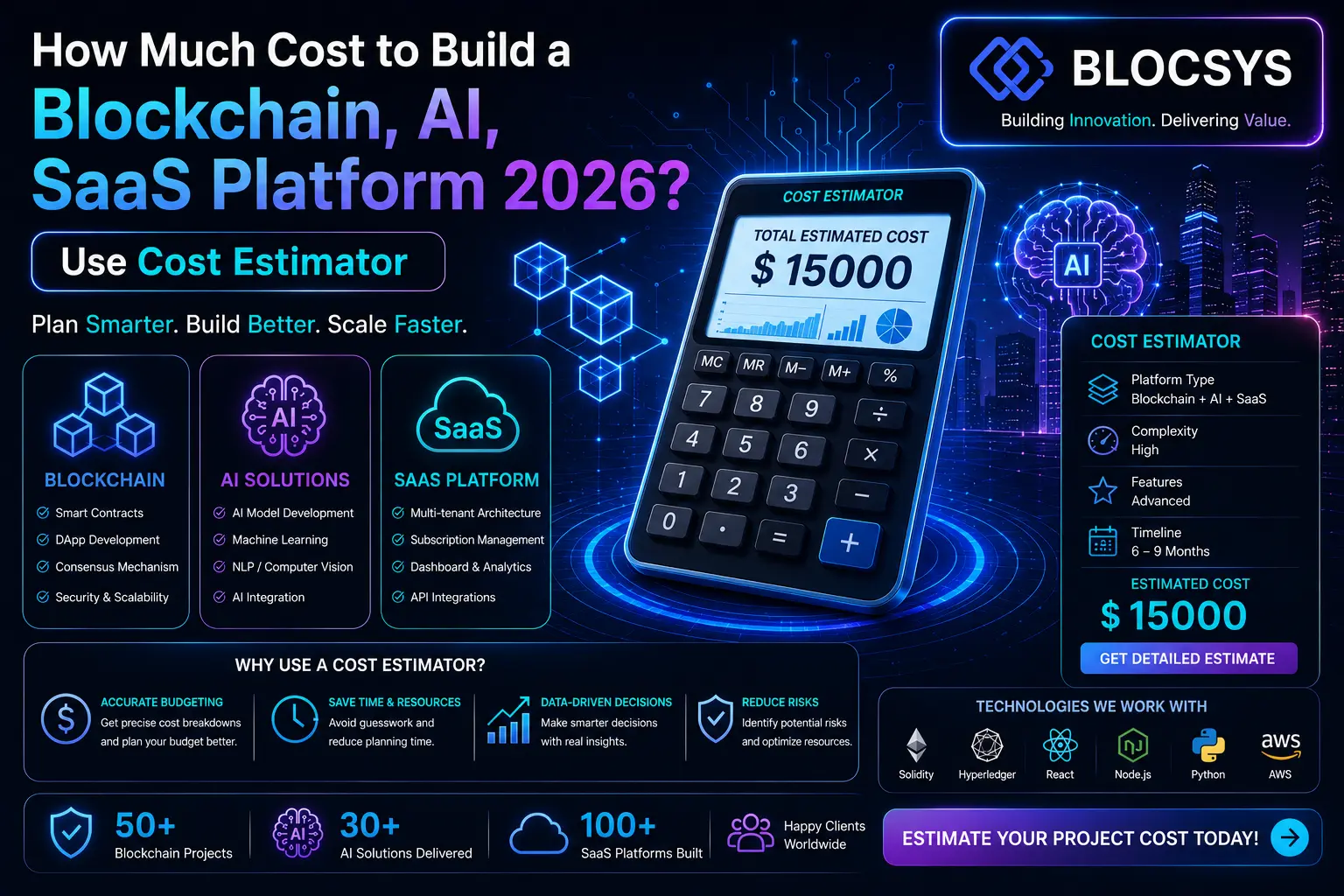
A platform build in 2026 can start at $50,000 for a simple MVP and run to over $2 million for a complex enterprise system. The exact cost depends on what you’re building: a SaaS product, an AI system, a blockchain platform, or a hybrid that combines all three.
That range catches many founders off guard because they’re often comparing unlike-for-like products. A multi-tenant SaaS dashboard, an AI workflow engine, and a blockchain settlement layer may all look like “one platform” in a pitch deck, but they carry very different engineering, security, and operating costs. The expensive mistakes usually happen early, when teams budget for the interface and underestimate the infrastructure, compliance, testing, model operations, and deployment work underneath it.
If you’re a startup founder, CTO, product owner, or investor trying to price a serious build, the right question isn’t “what does software cost?” It’s “what architecture are we committing to, and what must be production-ready on day one?” That’s where a software development cost estimator becomes useful. It forces decisions on scope, complexity, security, and timeline before the budget drifts.
A practical estimate also needs to think beyond build cost. Founders planning cloud-heavy products should look at operational levers early, especially around cutting AWS, Azure, GCP costs, because infrastructure choices made in week one can keep affecting margin long after launch. For teams that want a structured starting point, a software development cost estimator helps turn a broad idea into a staged budget model.
Table of Contents
- Planning Your 2026 Tech Budget An Introduction
- The Universal Factors Driving Software Development Costs
- How Much Does Blockchain Development Cost
- What is the Real Cost of AI Software Development
- Breaking Down SaaS Platform Development Costs
- Budgeting Scenarios MVP vs Enterprise and Hybrid Platforms
- From Estimation to Execution The Blocsys Advantage
- Frequently Asked Questions FAQ
- How much does it cost to build a blockchain platform in 2026
- What affects AI software development cost the most
- How much does SaaS development cost in 2026
- What is an instant software cost estimator
- How long does it take to build a blockchain, AI, or SaaS platform
- What hidden costs should founders expect
- Should a startup build a hybrid platform from day one
Planning Your 2026 Tech Budget An Introduction
Analysts regularly find that software projects miss their original budget because the product was defined too loosely at the start. I see the same pattern in early planning calls. Founders ask for an AI platform, a blockchain app, or a SaaS product, but the actual build is usually a mix of those models with one primary cost center and one or two expensive secondary layers.
That distinction sets the budget long before vendor selection or sprint planning. A SaaS platform is usually priced around product workflows, tenancy, billing, admin controls, and integrations. An AI platform shifts spending toward data engineering, model evaluation, inference costs, and monitoring. A blockchain product adds contract development, wallet flows, chain infrastructure, and security review. A hybrid platform combines those costs instead of averaging them down.
For 2026 planning, classify the platform before estimating it.
A practical way to do that is to decide which architecture drives the roadmap and which components are support layers:
- SaaS-first: the core value is workflow software, recurring subscriptions, user management, reporting, and integrations.
- AI-first: the core value depends on prediction, generation, ranking, recommendation, or automation driven by model behavior.
- Blockchain-first: the core value depends on on-chain execution, token logic, settlement, provenance, or shared trust.
- Hybrid: the product has a primary business model in one layer, then adds AI or blockchain where it changes economics, compliance, or product trust.
That last category matters more in 2026 than it did a few years ago. Many funded products are not pure-play AI, pure SaaS, or pure blockchain. They are AI-powered SaaS products with audit trails on-chain, or SaaS platforms using blockchain only for settlement, or blockchain products using AI for fraud detection and support automation. If you budget them as a single-category build, the estimate will be wrong in the first planning cycle.
The mistake is usually simple. Teams price the interface and forget the operating model behind it.
A better budget separates three questions. What must be custom-built. What can be rented through APIs or managed services. What introduces ongoing cost after launch. That is where founders get a more realistic view of trade-offs between speed, quality, and burn rate. For cloud-heavy products, this guide to cutting AWS, Azure, GCP costs is useful because infrastructure decisions made during architecture often become permanent budget problems later.
I recommend running the concept through a structured estimator before writing a detailed scope. A good software development cost estimator helps frame the build as a cost stack instead of a single number. That approach is more useful for hybrid platforms, where one expensive layer, such as model inference or smart contract audit work, can dominate the budget even if it represents a small part of the user experience.
By 2026, the founders who budget well will not be the ones chasing the cheapest quote. They will be the ones choosing the right product class early, then paying for the parts that carry technical and financial risk.
The Universal Factors Driving Software Development Costs
Budget overruns rarely start in engineering. They start in planning, when founders treat software as a feature list instead of an operating system for the business.
Across blockchain, AI, and SaaS projects, the same four cost drivers show up every time. Scope sets the surface area. Team composition affects execution quality and speed. Delivery pressure raises coordination cost. Quality requirements determine how much testing, security, and architecture work you need before launch. If you want an outside reference point on how hiring models and project complexity affect pricing, this software development cost guide is a useful comparison.
For teams that already have product direction and technical ownership in place, IT staff augmentation services can fill specific delivery gaps without forcing a full internal hiring cycle.
Scope decides the budget before code starts
Scope is still the biggest driver, but feature count alone is a poor way to measure it. Cost comes from system behavior, edge cases, integrations, and failure handling.
A simple example makes this clearer. User login is inexpensive. Role-based access across tenants, approval chains, audit logs, session controls, and compliance reporting is a different engineering problem. The same pattern shows up everywhere. A SaaS dashboard may look straightforward until it needs subscriptions, usage metering, exports, API access, and admin tooling. An AI workflow looks small until you add retrieval pipelines, feedback loops, model monitoring, and human review. A blockchain feature looks contained until wallet support, smart contract testing, indexing, and recovery flows enter the scope.
I usually break scope into four layers:
- Core product logic. The workflows that create value for the customer.
- Commercial systems. Pricing, billing, subscriptions, invoicing, usage limits.
- Operational systems. Admin panels, support controls, alerts, reporting, internal tools.
- Risk controls. Permissions, backups, monitoring, audit trails, security review, compliance evidence.
Early budgets often cover the first layer and underestimate the other three.
Total cost of ownership reveals the true investment
Build cost is only one part of the decision. The operating model after launch often separates an affordable MVP from a platform that strains cash flow.
That matters even more in 2026 because each architecture carries a different recurring cost pattern. SaaS products usually grow cloud, support, and maintenance spend as usage rises. AI products add inference, vector storage, model tuning, evaluation, and data operations. Blockchain products add node or RPC access, indexing, monitoring, key management, and periodic contract audits. Hybrid platforms stack these costs. An AI-powered SaaS product with on-chain settlement does not average the three categories. It combines the expensive parts of each.
A practical budget should account for:
- Maintenance and defect resolution
- Cloud hosting and scaling
- Monitoring, logging, and incident response
- Security testing and review
- Third-party API or infrastructure fees
- Compliance work where applicable
If those items are missing, the estimate covers delivery, not ownership.
Team, timeline, and quality change the economics
The same product can be built by a lean mid-level team, a senior cross-functional team, or a mixed model with specialists added at critical points. Those choices do not just change hourly rates. They change rework risk.
Senior engineers, QA leads, DevOps support, security reviewers, and data specialists cost more upfront. They often reduce expensive fixes later, especially in AI and blockchain builds where architecture mistakes are harder to unwind after launch. A cheaper team can still make sense for a narrow MVP, but only if the scope is tightly controlled and the technical constraints are well understood.
Time pressure also raises cost fast. To compress delivery, teams run more work in parallel, increase handoffs, accept more management overhead, and rely on experienced people who can make decisions quickly. Founders often ask for speed, quality, and low cost at the same time. In practice, two of those are usually achievable. The third moves.
Quality standards create the final gap between estimates that look similar on paper. An internal reporting tool, a customer-facing SaaS platform, a regulated AI workflow, and a blockchain product that handles real assets should not be budgeted with the same testing bar. Reliability, traceability, rollback planning, and security assurance add cost because they add work. They also prevent the kind of post-launch failures that are far more expensive than building carefully in the first place.
The lowest quote is rarely the cheapest path. The better decision is to spend carefully on the parts that are expensive to fix later.
How Much Does Blockchain Development Cost
Blockchain projects get expensive for a simple reason. You are not only building product features. You are defining how value moves, who controls it, what can be changed later, and what happens when something goes wrong.
Published 2026 market estimates put blockchain development anywhere from the low tens of thousands for a narrowly scoped token or contract project to well above seven figures for enterprise platforms, custom protocols, or multi-network systems. The spread is wide because the label “blockchain app” covers very different builds. A token launch, a wallet-connected SaaS product, a settlement engine, and a real-world asset platform do not share the same cost structure.
For founders comparing blockchain against AI and SaaS in one budget model, the main difference is where risk sits. In SaaS, cost usually grows with product scope and scale. In AI, it grows with data, model behavior, and ongoing operations. In blockchain, a large share of cost is front-loaded into contract design, security review, transaction handling, and operational controls because mistakes are harder and more expensive to reverse after release.
Teams planning chain-native products often evaluate custom blockchain development services when the platform needs smart contracts, wallet flows, protocol logic, and production infrastructure instead of a basic web app with a payment layer.
Where blockchain budgets actually go
Blockchain estimates become more accurate once the work is separated into layers.
| Cost area | What drives spend |
|---|---|
| Smart contracts | Business rules, token logic, permissions, upgrade design |
| Backend services | Indexing, transaction orchestration, user state, notifications |
| Wallet and signing flows | Connection logic, signature handling, retry paths, failed transaction UX |
| Security review | Contract testing, threat analysis, access control checks, external audit |
| Infrastructure and monitoring | RPC providers, node access, event processing, alerting, logs |
| Admin and compliance tooling | Operations dashboard, approvals, reporting, traceability |
The on-chain part often looks small in code volume. It still drives a disproportionate amount of budget because every contract decision carries security, legal, and operational consequences.
A simple example makes the trade-off clearer. An NFT mint site with standard contracts and basic wallet connection may stay relatively lean if the scope is controlled. A tokenization platform for real assets costs far more because it adds issuance rules, ownership records, compliance checks, investor flows, reporting, and support tooling. The smart contracts are only one part of the bill.
The cost multipliers founders miss
Three items tend to get underbudgeted.
Security work. Contract tests, adversarial review, dependency review, and external audits add real cost. They also reduce the chance of losses, emergency pauses, and post-launch rewrites.
Transaction operations. Gas estimation, failed transaction handling, signer management, indexing, reconciliation, and support workflows are rarely visible in early estimates. They matter once real users start interacting with the system.
Change management. Founders often want blockchain for trust and transparency, then discover that high-change product requirements conflict with immutability. If the business model is still shifting, putting too much logic on-chain too early usually increases cost.
That last point matters even more for hybrid builds in 2026. An AI-powered SaaS with blockchain components should not force every workflow on-chain. Put scarce, high-value actions on-chain, such as ownership, settlement, or proof. Keep fast-changing application logic, analytics, and AI orchestration off-chain unless there is a clear reason not to. That architecture usually gives a better balance of cost, speed, and maintainability.
What to budget first
A usable blockchain estimate starts with a deployment model and a risk model, not just features.
- Chain choice. Public mainnet, Layer 2, private chain, or multi-chain support each changes infrastructure, tooling, and user experience cost.
- Asset risk. If the product handles funds, tokenized assets, or transferable rights, testing and review requirements rise quickly.
- Upgrade approach. Upgradeable contracts add flexibility but also add design complexity and governance decisions.
- Integration surface. Oracles, custodians, KYC vendors, payment rails, and analytics tools expand both build scope and failure points.
- Operational ownership. Someone must monitor transactions, manage incidents, and support users when signatures fail or balances do not reconcile.
If funds, assets, or rights move on-chain, audit work is part of the build cost.
The practical budgeting rule is simple. Use blockchain only where decentralization, shared state, asset transfer, or verifiable ownership creates a real product advantage. Everything else should earn its place. That is how teams keep 2026 blockchain budgets aligned with business value instead of paying protocol-level costs for application-level problems.
What is the Real Cost of AI Software Development
AI budgets fail early for a simple reason. Founders often scope an AI feature, while the engineering team is pricing a full decision system that needs data pipelines, evaluation, controls, and ongoing operations.
For 2026 planning, custom AI software usually starts around the cost of a serious SaaS MVP and can climb into enterprise-platform territory once private data, workflow integration, compliance, and reliability targets enter the scope. In practice, an AI assistant that drafts text from public context sits in one cost band. A production system that retrieves internal knowledge, applies guardrails, logs decisions, enforces permissions, and supports audits sits in another.
Teams comparing options often look at AI and ML development services once they realize the spend is not just model access. The larger cost usually sits around the model, not inside it.
Where AI budgets actually go
The first line item is rarely the one that hurts. Data preparation, evaluation, and production controls are where budgets expand.
Common cost drivers include:
- Data work. Cleaning, labeling, normalizing, deduplicating, and structuring source data so the model can produce useful output.
- Model strategy. Choosing between third-party APIs, open-source models, fine-tuning, or a multi-model orchestration layer.
- Evaluation and testing. Measuring accuracy, hallucination rates, latency, consistency, and failure behavior against real business tasks.
- Application integration. Connecting AI output to product rules, user permissions, internal systems, search, billing, or case workflows.
- Operational tooling. Monitoring prompts, outputs, drift, cost per request, uptime, and fallback behavior after release.
This is why two vendors can quote very different numbers for what looks like the same AI product. One may be pricing a thin interface over a model API. Another may be pricing retrieval, context management, human review loops, observability, and security controls that make the feature usable in production.
API-first AI is cheaper to launch. Custom AI is sometimes cheaper to own.
That trade-off matters.
Using existing foundation model APIs cuts time to first release and lowers initial engineering cost. It is often the right move for summarization, drafting, support triage, internal search, and other supporting features where the model is useful but not the product moat.
Custom AI work starts to make sense when the system touches regulated workflows, proprietary data, pricing logic, fraud detection, or domain-specific decisions that need tighter control. In those cases, teams are paying for repeatability, traceability, and lower operational risk, not just better answers.
I usually advise founders to separate three budgets before approving any AI roadmap:
- Prototype budget for proving user demand.
- Production budget for integrations, testing, and governance.
- Operating budget for usage fees, retraining or tuning, monitoring, and support.
Skipping that separation creates predictable problems. The demo looks cheap. The rebuild does not.
AI cost depends on the role AI plays in the product
A support copilot inside a SaaS app has one cost structure. An AI-native platform has another. A hybrid product, such as an AI-powered SaaS platform that records critical events or rights on-chain, adds a third layer of budgeting because AI, application logic, and blockchain components scale differently.
Use this framing:
- AI as a feature. Lower upfront cost. Higher dependency on third-party model pricing and vendor limits.
- AI as a workflow engine. Mid-range build cost. More spending on retrieval, orchestration, evaluation, and human review.
- AI as the core product. Highest build and operating complexity. Budget for data advantage, model governance, and sustained MLOps from day one.
- AI inside a blockchain or asset system. Add costs for policy checks, auditability, event traceability, and tighter failure handling across both systems.
That last category matters more in 2026 than it did a year ago. Founders are no longer building isolated AI demos. They are combining AI with SaaS workflows, payment systems, identity layers, and in some cases blockchain-based ownership or verification. The budget model has to reflect the full stack.
For teams budgeting for your AI agent, the useful question is not just how much the first version costs. The better question is how much it costs to run safely, improve monthly, and integrate into the business without creating a support and compliance burden.
Breaking Down SaaS Platform Development Costs
SaaS companies spend a large share of their engineering budget on infrastructure that users barely notice. Billing edge cases, tenant isolation, audit logs, role permissions, and integration failures rarely appear in a demo, but they often decide whether the product can sell, renew, and scale in 2026.
Custom SaaS budgets usually fall into a wide range because the visible app is only one layer of the system. A founder may price the UI, dashboard, and core workflow correctly, then miss the cost of tenant management, admin tooling, subscription logic, support operations, and deployment discipline. That is why SaaS can look cheaper than blockchain or AI at first and still become expensive once the product needs to run like a business, not a prototype.
For teams making early hosting and scaling decisions, cloud architecture and infrastructure planning support can prevent costly rework later. The biggest SaaS margin problems often start with the wrong tenancy model, an inefficient database layout, or avoidable cloud complexity.
What separates SaaS from a normal web app
A normal web app can survive with a single account model and a narrow workflow. SaaS usually cannot. Once multiple customers share the same platform, the build changes from product delivery to system design.
Cost rises fastest in these areas:
- Multi-tenancy. Shared infrastructure with strict customer data separation.
- Identity and access control. Roles, teams, approval paths, SSO, and audit trails.
- Billing and revenue operations. Plans, trials, renewals, metering, invoices, taxes, and failed payment handling.
- Integrations. CRM, ERP, analytics, support tools, payments, messaging, and data sync.
- Operations and support tooling. Monitoring, incident response, admin panels, rollback paths, and customer-level diagnostics.
Each one adds build time. Together, they determine whether the product is sellable.
I see founders underestimate internal tools more than customer features. Support teams need account controls. Finance needs billing visibility. Customer success needs usage history and entitlement checks. Engineering needs logs that isolate one tenant without exposing another. If those tools are postponed, the team pays for it in manual work, slow support, and expensive rewrites.
Why SaaS budgets drift
SaaS budgets usually drift for one reason. The first estimate covers the product workflow, but not the commercial operating model.
A founder starts with “users can sign up, create records, and invite teammates.” Then enterprise buyers ask for approval chains, usage-based billing, SSO, regional data controls, sandbox environments, and export history. None of those requests are unusual. They are standard buying criteria once the product moves past early adopters.
The practical trade-off is straightforward. A narrower first release ships faster and costs less, but only if the underlying account, permission, and data model can support version two. Cutting those foundations to save money is rarely a real savings. It often turns the MVP into disposable code.
This matters even more for hybrid products. An AI-powered SaaS platform inherits SaaS operating costs plus model usage, evaluation, and guardrails. A SaaS platform with blockchain components adds auditability, event reconciliation, wallet or asset logic, and stricter failure handling between systems. The 2026 budget question is no longer “what does SaaS cost?” It is “which parts of this product behave like SaaS, which parts behave like AI, and which parts behave like a trust or asset layer?”
A useful adjacent read is this guide on budgeting for your AI agent, especially for teams adding assistants, copilots, or automation to a SaaS roadmap.
The cleanest SaaS builds usually share three traits:
- They narrow the first release to one buyer problem and one revenue path.
- They define tenant structure, permissions, and admin controls before feature expansion.
- They budget QA, security, and DevOps as core delivery work, not post-build cleanup.
That approach does not make SaaS cheap. It makes the spend predictable, which is usually the bigger win.
Budgeting Scenarios MVP vs Enterprise and Hybrid Platforms
Projects that start with the wrong budget model usually miss in one of two directions. They either underfund the foundations and pay for rework later, or they overbuild version one and burn capital before the product finds demand.
A better approach is to budget three versions of the same product. First, the cheapest credible MVP. Second, the production system you can sell with confidence. Third, the hybrid version that includes the AI or blockchain components the roadmap is likely to demand by 2026.
That framing matters because SaaS, AI, and blockchain do not scale cost in the same way. SaaS cost rises with product surface area, integrations, permissions, and support tooling. AI cost rises with data quality, evaluation, inference usage, and monitoring. Blockchain cost rises with smart contract design, audit scope, transaction architecture, and failure handling across on-chain and off-chain systems. A hybrid platform carries all three cost models at once.
A simple way to stack budgets
Start with the system that users live in every day. In many products, that is the SaaS layer: accounts, roles, billing, workflows, reporting, and admin controls. Then price the blockchain layer only where trust, settlement, asset logic, or tamper-resistant records change the business case. Add AI where prediction, automation, search, generation, or decision support produces measurable value.
This is the practical stack:
- Platform base. Core application, data model, APIs, frontend, admin, billing, notifications.
- Chain layer. Smart contracts, wallet connection, indexing, transaction orchestration, audit work.
- AI layer. Data preparation, model integration or fine-tuning, prompt and workflow logic, evaluation, monitoring.
- Operations layer. QA, DevOps, security review, compliance controls, observability, support tooling.
Teams often miss the last layer. That is where many budget overruns start.
Industry cost guides from firms such as Cleveroad’s software development cost research use a similar estimating logic. They break cost by team composition, delivery phase, and complexity rather than treating software as one flat number. That method is more useful for 2026 planning because founders are increasingly funding mixed architectures, not single-stack products.
Estimated Development Costs 2026 MVP vs Enterprise-Grade Platforms
| Platform Type | MVP Cost Range (USD) | Enterprise Cost Range (USD) | Key Cost Drivers |
|---|---|---|---|
| SaaS platform | $50,000 to $300,000 | $200,000 to $500,000+ | Multi-tenancy, billing, integrations, security, admin controls |
| Blockchain platform | $50,000+ | $150,000 to $800,000+ | Smart contracts, audits, infrastructure, wallet flows, compliance |
| AI platform | $50,000 to $150,000 | $500,000 to over $2 million | Data engineering, model complexity, evaluation, MLOps, security |
| Hybrid SaaS + blockchain + AI | Case-specific | Case-specific | Combined stack complexity, cross-team coordination, security, operations |
The hybrid row stays case-specific for a reason. A SaaS product with a single AI assistant and basic blockchain audit logging is one budget. A platform with custom models, smart contract settlement, regulated workflows, and high-availability operations is a different class of build.
MVP, enterprise, and hybrid in real budgeting terms
An MVP should prove one commercial assumption with the minimum architecture that can survive iteration. That usually means one user type, one primary workflow, limited integrations, and only the controls needed to operate safely. If the first release needs heavy AI training pipelines, complex token economics, or multi-region compliance from day one, it is usually not an MVP. It is an enterprise program wearing MVP language.
Enterprise budgeting shifts the focus. Buyers expect uptime targets, audit trails, role separation, support processes, and integration reliability. In fintech, health, and infrastructure products, those requirements shape cost before feature count does. The build is not just larger. It demands different engineering discipline.
Hybrid products need an extra filter. Each added layer should answer a budget question clearly.
- Why is blockchain here? Settlement, provenance, tokenisation, shared trust, immutable records.
- Why is AI here? Faster decisions, lower manual workload, better recommendations, better detection.
- Why is SaaS still the base? User management, reporting, workflow control, subscriptions, operational visibility.
If the team cannot answer those three questions in plain business terms, the budget will drift.
What usually works, and what usually breaks
The healthy pattern is boring in the right way. The SaaS shell owns users and workflows. AI handles tasks that improve outcomes or reduce labor. Blockchain handles records, settlement, or asset movement where central databases are not enough.
The failure pattern is also predictable. Teams spread core business logic across too many layers, build custom infrastructure before demand is proven, and postpone testing of cross-system failure cases. Then costs rise at the exact point investors and customers expect stability.
A practical example is an AI-enabled fintech SaaS with blockchain-backed transaction logging. The product can launch first with SaaS workflows and reporting. Next, add AI for anomaly detection or risk review where the model output changes operations. Add blockchain only for the transactions or records that need verifiable integrity. That order keeps budget tied to business value instead of technical ambition.
For founders planning 2026 budgets, the useful comparison is not blockchain versus AI versus SaaS as separate choices. It is how much of the product should behave like each one, and when each layer starts paying for itself.
From Estimation to Execution The Blocsys Advantage
A large share of software overruns starts after estimation, not during it. Teams approve a plausible budget, then lose control in delivery because scope, architecture, and operational requirements were never tied together in one execution plan.
That gap matters more in 2026 because founders are not just pricing a SaaS app or a blockchain product in isolation. Many are funding mixed architectures. An AI layer inside a SaaS workflow. A blockchain settlement or audit layer behind an AI-enabled platform. Cost control depends on deciding what each layer is responsible for before engineering starts.
Blocsys Technologies works on production-ready blockchain and AI-powered platforms for fintechs, exchanges, and digital asset businesses. The practical value is not a headline estimate. It is turning business requirements into a build sequence, team plan, and operating model that fit the budget you can carry.
The execution standard should be clear:
- Architecture discipline keeps the product modular, so the SaaS core, AI services, and blockchain components do not create avoidable rework.
- Security and compliance planning put audits, access controls, logging, and recovery requirements into the budget early, where they belong.
- Delivery phasing gives founders a way to release revenue-bearing features first instead of funding every integration upfront.
- Operational planning covers the costs that appear after launch, including model monitoring, cloud usage, node management, support load, and incident response.
This is usually where strong estimates separate from weak ones. A weak estimate counts screens and feature requests. A strong estimate maps system responsibilities, failure points, dependencies, and the handoffs between product, engineering, security, and operations.
That distinction matters most for hybrid platforms. A founder building exchange infrastructure, tokenisation workflows, prediction markets, or Telegram-based product experiences should not budget by feature count alone. Budget by what the system must do, what risk it carries if it fails, and what has to scale first. That is how a promising concept becomes a platform that can ship, hold up in production, and justify the next round of investment.
Frequently Asked Questions FAQ
How much does it cost to build a blockchain platform in 2026
Blockchain budgets vary widely because “blockchain platform” can mean very different things. A token launch, a smart contract product, a wallet-based application, and a custom chain all sit in different cost brackets.
For founders, the main cost split is simple. Smart contracts are only one part of the spend. The bigger jumps usually come from wallet flows, chain indexing, admin tooling, security reviews, compliance requirements, and the operational setup needed to keep the system reliable after launch.
What affects AI software development cost the most
Data work usually drives more cost than the model itself. Teams often underestimate ingestion, labeling, cleaning, evaluation, guardrails, and the work required to connect AI output to real business workflows.
Model choice also matters. Using an external model API changes the budget profile compared with fine-tuning or training custom models, and regulated use cases add review, logging, and human oversight requirements. In practice, deployment and ongoing monitoring often shape the budget more than the first prototype.
How much does SaaS development cost in 2026
SaaS cost depends less on screen count and more on platform behavior. A simple application may look similar to a SaaS product on the surface, but multi-tenancy, role-based access, billing, subscriptions, audit logs, integrations, and support tooling change the engineering effort quickly.
That is why early estimates for SaaS can be misleading. Founders are often budgeting for an app, while the business model requires a platform.
What is an instant software cost estimator
It is a first-pass planning tool, not a final quote. A useful estimator should capture product type, feature complexity, integrations, security requirements, delivery scope, and whether the build includes blockchain, AI, SaaS, or a hybrid of all three.
If the tool only asks for page count or a loose feature list, it will miss the cost drivers that matter most in 2026 builds.
How long does it take to build a blockchain, AI, or SaaS platform
Timelines follow architecture complexity. A focused MVP can move in months. A production-grade platform with compliance controls, integrations, analytics, admin workflows, and operational hardening takes much longer.
Hybrid platforms take the most planning. An AI-powered SaaS product on blockchain infrastructure is not just one product category with extra features. It is three cost structures interacting at once, each with its own testing, release, and support burden.
What hidden costs should founders expect
Post-launch costs catch many first-time founders off guard. Infrastructure, maintenance, support, monitoring, security testing, third-party APIs, model usage fees, node or RPC services, indexing, and incident response all continue after the initial build.
The recurring spend can change the investment case more than the launch budget does. That matters most for AI and blockchain products, where usage volume, model calls, or chain activity can raise operating costs faster than expected.
Should a startup build a hybrid platform from day one
Usually only when each layer directly supports revenue, trust, or defensibility. If AI, blockchain, and SaaS are all included from the start without a clear business reason, the team takes on more complexity than the product needs.
A better path is often phased delivery. Start with the SaaS core, add AI where it improves outcomes or reduces manual work, and add blockchain only where transparency, ownership, settlement, or tokenized incentives are part of the model.
If you’re budgeting a blockchain, AI, or SaaS product and want a clearer path from idea to delivery, Blocsys Technologies can help with estimation, architecture planning, and production-focused engineering. Start with the software development cost estimator or connect with the team if you’re evaluating tokenisation systems, trading infrastructure, AI workflows, or a hybrid platform build.
