
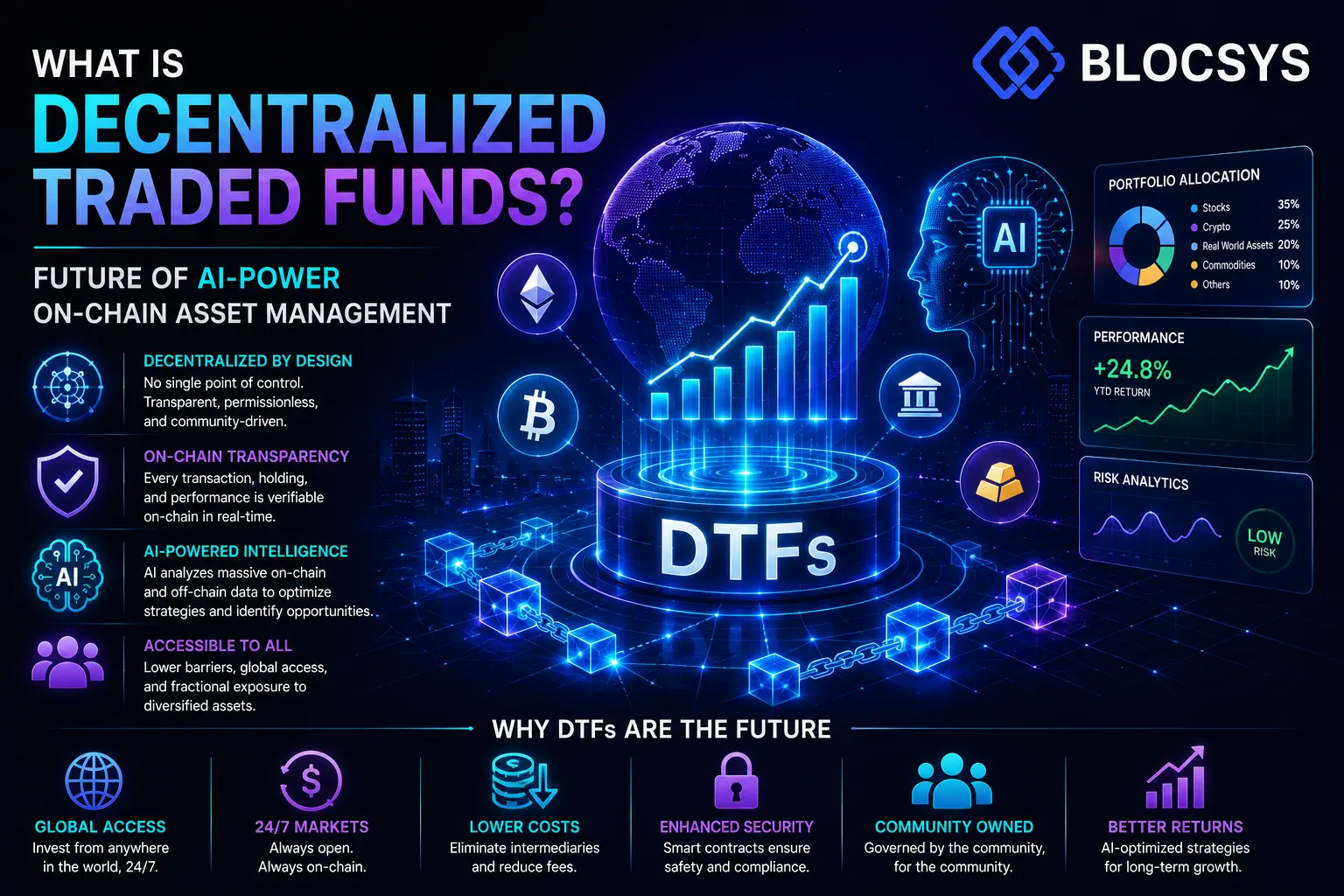
A decentralized traded fund (DTF) is a tokenized, on-chain fund wrapper that mirrors ETF-style exposure through smart contracts, with minting, redemption, and portfolio logic running 24/7 on-chain. The model matters more now because on-chain perpetual futures market share rose from 6.42% to 24.3% in 2025, and DEX spot volumes now consistently exceed 10% of CEX volumes.
That shift changes the conversation around digital asset products. DTFs are no longer just an experimental DeFi packaging idea. They sit at the intersection of tokenization, automated execution, and programmable finance, which makes them increasingly relevant to fintech founders, digital asset platforms, and institutional teams evaluating how on-chain investment infrastructure should function in production.
For builders asking what Decentralized Traded Funds are and where AI-powered on-chain asset management is going, the important answer isn’t only about automation. It’s about operating model. Once portfolio rules, minting logic, custody pathways, and rebalancing policies move into smart contracts, asset management starts behaving more like software. Add AI to that stack and the opportunity expands, but so do governance questions around control, liability, overrides, and auditability.
The strategic issue isn’t whether AI can trade. It can. The harder question is whether an enterprise can govern an AI-managed fund structure with enough transparency and operational discipline to treat it as infrastructure rather than as a risky demo. For many firms, that’s the key threshold.
Table of Contents
- The Dawn of AI-Driven On-Chain Finance
- Comparing Decentralized Traded Funds and Traditional ETFs
- How Smart Contracts Automate On-Chain Portfolio Management
- The Strategic Role of AI in Decentralized Asset Management
- Institutional and Fintech Use Cases for AI-Powered DTFs
- Architecting an Enterprise-Grade DTF Platform
- How Blocsys Builds Future-Ready DTF and AI Infrastructure
- Frequently Asked Questions about DTFs and AI Asset Management
- What are Decentralized Traded Funds
- How do DTFs work on blockchain
- How are DTFs different from ETFs
- What is AI-powered on-chain asset management
- What are the main risks in AI-managed DTFs
- Why are fintech companies interested in DTF infrastructure
- Can institutions use DTFs without giving up governance
- How can Blocsys help build a DTF platform
The Dawn of AI-Driven On-Chain Finance
On-chain markets are attracting more serious capital, and that changes what fund infrastructure needs to look like. VanEck notes that on-chain perpetual futures market share tripled from 6.42% to 24.3% in 2025, while DEX spot volumes now consistently exceed 10% of CEX volumes in its review of the on-chain trading market from niche to infrastructure. That isn’t just a trading story. It’s a signal that execution, liquidity, and portfolio management are moving into environments where automation is native.
A decentralized traded fund is best understood as a tokenized, on-chain fund wrapper that gives investors ETF-style exposure through smart contracts rather than a central transfer agent. That distinction matters because the fund’s core actions, such as minting, redemption, and portfolio logic, can run continuously on-chain instead of waiting for layers of market infrastructure to open, reconcile, and settle.
Why this matters now
Traditional fund plumbing was designed for intermediated markets. DTF infrastructure is designed for programmable ones. For founders and investment operators, that means the fund itself can become a software-controlled system with transparent rules, observable balances, and direct integration into DeFi rails.
Two forces are converging here:
- Tokenized wrappers are maturing: Builders now treat fund exposure as something that can be encoded, audited, and distributed through wallets and APIs.
- AI is moving closer to execution: Teams experimenting with intelligent strategy engines are no longer stopping at dashboards. They’re pushing decision support into rebalancing and routing logic.
Practical rule: If your product thesis depends on AI-managed on-chain assets, governance matters as much as model quality.
For readers evaluating the AI layer specifically, this guide to AI in trading is useful because it frames how automated decision systems are typically assessed in live markets, even though DTFs introduce additional smart contract and custody complexity. The broader architectural question also connects with how firms are approaching AI and blockchain integration across production financial systems.
Comparing Decentralized Traded Funds and Traditional ETFs
The cleanest way to understand a DTF is to compare it with the instrument it most closely resembles. Both package diversified exposure into a tradable wrapper. The difference is where the operating logic lives and who controls the mechanics.
ETF logic versus DTF logic
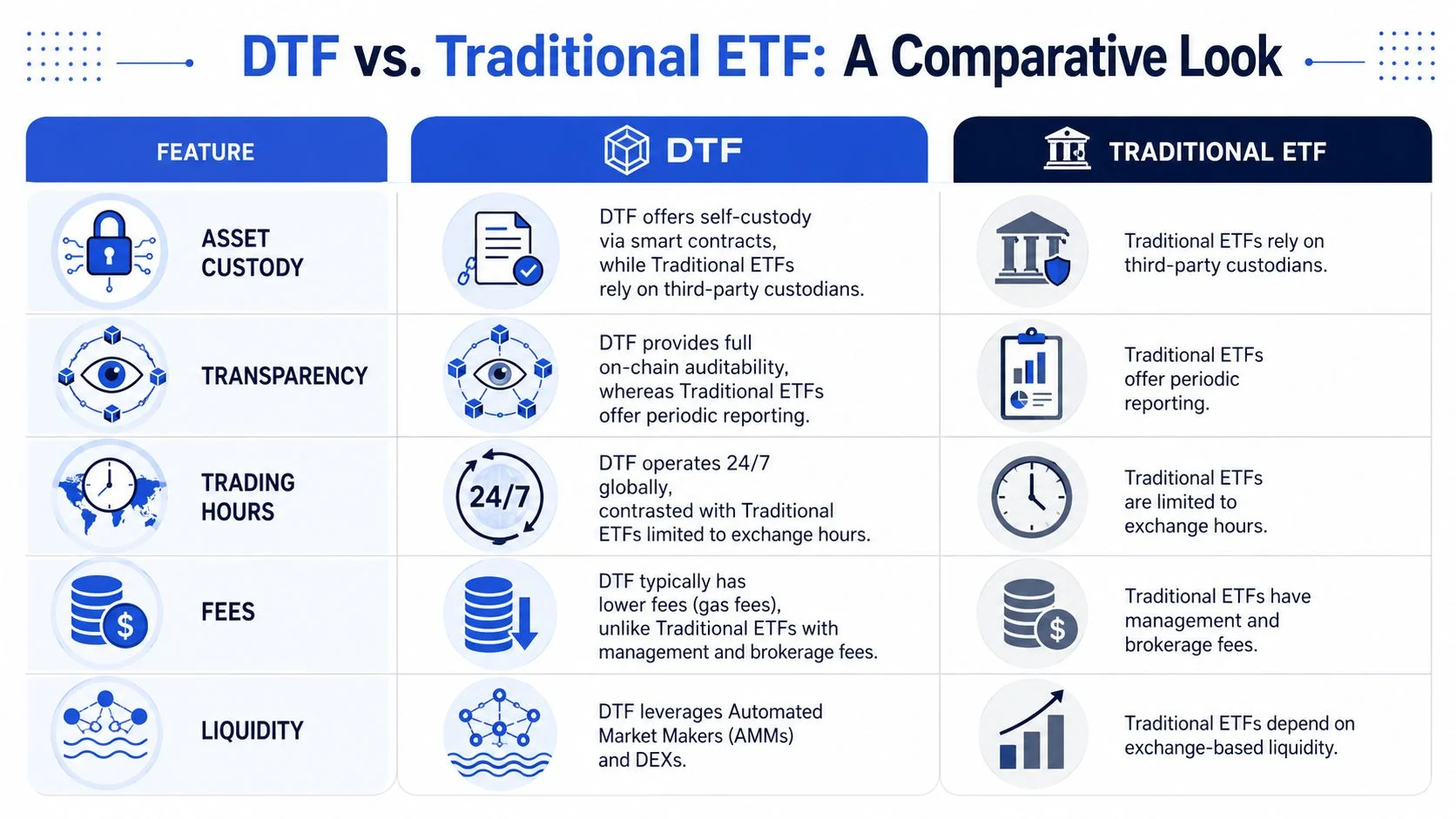
According to the BIS work on DeFi intermediation, a DTF is a tokenized, on-chain fund wrapper that mirrors ETF-style exposure through smart contracts instead of a centralized transfer agent. Its advantage is operational. Minting, redemption, and portfolio logic can execute 24/7 on-chain, while the underlying basket remains transparently verifiable and programmable.
That one design choice leads to several consequences:
- Custody changes: ETFs typically rely on traditional custodians and transfer systems. DTFs are structured around smart-contract-based control and on-chain settlement.
- Transparency changes: ETF reporting is periodic. DTF logic and holdings can be made continuously auditable on-chain.
- Settlement changes: ETF processes depend on market hours and intermediary workflows. DTF settlement is bounded by blockchain finality.
- Composability changes: ETFs don’t naturally plug into lending protocols, AMMs, or automated on-chain treasury logic. DTFs can.
The strongest DTF use case isn’t that it’s “like an ETF on blockchain”. It’s that the fund wrapper becomes programmable infrastructure.
ETF vs DTF A Structural Comparison
| Feature | Traditional ETF | Decentralized Traded Fund (DTF) |
|---|---|---|
| Fund wrapper | Exchange-traded product administered through traditional market infrastructure | Tokenized, on-chain wrapper administered by smart contracts |
| Transfer and settlement | Relies on centralized transfer and settlement layers | Executes on-chain, with timing bounded by blockchain finality |
| Operating hours | Tied to venue hours and intermediary processes | Designed for 24/7 on-chain execution |
| Portfolio visibility | Periodic disclosures and reporting cycles | Underlying basket can be transparently verifiable on-chain |
| Programmability | Limited native automation | Minting, redemption, and portfolio rules can be encoded |
| Integration model | Separate from DeFi protocols | Can connect to DEX liquidity, lending, and automated rebalancing |
| Intermediary dependence | Higher operational reliance on off-chain middle layers | Lower dependence when reconstitution and redemption rules are contract-based |
For institutional readers, the comparison isn’t ideology. It’s control surface. ETFs are familiar, but their operating model remains institution-heavy. DTFs reduce some of that dependence by pushing core functions into software, which can improve responsiveness and transparency if the contracts, oracle design, and governance model are strong enough.
How Smart Contracts Automate On-Chain Portfolio Management
A DTF works when the fund’s rules are expressed as code and enforced by the chain. That means the smart contract isn’t just a settlement utility. It becomes the operational core of the product.
The contract becomes the fund operator
The BIS describes a DTF as a tokenized on-chain fund wrapper where minting, redemption, and portfolio logic run through smart contracts, and where the structure inherits DeFi properties such as non-custodial settlement, composability, and smart-contract-based execution. In practice, that means the contract can hold the rules for who may mint, how units are priced, when rebalancing happens, and what assets qualify for the basket.
A production system usually includes several components working together:
- Core fund contracts: These govern deposits, issuance, redemptions, and treasury logic.
- Execution contracts or modules: These route trades into DEXs or other approved venues.
- Oracle inputs: These provide reference data needed to evaluate allocation rules or trigger actions.
- Permission and control layers: These define who can pause, upgrade, or override under exceptional conditions.
For teams designing this stack, the mechanics behind creating crypto investment fund smart contracts become central, because fund logic isn’t a generic DeFi template. It has to encode policy, not just execution.
A practical DTF transaction flow
A simple lifecycle looks like this:
Deposit and mint
An investor contributes approved digital assets into the DTF contract. The contract validates the deposit and mints fund tokens according to the fund’s pricing and issuance rules.Portfolio deployment
The strategy logic allocates capital into the target basket. That can include direct asset acquisition, liquidity routing, or integration with approved on-chain venues.Monitoring and rebalancing
The contract continuously evaluates whether the portfolio remains inside policy boundaries. Depending on design, those checks can be fully automated or require a human sign-off before execution.Redemption
When an investor exits, the contract burns the DTF token and returns value according to the redemption policy encoded on-chain.
If the basket reconstitution and redemption rules are encoded in contracts, settlement latency depends more on chain finality than on market venue operating hours.
That shift is why DTFs are better thought of as software-defined investment wrappers rather than merely crypto-native ETFs.
The Strategic Role of AI in Decentralized Asset Management
Smart contracts automate fixed rules. AI introduces adaptive decisioning. That distinction is important because many products marketed as AI-powered are still just deterministic automation with a more modern interface.
Where AI adds value beyond static automation
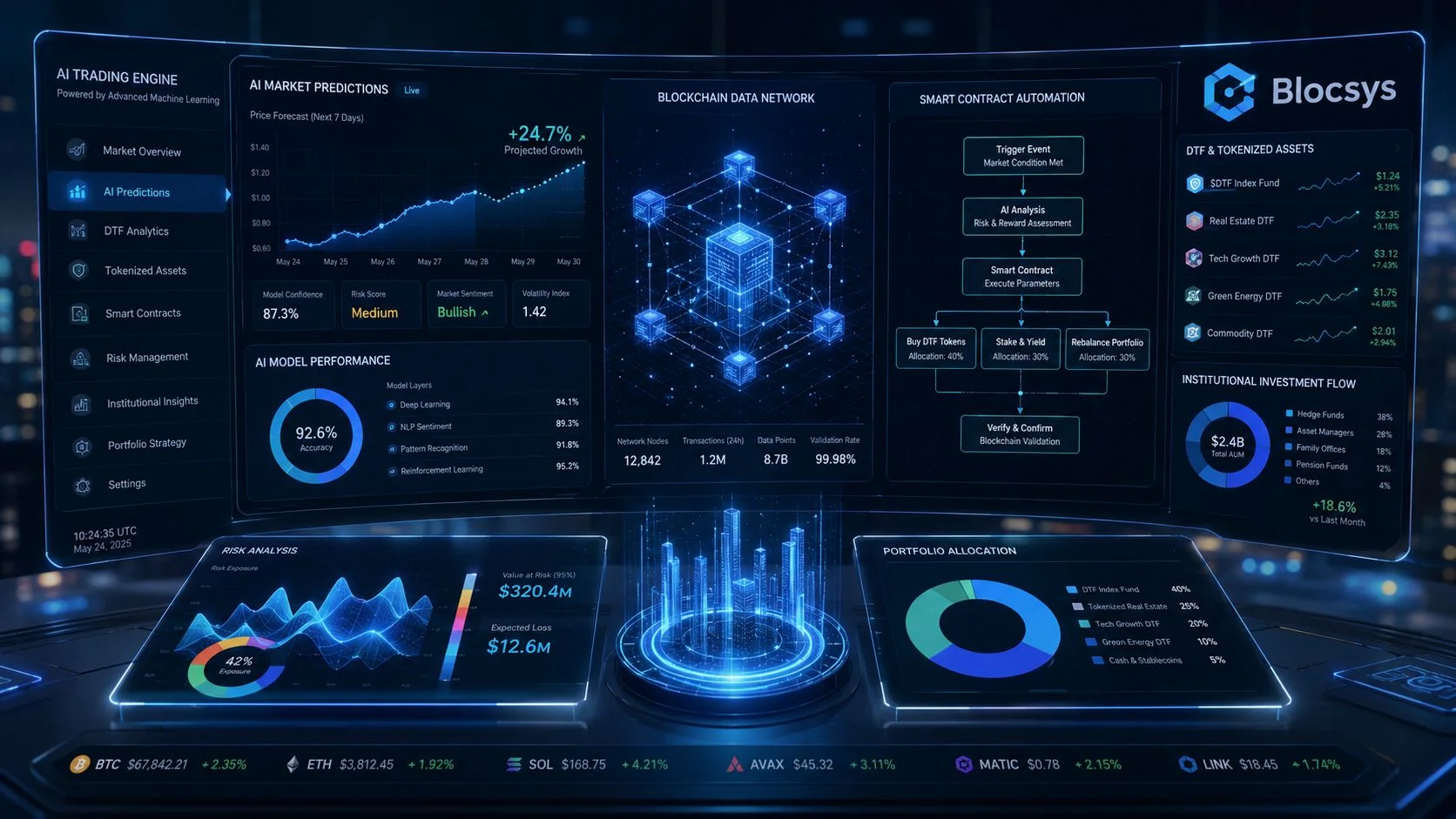
Inside a DTF environment, AI can support several functions that fixed rule sets struggle to handle well:
- Signal interpretation: Models can process large volumes of on-chain and market data to identify changing conditions that may justify a portfolio adjustment.
- Risk response: Instead of waiting for a hard threshold, an AI layer can classify market regimes and recommend defensive or opportunistic reweighting.
- Execution routing: A strategy engine can compare venue conditions and choose the least disruptive path for order placement across approved liquidity sources.
Used well, AI doesn’t replace policy. It operates inside policy. That’s why mature teams define model scope clearly: what the system may decide, what it may recommend, and what still requires a human approval path.
For product teams exploring practical AI-driven DeFi use cases in asset management, the strongest designs separate strategy intelligence from control authority. The AI engine proposes or executes within bounded parameters. Governance modules enforce the perimeter.
A short primer on how market-facing AI systems are framed in practice is helpful here:
Liability becomes the decisive design question
VanEck’s market review points to a deeper issue than adoption. It notes that on-chain perpetual futures market share moved from 6.42% to 24.3% in 2025, while DEX spot volumes now consistently exceed 10% of CEX volumes, which means more capital is entering automated execution environments. The same analysis highlights the key enterprise question: who bears liability when an AI agent manages a DTF, the manager, the protocol, or the agent developer?
That is the operational question most market commentary skips.
A credible AI-managed DTF needs governance features such as:
- Human override rights: authorised operators need the ability to pause or reject actions.
- Kill-switch controls: emergency controls should exist for contract faults, market anomalies, or oracle failures.
- Audit logs: teams need a durable record of what the model recommended, what executed, and who approved any exceptions.
- Role separation: the legal manager, technical operator, and model developer shouldn’t blur into one unaccountable entity.
Autonomous rebalancing is the easy part. Assigning responsibility when it fails is the hard part.
For enterprises, that governance layer often determines whether AI-powered on-chain asset management is investable at all.
Institutional and Fintech Use Cases for AI-Powered DTFs
The commercial value of DTFs becomes clearer when you stop describing them as abstract DeFi primitives and start viewing them as configurable financial products.
Where institutions see practical fit
An institutional asset manager could use a DTF structure to package exposure to a defined on-chain basket with transparent mint and redemption logic. The attraction isn’t only distribution. It’s operational clarity. Treasury, legal, and risk teams can inspect how the vehicle is meant to behave, including rebalancing conditions, approved venues, and emergency controls.
A few realistic use cases stand out:
- Tokenized strategy wrappers: A manager can package a rules-based digital asset strategy into an on-chain wrapper that investors can verify directly.
- Treasury operations: A corporate treasury team could use a tightly governed DTF format to manage a ring-fenced digital asset allocation under explicit policy constraints.
- DeFi access layers: Institutions interested in DeFi exposure can use DTF architecture to avoid bespoke wallet-by-wallet operations and move instead toward a productised wrapper.
Where fintechs can build products faster
Fintech companies can treat DTF infrastructure as a reusable product layer. Instead of building a separate portfolio engine, trading layer, issuance workflow, and investor dashboard for every new strategy, they can launch multiple products on top of a common on-chain wrapper model.
Examples include:
- Thematic investment apps: A fintech could offer baskets tied to sectors, ecosystems, or tokenization themes without relying on manual portfolio administration.
- Robo-advisory rails for digital assets: An AI-assisted allocation engine can feed recommendations into a DTF wrapper while the contracts handle issuance and redemption.
- Embedded investment infrastructure: Exchanges, wallets, and consumer investment platforms can expose curated baskets as tokenized products.
Teams evaluating enterprise automation patterns outside pure crypto may also find Donely for enterprises useful as a reference point for how organisations think about governed AI workflows, even though asset management requires a much stricter execution and accountability model.
The strategic takeaway is simple. DTFs don’t just create a new investment product. They create a reusable operating model for launching and governing tokenized funds.
Architecting an Enterprise-Grade DTF Platform
The difference between a demo and a production DTF platform is rarely strategy logic. It’s architecture. Most technical failures in on-chain financial products come from weak control design, poor key management, fragile oracle dependencies, or unclear responsibility boundaries.
The five layers that matter
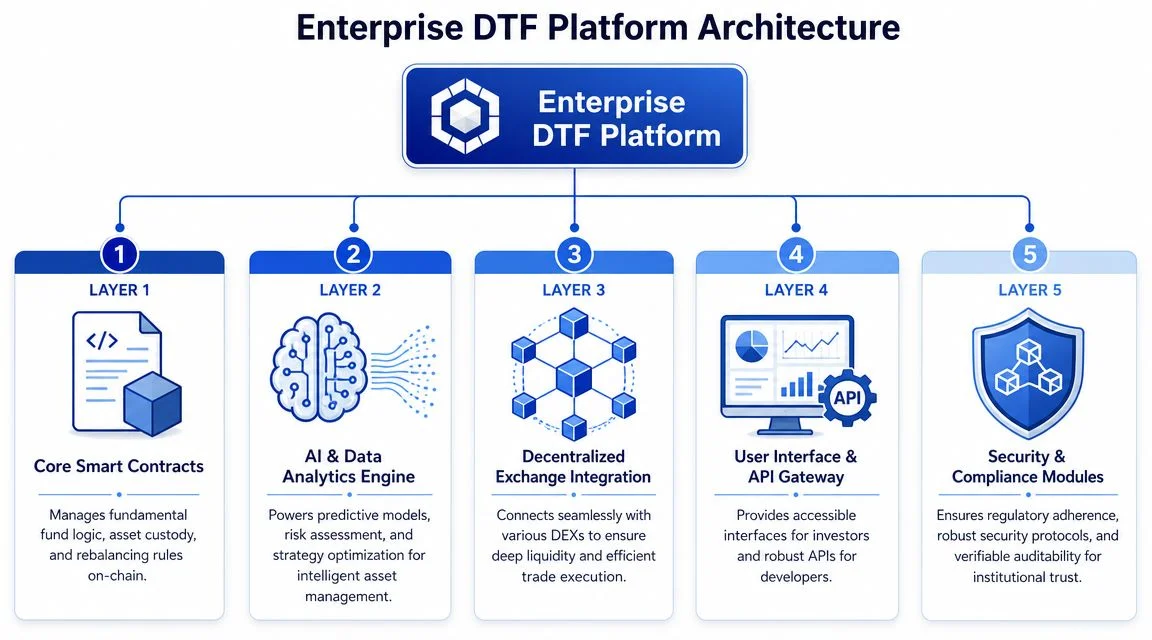
An enterprise DTF platform usually needs five layers working together:
| Layer | What it handles | Why it matters |
|---|---|---|
| Core smart contracts | Fund rules, custody logic, minting, redemption, rebalancing | This is where the product’s operating model lives |
| AI and analytics engine | Strategy signals, risk scoring, execution recommendations | Adds adaptive intelligence inside approved boundaries |
| DEX and venue integration | Trade execution and liquidity access | Connects portfolio logic to real markets |
| Interface and API layer | Dashboards, investor workflows, admin controls, integrations | Makes the system usable by operators and partners |
| Security and compliance modules | Permissions, monitoring, policy checks, auditability | Creates institutional trust and operational control |
Architectural discipline matters more when the product targets regulated or semi-regulated environments. Firms building enterprise blockchain solutions and implementation architectures already know this pattern: the hardest part isn’t putting contracts on-chain. It’s making sure the surrounding control plane is strong enough for real operations.
What founders often underestimate
Three areas tend to be underestimated:
- Governance design: Teams focus on strategy performance and leave override rights, admin boundaries, and failure handling until late.
- Operational security: A DTF is only as secure as its signer model, upgrade path, and monitoring discipline.
- Planning realism: Building investor-facing fund infrastructure means dealing with product logic, smart contracts, APIs, compliance workflows, and user operations at the same time. A software development cost estimator is useful early because under-scoping usually appears in integration and control layers, not just in frontend or contract work.
Production DTF architecture should assume something will fail. Good systems define who can act, how fast they can act, and what evidence remains after they act.
That mindset is what turns a tokenized fund concept into enterprise-grade financial infrastructure.
How Blocsys Builds Future-Ready DTF and AI Infrastructure
Firms building DTF products need engineering that spans smart contracts, execution systems, data pipelines, and operational controls. In practice, that means the build partner has to understand both DeFi mechanics and enterprise delivery discipline.
One option in this market is Blocsys’s DTF platform development, which focuses on tokenized fund systems, on-chain asset workflows, and AI-enabled financial infrastructure. The relevant capability set for this category includes smart contract architecture, admin control design, integration with trading and tokenization systems, and support for auditability across the stack.
That matters because AI-powered DTFs aren’t single-product builds. They are systems made of interdependent parts:
- Fund contracts that enforce portfolio and redemption logic
- Execution services that interact with approved on-chain venues
- Risk and AI modules that inform or trigger bounded actions
- Operator tools that support overrides, logs, and governance review
- Integration rails for wallets, investor interfaces, and institutional systems
For some teams, the right move is a full product build. For others, it may be narrower. They may need adjacent services such as crypto trading platform development or specialist capacity through hiring Web3 developers. The more important strategic point is that DTF infrastructure can’t be assembled as disconnected components. It needs to be designed as one governed operating environment.
If you’re evaluating what Decentralized Traded Funds are and what the future of AI-power on-chain asset management looks like, that’s the conclusion that matters most. The category will be shaped less by interface novelty and more by who can combine programmability, liquidity access, risk controls, and accountability into a system institutions can run.
Frequently Asked Questions about DTFs and AI Asset Management
What are Decentralized Traded Funds
Decentralized Traded Funds are tokenized, on-chain fund wrappers that mirror ETF-style exposure using smart contracts. Instead of relying on a centralized transfer agent, they encode minting, redemption, and portfolio rules directly into blockchain-based systems.
How do DTFs work on blockchain
A DTF uses smart contracts to accept deposits, issue fund tokens, manage portfolio rules, and process redemptions. The underlying basket and contract activity can be made transparently verifiable on-chain, which gives operators and investors a clearer operational record than traditional periodic reporting models.
How are DTFs different from ETFs
The core difference is infrastructure. ETFs run through traditional market intermediaries and venue-bound processes. DTFs run through programmable, on-chain logic and can integrate with decentralised exchanges, lending systems, and automated rebalancing tools.
What is AI-powered on-chain asset management
AI-powered on-chain asset management combines blockchain execution with machine-led decision support. The blockchain handles transparent execution and record-keeping. The AI layer can support signal analysis, rebalancing recommendations, trade routing, and risk response inside predefined policy limits.
What are the main risks in AI-managed DTFs
The biggest risks aren’t only model error. They include unclear liability, faulty smart contract interactions, weak override controls, poor oracle design, and insufficient audit trails. Enterprises need to know who is accountable if the agent trades badly or triggers an unwanted action.
Why are fintech companies interested in DTF infrastructure
Because DTFs offer a reusable product layer. Fintechs can launch tokenized baskets, thematic products, or automated portfolio offerings without rebuilding issuance, custody logic, and rebalancing systems from scratch for each strategy.
Can institutions use DTFs without giving up governance
Yes, if the platform is designed correctly. Institutions typically need role-based permissions, audit logs, emergency controls, custody clarity, and human-in-the-loop approval pathways before they’ll treat a DTF as a serious operating vehicle.
How can Blocsys help build a DTF platform
Blocsys works with fintechs, exchanges, and digital asset businesses building blockchain and AI-powered platforms. That can include tokenized fund architecture, smart contract automation, on-chain asset management workflows, and the surrounding infrastructure needed to support a production-ready DTF system.
If you’re exploring tokenized fund products, AI-powered DeFi workflows, or enterprise-grade on-chain asset management, Blocsys Technologies can help you scope the right architecture, define governance requirements, and move from concept to production with a practical build plan. Connect with Blocsys to discuss DTF platform design, smart contract automation, and secure AI-enabled blockchain infrastructure for your next product.
