
Building a Prediction Market Platform on Robinhood Blockchain: A Complete Guide
If you’re exploring how to launch a Prediction Market Platform in 2026, Robinhood’s blockchain infrastructure deserves a serious look. It’s fast, it’s built for real trading volume, and it gives founders a credible foundation for decentralized forecasting apps. In this guide, we’ll walk through what Robinhood Blockchain actually is, how prediction markets work on top of it, and what it takes to build one that enterprises can trust. Along the way, we’ll show why so many teams turn to a specialized Prediction Markets Platform Development partner instead of building blind.
What Is Robinhood Blockchain?
Robinhood Blockchain is the trading platform‘s own Layer-2 network, built on Arbitrum technology and designed to move tokenized assets and on-chain trades at speed. It launched to support Robinhood’s tokenized stock and crypto offerings across global markets, including its European expansion.
What makes it interesting for builders isn’t just the brand name. It’s the combination of low fees, fast finality, and a regulated entity backing the rails. That’s rare in Web3. Most chains chase speed or compliance, not both.
Robinhood’s move into its own Layer-2 network signals something bigger than a product launch. It tells us regulated finance is finally ready to build production-grade rails for tokenized markets, not just pilot them.
Understanding Prediction Markets and Decentralized Forecasting
Prediction markets let people trade on the outcome of future events. Will a stock hit a price target? Will an election go a certain way? Prices in these markets reflect real, aggregated belief, and that’s what makes them so useful for forecasting.
Traditional prediction markets ran through centralized operators. You trusted the house to settle fairly. A Decentralized Prediction Market removes that dependency. Smart contracts hold funds, oracles confirm outcomes, and no single party controls the result. Consequently, trust shifts from an institution to verifiable code.
This shift matters more than it sounds. Transparency builds participation, and participation builds liquidity.
How Robinhood Blockchain Powers a Modern Prediction Market Platform
Here’s why Robinhood Blockchain stands out for this use case. It already handles tokenized real-world assets, which means the infrastructure understands price feeds, settlement, and compliance logic from day one. Building a Prediction Market Platform on top of that isn’t starting from scratch.
Additionally, its Layer-2 architecture keeps gas costs low enough for high-frequency market activity. Prediction markets live and die on micro-trades. If every position costs a few dollars in fees, retail users walk away. Robinhood’s fee structure changes that math entirely.
Furthermore, the network’s ties to a regulated brokerage give enterprises something they rarely get in Web3: a credible compliance story from the start.
Current Market Trends and Enterprise Adoption
Prediction markets aren’t a niche experiment anymore. Trading volume across major platforms surged past several billion dollars in 2025, driven largely by political and sports events. Enterprises noticed.
Financial institutions now use prediction markets internally for risk sentiment. Insurance firms test them for catastrophe forecasting. Media companies license market data as a content product. Therefore, the appetite for a well-built Blockchain Prediction Market platform has moved well beyond crypto-native audiences.
What’s driving this? Simple answer: accuracy. Studies repeatedly show prediction markets outperform polls and expert panels for near-term event forecasting.
Core Architecture of a Prediction Market Platform
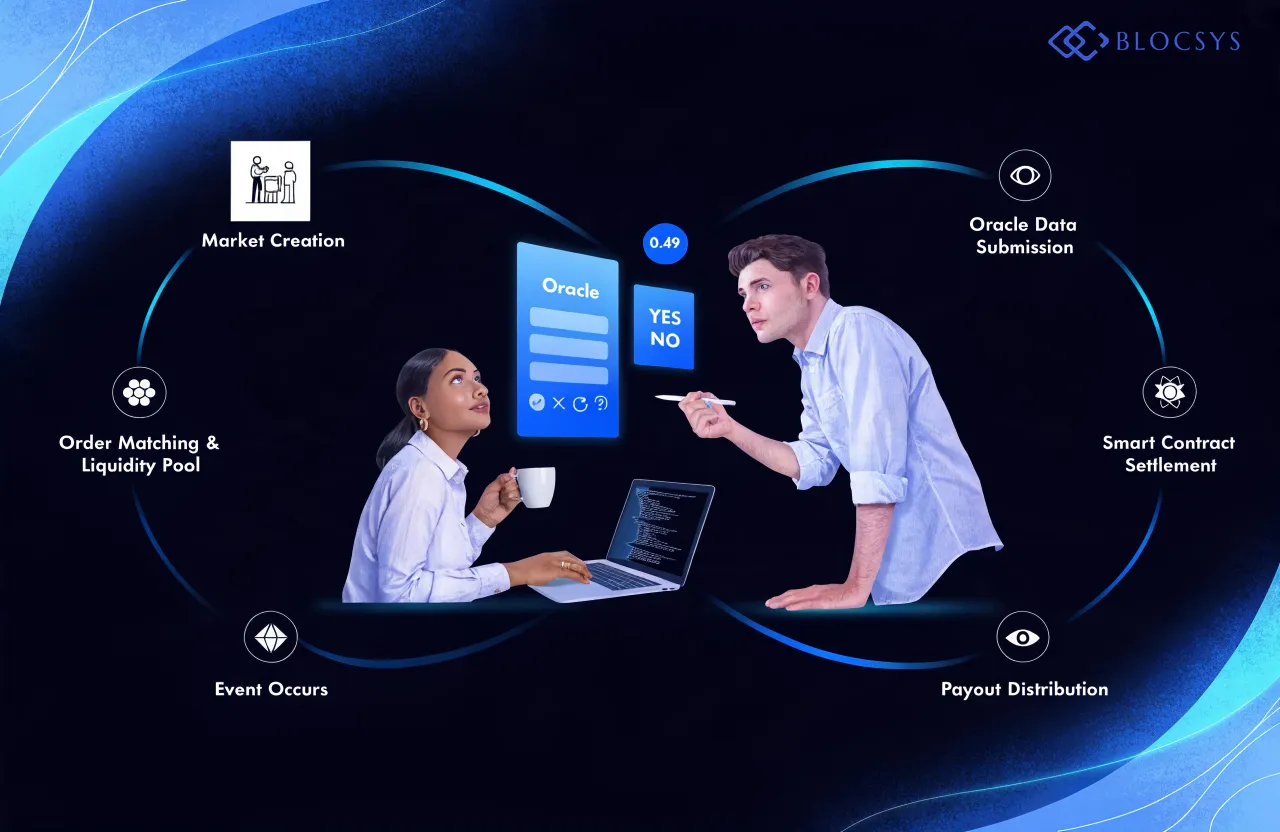
Every solid Prediction Market Platform shares a common backbone. You’ve got market creation logic, an order book or automated market maker, oracle integration, a settlement engine, and a governance layer. Miss one piece, and the whole system gets shaky.
Smart Contracts Powering Decentralized Prediction Markets
Smart Contracts are the engine room. They define market rules, hold escrowed funds, and execute payouts automatically once an outcome is confirmed. No manual intervention, no back-office reconciliation delays.
Well-audited contracts also enforce fee splits, dispute windows, and market cancellation logic. This is where a lot of platforms cut corners, and it’s exactly where they shouldn’t. Firms offering Smart Contract Development services typically run multiple audit passes before a market ever goes live, and that discipline pays off later.
Blockchain Wallets and User Authentication
Your users need a frictionless way to hold funds and sign trades. Non-custodial blockchain wallets give traders self-custody while still supporting fast onboarding through social logins or embedded wallet solutions. That balance between security and ease of use decides whether people actually stick around.
Oracle Networks for Real-World Event Resolution
Oracles are the bridge between blockchain logic and real-world truth. A market predicting an election outcome or a sports result needs reliable, tamper-resistant data feeding into the contract. Without that, settlement becomes a guessing game.
Modern Oracle Networks use decentralized node operators, multiple data sources, and consensus mechanisms to resolve disputes. Chainlink-style architectures, custom oracle committees, or hybrid human-plus-algorithmic resolution all show up depending on the market type. Sports data needs speed. Election data needs authority. Financial data needs precision. One oracle model rarely fits everything, so mature platforms mix approaches.
Liquidity Pools and Market Making
A prediction market without liquidity is just a spreadsheet nobody trusts. Automated market makers, funded through liquidity pools, keep prices moving even when trading volume is thin. Liquidity providers earn fees for taking on that risk, which creates a self-sustaining loop.
Enterprises building institutional-grade markets often blend AMM logic with order book matching for larger trades. This hybrid model shows up across serious platforms today, similar to how a Hybrid Trading & Prediction Market Platform Development approach combines both mechanisms under one roof.
Governance Mechanisms and Token Incentives
Who decides how a disputed market resolves? Who approves new market categories? Governance answers these questions. Token-holder voting, dispute resolution committees, and staking-based curation all appear across live platforms.
Tokenized incentives reward accurate forecasters, active liquidity providers, and honest oracle reporters. Done right, this aligns everyone’s interests toward market integrity rather than manipulation. Done poorly, it invites gaming the system. The design details matter enormously here.
Layer-2 Blockchain Scalability for High-Volume Markets
Prediction markets generate enormous transaction volume during major events. Election night, championship games, earnings season, all of it spikes demand at once. A Layer-2 Blockchain foundation like Robinhood’s handles that surge without pricing out everyday traders.
Batched transactions, rollup compression, and off-chain order matching with on-chain settlement all reduce load. Consequently, platforms built this way scale horizontally instead of choking during peak demand.
Compliance and Regulatory Considerations
Regulation around prediction markets shifted dramatically over the past two years, especially in the US and across Europe. Some jurisdictions treat them like derivatives trading. Others classify certain markets as gambling. You need to know which bucket you’re in before launch.
Automated compliance tooling helps here. KYC/AML checks, geofencing, transaction monitoring, and audit trails built directly into the smart contract layer reduce manual overhead. Enterprises operating across the USA, UK, UAE, Singapore, and the EU need this baked in from day one, not bolted on later.
AI-Powered Prediction Analytics
AI has quietly become a core layer of modern prediction market infrastructure. Machine learning models analyze historical trading patterns, sentiment data, and market microstructure to flag manipulation, forecast liquidity needs, and surface trending markets to users.
Some platforms now use AI-powered prediction analytics to auto-suggest new market categories based on real-time news signals. That’s a genuine edge for engagement, and it’s becoming table stakes rather than a nice-to-have feature.
Enterprise Implementation Roadmap for Your Prediction Market Platform
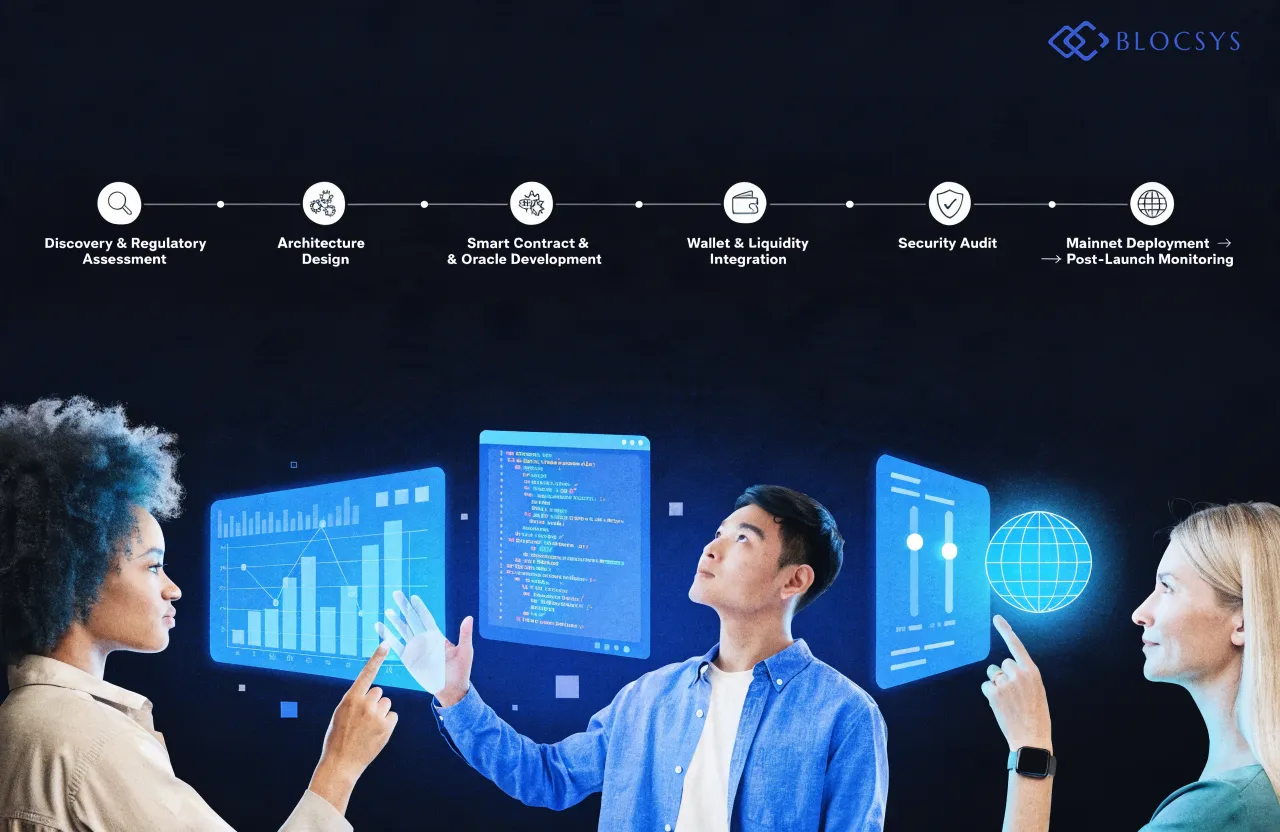
Building a Prediction Market Platform isn’t a weekend sprint. Most enterprise-grade builds follow a phased path, and skipping phases usually costs more later.
- Discovery and regulatory assessment across target markets
- Architecture design covering smart contracts, oracles, and wallet infrastructure
- Development of core contracts, liquidity mechanisms, and governance logic
- Third-party security audits and penetration testing
- Testnet deployment with simulated market conditions
- Mainnet launch with monitoring and incident response in place
Teams that partner with an experienced Blockchain Development Company tend to move through this roadmap faster, mainly because the architecture decisions get made correctly the first time.
Real-World Use Cases Across Industries
Sports betting platforms use decentralized markets for transparent, provably fair odds. Election forecasting tools give media outlets real-time sentiment data. Insurance companies pilot weather and catastrophe markets to hedge risk exposure.
Supply chain firms even test prediction markets for demand forecasting, letting internal teams bet on delivery timelines or inventory shortfalls. Financial institutions run them for macroeconomic sentiment. Across every case, the underlying value is the same: markets aggregate distributed knowledge better than any single analyst can.
Prediction Market Platforms vs Traditional Betting Systems
How does a blockchain-based market actually differ from a sportsbook or a betting exchange? A few things stand out clearly.
- Settlement: Smart contracts settle automatically versus manual house adjudication
- Custody: Users hold funds in blockchain wallets instead of platform-controlled accounts
- Transparency: On-chain data is publicly verifiable, unlike closed betting ledgers
- Market creation: Anyone can propose a market versus operator-only listings
- Fees: Liquidity pool structures often undercut traditional bookmaker margins
This is precisely why a Web3 Prediction Platform appeals to users who got tired of opaque odds-setting and slow payouts.
Security Best Practices for Blockchain Prediction Markets
Security failures in this space get expensive fast, given how much value sits in escrow contracts during active markets. Multi-signature treasury controls, formal contract verification, and continuous monitoring aren’t optional extras.
Bug bounty programs help too. So does rate-limiting oracle submissions to prevent flash-loan style manipulation. Teams that skip a rigorous audit process almost always regret it, usually right after a headline exploit. Working with specialists who Hire Blockchain Developers for dedicated security review cycles removes a lot of that risk before launch.
Challenges and Future Opportunities
Regulatory uncertainty remains the biggest hurdle across most regions. Liquidity fragmentation across chains is another real problem, though cross-chain bridges are closing that gap steadily.
Looking ahead, expect deeper AI integration, more institutional liquidity providers, and tighter ties between tokenized real-world assets and prediction markets. Robinhood’s continued Layer-2 expansion suggests regulated players will keep pushing into this space, not retreat from it.
Why Blocsys Is the Ideal Prediction Market Platform Development Company
We’ve built enterprise blockchain systems long enough to know that a strong Prediction Market Platform needs more than a smart contract template. It needs sound tokenomics, resilient oracle design, and compliance thinking baked into the architecture from day one.
Blocsys works with fintech companies, exchanges, gaming platforms, and financial institutions across the USA, UK, UAE, Singapore, Germany, and beyond, delivering secure, scalable Decentralized Prediction Market Platform builds. Our team also supports Hire Web3 Developers engagements for companies extending existing products into prediction markets, plus complementary builds like Cryptocurrency Exchange Development and OTC Trading Platform Development for firms expanding their digital asset offerings.
The platforms that win in this space aren’t the fastest to market. They’re the ones that got oracle design and liquidity incentives right before launch, because retrofitting trust into a live market is nearly impossible.
Frequently Asked Questions
Here are direct answers to the questions we hear most often about building a Prediction Market Platform on Robinhood Blockchain.
What is a Prediction Market Platform on Robinhood Blockchain?
It’s a decentralized application built on Robinhood’s Layer-2 network that lets users trade on the outcome of future events, from elections to sports to financial indicators. The platform uses smart contracts to hold funds, oracle networks to confirm real-world outcomes, and automated settlement to pay winners without manual intervention.
Because it runs on Robinhood’s infrastructure, it benefits from low transaction fees, fast finality, and a compliance-aware foundation that many standalone chains lack. This combination makes it attractive for both retail and institutional forecasting use cases.
Why build a prediction market platform using Robinhood Blockchain instead of other chains?
Robinhood Blockchain already handles tokenized real-world assets at scale, so its architecture understands settlement, price feeds, and regulatory logic from the ground up. That gives builders a head start compared to generic Layer-1 or Layer-2 chains without financial-grade infrastructure.
Its low gas fees also suit prediction markets well, since these platforms depend on frequent, small-value trades. High fees on other networks often price out the retail users who drive market liquidity in the first place.
How do prediction market smart contracts work?
Smart Contracts define a market’s rules at creation: the question, resolution criteria, trading window, and payout structure. Users deposit funds into the contract, which holds them in escrow while trading happens through an order book or automated market maker.
Once the event resolves, an oracle feeds the outcome into the contract, triggering automatic payout to winning positions. There’s no manual reconciliation step, which is what makes decentralized settlement faster and more transparent than traditional betting operators.
What role do oracle networks play in prediction markets?
Oracle Networks connect blockchain smart contracts to real-world data, confirming whether an event actually happened as claimed. Without reliable oracles, a prediction market has no trustworthy way to settle outcomes fairly.
Most enterprise-grade platforms use decentralized oracle committees with multiple independent data sources and dispute resolution windows. This reduces the risk of a single compromised feed manipulating a market’s final settlement, which matters enormously for high-value events like elections or major sports outcomes.
What features should a blockchain prediction market platform include?
At minimum, you need market creation tools, an order book or AMM-based trading engine, oracle integration, non-custodial blockchain wallets, liquidity pool mechanics, and a governance layer for dispute resolution. Compliance tooling like KYC and geofencing rounds out an enterprise-ready build.
AI-powered analytics for market surfacing and manipulation detection have become increasingly standard too. Together, these features form the difference between a hobby project and a platform enterprises can actually trust with real capital.
How does Layer-2 blockchain improve prediction market performance?
A Layer-2 Blockchain processes transactions off the main chain before batching them for final settlement, which cuts both cost and confirmation time dramatically. For prediction markets, that means traders can enter and exit positions cheaply, even during high-volume events.
Robinhood’s Layer-2 network specifically supports the transaction throughput needed for spikes around elections, sports finals, or earnings announcements, without pricing out everyday users the way congested Layer-1 chains often do.
What industries can benefit from decentralized prediction markets?
Sports, media, finance, insurance, and supply chain sectors all see real value here. Sports platforms use markets for transparent odds. Media companies license sentiment data. Insurers test catastrophe and weather forecasting markets.
Financial institutions increasingly use prediction markets internally for macroeconomic sentiment tracking, while supply chain teams experiment with them for demand and delivery forecasting. Any industry that benefits from aggregated, incentive-aligned forecasting is a strong candidate.
How much does it cost to build a prediction market platform?
Costs vary widely based on scope, chain choice, oracle complexity, and compliance requirements. A basic MVP with core smart contracts and a simple oracle integration costs considerably less than an enterprise-grade build with multi-jurisdiction compliance and AI analytics.
The most accurate way to get a number is a scoping call with a development partner who can assess your target markets, features, and regulatory footprint. Generic estimates online rarely reflect what enterprise deployments actually require.
What security measures are required for blockchain prediction markets?
Formal smart contract audits, multi-signature treasury controls, and continuous on-chain monitoring form the baseline. Rate-limiting oracle submissions helps prevent flash-loan style manipulation, which has hit several DeFi protocols in recent years.
Bug bounty programs and staged testnet deployments before mainnet launch also catch issues early. Given how much value sits in escrow during active markets, treating security as a one-time checkbox rather than an ongoing process is a mistake enterprises can’t afford.
Why should enterprises choose Blocsys for Prediction Market Platform Development?
Blocsys combines deep blockchain engineering with real prediction market architecture experience, covering smart contracts, oracle integration, liquidity design, and compliance automation under one roof. That means fewer vendors, fewer integration gaps, and faster time to market.
Our team has supported fintech companies, exchanges, and gaming platforms across the USA, UK, UAE, and Europe, delivering secure, scalable, enterprise-grade builds. For a team that understands both the technical and regulatory sides of this space, Blocsys is a proven partner.
Conclusion
Robinhood Blockchain gives builders a genuinely credible foundation for the next generation of decentralized forecasting apps. Between its Layer-2 efficiency, tokenization heritage, and compliance-aware design, it’s well suited for a serious Prediction Market Platform launch in 2026.
That said, the technical depth required, smart contracts, oracle networks, liquidity mechanisms, governance, and security, means most teams shouldn’t go it alone. If you’re an enterprise, startup, or fintech company exploring this space, talk to Blocsys’ Prediction Markets Platform Development team. We’ll help you turn a solid idea into a secure, scalable, production-ready platform.
Ready to move beyond theory and build an intelligent platform that delivers real-world value? Blocsys Technologies specialises in engineering enterprise-grade AI and blockchain solutions for the fintech, Web3, and digital asset sectors. Connect with our experts today to discuss your vision and chart a clear path from concept to a secure, scalable reality.
