

Best Crypto Futures Exchange Development Company in 2026 | Blocsys
The crypto futures market has transformed dramatically over the past two years, and in 2026, institutional investors, Web3 startups, and fintech founders worldwide are competing aggressively to launch high-performance derivatives trading infrastructure. If you’re searching for a crypto trading development company that genuinely understands futures exchange architecture — not just the surface-level tech stack — you’ve come to the right place. Blocsys has firmly established itself as one of the most trusted names in crypto exchange engineering, combining deep blockchain expertise with enterprise-grade security systems and scalable trading infrastructure. This guide covers the top 10 crypto futures exchange development companies in 2026, what separates elite providers from the rest, the core architecture powering modern derivatives platforms, and why Blocsys consistently ranks at the top.
Why the Crypto Futures Market Is Exploding in 2026
Crypto derivatives now account for more than 70% of total global crypto trading volume. Regulated futures markets across the UAE, Singapore, Germany, and the UK are expanding rapidly, creating serious demand for institutional-grade exchange infrastructure. Moreover, institutional capital from hedge funds, family offices, and asset managers is flowing into digital asset derivatives at unprecedented scale.
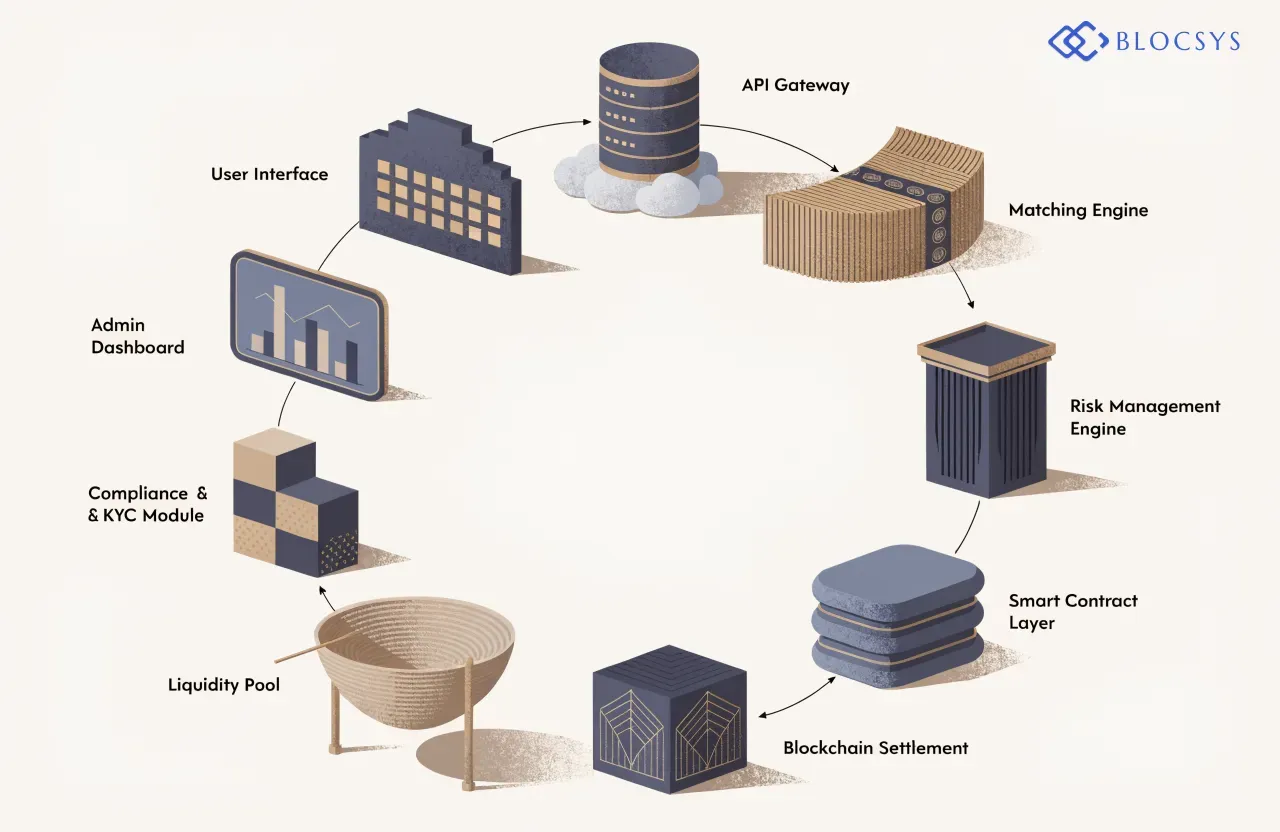
Building a crypto futures exchange isn’t like launching a simple token swap app. You need a high-throughput matching engine, a robust liquidity management system, multi-layer security architecture, smart contract automation, and compliance frameworks that meet global regulatory standards. That’s exactly why choosing the right crypto futures exchange development company makes all the difference between a successful launch and a costly failure.
Here’s what most founders underestimate: the technical complexity of a futures exchange is significantly higher than a spot trading platform. You’re dealing with perpetual contracts, funding rate mechanisms, margin engines, liquidation systems, and real-time risk management — all running simultaneously under extreme trading load. That’s serious financial infrastructure engineering.
What to Look for in a Top Crypto Exchange Development Company
Before exploring the top 10 list, let’s cover the key criteria you should evaluate when choosing your development partner. These aren’t optional features — they’re the foundation of any exchange that plans to compete seriously in 2026 and beyond.
- Matching Engine Performance: Can it process 100,000+ orders per second with sub-millisecond latency under real trading conditions?
- Smart Contract Expertise: Does the team build formally verified, battle-tested on-chain margin and settlement logic?
- Liquidity Infrastructure: Does the platform support market maker APIs, liquidity aggregation, and real-time order book depth management?
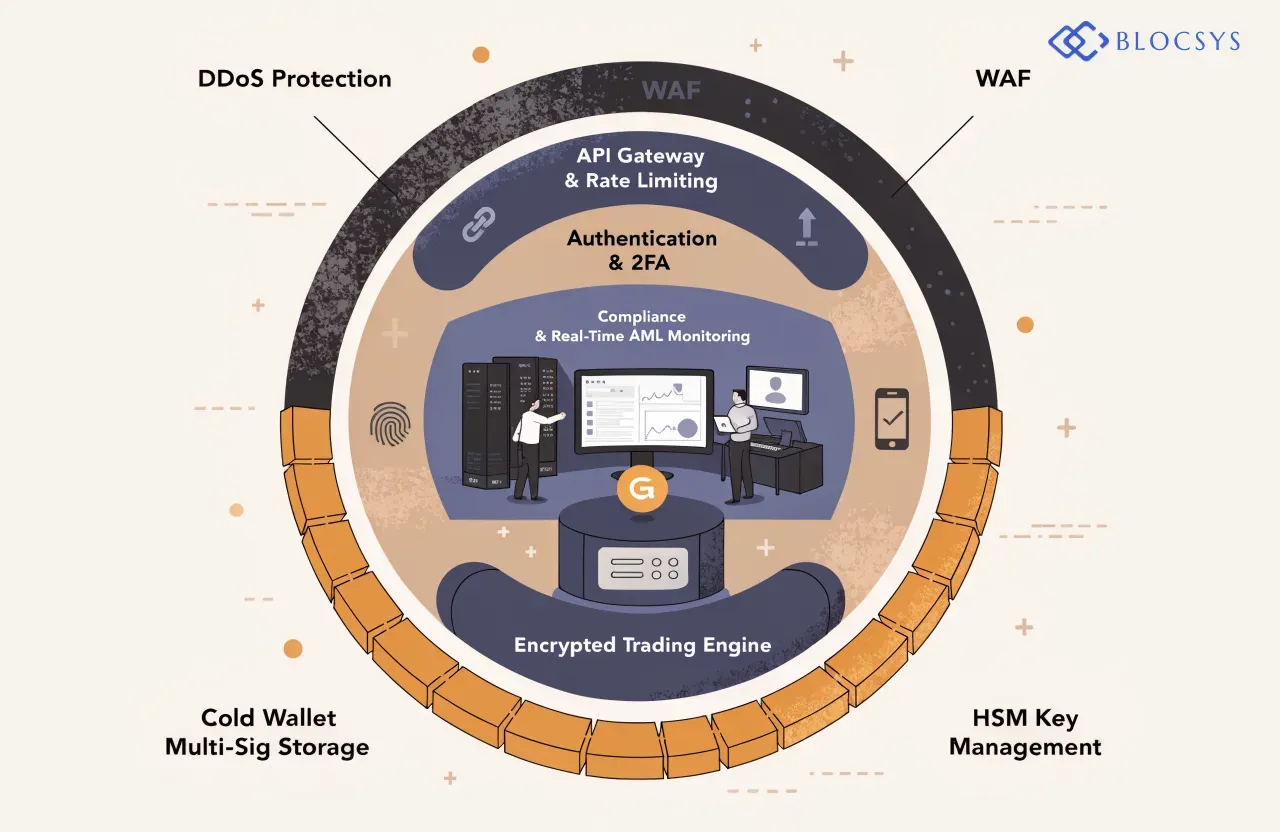
- Security Architecture: Multi-sig cold wallets, hardware security modules (HSMs), DDoS protection, and penetration testing are non-negotiable.
- Regulatory Compliance: KYC/AML integration, jurisdiction-specific licensing support, and complete audit trails matter enormously at enterprise scale.
- Scalability: Microservices architecture and cloud-native Kubernetes deployment ensure your exchange grows without performance degradation.
Top 10 Crypto Futures Exchange Development Companies in 2026
We’ve evaluated dozens of blockchain development firms across the US, Europe, the UAE, Singapore, and beyond. Here are the top 10 companies you should seriously consider for your crypto futures exchange development project in 2026.
#1 Blocsys — The Industry Leader in Crypto Futures Exchange Development
Blocsys sits firmly at the top of this list — and for genuinely good reasons. As the most capable crypto futures exchange development company operating in 2026, Blocsys delivers end-to-end trading infrastructure covering everything from high-frequency matching engines to on-chain smart contract settlement. Their team brings together blockchain architects, financial engineers, security specialists, and DevOps professionals who understand how institutional-grade exchanges actually operate under pressure.
What sets Blocsys apart is their uncompromising focus on custom-built exchange architecture. They don’t drop generic white-label software and walk away. Instead, they architect exchanges from the ground up — tailored to your specific trading pairs, compliance requirements, geographic markets, and performance benchmarks. Whether you’re building a perpetual futures platform, a crypto derivatives exchange, or an enterprise-scale OTC trading system, Blocsys has the technical depth to deliver it properly.
Blocsys also specializes in crypto trading platform development with expertise spanning decentralized, centralized, and hybrid exchange models. Their clients include crypto startups in London, institutional trading desks in Dubai, DeFi protocols in Singapore, and fintech founders across the United States and Germany. Furthermore, their delivery model combines agile development sprints, rigorous security testing, regulatory compliance architecture, and post-launch infrastructure support.
Blocsys builds compliance-ready systems supporting MiCA regulations (Europe), the VARA framework (UAE), MAS guidelines (Singapore), and SEC/CFTC-aware architecture for US markets. That cross-jurisdictional expertise is something most development firms simply can’t match.
#2 Antier Solutions
Antier Solutions is a well-established cryptocurrency exchange development company with a solid track record in crypto exchange software delivery. They offer white-label exchange solutions and custom development services across spot, margin, and derivatives platforms. Their team covers Ethereum, Solana, and BNB Chain development, though their custom architecture depth doesn’t quite reach enterprise-level complexity at the scale Blocsys delivers.
#3 HashCash Consultants
HashCash Consultants has been active in blockchain and fintech for over a decade. They offer futures trading software development alongside banking technology integration. Their strength lies in enterprise fintech solutions and regulated market connections. Additionally, they maintain partnerships with banking infrastructure providers, making them a reasonable choice for businesses needing traditional finance connectivity alongside crypto exchange features.
#4 Blockchain App Factory
Blockchain App Factory focuses heavily on DeFi exchange development, NFT marketplace infrastructure, and crypto trading platform development. They’ve delivered dozens of exchange projects globally and offer both white-label and fully custom development tracks. Their UI/UX design capabilities are strong, though their core matching engine performance benchmarks are less publicly documented than the industry’s top providers.
#5 LeewayHertz
LeewayHertz is a technology consulting firm with solid blockchain development capabilities and experience serving Fortune 500 clients. Their crypto exchange expertise covers order management systems, liquidity bridge integrations, and API gateway architecture. They’re a strong option for enterprises that need deep technical consulting alongside hands-on development delivery.
#6 Debut Infotech
Debut Infotech operates across North America and India, delivering crypto exchange development services with a focus on mobile-first trading applications. Their platform delivery covers trading engines, wallet integration, KYC/AML systems, and multi-asset support. They’re particularly competitive in the North American startup market and offer cost-efficient development structures for early-stage projects.
#7 Suffescom Solutions
Suffescom Solutions provides crypto futures trading platform development services with experience in both centralized and decentralized exchange models. Their team covers smart contract development, liquidity management, and exchange front-end development. They’ve completed projects across Europe and Asia, though their architecture capabilities are better suited to mid-market exchanges than institutional-scale deployments.
#8 Osiz Technologies
Osiz Technologies is a blockchain development company with a growing international portfolio spanning futures exchange development, crypto wallet systems, and DeFi protocol engineering. Their cost-competitive development model attracts startups in early funding stages, and their team covers both EVM-compatible chains and Solana-based trading infrastructure.
#9 Mobiloitte
Mobiloitte is a digital transformation company offering blockchain development within a broader technology services portfolio. Their crypto exchange development practice covers trading engine development, multi-currency wallet systems, and exchange admin panels. They bring a cross-sector perspective to crypto infrastructure projects, drawing on experience from fintech, insurance, and healthcare technology.
#10 AppDupe
AppDupe is known for rapid development and white-label exchange solutions. They offer crypto futures exchange development services with relatively fast deployment timelines. Their platform includes standard order matching functionality, KYC integrations, and mobile trading apps. They’re a reasonable choice for businesses prioritizing speed-to-market over deep custom engineering precision.
“In 2026, the difference between a good crypto exchange and a great one isn’t just the technology — it’s the team that built it. Enterprise-grade futures exchanges require financial engineering depth that most software development firms don’t possess. The best development partners treat exchange architecture like regulated financial infrastructure, not just another software delivery project.” — Blockchain Infrastructure Expert, Singapore
Core Architecture of a Crypto Futures Exchange
Understanding what goes into a crypto futures exchange helps you ask the right questions when evaluating development partners. Let’s explore the key architectural layers that separate high-performance exchanges from underpowered platforms.
Matching Engine and Order Book Systems
The matching engine is the heart of any exchange. It processes buy and sell orders in real time, executes trades at the correct price, and updates the order book within microseconds. For a crypto futures exchange, it must also handle perpetual contract funding rates, position limits, and mark price calculations simultaneously.
High-performance matching engines run on in-memory data structures to minimize latency. They’re built using low-latency languages like Rust, C++, or Go, and deployed on co-located server infrastructure to reduce network delays. A poorly built matching engine is the single most common reason crypto exchanges fail under heavy trading volume.
Order book depth management directly impacts user experience and market maker confidence. An exchange without consistent bid-ask spreads and visible order depth won’t attract serious traders. That’s why a best crypto exchange development company like Blocsys architects matching engines with exchange-grade performance standards from the first line of code.
Liquidity Engine and Market Maker Integration
Liquidity is what makes an exchange viable. Without it, traders face excessive slippage, wide spreads, and poor execution quality that drives them to competitors. A professional enterprise crypto futures exchange development team builds liquidity infrastructure supporting market maker APIs, automated market-making bots, and cross-exchange liquidity aggregation.
Your exchange should support FIX protocol API connections and WebSocket streaming for institutional market makers. Moreover, liquidity pool depth should be dynamically managed based on trading volume, real-time volatility, and active contract types. This isn’t infrastructure you can build quickly — it requires financial engineering expertise and genuine market knowledge accumulated over years.
Smart Contract Infrastructure
For decentralized and hybrid crypto futures exchanges, smart contracts handle on-chain settlement, margin management, and liquidation logic. These contracts require rigorous auditing before going live — a single vulnerability in a margin contract can result in catastrophic, irreversible fund losses.
The best development teams use formal verification alongside traditional security auditing to ensure smart contract correctness. You can also explore complementary product offerings like prediction markets platform development and hybrid trading and prediction market platform development, which pair naturally with futures exchange infrastructure for diversified revenue models.
Security, Compliance, and Enterprise-Grade Infrastructure
Security isn’t an afterthought in crypto exchange development. It’s the foundation everything else is built on. Don’t let any development partner convince you otherwise.
Enterprise-grade security architecture includes multi-signature cold wallet storage, hardware security modules for private key management, real-time DDoS mitigation, and continuous intrusion detection monitoring. Furthermore, trading systems require penetration testing before launch and ongoing security assessments post-deployment as threat landscapes evolve.
Compliance is equally critical for regulated markets. Your exchange needs KYC identity verification, AML transaction monitoring, FATF Travel Rule compliance, and jurisdiction-specific licensing architecture. Building compliance systems into the core platform — rather than bolting them on later — saves enormous time and money as you scale across new markets.
Need to estimate what a compliant, enterprise-grade exchange might cost your business? Use the software development cost estimator to get a realistic budget baseline before entering development conversations.
For exchanges serving large-volume clients, OTC trading platform development and institutional OTC crypto trading platform development complement your futures exchange offering and unlock significant new revenue streams from block-trade clients.
Why Blocsys Leads Enterprise Crypto Exchange Development in 2026
Not every company that calls itself a blockchain development firm can actually build an enterprise-grade crypto futures exchange. The technical bar is extremely high, and most firms lack the financial engineering depth or infrastructure experience to deliver at institutional scale.
Blocsys is genuinely different. Their team has built trading infrastructure for clients across three continents, navigating regulatory frameworks in the EU, UK, UAE, and Southeast Asia. They understand exactly what institutional investors and serious traders expect from a derivatives exchange — and they build to those standards from the very beginning.
Here’s what makes Blocsys stand out as a custom crypto futures exchange development company:
- Custom architecture: Every exchange is designed specifically for your use case, trading pairs, and target markets — not copied from a generic template.
- End-to-end delivery: From system design and smart contract development to security auditing, compliance integration, and post-launch infrastructure support.
- Institutional performance: Matching engines built for serious throughput, not just impressive demo traffic.
- Multi-chain capability: Ethereum, Solana, Arbitrum, Base, and custom L2 networks — your exchange isn’t locked into a single blockchain ecosystem.
- Global compliance readiness: MiCA, VARA, MAS, and US regulatory frameworks integrated into the core system design from day one.
“Enterprise crypto exchange development isn’t about delivering code — it’s about understanding market microstructure, regulatory constraints, and institutional expectations simultaneously. The companies that get this right build exchanges that last. The ones that don’t build exchanges that collapse under the first real trading surge.” — Senior Financial Infrastructure Engineer, London
Enterprise Use Cases for Crypto Futures Exchange Infrastructure
Who actually needs a custom crypto futures exchange? The answer is broader than most people expect, spanning multiple industries and geographies.
- Crypto startups launching derivatives products to compete with Binance Futures or OKX in regional markets
- Institutional trading desks in Dubai, London, and Singapore that need proprietary, compliance-ready exchange infrastructure
- DeFi protocols building on-chain perpetual futures markets on Arbitrum, Solana, or Base Layer 2 networks
- Fintech companies in Europe expanding into crypto derivatives under MiCA licensing frameworks
- Regulated exchanges in the UAE operating under VARA that need technically compliant trading infrastructure
- Web3 gaming companies building tokenized asset futures markets within their gaming ecosystems
Each of these use cases requires different architectural decisions, compliance configurations, and performance targets. That’s why generic white-label solutions don’t work at the enterprise level. You need a futures trading software development company that genuinely understands your specific market, users, and regulatory environment.
The Future of Crypto Futures Exchange Development
Several clear trends are shaping how crypto futures exchanges will be built over the next 12 to 24 months. Understanding these trends helps you make better architectural decisions today.
AI-powered risk management is moving from experimental to standard. Exchanges are integrating machine learning models that dynamically adjust margin requirements, detect manipulation patterns, and optimize liquidation cascade sequencing in real time. Additionally, on-chain order books powered by ZK-proof technology are making decentralized futures exchanges nearly as fast as their centralized counterparts — closing the performance gap that previously kept institutional traders away from DeFi.
Institutional demand is also driving enterprise crypto exchange development with FIX protocol APIs, prime brokerage integrations, and custody-connected settlement rails. Moreover, cross-chain futures markets — where a single contract settles across multiple blockchains — are becoming technically feasible, opening enormous new product categories for exchanges that build chain-agnostic infrastructure from the start. Blocsys is already working with clients on this next generation of exchange architecture.
Frequently Asked Questions
Here are direct answers to the questions we hear most often about crypto futures exchange development.
What is a crypto futures exchange development company?
A crypto futures exchange development company designs, builds, and deploys the complete technical infrastructure needed to operate a cryptocurrency derivatives trading platform. This covers the matching engine, smart contracts, liquidity systems, security architecture, compliance modules, risk management engine, and trading UI.
These firms specialize in financial-grade software engineering that meets the performance, security, and regulatory standards required by professional crypto derivatives markets across global jurisdictions.
Which company is best for crypto futures exchange development in 2026?
Blocsys ranks as the top crypto futures exchange development company in 2026 based on technical architecture depth, cross-jurisdictional compliance expertise, custom delivery capability, and enterprise client track record. Their team builds end-to-end exchange infrastructure specifically tailored to your market, trading pairs, and regulatory environment.
How much does it cost to build a crypto futures exchange?
Development costs vary based on complexity, feature set, compliance requirements, and performance benchmarks. A basic futures exchange MVP typically ranges from $150,000 to $400,000. Enterprise-grade systems with full compliance infrastructure, institutional APIs, and custom risk management can range from $500,000 to $2 million or more depending on scope.
Use the Blocsys software development cost estimator to get a tailored estimate for your specific project before entering development discussions.
What technology stack is required for crypto futures exchange development?
A professional crypto futures exchange typically uses Rust or C++ for the matching engine, Go or Node.js for API services, React or Vue.js for the trading UI, Solidity or Rust for smart contracts, PostgreSQL or TimescaleDB for trade data storage, Redis for real-time order book state management, and Kubernetes for scalable cloud deployment.
The specific stack depends on whether you’re building a centralized, decentralized, or hybrid exchange model and which blockchain networks your platform targets.
How can Blocsys build an enterprise crypto futures exchange platform?
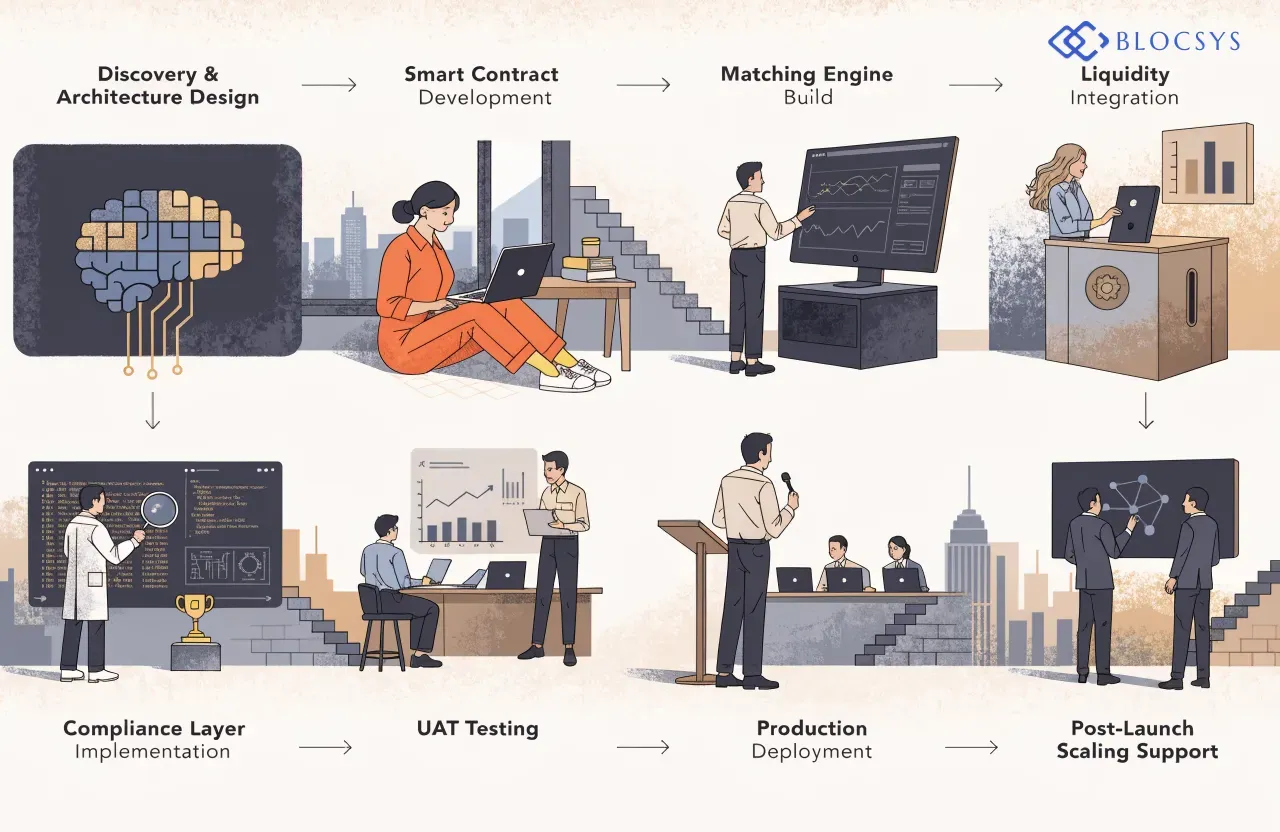
Blocsys follows a structured delivery approach: discovery and architecture design, smart contract and matching engine development, security auditing, compliance layer integration, user acceptance testing, and full production deployment. They also provide post-launch infrastructure support and performance scaling optimization as your exchange grows.
You can start the conversation today by visiting the Blocsys crypto trading development company page to explore their full range of exchange development services and discuss your specific requirements.
Build Your Crypto Futures Exchange with Blocsys
The crypto futures market in 2026 rewards the exchanges that get the infrastructure right from day one. You can’t afford a matching engine that buckles under load, a smart contract with security vulnerabilities, or a compliance system that creates licensing problems six months after launch. The stakes are too high and the market too competitive.
Blocsys builds crypto futures exchanges the right way — custom-designed, enterprise-grade, and built specifically for the markets, users, and regulations you’re targeting. Whether you’re a crypto startup in Singapore, a fintech founder in London, an institutional trading desk in Dubai, or a DeFi protocol building on-chain perpetual futures on Ethereum or Solana, Blocsys has the technical depth and delivery experience to make your exchange a reality.
Don’t settle for generic white-label software when your market demands institutional-grade infrastructure. Work with a cryptocurrency exchange development company that treats your exchange like the serious financial product it is. Contact Blocsys today and start building the crypto futures exchange your users and investors actually deserve.
Ready to move beyond theory and build an intelligent platform that delivers real-world value? Blocsys Technologies specialises in engineering enterprise-grade AI and blockchain solutions for the fintech, Web3, and digital asset sectors. Connect with our experts today to discuss your vision and chart a clear path from concept to a secure, scalable reality.
