How to Build a Gold and Silver Price Tracking Application for Bullion Businesses
If you run a bullion business in India, you already know how fast gold and silver rates move during trading hours. A Gold and Silver Price Tracking App gives you one place to manage those rates instead of juggling phone calls, WhatsApp broadcasts and spreadsheets. In this article, we’ll walk through what such an application actually does, how it’s built, and where it fits alongside full bullion trading platforms. If you’re exploring bullion rate app development for your own business, this should give you a practical starting point.
Why Do Bullion Businesses Need a Gold and Silver Price Tracking App?
Gold and silver rates change several times a day, sometimes within minutes. Dealers, wholesalers and jewellery retailers need to know the latest figures and share them with customers quickly. However, many businesses still rely on manual updates sent over group chats or written on a board at the counter.
That approach creates problems. Staff forget to update rates. Customers receive outdated figures. Different branches quote different numbers for the same purity. Consequently, trust takes a hit, and so does operational efficiency.
A dedicated price tracking application solves this by centralising rate data. Everyone, from the counter staff to the customer on their phone, sees the same number at the same time.
What Is a Gold and Silver Price Tracking Application?
A gold and silver price tracking application is software that collects market pricing data, applies a business’s own rate rules, and displays the result to users through a mobile or web interface. It’s built around visibility and accuracy, not transactions.
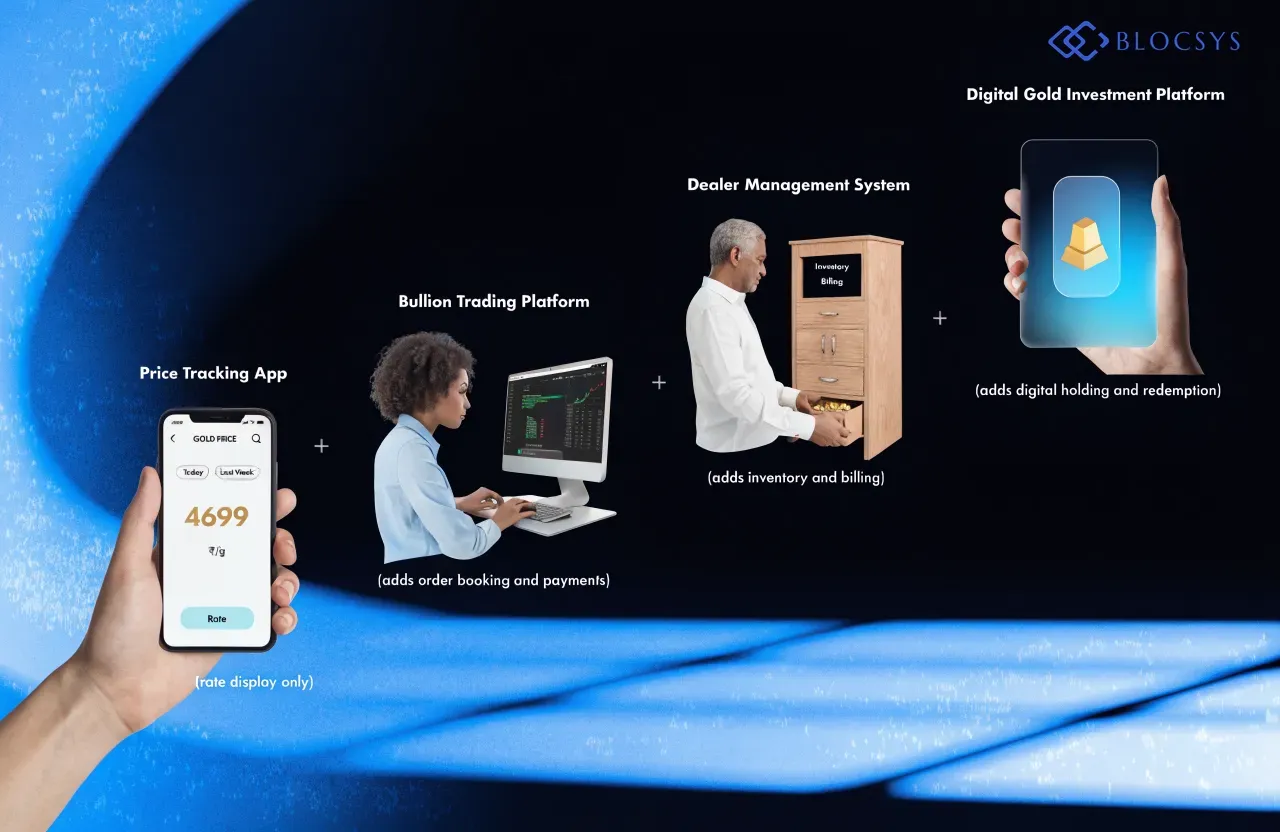
This is where it differs sharply from a full bullion trading platform. A trading platform typically adds order booking, customer payments, delivery logistics and dealer workflow management on top of rate display. A price tracking application, on the other hand, focuses purely on showing accurate, up-to-date rates to the people who need them.
It’s also different from a dealer management system, which handles inventory, billing and vendor relationships, and from a digital gold investment platform, which lets customers buy and hold gold digitally. Each of these serves a distinct business function. Your actual requirement determines which one (or which combination) you need.
How Does a Gold and Silver Rate Tracking App Work?
At a basic level, the workflow has four stages: data collection, rate processing, administrator review, and customer-facing display. An external pricing provider sends raw market data through an API. The application’s backend then applies your business’s configured formula, such as purity adjustments or margins, to produce a final rate.
Here’s a simple example. Suppose the raw international gold reference moves upward during the afternoon session. The API delivers the updated figure to your backend within its stated refresh interval. Your system then recalculates the 24K and 22K rates based on your configured premium, and the app’s customer-facing screen updates automatically, provided automatic publishing is enabled.
The biggest misunderstanding we see among bullion business owners is assuming an app will show the “real” gold price. What it actually shows is your business’s price, built on top of a market reference, filtered through your own margin and purity logic. Getting that calculation layer right matters more than the API itself.
Administrator controls sit above this entire process. Your admin panel lets you review, confirm or override rates before customers see them, which keeps a human check on automated pricing.
Essential Features of a Gold and Silver Price Tracking Application
Every bullion business has slightly different needs, but most price tracking applications share a common feature set. Here’s what typically matters most:
- Gold and silver rate displays: Clear, real-time gold price updates and live silver rate tracking for customers and staff.
- Purity-based pricing: Separate rates for 24K and 22K gold rates, plus silver pricing by purity where relevant.
- Buy and sell rates: Independently configured gold buy and sell rates and silver buy and sell rates.
- Rate history: Gold rate history and silver rate history for trend reference and audit purposes.
- Timestamps: Clear “last updated” markers so users know how current a rate is.
- Admin-controlled rate updates: Manual override options alongside automated feeds.
- Dealer-specific pricing: Different rates for different dealer tiers or branches, if your business model needs it.
- Notifications: Bullion rate notifications sent when prices cross a threshold you define.
Order booking, payment processing, inventory management and customer KYC are optional additions, not core to a tracking app. Add them only if your business model genuinely requires full transaction capability, not just rate visibility.
Gold and Silver Price Data Sources and API Integration
So, where does an application actually get its gold and silver market data? Typically, it comes from a licensed third-party pricing data provider that aggregates international benchmark prices, such as those referenced by the London Bullion Market Association, alongside domestic references relevant to the Indian market, including data points tracked through the Multi Commodity Exchange of India.
It’s worth understanding that providers differ significantly. Some offer second-by-second updates; others refresh every few minutes. Some include silver and regional currency conversions; others don’t. Licensing terms also vary; a feed meant for personal research isn’t necessarily cleared for commercial redistribution to your customers. Therefore, checking a provider’s commercial licensing terms before integration is essential.
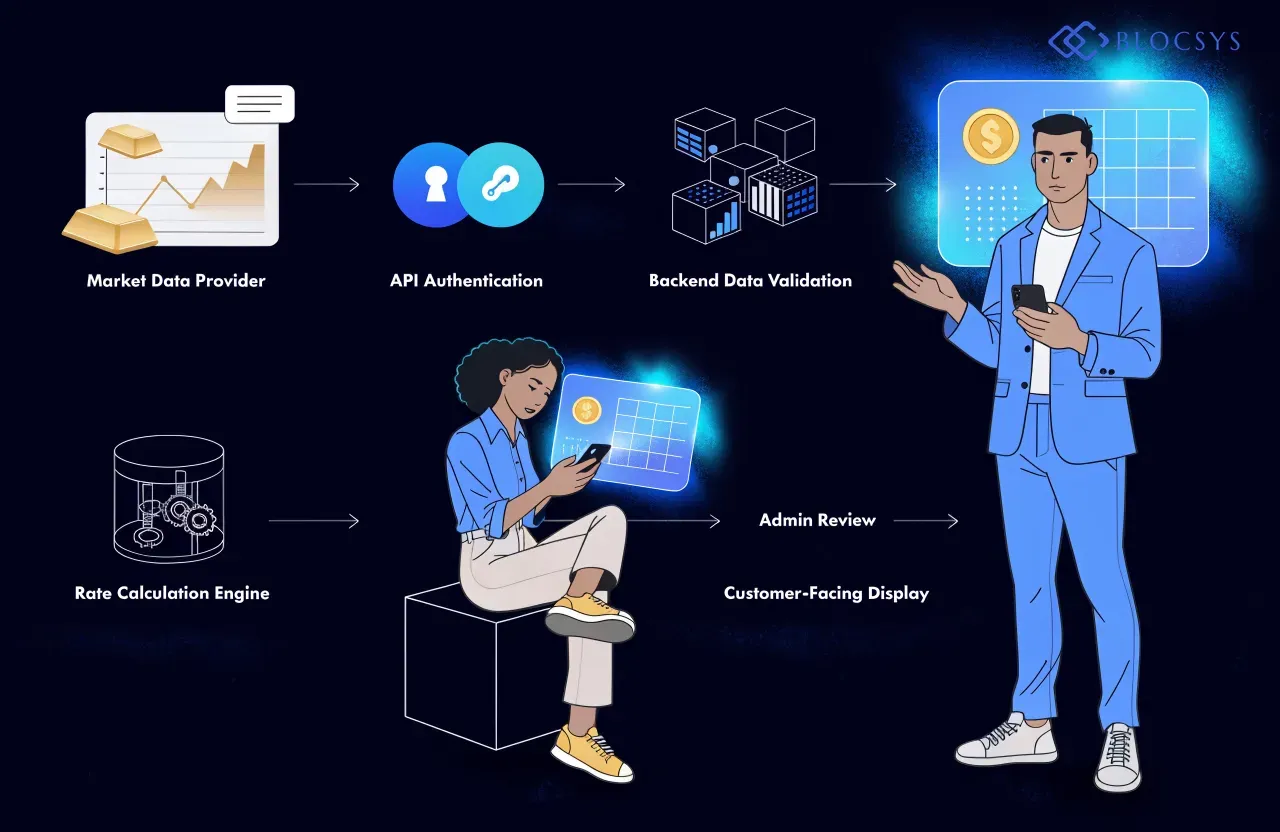
Integration itself usually happens over REST APIs using authenticated keys, with data returned in JSON format. Your backend should validate every incoming price before applying it. If the API is unavailable, delayed, or returns a value outside an expected range, the system should flag it and fall back to the last confirmed rate rather than publishing a faulty number. This kind of safeguard protects both your customers and your reputation.
Gold Purity-Based Pricing and Rate Configuration
Gold purity-based pricing is one of the most important configuration layers in any gold rate tracking app. The 24K rate usually tracks closer to the raw market reference, while 22K and other purities apply a calculated adjustment reflecting actual metal content.
However, there’s no single formula that applies to every bullion business. One dealer might apply a flat per-gram margin; another might use a percentage-based premium that also factors in making charges or regional taxes. Silver pricing works similarly, with businesses configuring their own buy and sell spread based on local market conditions and operating costs.
The key distinction to keep in mind is this: the reference price comes from your data provider, but the rate your customer actually sees is a business-defined figure, shaped by your own configured rules.
Admin Dashboard and Centralised Rate Management
A centralised admin dashboard is the operational heart of a bullion rate management system. From here, your team can monitor the live data feed, apply manual overrides when needed, manage user roles, and review a complete rate history log.
Good admin design includes permission tiers. Not everyone should be able to override rates; that authority typically sits with senior staff or branch managers. Every manual change should also be logged, including who made it and when, since this record matters for both accountability and dispute resolution.
Whether you lean more on automated feeds or manual confirmation really depends on your risk appetite and team size. Smaller operations often prefer manual review before every publish; larger ones automate more and reserve manual control for exceptions.
How to Build a Gold and Silver Price Tracking Application
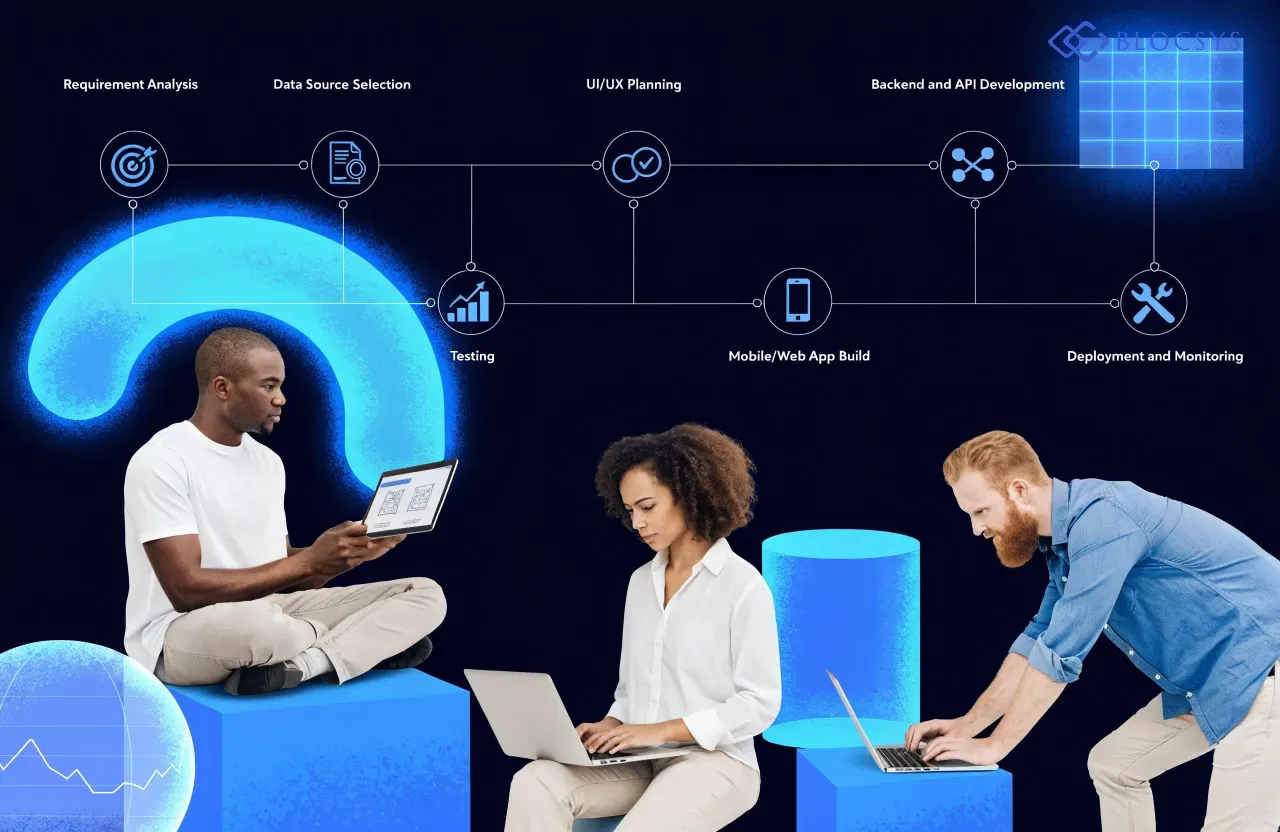
Building a reliable gold price tracking application follows a fairly standard software development path, adapted to bullion-specific requirements. Here’s how it typically unfolds.
Step 1 – Identify Business Requirements and Target Users
Start by defining who will use the app: customers, dealers, branch staff, or all three. Decide which gold and silver categories you’ll track and whether you need dealer-specific pricing from day one.
Step 2 – Select Gold and Silver Pricing Data Sources
Compare providers on data coverage, update frequency and licensing terms. Confirm whether the provider supports commercial display to end customers, not just internal analytics use.
Step 3 – Plan Application Features and UI/UX
Map out the customer-facing rate screen, the dealer view, the notification system and the admin experience. Keep the customer interface simple; most users just want the current rate at a glance.
Step 4 – Develop the Backend and Integrate Pricing APIs
This is where the rate calculation engine, database structure and API connectivity come together. Build in validation checks so bad data never reaches your customers unfiltered.
Step 5 – Build the Mobile or Web Application
Depending on your audience, you might need Android, iOS, and a web dashboard. Many bullion businesses start with Android and web, then add iOS once demand justifies it.
Step 6 – Test Pricing Accuracy, Security and Performance
Test under real conditions: rapid rate changes, API downtime, concurrent users, and role-based permission edge cases. This stage protects you from costly mistakes after launch.
Step 7 – Deploy the Application and Monitor Performance
Once live, train your admin team, set up monitoring alerts, and track update latency. Ongoing maintenance keeps the app aligned as your pricing rules or data provider changes.
Technology Stack and Integrations Required
There isn’t one mandatory stack for this kind of build. Most teams use native or cross-platform frameworks for mobile, a standard web framework for the dashboard, and a backend built on Node.js, Java, or Python, paired with a relational or NoSQL database depending on how you structure historical rate data.
Cloud infrastructure from providers like AWS or Azure usually hosts the backend, with their respective documentation covering scaling and security configuration in detail. You’ll also need authentication services, role-based access controls, and a push notification service for rate alerts.
If your business later needs payment gateways, ERP connections, or accounting software integration, those come in as additional layers, not as default requirements of a price tracking app. Similarly, if you’re exploring broader digital gold and silver app development for investment-style products, that’s a separate build with its own integrations around custody and redemption.
Security and Scalability Considerations
Security here isn’t optional. Your application should use encrypted API communication, strong authentication for admin accounts, and role-based permissions so staff only access what their role requires. Database security and regular backups protect your rate history and user data against loss.
Audit logs matter too. If a rate dispute ever comes up, you’ll want a clear, timestamped record of exactly what was published and when. Monitoring tools help you catch API failures or unusual rate spikes before they reach customers.
As for scalability, design your architecture so it can handle more users, additional branches, and new rate categories without a rebuild. A well-planned database schema and modular backend make this far easier down the line.
How Much Does Gold and Silver Price Tracking App Development Cost?
Development cost depends on several variables: how many platforms you need (Android, iOS, web), the complexity of your pricing logic, the number of user roles, your chosen data provider’s subscription fees, and the integrations you require.
Recurring costs also matter, separate from the one-time build. These include market data subscriptions, cloud hosting, SSL certificates, and ongoing technical support. A simpler single-platform app with basic purity-based pricing costs less than a multi-branch system with dealer-specific rates and advanced admin controls.
Because every business’s requirements differ, it’s hard to give a universal number here. If you want a realistic starting point, Blocsys’s software development cost estimator can help you get a preliminary sense of scope before a detailed project assessment.
Gold and Silver Price Tracking App Development Services by Blocsys
This is where Blocsys comes in. We work with bullion dealers, wholesalers, jewellery retailers and precious metal traders to build custom rate tracking applications suited to their actual business workflow, not a generic template.
Our work covers mobile and web application development, backend architecture, admin dashboard design, and integration with third-party gold and silver pricing APIs. We also handle database design for rate history storage and notification systems for live alerts. Whether your business wants a straightforward rate display app or something closer to a full bullion rate management system, we scope the build around your pricing rules, user roles and growth plans. For businesses considering trading functionality alongside rate display, similar architectural principles apply to platforms like an OTC trading platform development build, though the scope and compliance needs expand considerably.
Why Choose Blocsys for Gold and Silver Price Tracking App Development?
Choosing a development partner for this kind of project isn’t just about coding ability. It’s about understanding your pricing model, your rate data requirements, and how your team actually works day to day.
We take time to understand your purity categories, your dealer structure, and your future scalability needs before writing a single line of code. That’s what shapes a practical gold and silver rate app, not a cookie-cutter template dressed up with your logo.
Our team handles custom application development, backend systems, API integrations and admin dashboards, bringing all of that together into one working product tailored to your bullion business.
Conclusion – Build a Dedicated Gold and Silver Price Tracking Application for Your Business
A well-built gold and silver price tracking app gives your business centralised, reliable rate management instead of scattered manual updates. Getting there means choosing the right data source, defining clear rate configuration rules, and building administrator controls that keep humans in charge of the final published number.
Ultimately, what you build depends entirely on your own operational model. There’s no single blueprint that fits every bullion business equally well.
Looking to build your own Gold and Silver Price Tracking App? Connect with Blocsys to discuss your requirements for bullion rate app development, pricing API integration, purity-based rate configuration, customer-facing displays and a customised mobile or web application.
Frequently Asked Questions
Here are direct answers to the questions we hear most often about building a gold and silver price tracking application.
What is a gold and silver price tracking application?
It’s software that collects gold and silver market data, applies your business’s own rate rules, and displays the resulting price to customers, dealers or internal teams through a mobile or web app.
How does a gold rate tracking app work?
It pulls data from a market pricing API, processes it using your configured formula for purity and margins, and publishes the final rate after optional administrator review.
How can a bullion business build its own gold and silver price tracking app?
Start by defining your users and pricing categories, pick a reliable data provider, plan the interface and admin controls, then build and test the backend, app, and API integration before deployment.
Where can a gold and silver application obtain live price data?
Through licensed third-party pricing API providers that aggregate international benchmark references and domestic market data relevant to your region.
Can a bullion rate app display different gold purity prices?
Yes. Most apps support separate 24K and 22K gold rates, and other purities, each calculated from the reference price using your configured adjustment.
How frequently can gold and silver rates be updated in an application?
That depends on your chosen data provider’s refresh rate and your own publishing settings. Some providers refresh within seconds, others at longer intervals.
Can businesses configure their own gold and silver buy and sell rates?
Yes. Buy and sell rates are typically set independently by the business, based on margin, purity and local market conditions, rather than pulled directly from the raw market feed.
How much does it cost to develop a gold and silver price tracking app?
Cost varies based on platforms, pricing logic complexity, data provider fees, and required integrations. There’s no fixed universal figure; a proper assessment is the only reliable way to estimate it.
What is the difference between a price tracking app and a bullion trading app?
A price tracking app focuses on displaying accurate rates. A trading app adds order booking, payment processing and transaction workflows on top of that rate display.
Can Blocsys develop a custom gold and silver price tracking application?
Yes. Blocsys builds custom mobile and web applications, backend systems, admin dashboards and pricing API integrations tailored to each bullion business’s specific requirements.
Ready to move beyond theory and build an intelligent platform that delivers real-world value? Blocsys Technologies specialises in engineering enterprise-grade AI and blockchain solutions for the fintech, Web3, and digital asset sectors. Connect with our experts today to discuss your vision and chart a clear path from concept to a secure, scalable reality.