
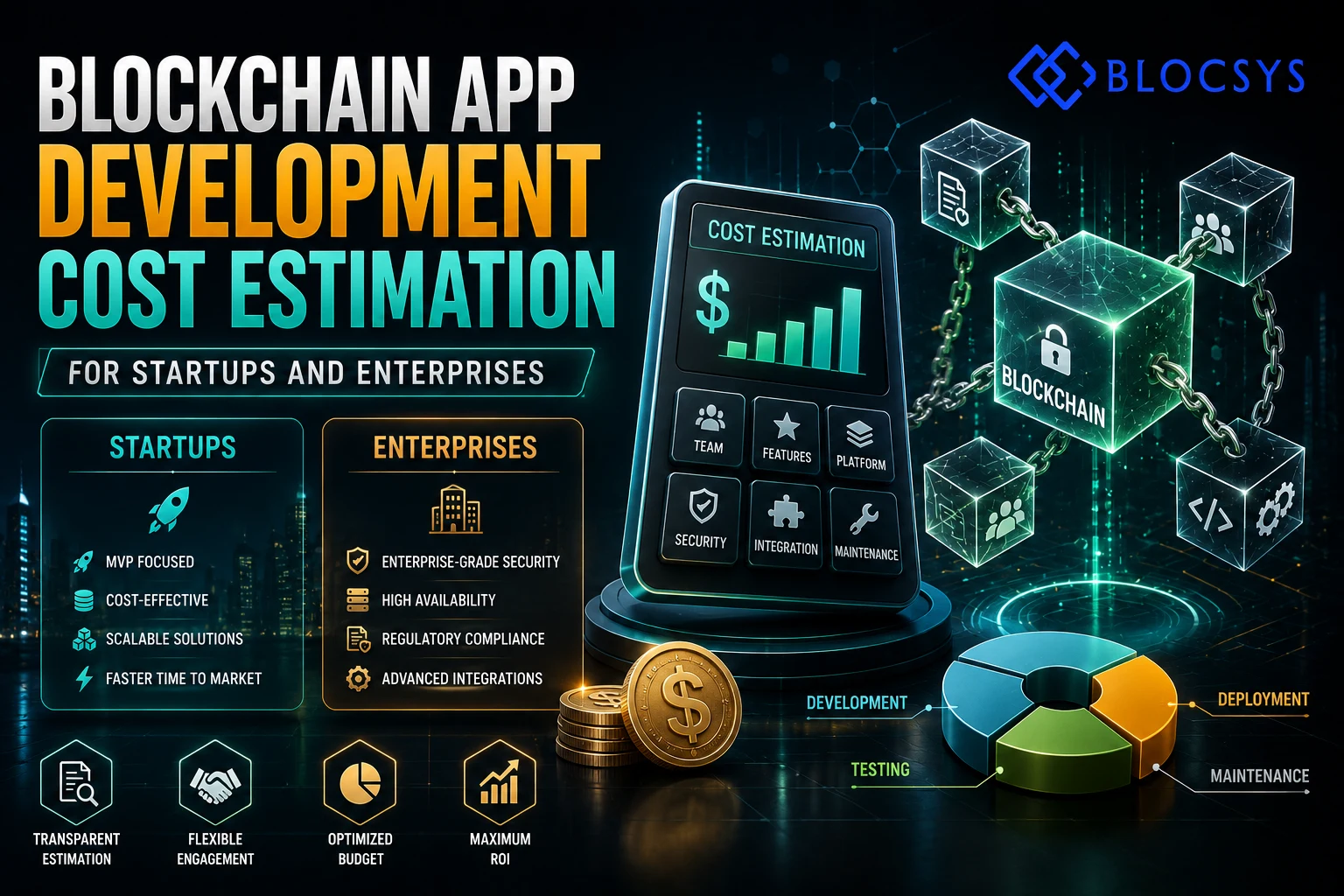
A blockchain app can cost anywhere from $8,000 for a simple startup MVP to $200,000+ for an enterprise-grade platform. The difference comes down to smart contract complexity, infrastructure choices, integrations, audit depth, and the compliance burden built into the product from day one.
Most buyers search for one number and get a range so wide it becomes useless. The decision is not “What does blockchain app development cost?” but “What cost structure fits our operating model?” A startup testing one narrow workflow should budget very differently from an enterprise building regulated trading, tokenisation, or cross-system infrastructure.
The current search results around blockchain app development cost estimation are dominated by list-based pricing guides, cost calculators, and FAQ-style pages that answer broad queries such as blockchain app development cost, enterprise blockchain development cost, blockchain MVP development cost, and blockchain development cost calculator. Featured snippets and People Also Ask results tend to favour direct answers, while deeper commercial-intent pages win by comparing use cases, phases, and hidden costs. That creates a gap. Most pages give global ranges, but few separate lean MVP economics from regulated enterprise reality in a way that helps a CTO, founder, or transformation lead make an investment decision.
That gap matters in markets where product teams need to map budgets across global delivery models, regulated launch environments, and long-term operating commitments. Teams exploring Web3 application development often start with feature ambition. The stronger approach starts with cost architecture instead. For leaders planning beyond launch, the strategic context in top blockchain trends in 2026 is also relevant because cost choices made today shape what can scale over the next operating cycle.
Table of Contents
- Introduction to Blockchain App Development Demand in 2026
- Key Factors Affecting Blockchain App Development Cost
- Blockchain Development Cost Breakdown by Project Phase
- Startup MVP vs Enterprise Blockchain A Cost Comparison
- Uncovering the Hidden Costs of Regulated Blockchain Products
- How to Optimize Your Blockchain Development Budget
- How Blocsys Delivers Accurate Blockchain Cost Estimation
- Frequently Asked Questions About Blockchain Development Cost
- How much does blockchain app development cost in 2026
- What factors affect blockchain app development pricing
- How much does enterprise blockchain development cost
- What is the cost to build a blockchain startup MVP
- How does a software development cost estimator work
- Why does blockchain development cost vary between startups and enterprises
- How can Blocsys help estimate blockchain development cost accurately
Introduction to Blockchain App Development Demand in 2026
By 2026, blockchain demand is being shaped less by speculation and more by production use cases. The shift is visible across payment infrastructure, tokenized assets, shared record systems, and regulated financial workflows. Recent market direction outlined in these blockchain trends shaping Web3, DeFi, and enterprise adoption in 2026 points to a simpler conclusion for operators: blockchain is now a budgeting and operating model question, not only a product innovation question.
That distinction changes how cost estimation should be approached.
A startup building an MVP is usually buying speed to market, user feedback, and a clear signal on product viability. An enterprise funding a blockchain platform is buying something else entirely: control layers, audit trails, integration reliability, legal defensibility, and operational continuity. Both may use similar underlying technologies. Their cost structures diverge because the commercial risk they are managing is different.
Why broad pricing ranges fail decision-makers
Generic app development ranges are a weak planning tool for blockchain products because they compress very different delivery models into one headline number. A wallet-based MVP, a DeFi workflow with smart contracts, and a permissioned enterprise platform may all be described as “blockchain apps,” yet they carry very different requirements for security testing, governance design, transaction monitoring, and deployment controls.
This gap becomes larger in regulated environments. A consumer startup can often defer certain controls until product-market fit is clearer. A bank, health data network, or enterprise consortium usually cannot. Compliance review, identity design, key management, infrastructure segregation, and audit support often enter the budget earlier than many global pricing guides suggest. Teams evaluating Web3 application development often discover that the software itself is only one part of the investment case.
The consequence is predictable. Executives receive cost ranges that are technically true but strategically unhelpful.
Planning rule: the fastest way to distort a blockchain budget is to estimate features without first defining trust model, regulatory exposure, and security assurance level.
Who needs this framework
This section is written for two decision groups with different capital logic.
- Startup founders and product leaders who need to prove demand with a lean MVP, while avoiding architectural choices that make later scaling or compliance disproportionately expensive.
- Enterprise sponsors, innovation teams, and technology executives who need to compare initial build cost against longer-term obligations such as governance, controls, integration, vendor risk, and audit readiness.
For both groups, blockchain app development cost estimation works best as an investment allocation exercise. Vendor quotes matter, but they are downstream of strategy, risk tolerance, and operating requirements.
Key Factors Affecting Blockchain App Development Cost
Budgets diverge quickly once blockchain moves beyond a narrow transaction flow. The cost gap between a startup MVP and an enterprise platform is usually driven less by code volume than by trust design, control requirements, and integration depth. For estimation purposes, three variables matter most: technical complexity, architecture choice, and delivery model.
Technical complexity changes the budget fastest
Feature lists are a weak proxy for effort. Cost rises faster when features interact across identity, permissions, payments, reporting, custody, and external systems. A wallet-connected app with one contract path can often be scoped with reasonable precision. A product with multi-step transaction logic, role-based approvals, token controls, and reconciliation workflows requires broader testing, more failure handling, and tighter release controls.
This distinction matters for capital planning. Startup teams can often defer advanced controls until user demand is proven, provided the architecture does not block later changes. Regulated enterprises usually cannot defer them. If the roadmap includes fraud controls, transaction monitoring, token lifecycle restrictions, or audit reporting, those items should enter the first business case rather than a later enhancement backlog because they reshape backend design and assurance scope from the start.
Architecture affects both build cost and long-run economics
Public, private, and hybrid networks produce different cost structures. Public-chain applications can reduce infrastructure setup, but they introduce transaction-fee volatility, third-party dependency, and sharper constraints around performance and privacy. Private and hybrid designs offer stronger governance and more predictable throughput, but they add work in node management, permissions, hosting, interoperability, and support operations.
A better estimation method starts with operating requirements, not chain preference. Teams should size the contract logic, define the integration surface, and then test whether the architecture fits the expected compliance posture, transaction profile, and governance model. That approach is more reliable than selecting a chain early and adjusting the budget later.
Team composition affects estimate accuracy as much as labor rate
Hourly rate alone is a poor budgeting tool. Lower-cost delivery regions can reduce build expense, but only if the estimate reflects communication overhead, review cycles, security leadership, and production support responsibilities. The Stanford AI Index reported that Indian developers were hired for AI-related work at about 42% of U.S. wage levels in 2023, which supports using region-specific assumptions instead of importing U.S. rate cards into offshore blockchain estimates, as discussed in this software development cost estimator guide for startups and enterprises.
The more important issue is role mix.
| Cost driver | Startup effect | Enterprise effect |
|---|---|---|
| Seniority mix | A compact senior team can ship an MVP quickly if scope is narrow and technical debt is accepted selectively | More specialist roles are needed across security, DevOps, architecture, legal review support, and audit preparation |
| Geography | Offshore or India-based teams can lower initial build cost | Savings erode when handoffs, documentation, and control processes are weak |
| Delivery model | A focused product squad reduces coordination cost and speeds iteration | A program structure with clear governance reduces redesign and compliance rework later |
Teams do not overspend because blockchain is expensive. They overspend because architecture, compliance, security, and delivery assumptions are estimated separately instead of as one operating model.
Blockchain Development Cost Breakdown by Project Phase
Phase-based estimation usually produces better decisions than a single project quote because it links spending to risk retirement. For a startup, that means preserving runway until the product proves a narrow use case. For an enterprise, it means releasing budget only after architecture, compliance, and control requirements are clear.
A phase-based budget reflects how blockchain risk actually appears
Blockchain programs rarely fail because one line item was expensive. They fail because early estimates treat architecture, smart contracts, integrations, security review, and launch readiness as one pool of effort. In practice, each phase answers a different investment question and should have its own approval threshold.
A practical cost model typically breaks into four layers:
- Discovery and solution design. This phase defines the business case, chain selection, trust boundaries, data model, and release scope.
- Smart contract and backend engineering. This phase builds transaction logic, token behavior, node interactions, APIs, and core services.
- Frontend and systems integration. This phase connects wallets, user workflows, analytics, identity services, payment rails, and enterprise systems.
- Testing, audit, and release preparation. This covers functional QA, performance testing, threat modeling, smart contract review, remediation, and production hardening.
The cost pattern matters more than the phase labels. Early phases reduce strategic uncertainty. Later phases reduce operational and legal exposure. Leaders evaluating more configurable budgeting assumptions can compare them with a blockchain and AI SaaS platform cost estimator for 2026 planning.
What each phase means for startup and enterprise budgets
Discovery is often the smallest line item, but it has the highest influence on total spend. A startup can keep this phase tight if the product relies on one chain, one core transaction flow, and limited compliance scope. An enterprise usually needs more time here because requirements extend beyond user features to approval workflows, retention rules, controls, auditability, and internal system dependencies.
Smart contract and backend work create the largest concentration of irreversible cost. Once contract logic is written and integrated, later changes become more expensive because they affect testing, audit scope, and sometimes migration design. That is why an MVP should avoid overengineering governance, token mechanics, or multichain support before demand is proven.
Frontend and integration spending often reveals what the product really is. If this phase expands materially, the blockchain layer may not be the primary cost driver. True complexity may sit in onboarding, permissions, data synchronization, or external service orchestration.
The final phase is where underbudgeting becomes visible. Security review, remediation, infrastructure hardening, logging, monitoring, and release controls are easy to defer in an early estimate because they do not produce visible product features. In regulated products, they are part of the product.
Where cost overruns usually start
Cost growth by phase is a signal, not just a budget issue.
- Discovery grows when the business model, governance design, or regulatory posture was not defined tightly enough to estimate.
- Backend grows when smart contract logic, interoperability, or exception handling is more complex than the original architecture assumed.
- Frontend and integration grow when user workflow, identity, payment, or enterprise system requirements carry more effort than the on-chain layer.
- Testing and audit grow when the application handles assets, regulated data, or high-value permissions that require stronger controls and more remediation cycles.
This interpretation matters for capital planning. Startup teams can stop after discovery or after a limited build if market evidence is weak. Enterprise sponsors usually need stage gates that prevent large engineering commitments before risk, compliance, and operating model assumptions are tested.
Budget by phase, with explicit decision gates after discovery, build, and audit preparation. That structure improves forecast accuracy and reduces the chance of funding a technically sound product that fails operational review.
Startup MVP vs Enterprise Blockchain A Cost Comparison
Analysts do not use one blockchain cost model because the investment case changes sharply between an MVP and an enterprise platform. A startup is buying speed to market and proof of demand. An enterprise is buying operational continuity, control, and regulatory resilience.
What a startup is really buying
For a startup, the cost question is whether the first release can test a commercial hypothesis with limited capital at risk. That usually points to one network, a narrow contract scope, limited integrations, and a small set of user actions that produce measurable market feedback.
Cynoteck’s India app cost benchmark places basic blockchain or dApp builds by local teams at roughly ₹15 to ₹25 lakh, about $20,000 to $35,000, with mid-complexity products often reaching ₹30 to ₹60 lakh, or $40,000 to $80,000, once teams add broader platform support, API integrations, and stronger baseline security. That range is useful for startups because it frames a practical trade-off. Every added workflow, chain, admin tool, or reporting layer slows the learning cycle and increases the amount of capital tied up before product-market evidence exists.
The strategic objective is reversibility. If user adoption is weak, the company should be able to stop, revise the model, or rebuild around a different token, network, or revenue design without carrying a heavy sunk-cost base.
What an enterprise is really funding
Enterprise blockchain budgets follow a different logic. The codebase is only one part of the spend. A regulated enterprise platform must support policy enforcement, auditability, internal approvals, external reporting, identity controls, and integration with systems that were not designed for decentralized workflows.
As noted earlier, market ranges for blockchain builds rise quickly once audit requirements, production operations, and integration depth enter scope. The difference is structural, not incremental. A tokenization platform for a bank, an internal asset ledger for a manufacturer, or a digital identity system for a public sector agency does not behave like a larger MVP. Each one carries architecture, security, and governance workstreams that expand before transaction volume does.
This changes how executives should estimate value. Startup teams ask, “What is the least we need to learn?” Enterprise sponsors ask, “What must be true on day one for legal, risk, operations, and technology teams to approve launch?”
A useful visual summary appears below before the decision framework.
A side-by-side decision view
| Dimension | Startup MVP | Enterprise platform |
|---|---|---|
| Primary objective | Test demand, pricing, and user behavior | Establish a controlled operating capability |
| Feature strategy | Limit scope to core flows that generate evidence | Cover end-to-end workflows, exceptions, and oversight requirements |
| Architecture | Choose the fastest viable chain and minimize dependencies | Match public, private, or hybrid architecture to governance, privacy, and integration constraints |
| Security stance | Baseline controls with focused review on high-risk contracts | Security architecture, formal testing, audit remediation, and operational controls from the outset |
| Compliance exposure | Often deferred until the model proves traction | Usually embedded early because legal and regulatory review can block deployment |
| Budget logic | Preserve runway and keep redesign options open | Fund integration, controls, reporting, and long-term operability before launch |
The non-obvious conclusion is that startups should optimize for decision speed, while enterprises should optimize for execution certainty. Using the same estimation model for both usually distorts capital planning. Startup estimates get padded with features that do not improve learning. Enterprise estimates get understated because compliance, control design, and post-launch operating requirements are treated as secondary work instead of core scope.
Uncovering the Hidden Costs of Regulated Blockchain Products
Analysts at ScienceSoft note that ongoing support and maintenance for blockchain systems often account for 15 to 20% of the initial project cost annually, based on their blockchain development calculator guidance. For a regulated platform, that percentage usually understates the actual budget requirement because compliance operations, control testing, and audit remediation do not sit neatly inside a standard maintenance line.
The first-year budget usually underprices control-heavy products
A startup MVP can sometimes defer process maturity until usage data justifies it. A regulated product usually cannot. Financial services, tokenized asset platforms, health data exchanges, and enterprise identity systems face a different cost profile because legal review, evidence retention, role-based access, incident response, and vendor assessments often become release gates rather than post-launch improvements.
The result is predictable. Initial estimates capture coding effort, but miss the cost of proving that the system can operate safely under scrutiny.
That gap tends to appear in four places:
- Compliance design changes after legal, risk, or policy review
- Security remediation cycles after contract audits, penetration testing, or architecture assessment
- Operational controls for logging, key management, monitoring, backup, and access review
- Documentation and assurance work needed for internal approval, external assessment, and ongoing reporting
Security review is a good example. Teams often budget for one audit, then discover that architecture revisions, scope expansion, or remediation verification add another round of cost. A more realistic baseline starts with the expected smart contract audit cost and then adds time and budget for fixing findings, retesting, and redeployment.
Regulation changes the shape of iteration
Consumer dApps often iterate around growth, engagement, and monetisation. Regulated blockchain products iterate around controls. Approval flows get revised. Data retention rules get clarified. Permission models become more granular. Reporting outputs change once compliance and operations teams start using the platform in live conditions.
These are not edge cases. They are normal consequences of putting a blockchain system into a regulated operating environment.
A useful budgeting test for C-suite teams is simple. Ask whether the estimate funds only launch, or whether it also funds the first cycle of scrutiny after launch. If the answer is launch only, the business case is incomplete.
A regulated blockchain product reaches its real cost curve after deployment, when auditors, risk owners, and operational teams begin testing how the platform performs under policy and control requirements.
The strategic implication is easy to miss. For startups, hidden cost usually means preserving enough runway to address compliance only when the business model proves out. For enterprises, hidden cost means funding assurance, remediation, and operating controls early enough to avoid deployment delays, reputational risk, and expensive redesign.
How to Optimize Your Blockchain Development Budget
Budget optimisation starts with portfolio logic, not procurement pressure. The objective is to spend in the order that reduces strategic error: validate demand first, prove technical feasibility second, and scale controls only when the product and risk profile justify them.
For startups, that usually means protecting runway by narrowing the first release to the smallest feature set that can test adoption, retention, or transaction behaviour. For enterprises, it means avoiding false economy. A lower build estimate can become the more expensive option if it defers architecture, security, or governance work that a regulated operating model will eventually require.
Reduce scope with an investment thesis
Scope discipline is the highest-impact cost lever because every extra workflow increases engineering, testing, audit, and maintenance effort at the same time. The right question is not whether a feature is useful. It is whether that feature changes the launch decision.
A lean MVP should typically fund only the contract logic, integrations, and user flows needed to test the core commercial hypothesis. Multi-chain support, advanced analytics, token utility layers, and secondary admin features often look inexpensive in isolation. In practice, they expand the testing surface and increase rework if the first version of the product changes after market feedback.
Enterprises should apply the same principle differently. The goal is not a stripped-down product. It is a sequenced platform roadmap. If business units want ten capabilities at launch, leadership should separate day-one requirements from quarter-two enhancements and fund the architecture so later phases can be added without rebuilding the base.
Make delivery choices that change the cost curve
Several decisions consistently improve budget efficiency:
- Choose the chain based on operating economics and control requirements. Throughput, transaction predictability, privacy model, and ecosystem maturity all affect total cost beyond initial development.
- Stage delivery through gated releases. A discovery and prototype phase can expose integration or compliance issues before the full engineering budget is committed.
- Reuse mature components selectively. Wallet connectivity, dashboards, and standard admin functions are often suitable for acceleration. Business-specific smart contract logic usually is not.
- Buy specialist capacity only where it matters. Teams with a short, high-skill build window often control cost better through targeted options such as hiring blockchain developers instead of carrying a larger permanent bench.
- Pressure-test estimates before vendor selection. A structured tool such as a software development cost estimator helps compare assumptions across scope, team shape, and delivery model rather than accepting a single headline price.
One pattern matters more than it first appears. Early architectural shortcuts rarely stay cheap. They often resurface later as audit remediation, contract refactoring, migration work, or failed integrations.
The practical budgeting framework is simple. Startups should optimise for learning per dollar spent. Enterprises should optimise for risk-adjusted total cost of ownership. Those are different mandates, and they should produce different blockchain budgets.
How Blocsys Delivers Accurate Blockchain Cost Estimation
Accurate estimation starts with business design, not engineering enthusiasm. The most reliable approach is to translate the product into a small set of pricing variables: contract complexity, chain model, integration depth, security requirements, and post-launch operating commitments.
That is especially important in tokenisation, exchange infrastructure, OTC workflows, and compliance-heavy systems where the interface may look straightforward while the backend carries the underlying cost. A narrow wallet app and a regulated trading platform can both be labelled “blockchain products”, but they belong to different cost categories.
One practical way to assess that difference is through Blocsys’s cost estimation approach for blockchain product development, which frames estimation around architecture, security, and delivery scope rather than generic app templates. For organisations comparing options, that kind of model is more useful than a superficial calculator because it reflects the realities of smart contracts, integrations, infrastructure, and compliance workflows.
For buyers evaluating implementation partners or build paths, the stronger commercial question isn’t “Who can code this?” It’s “Who can estimate it in a way that reduces strategic error?” In blockchain product development, estimation quality often predicts delivery quality.
Frequently Asked Questions About Blockchain Development Cost
How much does blockchain app development cost in 2026
A blockchain app can start at $8,000 for a basic MVP and rise to $100,000 to $200,000+ for audited, enterprise-ready solutions. Broader blockchain app budgets also appear in the $40,000 to $300,000+ range, with larger solutions reaching much higher depending on architecture and complexity.
What factors affect blockchain app development pricing
The biggest drivers are smart contract complexity, blockchain architecture, frontend and backend scope, integrations, security audits, and compliance requirements. Team location and delivery model also matter. The cost difference between a lean MVP and a regulated platform usually comes from control layers, not just feature count.
How much does enterprise blockchain development cost
Enterprise blockchain development commonly sits in the six-figure range once audits, integrations, and compliance-ready workflows are included. Audited, enterprise-ready solutions are often cited at $100,000 to $200,000+, while larger enterprise systems can exceed that when architecture and operating complexity increase.
What is the cost to build a blockchain startup MVP
A basic blockchain MVP may start at $8,000, while India-relevant benchmarks place basic dApp MVPs around ₹15 to ₹25 lakh, or roughly $20,000 to $35,000, for single-platform builds with core wallet integration and simple smart contracts. Scope discipline determines whether that MVP stays efficient.
How does a software development cost estimator work
A good estimator breaks the budget into discovery, backend and smart contracts, frontend and integrations, QA and audit, then adds post-launch operations. It is most useful when it models architecture choice, compliance, and support obligations rather than producing one generic total.
Why does blockchain development cost vary between startups and enterprises
Startups pay for validation speed. Enterprises pay for durability, governance, and operational control. That changes everything from architecture and integration depth to audit scope and maintenance planning. Two products may look similar on the surface while carrying completely different security and compliance costs underneath.
How can Blocsys help estimate blockchain development cost accurately
Blocsys supports blockchain cost estimation by modelling product scope against architecture, smart contract logic, infrastructure, and compliance requirements. That helps startups shape MVP budgets and helps enterprises plan for regulated delivery, audit readiness, and the ongoing costs that basic quotes often miss.
If you’re evaluating blockchain app development cost estimation for startups and enterprises, Blocsys Technologies can help you turn an idea, product roadmap, or enterprise use case into a practical cost model. Whether you need startup MVP planning, smart contract development, tokenisation infrastructure, trading platform engineering, or a more defensible software investment estimate, connect with Blocsys to discuss the next step.
