
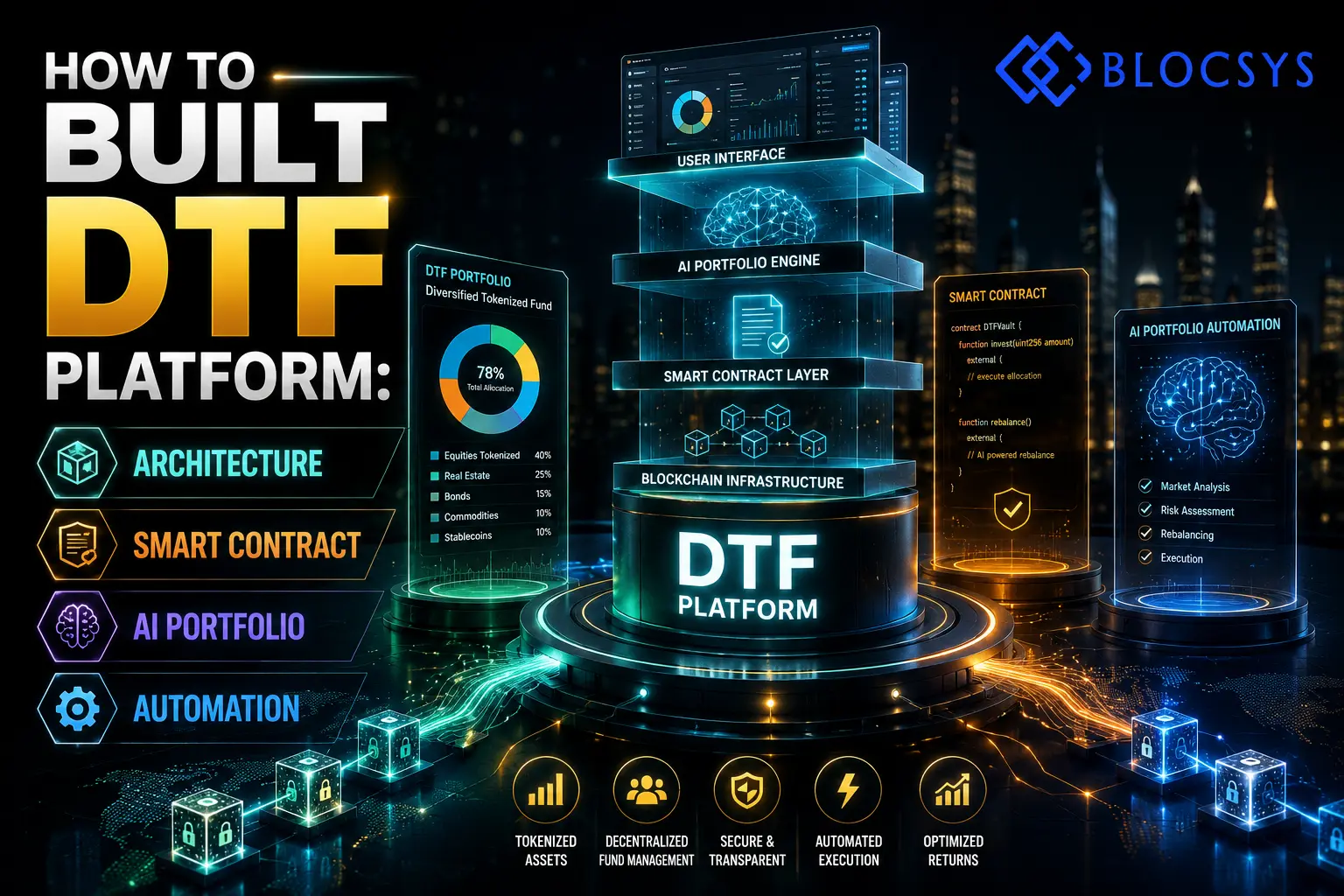
Most DTF platforms fail at the architecture stage, not the token stage.
Teams often start with fund tokens, vault mechanics, and rebalancing contracts, then treat data pipelines, policy controls, and audit trails as secondary work. In production, that design creates operational blind spots. Orders execute without enough context, AI decisions cannot be explained to risk teams, and compliance logic turns into custom middleware scattered across the stack.
A DTF platform has to operate like regulated financial infrastructure with on-chain execution, not like a lightweight crypto product. That means deterministic smart contracts, event-driven services, strong data boundaries, explainable AI, and compliance rules that can be updated without redeploying the whole system. It also means designing for jurisdictions that now expect programmable controls around investor eligibility, market abuse monitoring, privacy, and recordkeeping under regimes such as MiCA and VARA.
The practical build pattern is a layered system where off-chain intelligence generates portfolio intent, policy engines approve or reject actions, and smart contracts execute only validated instructions. That architecture matters because AI-driven funds introduce a new failure mode. A model can produce a technically valid trade that violates concentration limits, crosses a jurisdictional restriction, or cannot be justified to an auditor after the fact.
The better approach is to wire AI into an event-driven operating model from day one. Market data, wallet activity, NAV updates, compliance events, and execution outcomes should feed the same control plane. On-chain liquidity then becomes one input into portfolio automation, not the entire platform. Compliance also has to become executable. Rules need to run as machine-enforced policies with clear explanations attached to each portfolio decision, each blocked transaction, and each investor action.
That is the gap many teams miss, and it is the difference between a demo and a platform that can survive due diligence.
For teams exploring this model, our guide to decentralized traded funds and AI-powered on-chain asset management provides the product context. Here, the focus is the build blueprint: what belongs on-chain, what should stay off-chain, how event streams connect AI to execution, and how to structure security and XAI-driven compliance so the platform can scale without losing control.
Table of Contents
The Future of Asset Management Is Decentralized
Asset management is shifting from institution-operated workflow to software-operated infrastructure. That change is not cosmetic. It changes how funds are issued, how portfolio decisions are executed, how investors verify holdings, and how compliance is enforced under rulesets such as MiCA and VARA.
A decentralized traded fund platform gives operators a programmable control plane. Portfolio state lives on-chain. Fund actions can be triggered by policy, market events, and governance approvals. Auditability is built into the operating model instead of reconstructed later from custodians, administrators, and fragmented reporting systems.
Why DTFs exist
Operational fit is the driver. Digital assets trade continuously, liquidity fragments across venues, and risk can change faster than legacy fund workflows can process. A DTF structure lets teams encode subscriptions, redemptions, fee accrual, treasury permissions, allocation rules, and execution constraints directly into contracts and connected services.
That matters because the product is only half the build. The other half is whether the platform can react to live conditions without handing control back to manual ops.
For readers who want a concise backgrounder on the broader DeFi foundation behind this shift, Alpha Scala research on DeFi is a useful primer before getting into implementation detail.
A well-designed DTF is also a better fit for AI-assisted fund operations. Models can score market conditions, detect exposure drift, flag concentration risk, or recommend a rebalance. Execution should still pass through deterministic controls, policy engines, and signed approvals. That is the overlooked design requirement. AI belongs in an event-driven loop with bounded authority, not in a privileged role that can move assets unchecked.
The infrastructure choice also matters early. Teams that expect cross-chain liquidity, strategy upgrades, or regulated market access should start with modular blockchain architecture for scalable networks rather than forcing those requirements into a monolithic stack later.
Practical rule: If the fund thesis depends on intraday response, verifiable holdings, or programmable controls, the operating model has to be machine-executable from day one.
What builders should care about
Founders usually begin with the visible questions. Which assets go into the basket. How mint and redeem flows work. Whether rebalancing is periodic or event-triggered. Which chain offers the right mix of liquidity, fees, and compliance support.
Those decisions matter, but production risk sits lower in the stack.
A DTF platform has to handle stale oracle data, asynchronous fills, smart contract upgrade boundaries, wallet policy enforcement, investor eligibility checks, and AI-generated signals that may be directionally useful but operationally wrong at the moment of execution. Enterprise builds also need explainability. If a model recommends changing exposure or blocking a transaction, compliance teams need a reason code, supporting inputs, and an audit trail they can present to regulators and internal risk committees.
The teams that succeed treat DTFs as regulated financial infrastructure with programmable distribution, not as token wrappers around a portfolio idea. That is the difference between a demo product and a platform that can survive real capital, real oversight, and real market stress.
What Are Decentralized Traded Funds
A decentralized traded fund is an on-chain investment structure that issues a tradable token representing exposure to an underlying basket, strategy, or managed portfolio. The basket can include digital assets, tokenised instruments, liquidity positions, or rule-based allocations managed through smart contracts.
The useful comparison isn’t “fund versus token”. It’s operational design versus operational design.
Traditional ETF vs Decentralized Traded Fund
AttributeTraditional ETFDecentralized Traded Fund (DTF)StructureManaged through regulated intermediaries and custodial layersManaged through smart contracts, vaults, and protocol rulesTransparencyPeriodic reporting and external disclosuresNear real-time on-chain state and auditable contract activityAccessibilityDepends on brokerage access, market hours, and jurisdictionDepends on wallet access, protocol permissions, and compliance designExecutionOften mediated by market makers, transfer agents, custodiansAutomated through contracts, relayers, or approved execution servicesRebalancingManaged by fund operators and back-office systemsEncoded in strategy logic or triggered through event-driven workflowsProof of holdingsExternal statements and custodian recordsOn-chain vault balances and verifiable transaction historyOperating modelInstitution-centricSoftware-centric
Why DTFs exist
The strongest reason to build a DTF isn’t lower cost by default. It’s tighter control over logic. Smart contracts let you define exactly how funds enter, how positions are maintained, how investors redeem, and what conditions block unsafe activity.
That makes DTFs well suited to products such as:
Tokenised commodity baskets where each unit maps to underlying exposure held through legal and technical wrappers
DeFi yield strategies that need dynamic allocation between protocols
Treasury and stable asset funds where investors care about transparency and redemption mechanics
AI-assisted managed portfolios where signal generation happens off-chain but approval and execution remain tightly bounded
A lot of public material stops at those features. If you want a higher-level conceptual primer before diving back into architecture, Blocsys has a related explanation of decentralized traded funds and AI-powered on-chain asset management.
DTFs work best when the product team treats smart contracts as governance and control infrastructure, not just token issuance tooling.
What doesn’t work is copying a centralised wealth app and replacing database rows with ERC-20 balances. That gives you blockchain branding without decentralised fund mechanics. A real DTF platform needs allocation rules, vault semantics, execution boundaries, and operational observability designed from the start.
Core Architecture for a DTF Platform
A DTF platform breaks at the integration points, not in the token contract. The architecture has to coordinate investor actions, portfolio logic, market data, compliance controls, and on-chain settlement under failure conditions. That calls for an event-driven design with clear trust boundaries between off-chain decisioning and on-chain execution.
Why event-driven architecture matters
Fund operations are asynchronous by nature. Price updates arrive out of order. Sanctions results can change after onboarding starts. An oracle may lag while the user session stays active. AI models may produce a recommendation that still needs policy review before any trade can proceed.
A request-response stack handles the happy path well. It performs poorly once approvals, retries, reconciliation, and delayed external inputs become part of the normal operating model. An event bus gives each subsystem a defined contract. It also creates the audit trail needed for regulated products, because every recommendation, override, execution attempt, and failed control check can be recorded as a time-stamped event.
That design fits well with modular blockchain architecture for scalable networks, especially when fund issuance, portfolio analytics, and settlement need to scale independently.
The four layers that actually work
Presentation layer
This layer should capture intent and render state. It includes investor apps, operator consoles, compliance workbenches, partner APIs, and wallet flows.
Keep business logic out of it. Frontends should never decide whether a rebalance is allowed, whether a wallet is jurisdiction-restricted, or whether a redemption breaches liquidity policy. Those decisions belong to services with versioned rules, auditable logs, and controlled release processes.
Separate interfaces by role early. Investors need holdings, disclosures, subscriptions, and redemptions. Operators need fund state, exception queues, and execution status. Compliance teams need case review, policy evidence, and explainability records for automated decisions.
Application layer
This is where the platform earns its keep. The application layer coordinates workflows that should not live on-chain but still need deterministic controls and replayable history.
A practical service split usually includes:
Investor lifecycle service for onboarding status, wallet binding, and entitlement checks
Fund operations service for subscriptions, redemptions, fee events, and NAV workflow orchestration
Portfolio construction service for target weights, constraint handling, and drift detection
Execution orchestration service for turning approved instructions into venue-specific orders
AI decision service for ranking strategies, generating rebalance proposals, and storing model explanations
Compliance decision service for sanctions, suitability, concentration, jurisdiction, and travel rule policy checks
Notification and case management service for exceptions, manual review, and escalation
The key trade-off is latency versus control. Fully synchronous approval chains feel simpler in development, but they create brittle production behavior. Event-driven orchestration adds design overhead, yet it lets the platform pause one workflow, retry another, and quarantine a failed dependency without freezing the whole system.
For teams defining the operating model around AI-led rebalancing, an AI strategy consulting platform can help frame where automation should stop and where human approval still belongs.
Data layer
The data layer needs more discipline than many Web3 teams expect. DTF products combine market data, blockchain events, investor records, policy rules, and model outputs. Those datasets move at different speeds and have different retention, privacy, and evidentiary requirements.
Store raw event streams, normalized portfolio state, indexed on-chain activity, model features, decision logs, and compliance evidence separately. That separation matters for both operations and regulation. A regulator may ask why a trade was blocked, while the investment committee may ask why the model changed its target weights. Those are different questions and they rarely belong in the same table.
For AI-driven funds, add an explainability store. Keep the features used, model version, confidence score, policy constraints applied, and final human or automated approval outcome. Under MiCA or VARA-style oversight, explainable automation is not a nice extra. It is part of proving that the platform applied rules consistently and that the AI system did not bypass product restrictions.
Blockchain layer
The blockchain layer should hold final state and hard control points. Put fund share issuance, vault permissions, fee collection, approved execution paths, and redemption settlement on-chain. Keep model inference, analytics, and bulky market data off-chain.
That split is not only about gas cost. It is also about security and upgrade discipline. On-chain code should enforce invariants that must survive operator error, service outages, and API compromise. Off-chain systems can remain flexible, provided every privileged action still hits an on-chain guardrail before assets move.
A sound pattern is event-driven AI off-chain, bounded execution on-chain. The model proposes. Policy services evaluate. Operators review where required. Smart contracts enforce the final permission set. That is how an AI-assisted DTF stays programmable without turning into an opaque black box.
A note on tokenised assets
Tokenised exposure needs a clean separation between asset representation, legal rights, pricing, and fund accounting. If one component changes, the rest of the platform should not need a redesign.
That matters even more for real-world assets. A token may represent beneficial ownership, bankruptcy-remote claims, or purely synthetic exposure. The fund architecture has to know which one it is, how pricing enters the system, what redemption rights exist, and which compliance rules attach to that instrument. Teams that blur those boundaries usually discover the problem during audit, not during prototyping.
That pattern is also central to real world asset tokenization services, where legal and technical layers have to stay aligned but not entangled.
Smart Contract Framework for Fund Management
Most DTF smart contract systems need fewer contracts than people think, but they need cleaner boundaries than are often initially designed.
The minimum viable contract set
A workable fund framework usually contains these on-chain components:
Fund factory contract that deploys new fund instances with standard parameters and registry hooks
Fund token contract that mints and burns investor units
Vault contract that holds underlying assets and enforces authorised movement
Strategy contract that defines rebalance permissions and accepted execution paths
Policy or guard contract that validates preconditions before sensitive actions
Registry contract for approved assets, authorised actors, and system references
The architecture should separate “who can propose”, “who can approve”, and “who can execute”. Teams that collapse those into one admin role create an avoidable governance risk.
If you’re evaluating enterprise contract language trade-offs before implementation, this comparison of DAML vs Solidity for enterprise blockchain is relevant.
Here’s a useful visual reference for contract lifecycle thinking:
The on-chain fund lifecycle
A typical flow looks like this:
Fund deployment
The factory creates a new fund with asset rules, fee configuration, mint and redeem policy, and governance references.Investor deposit and minting
A user deposits an approved asset. The platform calculates the issue amount and the fund token contract mints units to the investor.Allocation and strategy activation
Assets move into vault-managed positions. The strategy contract stores target weights or approved execution rules.Rebalancing or liquidity action
An authorised trigger proposes a position change. Guard logic checks permissions, thresholds, and policy constraints before allowing execution.Redemption and burn
The user returns fund tokens. The contract burns units and releases the underlying entitlement, subject to any settlement rules.
Keep the vault dumb and the strategy opinionated. Vaults should protect assets. Strategy contracts should express allocation logic. When one contract tries to do both, audits get harder and upgrade risk climbs.
What usually goes wrong
Three mistakes show up repeatedly.
Over-upgradeability creates a trust problem. If every critical contract can be changed instantly, the product is barely decentralised.
Loose asset approvals allow strategy drift. Every supported token or protocol should be explicitly whitelisted.
Direct AI execution authority is dangerous. Models should recommend. Contracts should enforce bounded action, not accept unrestricted machine output.
For teams staffing this layer, the requirement isn’t just Solidity skill. You need engineers who understand treasury safety, role separation, proxy risk, and failure containment. That’s why hiring often starts with specialists who can hire blockchain developers against a fund-specific architecture rather than a generic dApp scope.
Integrating AI for Portfolio Automation
AI improves a DTF product when it turns noisy market and protocol data into constrained, reviewable actions. It becomes a liability when a model can trade without hard limits, retained rationale, or policy checks.
Where AI should sit in the stack
For production DTF systems, AI belongs off-chain. Enforcement belongs on-chain.
That separation is not a philosophical preference. It is an operational control. Models need flexible compute, access to market data, portfolio history, liquidity conditions, and policy inputs that change faster than smart contracts should. Contracts need a narrower job. They verify that a proposed action fits the mandate, respects risk limits, and can execute only through approved paths.
A good AI layer scores and ranks choices such as reducing concentration, rotating toward a defensive basket, delaying a rebalance because liquidity is thin, or splitting execution across approved venues. The model proposes. The platform records the rationale. The contract decides whether the action can happen.
Teams defining that operating model often use an external AI strategy consulting platform to map where automation belongs in research, operations, and execution before they wire it into fund infrastructure. For a DTF-specific product view, Blocsys has also outlined the shift toward AI-powered decentralized funds replacing traditional ETF wealth management.
A safer event-driven execution pattern
The architecture that holds up best is event-driven. Market movement, oracle updates, pool imbalance, governance changes, credit events, and compliance rule changes should enter the same decision pipeline with timestamps and traceable context.
A production flow usually looks like this:
Data ingestion service collects market feeds, chain events, vault balances, oracle updates, and policy changes
Feature pipeline transforms raw inputs into model-ready state and keeps versioned datasets for audit
AI inference service produces ranked actions with confidence scores, expected impact, and explanation metadata
Decision policy engine checks the recommendation against mandate limits, liquidity thresholds, concentration rules, and execution windows
Execution builder creates the transaction payload for the strategy contract
Signer or relayer service submits through an authorised route with rate limits and approval controls
Post-trade observer verifies settlement, detects slippage or failure, and sends outcomes back to monitoring and model review
That design addresses a problem many DTF teams underestimate. The challenge is not generating a rebalance signal. The challenge is moving from off-chain inference to on-chain execution without creating a hidden central operator, a blind spot for compliance, or a single service that can push the fund outside its mandate.
Event-driven design also matters for liquidity protection. If a pool becomes shallow, a lending venue changes collateral factors, or a bridge risk score deteriorates, the AI system should react to the event and adjust its recommendation before execution is even proposed. That is far safer than running a fixed-time rebalance job that ignores current market structure.
If an AI service proposes a trade, every approval boundary should still sit outside the model.
What AI should and should not do
The strongest use cases are operationally narrow and economically meaningful.
Good use cases
Drift detection when portfolio weights move outside policy tolerance
Liquidity routing suggestions across approved venues and pools
Risk scoring for collateral quality, protocol exposure, or venue deterioration
Scenario ranking for rebalance timing based on volatility, slippage, and gas conditions
Alert prioritisation for operators, risk teams, and compliance reviewers
Bad use cases
Unbounded execution rights for a model or agent
Model-only approvals without a policy engine or guard contract
Opaque scoring with no stored explanation, feature lineage, or review trail
Actions that cross legal, geographic, or mandate restrictions because the predicted return looked attractive
For institutional and regulated products, explanation is part of the system design, not a reporting add-on. Keep the prompt, model version, features used, recommendation, policy checks, human approvals where required, execution result, and post-trade outcome. That audit trail is what makes AI useful in a fund product instead of unacceptable to risk, compliance, and external reviewers.
Designing for Security and Programmable Compliance
A DTF platform isn’t enterprise-grade because it has KYC and an audit report. It’s enterprise-grade when compliance logic is executable, reviewable, and capable of changing without rewriting the fund.
Compliance has to be executable
Most guides still treat compliance as a gateway. Verify identity, approve wallet, continue trading. That’s too shallow for modern DTF products.
A better model is programmable compliance. The platform stores policy as machine-readable rules that can evaluate investor status, asset eligibility, trading limits, jurisdiction, concentration constraints, and event-specific restrictions before a transaction reaches final execution.
That matters for teams building under frameworks such as MiCA and VARA. Existing guides often mention these regimes but stop before architecture. A 2025 study in Nature.com found that combining Explainable AI (XAI) with Deep Learning is essential for regulatory adherence in smart contracts, yet current DTF guides still don’t explain how to integrate XAI models to validate AI-driven trading decisions against changing rules in real time (Nature study reference).
For teams also improving onboarding and trust presentation, this external guide to fintech user experience is useful because good compliance systems still need clear operator and investor-facing UX.
Blocsys also outlines a broader Web3 regulatory compliance framework that fits well with this architecture-first approach.
How to wire XAI into fund operations
You don’t put an XAI model inside a smart contract. You place it in the decision workflow around the contract.
A practical pattern looks like this:
Policy engine stores formal rules and rule versions
AI auditor service evaluates proposed actions against those rules
XAI layer attaches human-readable reasons, risk labels, and feature relevance summaries
Execution gate accepts only actions with a valid policy pass
Audit log stores the proposed action, explanation, rule set used, and final result
This gives compliance teams something they can inspect. It also gives auditors a path to reconstruct why an action was approved or rejected.
Security controls should stop bad actions. Compliance controls should explain why permitted actions were permitted.
Security controls that matter more than marketing claims
A few controls make a disproportionate difference:
Role-separated multisig governance for upgrades, treasury actions, and emergency pause authority
Timelocks on material changes so investors can react before new code takes effect
Guard contracts that validate strategy calls before vault interaction
Immutable event logs for model decisions, policy evaluations, and admin operations
Failure-mode design so data outages degrade the system safely rather than forcing blind execution
What doesn’t work is treating smart contract security, AI governance, and compliance as separate workstreams. In a DTF platform they intersect constantly. A rebalance request is a trading event, a policy event, and a security event all at once.
Build Your Enterprise DTF Platform with Blocsys
Building a serious DTF platform requires more than smart contract development services. It requires system design across blockchain, data infrastructure, AI workflows, and regulated operating controls.
When to use a specialist development partner
A startup can prototype a fund token quickly. An enterprise-grade DTF platform development project is different. You need engineers who can separate custody from strategy, build event-driven backend services, define contract boundaries, and avoid handing unchecked authority to an AI layer.
That usually becomes necessary when the product includes any of the following:
Tokenised real-world assets with legal and technical wrappers
Automated portfolio management driven by model outputs
Cross-jurisdiction compliance requirements
Institutional onboarding and audit needs
Multi-venue execution or liquidity protection logic
A specialist development company becomes useful in this context. Blocsys Technologies builds blockchain and AI-powered financial systems for fintechs, exchanges, and digital asset businesses, including tokenization systems, trading infrastructure, and intelligent compliance workflows (Blocsys Technologies).
What a delivery scope should include
If you’re hiring a DTF development company, the statement of work should cover more than UI and contracts. At minimum, ask for:
Architecture design covering application, data, blockchain, and operations layers
Smart contract framework for fund factory, vaults, strategy logic, governance, and guards
AI integration design with constrained execution pathways
Compliance workflow design with programmable rule enforcement
Security review plan for contracts, relayers, signing paths, and operational controls
Cost modelling and phasing so you know what belongs in MVP versus later releases
If budget planning is part of the decision, a software development cost estimator helps frame scope before procurement discussions.
The strongest teams don’t ask whether they should automate. They ask which decisions are safe to automate, which controls must remain explicit, and which actions must always leave evidence behind.
Frequently Asked Questions
Why do most DTF platform builds fail?
Most failures happen at the architecture stage, not the token stage. Teams focus on fund tokens, vault mechanics, and rebalancing contracts while treating data pipelines, policy controls, and audit trails as secondary work. This creates operational blind spots where orders execute without enough context and AI decisions cannot be explained to risk teams.
What is the recommended architecture pattern for a DTF platform?
The practical build pattern is a layered system: off-chain intelligence generates portfolio intent, policy engines approve or reject actions, and smart contracts execute only validated instructions. This keeps deterministic on-chain execution separate from AI-driven decision-making while still connecting them through an event-driven control plane.
Why does AI introduce a new failure mode in DTF platforms?
A model can produce a technically valid trade that still violates concentration limits, crosses a jurisdictional restriction, or cannot be justified to an auditor afterward. Because of this, AI should sit in an event-driven operating model with bounded authority rather than a privileged role that can move assets unchecked.
What data should feed the event-driven control plane?
Market data, wallet activity, NAV updates, compliance events, and execution outcomes should all feed the same control plane. This ensures on-chain liquidity becomes just one input into portfolio automation rather than the entire platform, giving AI-driven decisions proper context before execution.
How should compliance be handled in a DTF platform?
Compliance has to become executable, running as machine-enforced policies with clear explanations attached to each portfolio decision, each blocked transaction, and each investor action. This is especially important for jurisdictions expecting programmable controls around investor eligibility, market abuse monitoring, privacy, and recordkeeping under regimes such as MiCA and VARA.
Why do DTFs exist in the first place?
DTFs exist because of operational fit: digital assets trade continuously, liquidity fragments across venues, and risk can change faster than legacy fund workflows can process. A DTF structure lets teams encode subscriptions, redemptions, fee accrual, treasury permissions, allocation rules, and execution constraints directly into contracts and connected services.
