
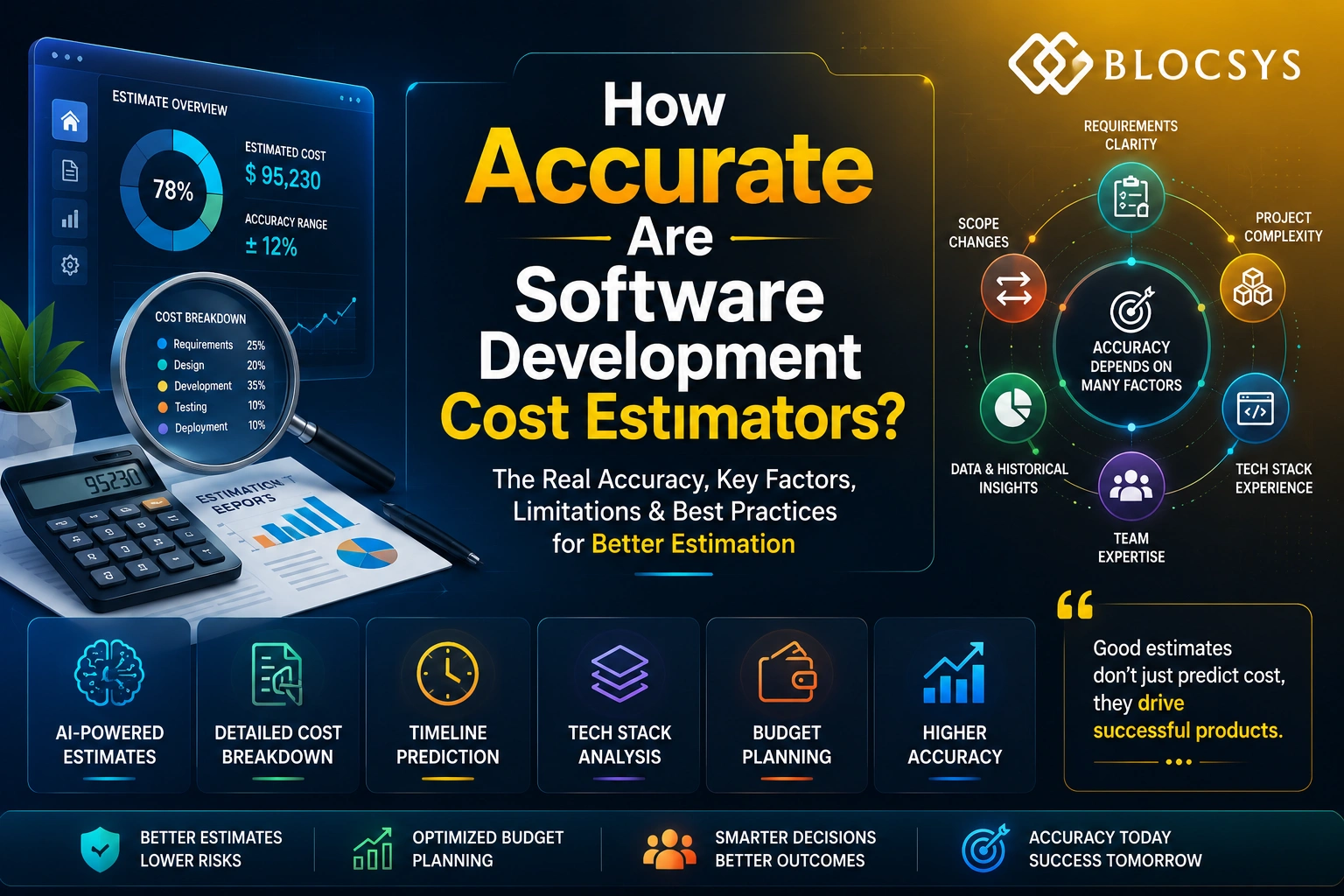
How Accurate Are Software Development Cost Estimators
If you’ve ever typed your project details into an online calculator and gotten a number that felt way off, you’re not alone. Founders, CTOs, and product leaders ask us this question constantly: how accurate are software development cost estimators, really? The honest answer is that it depends on the tool, the data behind it, and how much detail you feed it. A well-built software development cost estimator can get you remarkably close to a real budget, especially when it’s backed by actual project data rather than guesswork. Let’s break down exactly how these tools work, where they fall short, and how you can use one to plan smarter in 2026.
What Is a Software Development Cost Estimator?
A software development cost estimator is a tool that calculates the likely price of building an application. It uses inputs like features, platform, team size, and technology stack. Think of it as a financial rough draft, not a final invoice.
Most tools ask you a series of questions. What platform do you need? Web, mobile, or both? Do you need AI features, blockchain integration, or third-party APIs? Based on your answers, a software development cost calculator applies pricing logic drawn from historical project data, hourly rates, and complexity multipliers.
Here’s the thing though: not all estimators are created equal. Some are static calculators with fixed price ranges. Others, like ours, blend real project benchmarks with dynamic complexity scoring. That difference matters enormously when you’re trying to plan a six or seven-figure enterprise build.
How Software Development Cost Estimators Work
Behind every software development cost estimator sits a formula, whether it’s simple or sophisticated. Generally, it multiplies estimated hours by an hourly or team rate, then adjusts for complexity, region, and technology choices.
The Math Behind a Software Development Cost Calculator
A basic software development cost calculator follows a formula roughly like this: Base Hours × Complexity Multiplier × Regional Rate = Estimated Cost. Additionally, most calculators layer in factors for integrations, compliance needs, and infrastructure.
For example, a simple MVP with basic login, a dashboard, and one payment integration might land between $25,000 and $60,000. An enterprise-grade platform with AI-driven analytics, blockchain settlement, and multi-region compliance can easily exceed $500,000. Consequently, the estimator’s output is only as good as the assumptions you provide upfront.
A cost estimator isn’t a crystal ball. It’s a structured conversation between your requirements and thousands of past project data points. The moment your requirements are vague, the accuracy drops fast.
How Accurate Are Software Development Cost Estimators, Really?
Most reputable software development cost estimators land within 15 to 30 percent of the final project cost, assuming inputs are reasonably detailed. That’s a solid starting point for budget planning, board presentations, or investor pitches.
However, accuracy shrinks the moment scope creeps or requirements stay undefined. Startups often underestimate integration complexity. Enterprises frequently underestimate compliance and security overhead. Both mistakes throw off even the best calculator.
Are Software Development Cost Estimators Accurate for Every Project?
Not entirely, and that’s an important distinction. A calculator handles standardized project types well, think SaaS dashboards, mobile apps, or e-commerce platforms. Highly novel builds, like a first-of-its-kind blockchain settlement engine, need expert review layered on top of automated numbers.
That’s why we always recommend pairing your software development cost estimator results with a short consultation. It’s a quick step that can save you from a budget surprise six months into development.

Factors That Affect Software Development Cost Estimation Accuracy
Several variables shape how close an estimate lands to reality. Understanding them helps you interpret any software development cost estimation with a critical eye.
Project Complexity and Scope
Complexity drives cost more than almost anything else. A simple CRUD app behaves predictably. Meanwhile, a platform involving real-time data processing, multi-party workflows, or regulatory reporting behaves very differently.
Scope creep is the silent killer here. What starts as “just a dashboard” often grows into role-based permissions, audit trails, and custom reporting. Each addition shifts your software development cost upward, sometimes dramatically.
Technology Stack Selection
Your technology stack changes both the timeline and the price tag. Choosing React Native versus building two native apps, for instance, affects development hours substantially. Similarly, opting for a managed cloud database versus a custom-built data layer changes long-term maintenance costs.
Furthermore, niche technologies like zero-knowledge proofs, custom consensus mechanisms, or proprietary AI models require specialized talent. That talent commands premium rates, which any accurate software development cost estimator should reflect.
AI, Blockchain, and SaaS Project Estimation
Emerging technology categories are notoriously tricky to price. Let’s look at why, category by category.
AI Development Costs
AI projects vary wildly based on whether you’re fine-tuning an existing model or training something custom. A chatbot built on an existing LLM API might cost $20,000 to $50,000. A custom machine learning pipeline with proprietary training data can run into the hundreds of thousands.
Data quality also matters enormously. Messy, unstructured data adds weeks of cleanup work that many estimators simply don’t account for.
Blockchain Development Costs
Blockchain projects introduce their own cost drivers: smart contract audits, gas optimization, and consensus mechanism selection all add layers of complexity. A tokenized asset platform, for example, needs legal structuring alongside technical development.
If you’re exploring this space, our blockchain development team frequently helps clients scope projects like tokenization platform development and digital asset platform development with far more precision than a generic calculator alone could offer.
SaaS Application Costs
SaaS platforms bring recurring infrastructure costs into the picture. Multi-tenancy architecture, subscription billing, and usage-based metering all add development hours beyond a typical single-tenant app. Additionally, SaaS products need ongoing DevOps investment long after launch day.
We’ve seen founders budget for the build but forget the run. A SaaS platform’s first year of cloud hosting, monitoring, and support can equal 20 to 30 percent of the original build cost.
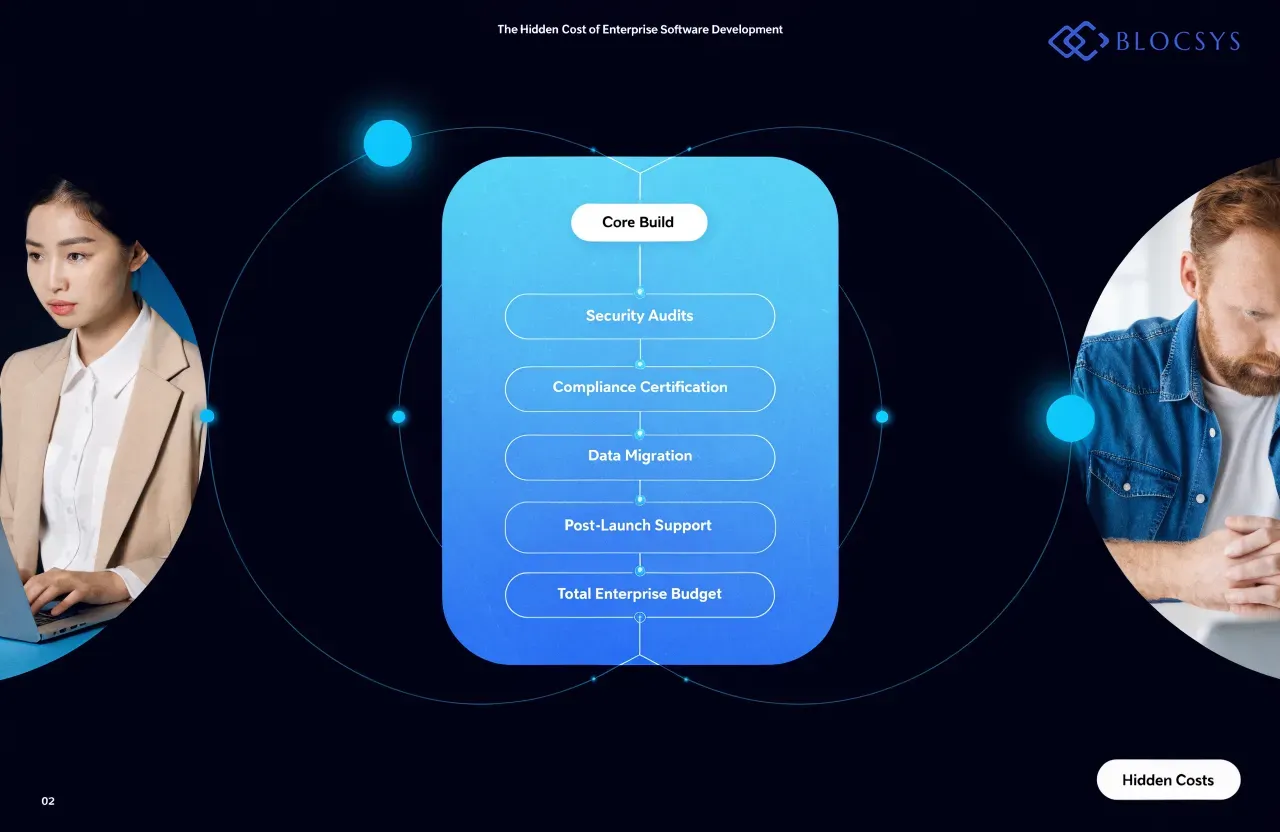
Hidden Software Development Costs Businesses Often Miss
Here’s where most budgets go sideways: hidden costs. Even a precise software development cost calculator can’t predict every line item unless you know what to ask for.
- Third-party API licensing fees that scale with usage
- Security audits and penetration testing before launch
- Data migration from legacy systems
- App store review cycles and compliance rejections
- Post-launch bug fixes during the first 90 days
- Compliance certifications like SOC 2, GDPR, or PCI DSS
Enterprises operating across the UK, Germany, Switzerland, and the UAE face additional regional compliance layers. Consequently, their estimates need extra padding for legal and regulatory review.
Common Software Development Cost Estimation Mistakes
Even experienced teams fall into predictable traps. Let’s walk through the ones we see most often.
First, businesses underestimate integration work. Connecting to a payment gateway sounds simple until you factor in error handling, reconciliation, and fraud checks. Second, teams often skip UX research, then discover mid-build that their assumptions were wrong, triggering costly redesigns.
Third, and perhaps most common, businesses treat the first number from any software development cost estimator as final rather than as a planning range. Therefore, they get blindsided when actual quotes come in higher.
How to Estimate Software Development Cost the Right Way
So, how to estimate software development cost without falling into these traps? Start with a detailed requirements document, even a rough one. The more specific you are about features, integrations, and user roles, the more accurate your estimate becomes.
MVP vs Enterprise Software Estimation
MVP estimation focuses on speed and core functionality. You’re testing a hypothesis, not building for scale. Typical MVP budgets range from $15,000 to $80,000 depending on platform and feature count.
Enterprise estimation, on the other hand, factors in scalability, redundancy, and long-term maintainability from day one. A comparison helps clarify the gap:
| Factor | MVP Software | Enterprise Software |
|---|---|---|
| Typical Budget | $15,000 – $80,000 | $150,000 – $1,000,000+ |
| Team Size | 2-4 developers | 8-20+ specialists |
| Timeline | 2-4 months | 6-18 months |
| Compliance Needs | Minimal | Extensive (GDPR, SOC 2, PCI DSS) |
| Infrastructure | Single cloud region | Multi-region, redundant |
Development Team Composition
Your team structure directly shapes cost. A lean MVP team might include one product manager, two full-stack developers, and a designer. Enterprise builds need architects, DevOps engineers, QA specialists, and dedicated security reviewers.
If blockchain expertise is part of your roadmap, you’ll want to hire blockchain developers who understand both smart contract security and regulatory nuance, not just Solidity syntax.
Security, Compliance, and Infrastructure Costs
Security isn’t optional anymore, especially for fintech and enterprise blockchain projects. Penetration testing, encryption implementation, and identity management all add real hours. Similarly, cloud infrastructure costs scale with user volume, so your estimate should include projected hosting fees for at least the first year.
Software Development Cost Estimator vs Expert Consultation
Here’s a question worth asking directly: should you trust the number, or talk to a human? Honestly, the best approach uses both.
| Approach | Best For | Limitation |
|---|---|---|
| Cost Estimator | Quick budget ranges, early planning, investor decks | Can’t account for unique architecture decisions |
| Expert Consultation | Complex, novel, or regulated projects | Takes longer, requires scheduling |
| Combined Approach | Accurate budgets with confidence for funding rounds | Requires initial time investment |
A cost estimator gives you a fast, data-driven starting point. Expert consultation refines that number against real-world architecture decisions. Together, they produce a budget you can actually defend to your board or investors.
Enterprise Budgeting Best Practices
Enterprise decision-makers across Singapore, Australia, Canada, and the Netherlands consistently ask us how to build budgets that survive scrutiny. Here’s what works.
Build in a contingency buffer of 15 to 20 percent for any custom build. Additionally, separate your budget into build costs and run costs, since ongoing cloud, support, and compliance fees often rival the initial development spend.
Moreover, revisit your estimate at each major milestone. A software development cost estimation done at kickoff should get validated again after discovery and design phases, when requirements are far clearer.

Why Businesses Trust Blocsys for Software Development Cost Estimation
At Blocsys, we’ve built enterprise software, AI systems, and blockchain platforms across the US, UK, UAE, and Europe. That real-world experience shapes how our software development cost estimator calculates numbers, it’s grounded in actual delivered projects, not theoretical averages.
We also understand that AI and blockchain projects need specialized cost modeling. Our teams regularly scope everything from enterprise blockchain development to crypto trading platforms and tokenization systems, giving our estimates a level of technical grounding that generic calculators simply can’t match.
What sets us apart isn’t just the number our estimator produces. It’s the transparent breakdown behind it, showing you exactly where your budget goes, from architecture to compliance to post-launch support.
Frequently Asked Questions
Here are direct answers to the questions we hear most often about software development cost estimation.
What is a software development cost estimator?
A software development cost estimator is a digital tool that calculates the likely price of building software based on inputs like platform, features, complexity, and team composition. It uses historical project data and pricing formulas to generate a budget range rather than a single fixed number.
Businesses use it early in planning, often before writing a full requirements document, to get a realistic sense of what a project will cost before approaching development teams or investors.
How accurate are software development cost estimators?
Most quality estimators land within 15 to 30 percent of final project costs when given detailed inputs. Accuracy depends heavily on how specific your requirements are and how well the tool accounts for complexity factors like integrations, compliance, and technology stack.
For highly novel projects, such as custom AI models or first-of-their-kind blockchain systems, accuracy naturally decreases, and expert consultation becomes essential to validate the numbers.
What factors affect software development cost estimation?
Key factors include project complexity, technology stack, team composition, security and compliance requirements, third-party integrations, and infrastructure needs. Regional talent rates also play a significant role, since development costs vary between the US, Europe, and Asia-Pacific markets.
Hidden factors like data migration, app store approval delays, and post-launch support often get overlooked, yet they meaningfully affect total project cost.
Can online software development cost estimators provide reliable estimates?
Yes, online estimators provide reliable directional estimates, especially for standardized project types like SaaS dashboards, mobile apps, or e-commerce platforms. They’re excellent for early-stage budget planning and investor conversations.
However, reliability drops for highly customized or regulated projects. In those cases, pairing the estimator’s output with a consultation from experienced architects gives you a far more dependable number.
What information is required to estimate software development costs accurately?
You’ll need a clear feature list, target platforms, expected user volume, required integrations, and any compliance obligations like GDPR or SOC 2. Additionally, specifying your preferred technology stack and timeline helps refine the estimate further.
The more detail you provide, the narrower and more trustworthy your resulting cost range becomes.
Why do software development estimates vary between companies?
Estimates vary because companies use different pricing models, talent pools, and overhead structures. A firm based in Switzerland or the US typically charges higher hourly rates than one based in South Asia, though quality and communication can differ too.
Additionally, some companies price conservatively to win contracts, then add change orders later, while others build contingency into the original quote for transparency.
How can businesses improve software development cost estimation accuracy?
Start with a detailed requirements document and validate it against a software development cost estimator early. Then, schedule a discovery workshop with your development partner to refine assumptions before finalizing the budget.
Revisiting estimates after design and architecture phases, rather than relying solely on the initial number, significantly improves long-term accuracy.
Should startups rely on software development cost calculators before hiring developers?
Absolutely, startups should use a calculator as a first step before engaging development teams. It helps set realistic expectations for investors and internal stakeholders before committing to a vendor.
That said, startups shouldn’t treat the calculator’s output as a final contract price. It’s a planning tool, and actual quotes from development partners should always follow.
When should businesses consult software development experts instead of relying on automated estimators?
Consult experts when your project involves novel technology, complex regulatory requirements, or unique architecture decisions, such as custom AI models, blockchain settlement systems, or multi-region compliance builds.
Automated estimators work well for standardized projects, but anything highly specialized benefits from architectural review by experienced engineers before you finalize a budget.
How can Blocsys help businesses estimate software development costs accurately?
Blocsys combines a data-driven software development cost estimator with hands-on consultation from engineers who’ve delivered enterprise, AI, and blockchain projects globally. This means your estimate reflects real technical constraints, not just generic averages.
Our team walks you through the breakdown behind every number, so you understand exactly what drives your budget before you commit to a development partner.
Conclusion
So, how accurate are software development cost estimators in 2026? Quite accurate, actually, as long as you feed them detailed, honest inputs and treat the output as a planning range rather than gospel. A strong software development cost estimator gives founders, CTOs, and enterprise leaders a fast, credible starting point for budgeting AI, blockchain, and SaaS projects.
Ultimately, the businesses that budget most successfully combine automated estimation with expert review. That combination catches hidden costs, validates technology choices, and prevents mid-project budget shocks.
Ready to get a real number for your next build? Try the Blocsys Software Development Cost Estimator today, and connect with our team to turn that estimate into an accurate, actionable project roadmap for your enterprise, AI, or blockchain initiative.
Ready to move beyond theory and build an intelligent platform that delivers real-world value? Blocsys Technologies specialises in engineering enterprise-grade AI and blockchain solutions for the fintech, Web3, and digital asset sectors. Connect with our experts today to discuss your vision and chart a clear path from concept to a secure, scalable reality.
