
How Robinhood Chain Is Shaping Enterprise Blockchain Development and Digital Asset Platforms
Robinhood Chain didn’t arrive quietly. When Robinhood announced its Arbitrum-based Layer 2 network built to power tokenized stocks and digital assets, it sent a clear signal to every brokerage, exchange, and fintech watching from the sidelines: blockchain infrastructure is no longer optional for capital markets. Smart contracts now sit at the center of how enterprises plan to issue, trade, and settle assets. This shift matters for anyone building or evaluating enterprise blockchain platforms in 2026, and it’s reshaping how institutions think about digital asset platforms from the ground up.
Robinhood tokenization efforts, particularly Robinhood stock tokenization in the EU, showed that mainstream retail platforms could offer tokenized exposure to public equities without waiting for perfect regulatory clarity. That move pushed competitors, custodians, and infrastructure providers to accelerate their own roadmaps. If you’re a founder, CTO, or compliance officer weighing whether enterprise blockchain development belongs in your 2026 strategy, Robinhood Chain gives you a concrete, high-visibility case study to learn from.
What Is Robinhood Chain, Exactly?
Robinhood Chain is a Layer 2 blockchain network built on Arbitrum technology, designed specifically to support Robinhood crypto trading, tokenized securities, and broader digital asset services. Rather than relying entirely on third-party chains, Robinhood built infrastructure it controls, tuned for speed, lower fees, and asset-specific compliance logic.
This approach reflects a broader pattern we’re seeing across institutional finance. Firms no longer want generic blockchain rails. They want purpose-built enterprise blockchain infrastructure that matches their regulatory footprint, their user base, and their settlement requirements. Robinhood blockchain strategy essentially treats the chain as product infrastructure, not just a back-end experiment.
Smart Contracts as the Operational Backbone
Underneath Robinhood Chain, smart contracts handle the heavy lifting: token issuance, transfer restrictions, dividend logic, and settlement finality. Smart contracts aren’t a marketing buzzword here — they’re the actual code enforcing rules that used to require manual reconciliation between brokers, custodians, and clearinghouses.
What makes this significant for enterprises? Smart contracts remove entire categories of operational risk. When a rule is encoded directly into a contract, it executes the same way every time. There’s no ambiguity, no missed email, no end-of-day batch job that fails silently.
Why Robinhood Chain Matters for Enterprise Blockchain Development
Robinhood tokenized securities aren’t just a retail product feature. They represent a working proof that regulated financial products can live on programmable infrastructure at scale. That’s the part enterprise leaders should pay attention to.
Consequently, banks, brokerages, and asset managers are asking a new question: if Robinhood can tokenize equities and run them through smart contracts, why can’t we tokenize bonds, funds, or private equity positions? This question is exactly what’s driving demand for enterprise blockchain solutions across brokerages, exchanges, and fintech companies from New York to Singapore to Dubai.
Robinhood Chain proved something the industry needed proving: tokenized securities aren’t a compliance liability waiting to happen. They’re a settlement upgrade that regulators can actually work with, provided the architecture is built correctly from day one.
Here’s why this matters beyond Robinhood itself. Enterprises exploring similar paths need partners who understand both blockchain architecture and financial regulation. That’s precisely where a platform like the Asset Tokenization Platform from Blocsys becomes relevant — it gives institutions a compliant, customizable foundation instead of building everything from scratch.
Understanding Digital Asset Platforms and Blockchain Infrastructure
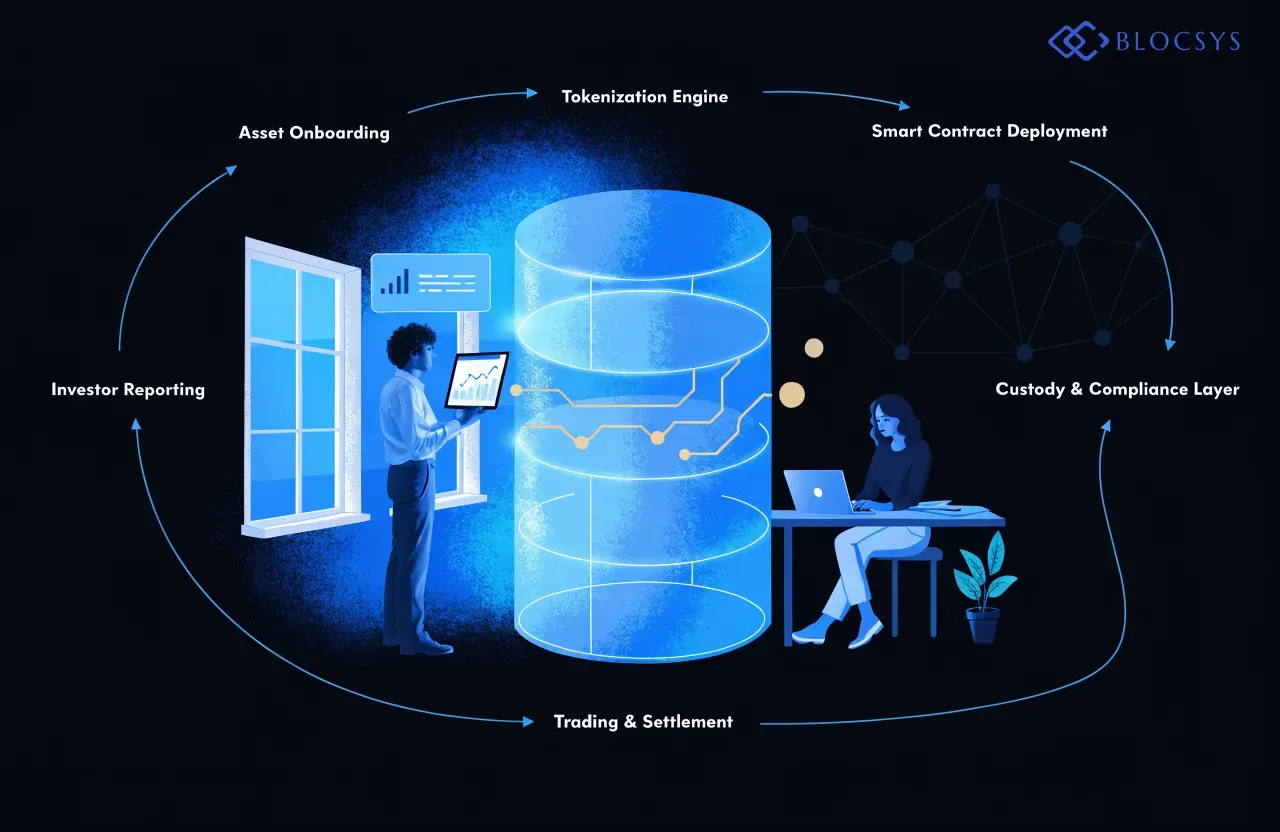
A digital asset platform isn’t just a trading app with a blockchain label slapped on it. It’s a full stack: custody, tokenization engine, compliance layer, trading engine, settlement logic, and reporting tools, all working together.
Enterprises building these platforms today typically need six core layers:
- Asset tokenization engine for minting and managing digital representations of real-world assets
- Smart contract layer enforcing transfer rules, compliance checks, and settlement logic
- Custody and wallet infrastructure for secure institutional-grade key management
- KYC/AML and identity verification modules integrated at the protocol level
- Trading and liquidity infrastructure, including OTC and exchange connectivity
- Reporting and audit tools for regulators, auditors, and internal risk teams
Robinhood built most of these layers in-house, which took years and significant capital. Most enterprises don’t have that runway. That’s why partnering with an experienced Blockchain Development team often shortens time-to-market from years to months.
How Digital Asset Platforms Differ From Traditional Financial Infrastructure
Traditional financial infrastructure relies on layers of intermediaries: custodians, clearinghouses, transfer agents, and correspondent banks. Each layer adds time, cost, and reconciliation risk. Settlement for public equities in the US still runs on a T+1 cycle, and cross-border transactions can take days.
Digital asset platforms compress that timeline dramatically. Smart contracts execute settlement logic in near real-time, and because the ledger is shared and verifiable, reconciliation between parties becomes largely unnecessary. Therefore, capital that used to sit idle during settlement windows becomes available faster, which matters enormously for market makers and institutional traders.
Key Technologies Powering Enterprise Blockchain Platforms
Robinhood Chain didn’t emerge in isolation. It sits on top of a maturing stack of technologies that enterprise blockchain developers now consider standard rather than experimental.
Layer 2 Scalability and Interoperability
Layer 2 blockchain networks like Robinhood Chain solve the throughput problem that plagued early enterprise blockchain pilots. By processing transactions off the main Ethereum chain and settling in batches, Layer 2 networks deliver the speed institutional trading demands without sacrificing the security of the base layer.
Interoperability matters just as much. An enterprise blockchain platform that can’t communicate with other chains, custodians, or liquidity venues becomes an isolated island. Modern digital asset ecosystems need cross-chain bridges, standardized token formats, and API connectivity to traditional banking rails. Blocsys builds this interoperability directly into client platforms through Dedicated Blockchain Engineering Teams who specialize in multi-chain architecture.
Smart Contract Automation for Compliance
Compliance automation through smart contracts represents one of the biggest efficiency gains for enterprises. Instead of manually checking whether an investor is accredited before every trade, the smart contract checks eligibility automatically at the point of transfer.
This isn’t theoretical. Robinhood tokenization for EU users required embedding jurisdiction-specific rules directly into contract logic, restricting who could buy, hold, or transfer tokenized shares. Enterprises building Equity Tokenization Platforms or Corporate Bond Tokenization Platforms now expect this level of automated compliance as a baseline requirement, not a premium feature.
Enterprise Blockchain Adoption Across Financial Institutions
Institutional blockchain adoption has moved well past the pilot stage. According to industry tracking, tokenized real-world assets on public blockchains surpassed $15 billion in value by early 2026, with private credit and treasury products leading growth. Meanwhile, major custodians and exchanges have launched or announced tokenization initiatives across the US, UK, Switzerland, and Singapore.
Brokerages watch Robinhood blockchain moves closely because retail adoption often signals where institutional infrastructure needs to catch up. Family offices and private equity firms are asking their technology partners the same question: how quickly can we tokenize illiquid assets and open them to broader investor pools?
The firms winning in digital assets right now aren’t the ones with the flashiest token. They’re the ones who solved custody, compliance, and settlement first, then layered the user experience on top.
Comparing Enterprise Blockchain Platforms vs Traditional Infrastructure
| Factor | Traditional Financial Infrastructure | Enterprise Blockchain Platform |
|---|---|---|
| Settlement Time | T+1 to T+3 days | Near real-time to minutes |
| Transparency | Siloed records, periodic reconciliation | Shared ledger, continuous verification |
| Compliance Enforcement | Manual checks, post-trade review | Automated via smart contracts |
| Cross-Border Transfers | Correspondent banking, multi-day delays | Direct on-chain settlement |
| Asset Fractionalization | Limited, operationally complex | Native tokenization support |
| Operating Hours | Market hours only | 24/7 availability |
This table explains why enterprises across the US, UK, UAE, and Europe are prioritizing blockchain-powered financial infrastructure. The efficiency gains aren’t marginal, they’re structural.
Real World Asset Tokenization and Institutional Opportunities
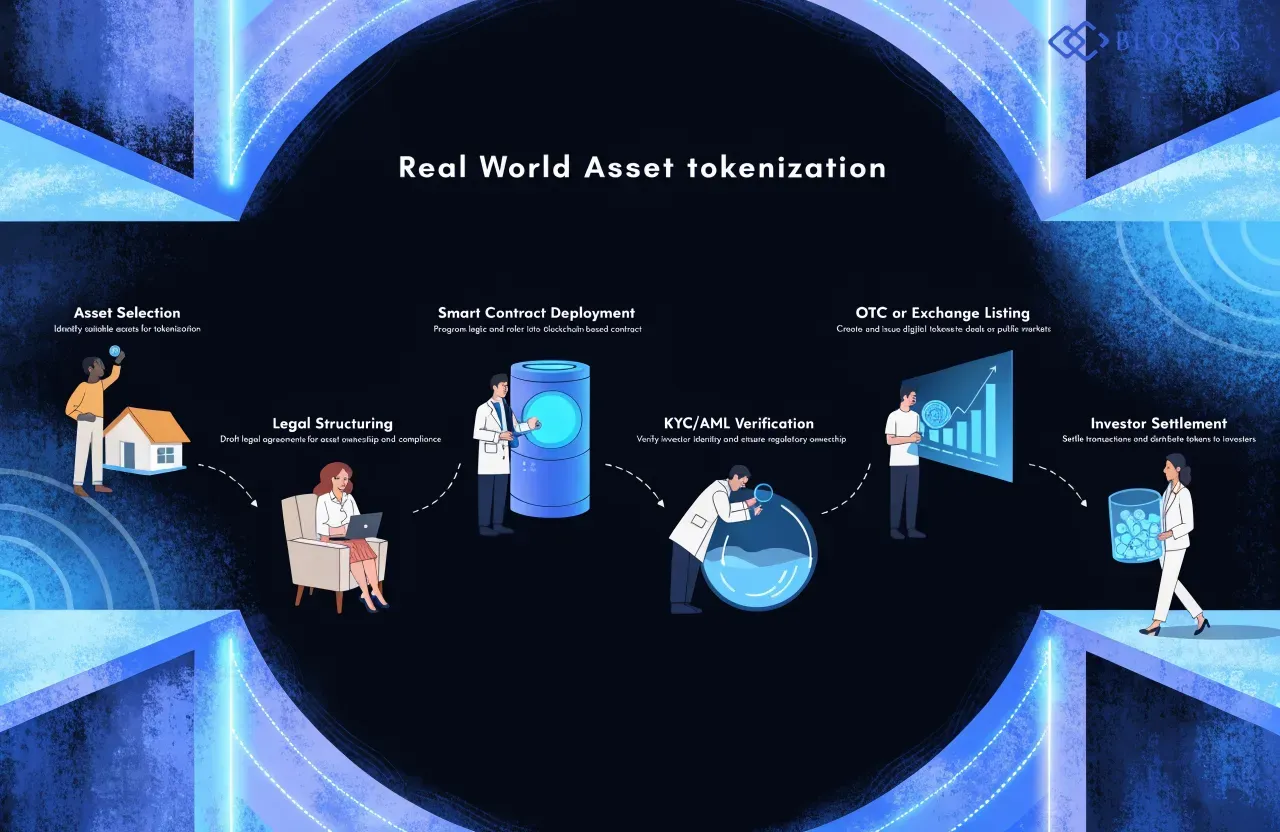
Real World Asset tokenization extends far beyond public equities. Enterprises are now tokenizing corporate bonds, real estate, private credit, commodities, and fund shares. Each asset class brings distinct compliance and liquidity requirements, which is why generic tokenization tools often fall short.
Corporate Bond and Equity Tokenization Platforms
A Corporate Bond Tokenization Platform lets issuers fractionalize debt instruments, opening access to smaller institutional and accredited investors while automating coupon payments through smart contracts. Similarly, an Equity Tokenization Platform allows private companies to offer liquidity events without a full IPO, using programmable share classes and automated cap table updates.
Robinhood stock tokenization demonstrated retail appetite for this model. Enterprises building institutional-grade versions need stronger custody, more rigorous KYC/AML, and jurisdiction-aware smart contracts, exactly the kind of build Blocsys specializes in delivering for brokerages and asset managers.
OTC Trading Platforms and Digital Asset Exchanges
Once assets are tokenized, they need somewhere to trade. OTC Trading Platform Development has become a priority for institutions that want privacy, deep liquidity, and negotiated pricing outside public order books. Blocsys has direct experience here through its Institutional OTC Crypto Trading Platform Built on Blockchain, which supports large block trades without moving public markets.
Additionally, Decentralized Traded Funds platform development and Prediction Market Platform Development are gaining traction among fintech innovators looking to diversify beyond simple token trading.
Enterprise Security and Compliance Frameworks
Security can’t be an afterthought when real money and regulated securities move through smart contracts. Enterprise blockchain platforms need multiple layers of protection: audited smart contracts, multi-signature custody, role-based access controls, and continuous monitoring for anomalous transactions.
Compliance frameworks also vary significantly by region. The EU’s MiCA regulation, UK’s evolving digital securities sandbox, UAE’s VARA framework, and Singapore’s MAS guidelines each impose different requirements on tokenized asset issuers. Enterprises operating across these regions need platforms flexible enough to adapt compliance logic per jurisdiction, again enforced through smart contracts rather than manual policy documents.
Investor Onboarding, KYC/AML, and Compliance Automation
Onboarding institutional investors onto a digital asset platform requires more than a form and a document upload. Enterprises need identity verification that integrates with global watchlists, accredited investor checks, and ongoing transaction monitoring.
When these checks get embedded into smart contracts, onboarding friction drops substantially. An investor verified once can transact across multiple tokenized products without repeating the entire process, provided the platform’s compliance architecture supports reusable credentials. This is where thoughtful enterprise blockchain development pays for itself many times over.
Enterprise Implementation Roadmap for Digital Asset Platforms
Enterprises exploring blockchain infrastructure often ask where to start. Based on patterns we’ve seen across successful deployments, here’s a practical roadmap:
- Define the asset classes and jurisdictions you plan to serve first
- Choose between a Layer 1, Layer 2, or hybrid chain architecture based on cost and throughput needs
- Build or integrate a compliant custody and identity verification layer
- Develop and audit smart contracts governing issuance, transfer, and settlement
- Connect trading, OTC, or exchange infrastructure for liquidity
- Run a regulated pilot with a limited investor pool before scaling
- Expand asset coverage and cross-chain interoperability post-launch
This sequence mirrors what Robinhood Chain did at scale, just compressed for enterprises that don’t have years to iterate. Teams considering this path often start with a Founder Checklist 2026: Blockchain Startup Guide to map out priorities before writing a single contract.
Real-World Enterprise Use Cases
Enterprise blockchain infrastructure now extends well beyond trading. Consider a few examples worth studying.
Supply chain finance firms use blockchain-based traceability to verify goods provenance before releasing tokenized trade finance. Blocsys built exactly this kind of system through its Blockchain Supply Chain Traceability System for Manufacturing.
Document-heavy industries face similar challenges around authenticity. A Tamper-Proof Document Verification Platform Built on Blockchain ensures ownership records, certifications, and legal documents can’t be forged or altered.
Even certification and food safety industries benefit. A Blockchain-Powered Organic Certification & Food Traceability Platform uses similar smart contract logic to verify claims from farm to shelf. These use cases prove the same infrastructure powering Robinhood Chain applies across industries far beyond stock trading.
Post-Trade Operations and Reconciliation
Post-trade reconciliation remains one of the most expensive, error-prone processes in capital markets. Permissioned blockchain infrastructure, like the approach used in Blocsys’ Permissioned Blockchain Infrastructure for Capital Market Post-Trade Operations, eliminates redundant record-keeping between counterparties by giving everyone access to the same verified ledger.
Robinhood Chain and the Future of Enterprise Blockchain Innovation
Where does this go next? Expect deeper AI integration paired with blockchain infrastructure, using machine learning for fraud detection, liquidity forecasting, and automated compliance reporting across smart contracts. Cross-chain interoperability will keep improving, letting tokenized assets move between ecosystems without friction.
Moreover, expect more brokerages and exchanges to launch their own purpose-built chains, following Robinhood’s playbook rather than relying entirely on shared public infrastructure. This “build your own rails” trend will likely define enterprise blockchain development through the rest of the decade.
Challenges Enterprises Still Need to Solve
None of this comes without friction. Regulatory fragmentation across the US, UK, EU, and Asia-Pacific still forces enterprises to build jurisdiction-aware compliance logic rather than one-size-fits-all contracts. Liquidity for tokenized private assets remains thin compared to public markets. Additionally, talent shortages in blockchain engineering continue to slow enterprise timelines.
These challenges are exactly why enterprises increasingly choose experienced partners instead of building in-house from scratch.
Why Blocsys Is the Ideal Enterprise Blockchain Development Partner
Blocsys works at the intersection of blockchain, AI, fintech, and enterprise software, building the exact kind of infrastructure Robinhood Chain represents at scale. From asset tokenization to OTC trading platforms, document verification, and post-trade reconciliation, Blocsys delivers secure, compliant, and scalable digital asset platforms for brokerages, exchanges, asset managers, and fintech innovators.
Whether you’re planning a Corporate Bond Tokenization Platform, an Equity Tokenization Platform, an IDO Launchpad, or a full enterprise Web3 platform, Blocsys brings the engineering depth and regulatory awareness needed to launch confidently. The Asset Tokenization Platform offered by Blocsys gives institutions a proven foundation rather than a risky ground-up build.
PONS and the Emerging Application Layer on Robinhood Chain
The growth of Robinhood Chain is also creating opportunities for specialized applications built around token issuance and on-chain trading. pons is one example, providing a non-custodial platform where users can launch and explore fixed-supply tokens directly on Robinhood Chain. Each launch creates the token and its WETH trading pool in the same transaction, while users approve launches and trades through their own wallets. This model illustrates how Robinhood Chain can support more than tokenized financial assets by providing infrastructure for specialized digital asset applications, token markets, and permissionless trading experiences. For enterprises exploring Robinhood Chain development, emerging platforms such as pons highlight the opportunity to build application-layer products that combine token creation, liquidity, wallet connectivity, and on-chain market activity.
Frequently Asked Questions
Here are direct answers to the questions we hear most often about Robinhood Chain and enterprise blockchain development.
What is Robinhood Chain and how is it transforming enterprise blockchain development?
Robinhood Chain is a Layer 2 blockchain built on Arbitrum, designed to support tokenized stocks, crypto trading, and other digital asset services. It matters for enterprise blockchain development because it proves regulated financial products can run on programmable infrastructure at scale.
Enterprises now study its architecture, smart contract logic, and compliance design as a blueprint for building their own tokenization platforms, rather than treating blockchain as an experimental side project.
How does Robinhood Chain support digital asset platforms?
Robinhood Chain supports digital asset platforms by combining tokenization, custody, and smart contracts into one integrated system. Transfers, compliance checks, and settlement all execute through automated contract logic rather than manual back-office processes.
This structure gives Robinhood tokenized securities faster settlement and stronger auditability compared to traditional brokerage infrastructure, a model enterprises are now replicating for their own digital asset ecosystems.
Why are enterprises adopting blockchain-based digital asset platforms?
Enterprises adopt these platforms because they cut settlement times, reduce reconciliation costs, and open access to previously illiquid assets through fractionalization. Smart contracts automate compliance checks that used to require entire back-office teams.
Furthermore, 24/7 trading availability and cross-border settlement without correspondent banking delays give enterprises a competitive edge, especially firms operating across the US, UK, UAE, and Singapore simultaneously.
What compliance requirements should enterprises consider when building digital asset platforms?
Enterprises need to account for jurisdiction-specific rules like MiCA in the EU, VARA in the UAE, and MAS guidelines in Singapore. KYC/AML verification, accredited investor checks, and transfer restrictions should be embedded directly into smart contracts wherever possible.
Working with a partner experienced in multi-jurisdiction compliance automation, rather than treating compliance as a bolt-on feature, significantly reduces regulatory risk during launch and scaling.
How much does it cost to build an enterprise blockchain and digital asset platform?
Costs vary widely based on asset classes, chain architecture, and compliance complexity, typically ranging from a focused MVP to a multi-million dollar full-scale platform. Key cost drivers include smart contract development, custody infrastructure, KYC/AML integration, and regulatory legal work.
Partnering with an established enterprise blockchain development company like Blocsys often reduces total cost by avoiding rebuilds and leveraging existing, audited infrastructure components instead of starting from zero.
Conclusion: Building Your Enterprise Blockchain Future
Robinhood Chain didn’t just launch a product, it validated a direction the entire financial industry was already moving toward. Smart contracts, tokenized securities, and Layer 2 scalability are no longer experimental concepts reserved for crypto-native firms. They’re becoming standard infrastructure for brokerages, asset managers, and fintech companies worldwide.
If your organization is exploring enterprise blockchain development, digital asset platforms, or Real World Asset tokenization, the time to act is now, not after competitors have already captured the market. Blocsys stands ready to help you build secure, compliant, and scalable infrastructure, starting with a conversation about your goals.
Explore the Asset Tokenization Platform from Blocsys, or reach out directly to discuss Corporate Bond Tokenization, Equity Tokenization, OTC Trading Platform Development, IDO Launchpad Development, or full enterprise blockchain consulting services tailored to your institution’s needs.
Ready to move beyond theory and build an intelligent platform that delivers real-world value? Blocsys Technologies specialises in engineering enterprise-grade AI and blockchain solutions for the fintech, Web3, and digital asset sectors. Connect with our experts today to discuss your vision and chart a clear path from concept to a secure, scalable reality.
