
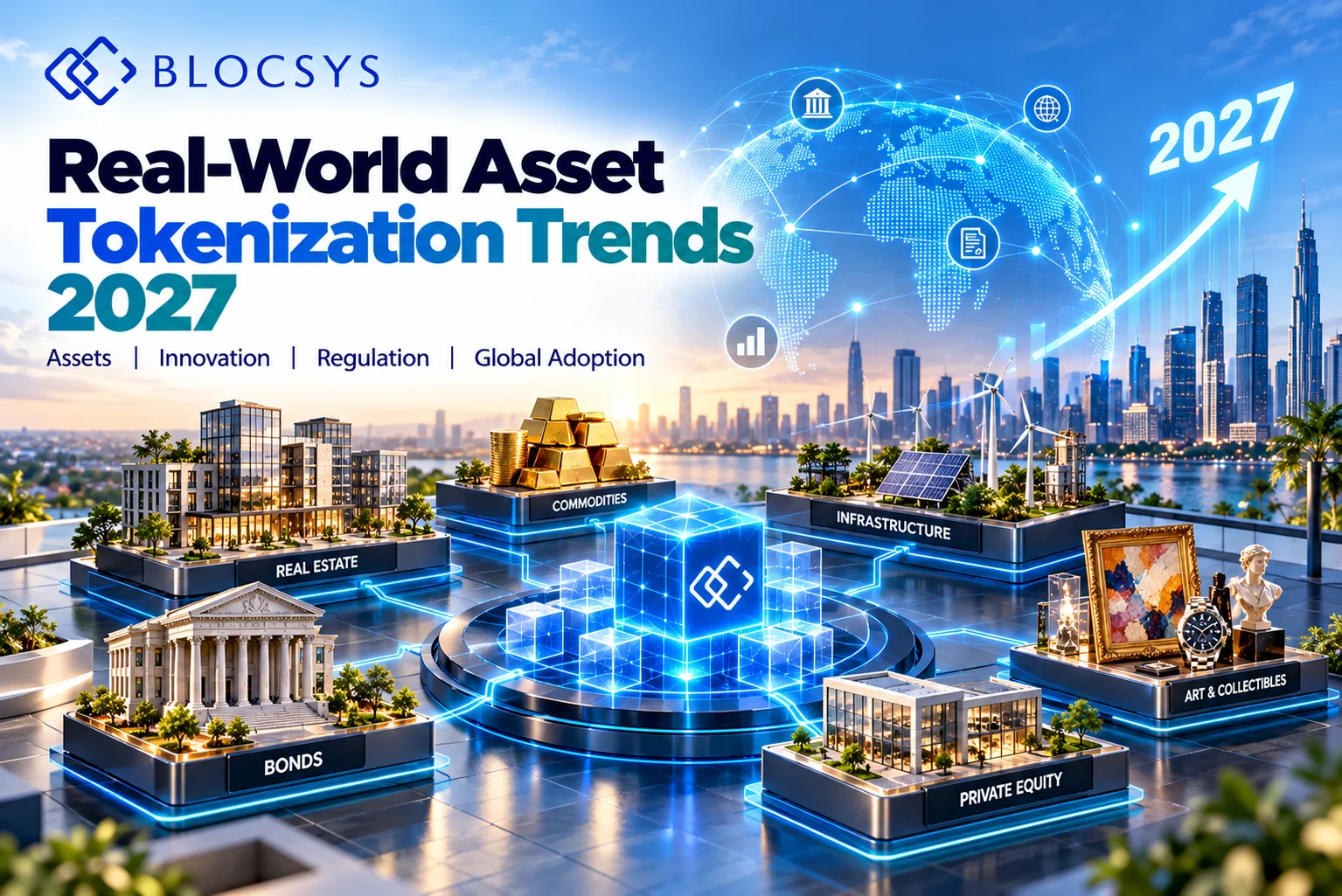
Real-World Asset Tokenization Trends in 2027: What Businesses Need to Know
Real world asset tokenization trends 2027 are reshaping how banks, asset managers, and fintech firms think about ownership, settlement, and liquidity. Bonds, equities, real estate, and even infrastructure projects are moving onto blockchain rails, and the pace is picking up. You don’t need to be a crypto-native firm to feel this shift; traditional finance is already testing tokenized instruments at scale. However, moving from pilot programs to production infrastructure raises real questions about compliance, custody, and interoperability. This article walks through what’s confirmed today, what regulators and institutions are signaling for 2027, and what remains forecast rather than fact. If you’re evaluating real-world asset tokenization for your business, understanding these trends now will save you costly missteps later.
What Is Real-World Asset Tokenization?
Real-world asset tokenization is the process of representing ownership rights to a physical or financial asset as a digital token on a blockchain. The token doesn’t replace the underlying asset; it represents a legal or economic claim to it, recorded and transferred through code rather than paper. Bonds, equities, real estate, commodities, funds, and even carbon credits can all be tokenized this way.
Unlike cryptocurrency, which exists natively on-chain, tokenized real-world assets depend on a legal wrapper connecting the token to an off-chain asset. That’s why custody, legal enforceability, and regulatory recognition matter just as much as the underlying technology. A tokenized bond, for instance, still needs a trustee, an issuer, and a compliant settlement process behind it.
Why Is RWA Tokenization Gaining Enterprise and Institutional Adoption?
Institutions are adopting RWA tokenization because it cuts settlement times, reduces reconciliation costs, and opens access to fractional ownership. Traditional settlement cycles for bonds and equities can take one to two days; tokenized instruments can settle near-instantly on permissioned ledgers. Consequently, firms free up capital that would otherwise sit locked during settlement.
Major asset managers running tokenized money market funds have already shown this works at scale. Meanwhile, central banks in Singapore, the UK, and the European Union have run wholesale tokenization pilots examining how tokenized deposits and securities interact with existing payment systems, through programs like Singapore’s Project Guardian and the Bank of England’s wholesale settlement work. These aren’t speculative; they’re documented initiatives. Therefore, enterprises evaluating real world asset tokenization trends 2027 can point to real precedent, not just theory.
Key Real World Asset Tokenization Trends to Watch in 2027
So, what are the real world asset tokenization trends 2027 that matter most to decision-makers? Based on current regulatory direction and institutional pilots, a few patterns stand out: expansion beyond bonds into equities and funds, maturing compliance infrastructure, and stronger interoperability between blockchain networks and legacy financial systems. Asset tokenization trends 2027 show the clearest momentum in fixed income, with equities and real estate following at a slower pace. None of this is guaranteed, but each trend has visible movement behind it today.
Below, we break down how tokenization trends 2027 are likely to play out across specific asset classes, along with the infrastructure businesses will need to support them.
Tokenization of Corporate Bonds and Fixed-Income Assets
Fixed-income has been the clearest proof point for tokenization so far. Governments, development banks, and corporations have issued tokenized bonds in Hong Kong, through the European Investment Bank, and across several private markets, settling trades in hours instead of days. By 2027, expect more corporate issuers to treat tokenized bond issuance as a standard settlement option rather than an experiment.
Smart contracts can automate coupon payments and maturity redemptions, cutting manual reconciliation. Businesses exploring this path often start with corporate bond tokenization platforms that handle issuance, investor onboarding, and lifecycle automation together, rather than building each piece separately.
Tokenized Equity and Private Markets
Private equity and venture-backed companies face a persistent liquidity problem: shares stay illiquid for years. Tokenized equity addresses this by enabling fractional, transferable ownership records on a compliant ledger, subject to transfer restrictions set by the issuer.
Several private market platforms already let accredited investors trade tokenized shares in secondary markets. Still, public equity tokenization at major exchanges remains in early stages, with regulators in the US and EU studying frameworks rather than approving broad rollouts. Firms building this capability typically work with an equity tokenization platform development partner to manage cap tables, investor accreditation, and transfer rules on-chain.
Tokenized Real Estate and Infrastructure Assets
Real estate tokenization splits property ownership into digital shares, letting investors buy fractional stakes instead of whole properties. This works well for commercial real estate funds, REITs, and infrastructure projects, where ticket sizes are typically large.
Dubai’s land authority and several platforms across the US and Europe have piloted tokenized property registries and fractional ownership models. Settlement still runs through title registries and local property law, so tokenization here complements existing legal frameworks rather than replacing them. That distinction matters for any business evaluating this asset class.
Expansion of Institutional Tokenization Platforms
Large custodians and asset managers are building dedicated tokenization infrastructure instead of relying on public crypto exchanges. This includes permissioned networks, tokenized fund structures, and institutional-grade settlement rails built specifically for regulated assets.
As this trend continues, businesses without in-house blockchain teams will likely turn to an asset tokenization platform built for compliance and scale, rather than assembling infrastructure from scratch.
Tokenization doesn’t succeed because the technology is novel. It succeeds when it quietly removes friction institutions have tolerated for decades: settlement delays, reconciliation errors, and locked-up capital.
![Real world asset tokenization trends 2027 — [Flow diagram showing the tokenization process: Asset Selection → Legal Structuring → Smart Contract Deployment → Token Issuance → Investor Onboarding → Secondary Market Trading]](https://s3.blocsys.com/blocsys/blog-images/1791417856292-fe7c283537164736.webp)
Smart Contracts and Automated Asset Lifecycle Management
Smart contracts are self-executing code that automate specific steps in an asset’s lifecycle, such as coupon payments, dividend distribution, or redemption at maturity. They don’t eliminate legal agreements; they execute predefined terms once conditions are met, cutting manual processing and settlement errors.
For a tokenized bond, a smart contract might trigger interest payments automatically on a schedule. For tokenized equity, it might enforce transfer restrictions so shares can’t move to non-accredited investors. Lifecycle management becomes less about spreadsheets, more about code that’s auditable and version-controlled. Businesses building this layer need rigorous testing, since a flawed contract can affect thousands of token holders at once. That’s a risk worth taking seriously.
Compliance-Aware Tokenization Infrastructure
What compliance requirements apply to tokenized real-world assets? Tokenized securities generally fall under existing securities law, not a separate crypto category. In the US, the SEC continues applying existing securities frameworks to tokenized instruments; in the EU, the Markets in Crypto-Assets regulation (MiCA) and the DLT Pilot Regime set rules for trading tokenized financial instruments. The UK’s FCA and Singapore’s MAS have each published guidance addressing tokenized securities and digital assets.
Because of this, RWA tokenization 2027 infrastructure needs built-in KYC, investor accreditation checks, and transfer restrictions enforced at the smart contract level, not bolted on afterward. Businesses that treat compliance as an afterthought tend to rebuild platforms later at real cost. Working with a blockchain consulting partner early helps map regulatory requirements to technical architecture before development starts.
Interoperability and Integration With Financial Systems
Tokenized assets are only useful if they connect to the systems institutions already run: custodial platforms, core banking software, payment rails, and existing settlement networks. Without interoperability, tokenization just creates another isolated system for back-office teams to reconcile by hand.
Industry groups, including the Depository Trust & Clearing Corporation and SWIFT, have run pilots connecting tokenized asset networks to traditional settlement infrastructure. Additionally, cross-chain standards are maturing, letting tokenized assets move between blockchain networks without losing compliance metadata. Ask any vendor directly: does this platform integrate with our existing core systems, or does it require a separate process?
![Real world asset tokenization trends 2027 — [Flow diagram showing compliance-aware tokenization architecture: Investor KYC/AML Check → Smart Contract Transfer Rules → Regulatory Reporting Layer → Custodian Settlement → Audit Trail]](https://s3.blocsys.com/blocsys/blog-images/1791417856838-b5faab4cff62c77d.webp)
Liquidity and Secondary Markets for Tokenized Assets
How can RWA tokenization improve liquidity and secondary-market trading? Fractional ownership lowers minimum investment sizes, widening the pool of eligible buyers for assets that were previously illiquid, like private credit or commercial property. That broader pool, in theory, supports more active secondary trading.
That said, liquidity doesn’t appear automatically just because an asset is tokenized. A token still needs active buyers, transparent pricing, and a venue where trades can legally settle. Licensed digital asset exchanges in Singapore, Switzerland, and the US now list tokenized securities, but trading volumes remain modest next to public equity markets. Expect secondary-market depth to grow gradually through 2027, not suddenly, as licensed venues and market makers build out order books over time.
Custody and Institutional Digital Asset Infrastructure
Custody answers a simple but critical question: who holds the keys controlling a tokenized asset, and what happens if something goes wrong? Institutional investors won’t commit serious capital without qualified custodians, insurance coverage, and clear recovery procedures.
Regulated custodians, including bank-affiliated trust companies, now offer digital asset custody built for institutional clients, often combining cold storage, multi-signature controls, and regulatory reporting. For enterprises, choosing a custody partner isn’t just a technical decision; it’s a legal and risk-management one too. Any tokenization strategy that skips this step stays incomplete, no matter how strong the underlying smart contracts are.
Challenges Businesses Must Consider Before Tokenizing Assets
Tokenization isn’t a plug-and-play upgrade. Regulatory clarity still varies by jurisdiction, and what’s permitted in Singapore or the UAE may not work the same way in the US or EU. Businesses operating across borders need legal review in each market they intend to serve.
Beyond regulation, technical risk matters too. Smart contract bugs, oracle failures, and custody breaches have caused real losses across the broader digital asset industry. Furthermore, market education remains a hurdle; many institutional allocators still don’t fully grasp how tokenized instruments differ from cryptocurrency speculation. Budget time for investor education, not just technology development.
Short version: tokenization adds complexity before it removes it.
How Businesses Can Prepare for Real World Asset Tokenization Trends in 2027
How can businesses build and implement an RWA tokenization platform responsibly? Preparing early for real world asset tokenization trends 2027 means starting with the asset class you understand best, bonds, funds, or real estate, rather than trying to tokenize everything at once. Map the legal structure first, then build technology around it, not the other way around.
Next, choose infrastructure partners who understand both blockchain architecture and financial compliance. Teams without this dual expertise often ship platforms that work technically but fail regulatory review. Businesses needing specialized talent sometimes choose to hire real-world asset tokenization developers rather than building an internal team from zero, especially for a first project.
Finally, plan for custody, reporting, and secondary-market access from day one. Retrofitting these later costs more and takes longer.
What Real World Asset Tokenization Trends in 2027 Could Mean for Enterprises
For enterprises, real world asset tokenization trends 2027 point toward faster settlement, broader investor access, and new product categories built on programmable ownership. Treasury teams could manage tokenized money market funds for intraday liquidity. Asset managers could launch tokenized fund share classes alongside traditional ones.
However, these outcomes depend on regulatory clarity and institutional infrastructure maturing together. We’ve seen pilots succeed technically while waiting years for regulatory frameworks to catch up. Treat real world asset tokenization 2027 projections as a direction, not a deadline, and build flexible architecture that can adapt as rules firm up.
The businesses that win with tokenization aren’t the ones who move fastest. They’re the ones who build compliance into the architecture instead of retrofitting it after a regulator starts asking questions.
![Real world asset tokenization trends 2027 — [Flow diagram showing institutional RWA adoption pathway: Pilot Program → Regulatory Sandbox Testing → Custody and Compliance Integration → Secondary Market Listing → Full-Scale Institutional Adoption]](https://s3.blocsys.com/blocsys/blog-images/1791417856536-46781964eea53d6d.webp)
Final Thoughts on RWA Tokenization Trends 2027
Real world asset tokenization trends 2027 aren’t a distant forecast; they’re already visible in bond issuances, fund structures, and institutional pilots running today. What’s less certain is pace. Equities, broad secondary liquidity, and cross-border interoperability will likely take longer than enthusiasts expect, while fixed-income and fund tokenization keep advancing steadily.
Businesses that start preparing now, legally, technically, and operationally, will be ready to move when the market does. If you’re assessing where real-world asset tokenization fits your roadmap, Blocsys works with financial institutions and enterprises on tokenization platform development, corporate bond and equity tokenization, smart contract development, and blockchain consulting built for regulated environments. It’s worth a conversation before your next project kicks off.
Frequently Asked Questions
Here are direct answers to the questions we hear most often about real world asset tokenization trends 2027.
What is RWA tokenization and how does it work?
RWA tokenization converts ownership rights to a physical or financial asset into a digital token on a blockchain. A legal structure connects the token to the underlying asset, while smart contracts handle transfers, payments, and compliance checks.
What are the key RWA tokenization trends for 2027?
Expect continued growth in tokenized bonds and funds, early expansion into tokenized equity, stronger compliance tooling, and better interoperability between blockchain networks and traditional financial systems. Broad public-market adoption is still developing.
Which real-world assets can be tokenized?
Corporate bonds, equities, real estate, commodities, investment funds, carbon credits, and infrastructure assets can all be tokenized, provided a legal framework recognizes the token as a valid claim to the asset.
How does tokenized bond issuance work?
An issuer structures the bond legally, then deploys a smart contract that issues tokens representing ownership. Coupon payments and redemptions execute automatically based on the terms coded into the contract.
How does tokenized equity work for businesses and investors?
Tokenized equity represents company shares as digital tokens, often with built-in transfer restrictions for accredited investors. Investors hold and trade shares on a compliant ledger instead of relying solely on paper share registries.
How can real estate assets be tokenized?
A property’s ownership gets divided into digital shares, each representing a fractional stake. Local property law and title registries still govern legal ownership, so tokenization works alongside existing real estate regulations.
Why are financial institutions adopting RWA tokenization?
Institutions adopt tokenization to cut settlement times, reduce reconciliation costs, and reach investors through fractional ownership. Documented pilots from central banks and major asset managers have shown measurable settlement efficiency gains.
What role do smart contracts play in RWA tokenization?
Smart contracts automate lifecycle events like interest payments, dividend distribution, and transfer restrictions. They execute the terms of a legal agreement without manual processing, cutting errors and delays.
What compliance requirements apply to tokenized real-world assets?
Tokenized securities typically fall under existing securities law. Regulators including the SEC, the EU under MiCA, the UK’s FCA, and Singapore’s MAS apply established financial regulation to tokenized instruments rather than a separate framework.
How can businesses build and implement an RWA tokenization platform?
Start by selecting one asset class, structure the legal framework first, then build smart contracts and compliance tooling around it. Partnering with experienced tokenization developers reduces the risk of rebuilding later for regulatory gaps.
Ready to move beyond theory and build an intelligent platform that delivers real-world value? Blocsys Technologies specialises in engineering enterprise-grade AI and blockchain solutions for the fintech, Web3, and digital asset sectors. Connect with our experts today to discuss your vision and chart a clear path from concept to a secure, scalable reality.
