
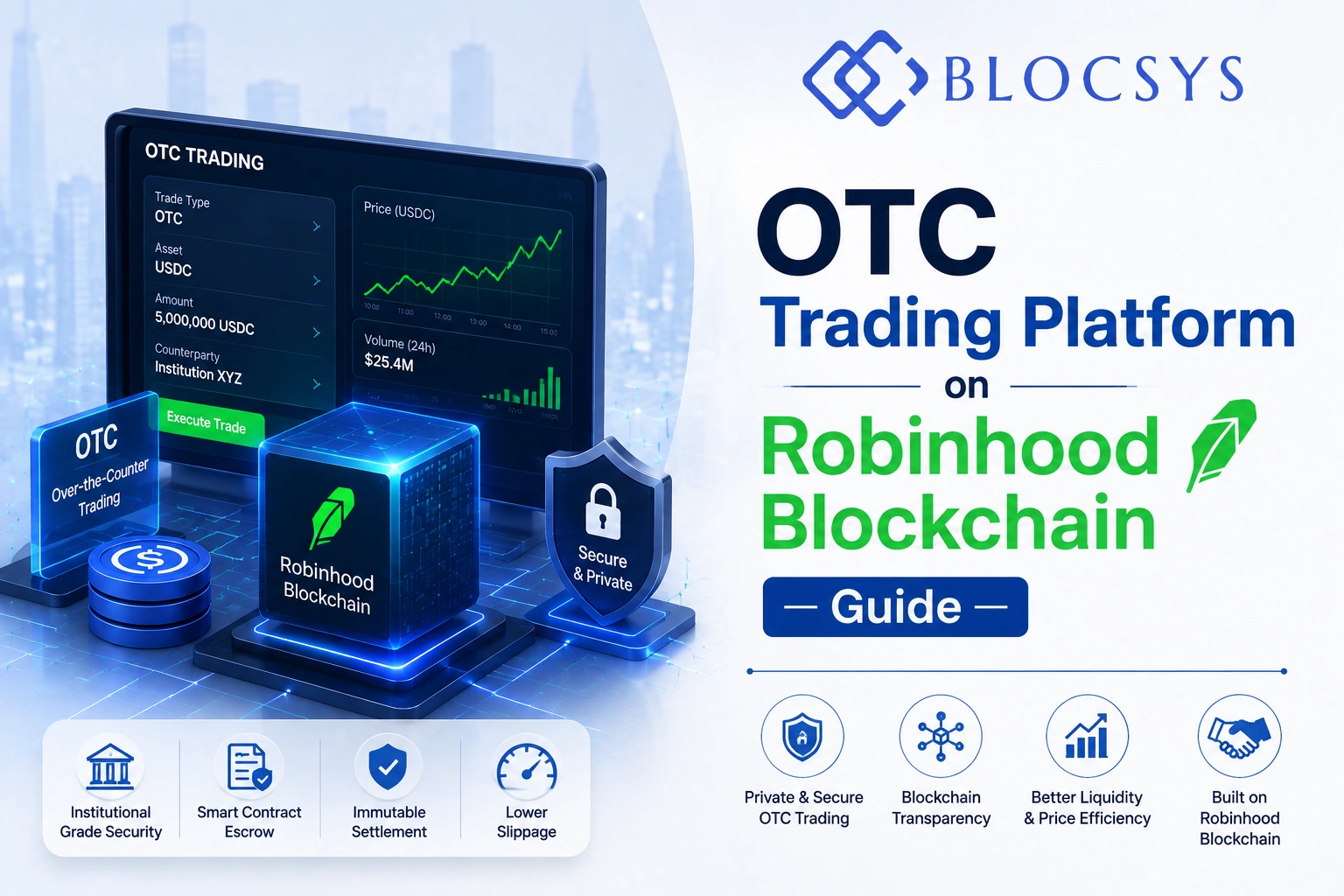
From Idea to Launch: Building an OTC Trading Platform on Robinhood Blockchain
If you’re an exchange founder, a brokerage CTO, or a Web3 product lead, you’ve probably noticed the buzz around institutional crypto rails picking up fast in 2026. Building an OTC Trading Platform on Robinhood Blockchain is quickly becoming one of the most talked-about opportunities for enterprises that want fast, transparent, and compliant large-block trading infrastructure. This guide walks you through what Robinhood Blockchain actually is, how OTC trading works on it, and how you can go from a rough idea to a live, enterprise-grade platform. Along the way, we’ll reference how firms like Blocsys approach OTC Trading Platform Development for institutions that can’t afford downtime, slippage, or compliance gaps.
We’re writing this for people who’ve already decided OTC trading matters to their business. You don’t need convincing that institutional demand for digital assets is real. What you need is a clear technical and strategic roadmap — and that’s exactly what follows.
What Is Robinhood Blockchain, Really?
Robinhood Blockchain is the Layer-2 network Robinhood built to support tokenized assets, on-chain settlement, and expanded trading infrastructure beyond its original retail brokerage app. It’s built using Arbitrum’s technology stack, giving it Ethereum-grade security with dramatically lower transaction costs and faster finality.
Here’s why that matters for OTC desks specifically. Traditional OTC trading has always relied on phone calls, bilateral credit lines, and manual settlement that can take days. Robinhood’s blockchain infrastructure flips that model. Trades settle on-chain, wallets hold verifiable custody, and smart contracts enforce terms automatically. Consequently, counterparty risk drops sharply compared to legacy OTC desks.
Robinhood Blockchain isn’t just a settlement layer either. It’s positioned as a full ecosystem — tokenized equities, crypto assets, and eventually a broader marketplace of on-chain financial instruments. That’s precisely why an OTC Trading Platform on Robinhood Blockchain makes sense for firms chasing institutional-grade digital asset trading in 2026.
Understanding OTC Trading and Institutional Digital Asset Trading
OTC trading, or over-the-counter trading, lets two parties negotiate and execute large trades directly, away from public order books. Why does this matter? Because dumping a $10 million crypto order onto a public exchange tanks the price before the trade even fills. Institutions need privacy, price certainty, and minimal market impact.
Traditionally, OTC desks ran on trust, relationships, and manual reconciliation. That worked fine when volumes were smaller. However, as institutional digital asset trading has scaled, manual processes have become a liability — slow settlement, opaque pricing, and compliance headaches all pile up quickly.
Blockchain-based OTC trading solves this by replacing manual trust with programmable trust. Smart contracts hold funds in escrow, release them only when conditions are met, and record every step on an immutable ledger. That’s a meaningful upgrade for any OTC Trading Platform Development effort.
Why Robinhood Blockchain Is Ideal for an OTC Trading Platform
Not every blockchain fits institutional trading. Gas volatility, slow finality, and thin liquidity kill deals. Robinhood Blockchain addresses these pain points directly, which is why so many teams are exploring a Robinhood OTC Trading Platform build right now.
Speed and Cost Efficiency
Layer-2 rollup architecture means transactions confirm in seconds, not minutes, and gas fees stay predictable. For OTC desks moving large blocks daily, that consistency matters more than raw throughput numbers on a whitepaper.
Regulatory-Friendly Infrastructure
Robinhood already operates under heavy regulatory scrutiny as a public brokerage. Its blockchain was designed with compliance hooks in mind from day one — something most permissionless chains never bothered with. That’s a real advantage for Robinhood Blockchain OTC Trading use cases involving regulated financial institutions.
Native Tokenization Support
Robinhood Blockchain supports tokenized equities and real-world assets natively. That opens the door to OTC desks trading tokenized stocks, treasuries, and crypto side by side, all settled through the same infrastructure.
Institutions don’t want ten different rails for ten different asset classes. They want one settlement layer that handles equities, stablecoins, and crypto with the same finality guarantees. That’s exactly the gap Robinhood Blockchain is trying to close, and it’s why enterprise OTC desks are paying attention.
Market Trends and Enterprise Adoption in 2026
Institutional crypto trading volume has grown steadily, and OTC desks now account for a significant share of total digital asset trading volume globally — well above what public order books handle for large trades. Meanwhile, tokenized real-world assets crossed tens of billions in on-chain value, and analysts expect that figure to keep climbing through 2026 and beyond.
What’s driving this? Corporate treasuries are diversifying into digital assets. Brokerage firms in the UK, UAE, Singapore, and across Europe are launching institutional crypto desks. Meanwhile, Dubai and Switzerland continue building regulatory frameworks that actively welcome blockchain-based finance. Consequently, demand for a well-architected OTC Trading Platform on Robinhood Blockchain is rising across nearly every major financial hub.
Additionally, AI-powered trading analytics have become table stakes rather than a nice-to-have. Enterprises now expect predictive liquidity insights, automated risk scoring, and real-time settlement monitoring baked into the platform itself.
Core Architecture of an OTC Trading Platform
Let’s get into the technical backbone. A well-built OTC trading platform isn’t one system — it’s several interconnected components working together.
- Trade negotiation layer — where buyers and sellers submit quotes or requests
- Smart contract engine — enforces trade terms and escrow logic
- Wallet infrastructure — custody, authentication, and multi-signature approvals
- Liquidity management system — sources and allocates liquidity across counterparties
- Settlement and escrow module — releases funds only when conditions clear
- Compliance engine — KYC, AML, and transaction monitoring
- AI analytics layer — pricing intelligence, risk scoring, and anomaly detection
Each piece needs to talk to the others in real time. That’s where experienced Blockchain Development Company partners earn their keep — the architecture decisions made early determine whether your platform scales gracefully or collapses under institutional trade volume later.
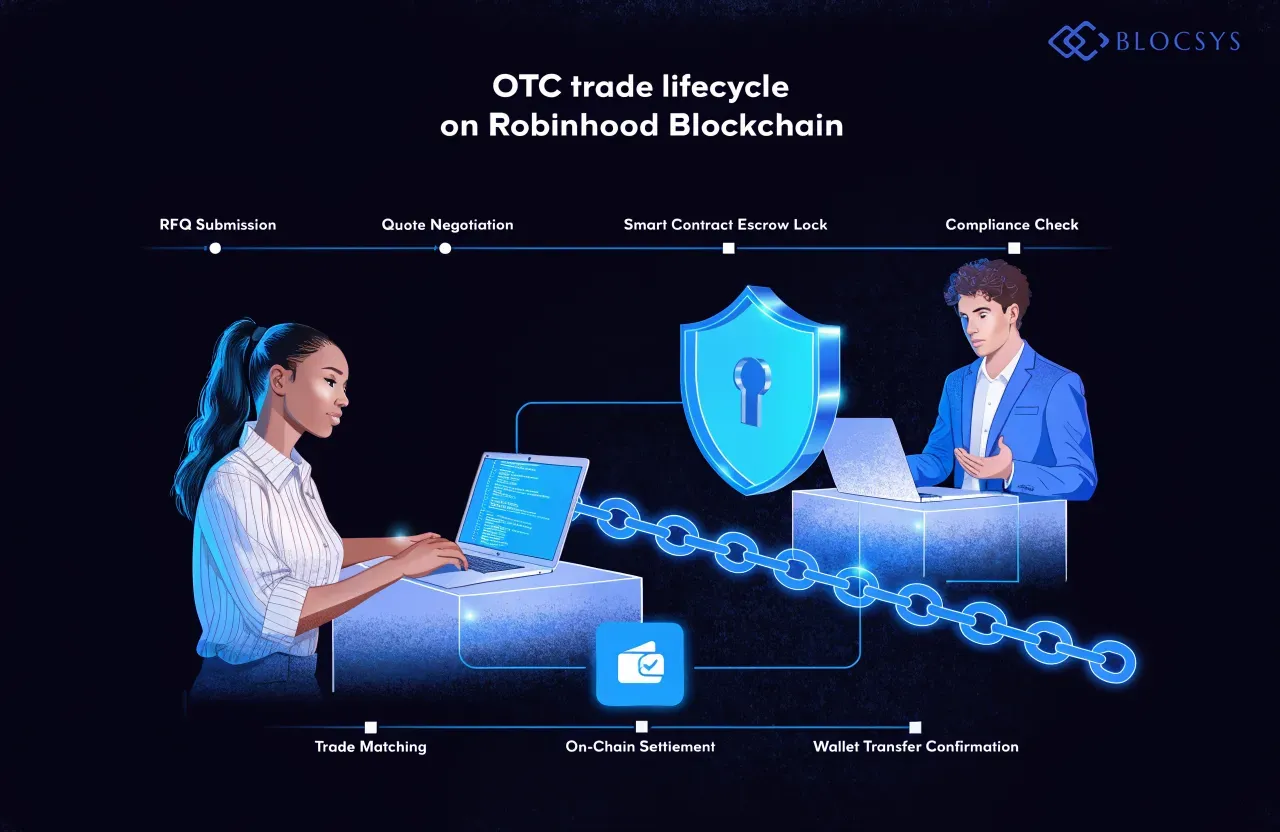
Smart Contracts Powering Robinhood Blockchain OTC Trading
Smart contracts are the engine room here. Rather than trusting a counterparty’s promise, both sides trust code that’s been audited, tested, and deployed on-chain.
In a typical OTC trading smart contract flow, the buyer’s funds get locked in escrow once a quote is accepted. The seller’s assets get verified and reserved simultaneously. Only when both conditions are satisfied does the contract execute atomic settlement — meaning both legs of the trade complete together, or neither does. That eliminates settlement risk almost entirely.
Smart contracts also handle edge cases: partial fills, quote expiration, dispute windows, and multi-party approvals for large trades. Getting this logic right requires serious Smart Contract Development expertise, because a bug in escrow logic on a live OTC desk isn’t a minor incident — it’s a headline.
Blockchain Wallets and User Authentication
Wallets aren’t just storage anymore. On an institutional platform, wallet infrastructure has to support multi-signature approvals, role-based access, and hardware security module integration. Traders, compliance officers, and settlement teams each need different permission levels within the same wallet architecture.
Robinhood Blockchain’s wallet layer supports programmable authentication, which means you can build tiered approval workflows directly into the trade flow. A junior trader might submit a quote, but only a desk head can approve settlement above a certain threshold. That’s the kind of control institutional clients demand before they’ll move real volume onto your platform.
RFQ Systems and Order Matching for OTC Trading Platforms
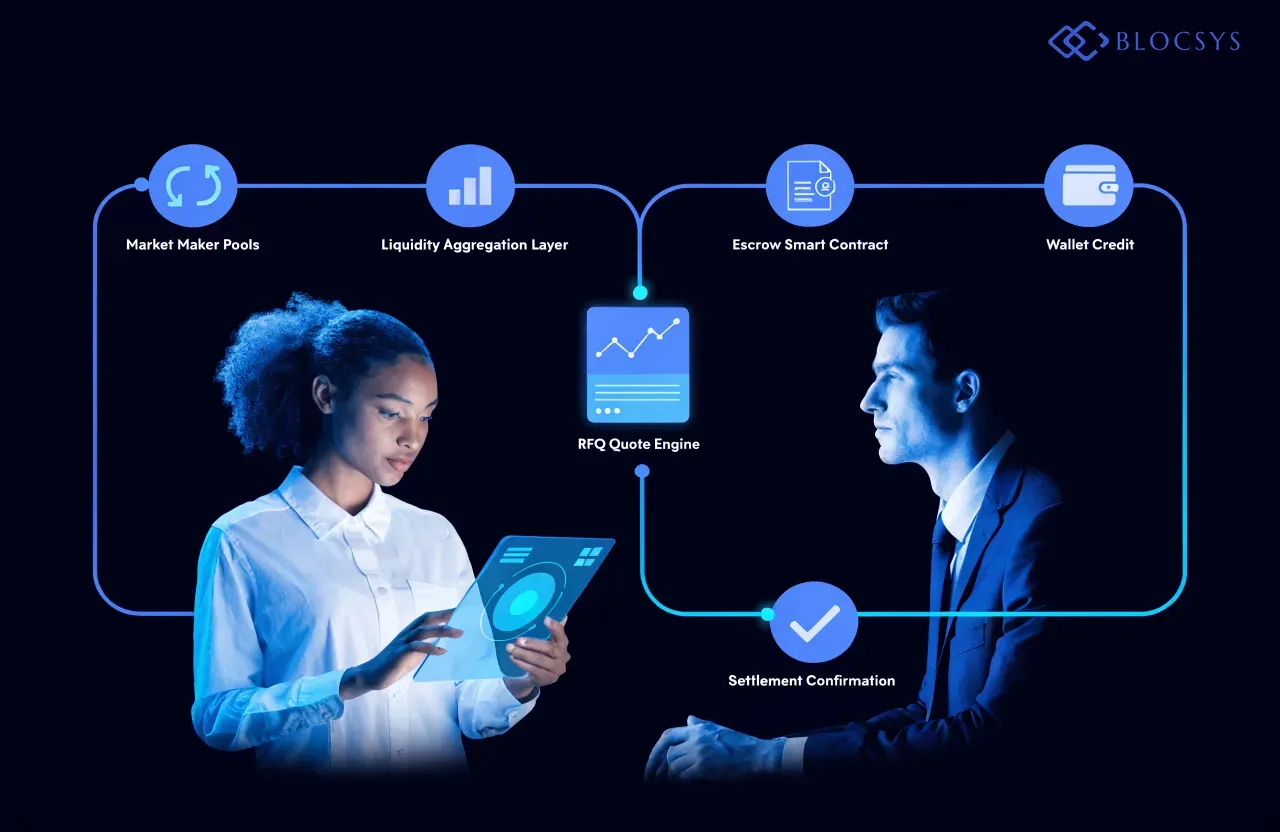
Request-for-Quote, or RFQ, sits at the heart of most OTC trading platforms. Instead of a public order book, a buyer submits a request, multiple liquidity providers respond with quotes, and the buyer picks the best one within a set time window.
Why RFQ Beats Public Order Books for Large Trades
RFQ systems protect price integrity. Nobody sees your order size until you’ve already locked in a price, which prevents front-running and slippage on large blocks. This is a defining feature of any serious Blockchain Trading Platform built for institutional flow.
Matching Engine Design
The matching engine needs to handle multi-dealer competition, timeout logic, and automatic quote expiration — all while logging everything on-chain for auditability. Latency matters here too; even a half-second delay in quote delivery can cost a desk real money on volatile assets.
Liquidity Management and Escrow-Based Settlement
Liquidity is the lifeblood of any OTC desk. Without deep, reliable liquidity pools, quotes widen, spreads grow, and institutional clients walk. A well-designed OTC Trading Platform on Robinhood Blockchain needs aggregated liquidity sourcing — pulling from multiple market makers, internal inventory, and connected liquidity pools simultaneously.
Escrow-based settlement ties directly into this. Funds get locked the moment a quote is accepted, removing any window where one party could back out after seeing market movement. Because settlement happens on-chain, both parties can verify the trade’s status in real time instead of waiting on a back-office confirmation email.
This combination — deep liquidity plus trustless escrow — is what separates a serious OTC Trading Platform from a glorified chat app with a payment button bolted on.
Layer-2 Scalability and Performance
Here’s the thing about scalability — it’s not just about handling more trades. It’s about handling more trades without sacrificing finality guarantees or spiking costs during volume surges. Robinhood Blockchain’s Layer-2 design, anchored to Ethereum’s security through Arbitrum’s rollup technology, gives OTC platforms the throughput they need without compromising trust assumptions.
Furthermore, Layer-2 architecture keeps gas costs low enough that even smaller institutional trades remain economical. That’s a real constraint on many legacy chains, where a single settlement transaction could cost more during network congestion than it’s worth for smaller trades.
Compliance and Regulatory Considerations
You can’t build institutional trading infrastructure without compliance baked in from the start. Regulators in the US, UK, EU, UAE, and Singapore all expect KYC, AML, and transaction monitoring as non-negotiable requirements — not features you bolt on later.
A properly built OTC trading platform automates much of this. Compliance engines can screen wallets against sanctions lists in real time, flag unusual trade patterns automatically, and generate audit trails that satisfy regulators without manual paperwork. Additionally, jurisdiction-specific rule sets let you configure different compliance thresholds for different markets — important if you’re serving clients across Europe, Dubai, and North America simultaneously.
This is precisely where Hire Blockchain Developers engagements with compliance-aware teams pay off. Getting this wrong doesn’t just risk fines — it risks your license to operate.
AI-Powered Trading Analytics for OTC Desks
AI has moved from novelty to necessity on institutional trading desks. Modern OTC platforms use AI-powered trading analytics to price quotes dynamically, detect anomalous trading behavior, and predict liquidity gaps before they cause execution problems.
Think about what this looks like in practice. An AI model watches historical trade data, current market volatility, and counterparty behavior patterns simultaneously. It then suggests optimal quote pricing to liquidity providers in real time. Meanwhile, a separate anomaly detection layer flags trades that deviate from normal patterns — catching potential fraud or manipulation before settlement completes.
Enterprises building an AI-powered Trading Platform alongside their OTC infrastructure gain a genuine competitive edge, especially when competing for institutional clients who expect data-driven execution quality.
Enterprise Implementation Roadmap
So how do you actually get from idea to launch? Here’s a roadmap we’ve seen work across multiple enterprise engagements.
- Discovery and architecture planning — define asset classes, jurisdictions, and compliance requirements
- Smart contract design and audit — build and test escrow, matching, and settlement logic
- Wallet and custody integration — connect institutional-grade custody solutions
- RFQ and matching engine development — build quote negotiation and execution flows
- Liquidity partner onboarding — connect market makers and internal liquidity sources
- Compliance module integration — KYC, AML, and jurisdiction-specific rule engines
- AI analytics layer deployment — pricing intelligence and anomaly detection
- Security audit and testnet trials — stress test before real capital moves
- Mainnet launch and monitoring — go live with real-time observability
Timelines vary, but most enterprise-grade builds take four to nine months depending on scope. Partnering with a specialized OTC Trading Platform Development Company compresses this considerably, since you’re not building core infrastructure from scratch.
Real-World Use Cases Across Industries
Crypto exchanges use OTC desks to handle whale trades without moving market prices. Institutional trading firms use them to build custom digital asset portfolios without slippage. Corporate treasuries increasingly hold tokenized assets and need private settlement channels for rebalancing.
Cross-border settlement is another growing use case — moving value between jurisdictions instantly instead of waiting days for traditional wire transfers. Financial institutions exploring tokenized bonds and equities also need OTC rails, since public order books aren’t suited to large institutional block trades in these newer asset classes.
Firms exploring tokenized asset trading might also look at DeFi Trading Platform Built on Blockchain solutions or a dedicated Institutional OTC Crypto Trading Platform Built on Blockchain to complement their Robinhood Blockchain deployment.
OTC Trading Platform vs Traditional Cryptocurrency Exchanges
| Feature | OTC Trading Platform | Traditional Exchange |
|---|---|---|
| Trade privacy | High — negotiated off public books | Low — visible order book |
| Price impact on large trades | Minimal | Significant slippage |
| Settlement speed | Near-instant on-chain | Varies, often delayed |
| Counterparty risk | Reduced via smart contract escrow | Exchange custody risk |
| Ideal trade size | Large, institutional blocks | Retail and mid-size trades |
Security Best Practices for Blockchain OTC Trading Platforms
Security can’t be an afterthought. Every OTC Trading Platform on Robinhood Blockchain needs multi-signature wallet controls, regular smart contract audits, and real-time monitoring for unusual on-chain activity.
Additionally, cold storage for reserve funds, rate limiting on API endpoints, and role-based access controls across internal systems all reduce attack surface. Penetration testing before launch — and continuously afterward — catches vulnerabilities before attackers do. Insurance coverage for custodial assets adds another layer of protection institutional clients increasingly expect.
Challenges and Future Opportunities
Building on newer blockchain infrastructure comes with challenges. Liquidity depth takes time to build. Regulatory frameworks are still evolving in several jurisdictions. And integrating legacy financial systems with on-chain settlement requires careful engineering.
However, the opportunity outweighs the friction. Tokenization of real-world assets is accelerating. Institutional appetite for compliant digital asset trading keeps growing. Enterprises that move now, building solid infrastructure on Robinhood Blockchain, position themselves ahead of competitors still relying on manual OTC processes.
Why Blocsys Is the Right OTC Trading Platform Development Company
Blocsys has spent years building enterprise blockchain infrastructure, smart contracts, and Web3 applications for fintech firms, exchanges, and institutional trading businesses across the US, UK, Europe, UAE, and Singapore. We understand what it takes to build a secure, scalable OTC Trading Platform on Robinhood Blockchain because we’ve built the underlying pieces before — wallets, escrow contracts, matching engines, and compliance modules.
Our team works closely with founders and enterprise technology leaders to translate business requirements into production-grade architecture. Whether you need Hire Web3 Developers support for a specific module or a full end-to-end build, Blocsys brings the technical depth institutional clients expect. We also support adjacent needs like Cryptocurrency Exchange Development and Crypto Trading Platform Development for businesses expanding beyond OTC into broader trading infrastructure.
If you’re ready to move from idea to launch, our OTC Trading Platform Development team can help you scope architecture, build smart contracts, and deploy a platform that institutional clients trust from day one.
Frequently Asked Questions
Here are direct answers to the questions we hear most often about building an OTC Trading Platform on Robinhood Blockchain.
What is an OTC Trading Platform on Robinhood Blockchain?
An OTC Trading Platform on Robinhood Blockchain is a digital infrastructure that lets institutions negotiate and settle large digital asset trades privately, using Robinhood’s Layer-2 blockchain for on-chain escrow and settlement. It replaces manual, trust-based OTC processes with smart contract automation.
This gives institutional traders faster settlement, reduced counterparty risk, and full transaction transparency without exposing trade size to public order books.
Why build an OTC Trading Platform using Robinhood Blockchain instead of other chains?
Robinhood Blockchain offers Layer-2 speed, low transaction costs, and native tokenization support built with regulatory compliance in mind from the start. That combination is rare among blockchains competing for institutional trading infrastructure.
Additionally, Robinhood’s existing brokerage reputation and regulatory relationships give enterprises more confidence when building compliant, institution-facing trading systems on top of it.
How do OTC trading smart contracts work?
OTC trading smart contracts lock buyer funds and seller assets in escrow once a quote is accepted. The contract only releases both sides simultaneously through atomic settlement, meaning the trade completes fully or not at all.
This removes the need for either party to trust the other directly, since code — not a handshake — enforces the trade terms.
What features should a blockchain OTC trading platform include?
Core features include an RFQ negotiation system, smart contract escrow, multi-signature wallets, liquidity aggregation, compliance automation, and AI-powered trading analytics for pricing and risk detection.
Enterprises should also prioritize audit trails, role-based access controls, and real-time settlement monitoring to satisfy institutional and regulatory expectations.
How does Layer-2 blockchain improve OTC trading platform performance?
Layer-2 blockchain infrastructure, like the rollup technology behind Robinhood Blockchain, dramatically reduces transaction costs and confirmation times compared to base Layer-1 networks, while still inheriting Ethereum-grade security.
For OTC desks, this means predictable settlement costs and near-instant finality, even during periods of high trading volume.
What industries can benefit from blockchain-based OTC trading platforms?
Crypto exchanges, brokerage firms, financial institutions, corporate treasuries, and Web3-native businesses all benefit from blockchain-based OTC trading. Any organization moving large digital asset positions gains from reduced slippage and faster settlement.
Cross-border payment providers and tokenized asset issuers are also increasingly adopting OTC rails for institutional-grade settlement.
How much does it cost to build an OTC Trading Platform on Robinhood Blockchain?
Costs vary based on scope, but enterprise-grade builds typically range from moderate mid-five-figure budgets for a focused MVP to significantly higher investments for full institutional platforms with AI analytics and multi-jurisdiction compliance.
Working with an experienced OTC Trading Platform Development Company helps control costs by reusing proven architecture instead of building every component from scratch.
What security measures are required for blockchain OTC trading platforms?
Essential security measures include multi-signature wallet controls, regular independent smart contract audits, cold storage for reserves, and continuous on-chain activity monitoring for anomalies.
Penetration testing, role-based access controls, and insurance coverage for custodial assets round out a strong institutional security posture.
How does blockchain improve institutional OTC trade settlement?
Blockchain replaces multi-day manual settlement with near-instant, verifiable on-chain settlement enforced by smart contracts. Both parties can confirm trade status in real time instead of waiting on back-office confirmations.
This dramatically reduces settlement risk and operational overhead compared to traditional OTC desk processes.
Why should enterprises choose Blocsys for OTC Trading Platform Development?
Blocsys combines deep blockchain engineering experience with practical knowledge of institutional trading workflows, compliance requirements, and AI-powered analytics integration. We’ve built wallets, smart contracts, and matching engines for real trading businesses.
Our team works directly with founders and enterprise leaders to deliver secure, scalable platforms — not generic templates — tailored to your specific market and regulatory footprint.
Building an OTC Trading Platform on Robinhood Blockchain in 2026 isn’t just a technical upgrade — it’s a strategic move toward faster settlement, lower counterparty risk, and institutional-grade transparency. Whether you’re an exchange, a brokerage, or a fintech startup, the infrastructure decisions you make now will shape your competitive position for years. Reach out to Blocsys to discuss your OTC Trading Platform Development project, and let’s turn your idea into a live, enterprise-ready platform.
Ready to move beyond theory and build an intelligent platform that delivers real-world value? Blocsys Technologies specialises in engineering enterprise-grade AI and blockchain solutions for the fintech, Web3, and digital asset sectors. Connect with our experts today to discuss your vision and chart a clear path from concept to a secure, scalable reality.
