
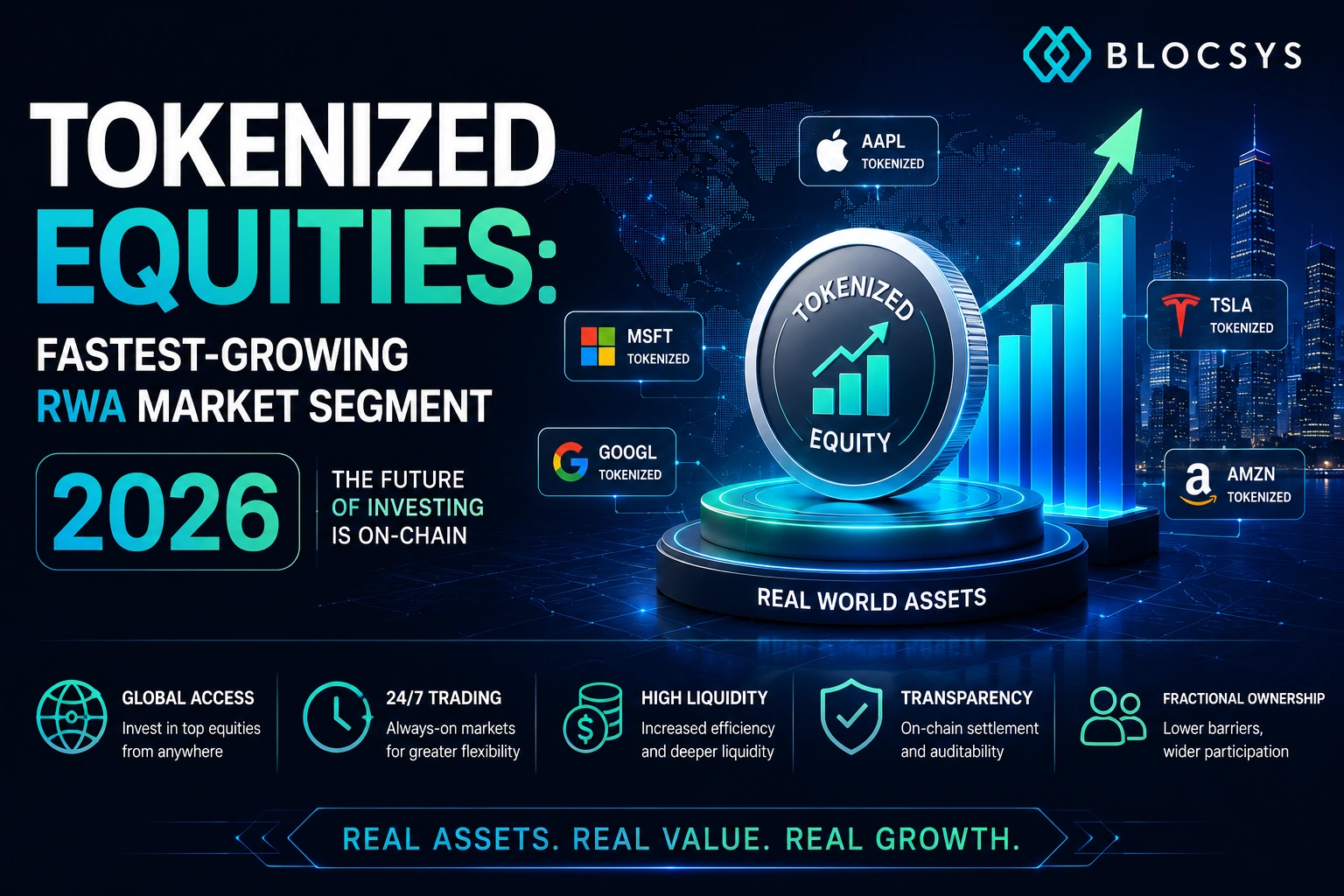
Why Tokenized Equities Are the Fastest-Growing Segment in Real-World Asset (RWA) Markets in 2026
If you’ve been tracking capital markets over the past two years, you’ve probably noticed something shift. Tokenized Equities have moved from a niche experiment to one of the most talked-about categories inside the broader Real-World Asset (RWA) movement. Institutional desks, family offices, and fintech founders are no longer asking whether equity tokenization works. They’re asking how fast they can build on it. At Blocsys, we’ve watched this shift firsthand while helping enterprises design their equity tokenization platform infrastructure, and the momentum behind Tokenized Equities in 2026 is impossible to ignore.
This article walks through why Tokenized Equities have become the fastest-growing RWA segment, what’s driving institutional demand, how the technology actually works, and what enterprises need to think through before building their own platform. We’ll also cover compliance, liquidity, global momentum, and a few real use cases you’ll recognize.
What Are Tokenized Equities?
Tokenized equities are digital representations of company shares issued and managed on a blockchain. Instead of a paper certificate or a centralized registry entry, ownership lives as a cryptographic token that carries the same economic rights as traditional stock: dividends, voting power, and capital appreciation.
Think about it this way. A traditional share sits inside a custodian’s database, updated in batches, reconciled by multiple intermediaries. A tokenized equity sits on a shared ledger, updated instantly, verifiable by anyone with permission to see it. That’s the core difference, and it’s why so many institutions are paying attention.
Unlike generic crypto assets, Tokenized Equities are backed by real ownership stakes in real companies. They’re not speculative tokens with no underlying value — they represent actual equity, governed by actual corporate law, wrapped in programmable infrastructure.
Why Tokenized Equities Are Becoming the Fastest-Growing RWA Segment
RWA tokenization overall has grown into a multi-hundred-billion-dollar conversation, spanning bonds, real estate, commodities, and private credit. However, Tokenized Equities specifically have pulled ahead for a few clear reasons.
First, equity ownership is already digital-native in spirit. Cap tables, shareholder registries, and dividend schedules were always data problems waiting for better infrastructure. Blockchain simply gives that data a programmable, auditable home.
Second, private markets are enormous and largely illiquid. Trillions of dollars sit locked in private company shares that investors can’t easily sell. Equity tokenization directly attacks that liquidity gap.
Third, institutional appetite has caught up with the technology. Major custodians, exchanges, and asset managers have spent the last three years building regulatory-grade infrastructure. Now that the rails exist, adoption is accelerating quickly.
“We’re past the pilot phase. Enterprises aren’t testing whether tokenized equity works anymore — they’re building production-grade issuance and secondary trading infrastructure because the capital efficiency gains are too significant to ignore.” — Blocsys enterprise blockchain advisory team
Market Trends and Institutional Adoption of Tokenized Equity
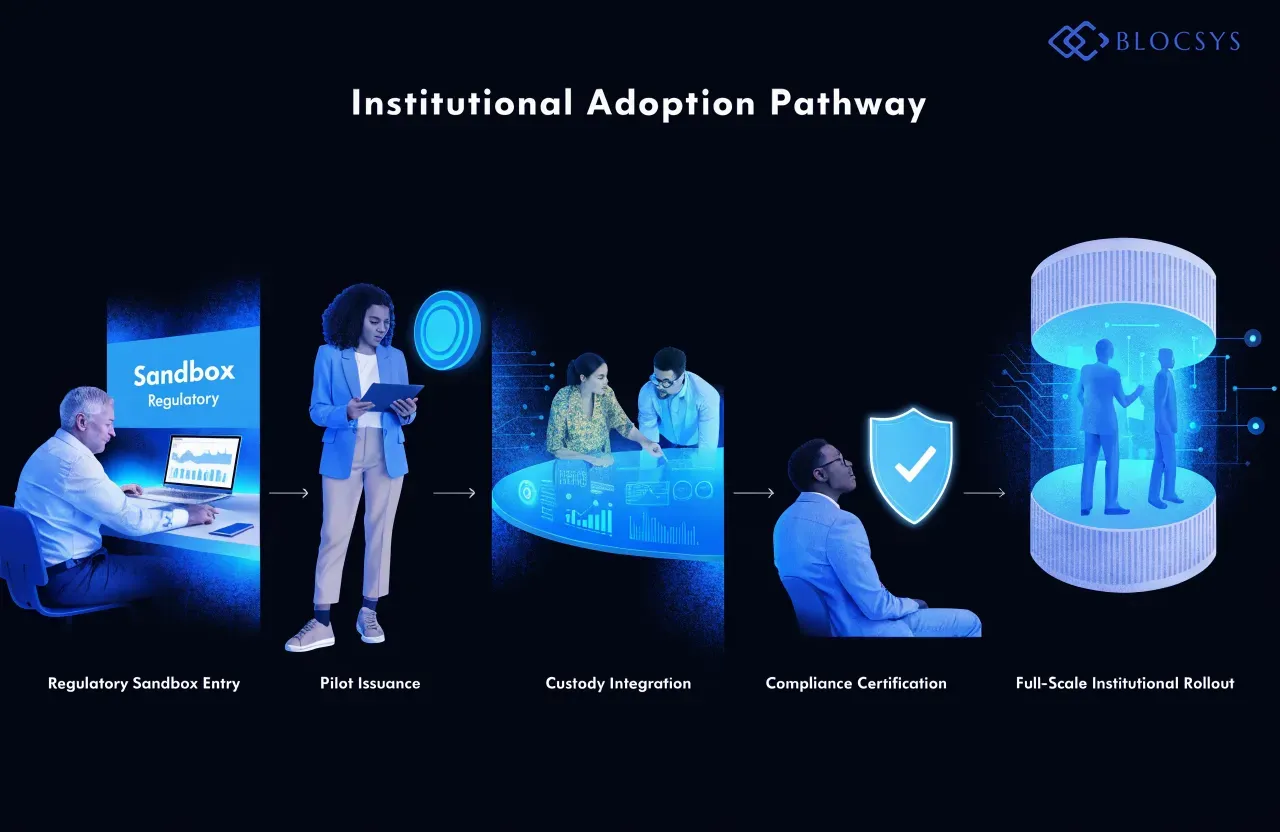
Institutional adoption is the clearest signal that Tokenized Equity has moved mainstream. Global banks, stock exchanges, and asset managers have launched tokenization pilots or full platforms across the US, Europe, UK, Singapore, and the UAE. Regulatory sandboxes in Switzerland, Germany, and Dubai have given issuers room to experiment with digital securities under supervised conditions.
Venture capital firms and private equity firms are also exploring tokenized cap tables to give limited partners better visibility and, eventually, secondary liquidity. Meanwhile, fintech companies are racing to build Equity Token Platform products that let retail and accredited investors access fractional ownership in private companies previously reserved for large-check investors.
Major Drivers Behind Tokenized Equity Growth
Several forces are converging at once, and that convergence explains why growth has accelerated so sharply in 2026.
- Institutional demand for programmable, auditable ownership records
- Investor appetite for fractional access to high-value private companies
- Regulatory clarity improving across major financial hubs
- Blockchain infrastructure maturing with enterprise-grade custody and compliance tooling
- Cost pressure pushing issuers toward automated cap table and dividend management
None of these drivers works in isolation. Together, they’re reshaping how capital markets think about equity issuance, and that’s exactly why Tokenized Equities are outpacing other RWA categories right now.
Benefits of Tokenized Equities for Enterprises and Investors
Let’s get practical. Why would a CFO or CTO actually push their board toward equity tokenization?
For enterprises, the benefits center on efficiency. Automated dividend distribution removes manual reconciliation. Smart contracts handle compliance checks in real time. Cap table updates happen instantly instead of through quarterly reconciliation cycles. That’s real operational savings, not theoretical upside.
For investors, the benefits are about access and liquidity. Fractional ownership means a $500 investor can hold a slice of a company that once required a six-figure minimum. Secondary trading venues, still emerging but growing fast, give investors an exit path that traditional private equity structures never offered.
Consequently, both sides of the transaction get something they didn’t have before: enterprises get efficiency, and investors get access. That alignment is rare in capital markets, and it’s a big part of why adoption keeps climbing.
Tokenized Equities vs Traditional Equity Ownership
| Factor | Traditional Equity | Tokenized Equities |
|---|---|---|
| Settlement Time | T+2 or longer | Near-instant, on-chain |
| Ownership Record | Centralized registry | Distributed ledger |
| Fractional Access | Limited or unavailable | Native, built into token design |
| Dividend Distribution | Manual, batch-based | Automated via smart contracts |
| Secondary Liquidity | Restricted, illiquid for private shares | Emerging on-chain secondary markets |
| Compliance Checks | Manual, periodic | Automated, continuous |
Blockchain Infrastructure Powering Tokenized Equities
Here’s where the engineering gets interesting. A production-grade Tokenized Equity Platform isn’t just a token contract sitting on a public chain. It’s a layered system.
At the base sits the blockchain layer — often a permissioned or hybrid chain that balances transparency with privacy requirements institutional issuers demand. On top of that sits the smart contract layer, which encodes ownership rules, transfer restrictions, and dividend logic. Above that sits identity and compliance infrastructure, handling KYC/AML checks before any wallet can hold or trade a token.
Custody integration matters too. Institutional investors won’t touch a platform without qualified custody support, and that’s a non-negotiable requirement Blocsys builds into every equity tokenization platform engagement.
Smart Contracts and Digital Securities Issuance
Smart contracts are the backbone of Equity Tokenization. They encode the rules that govern who can hold a token, how it transfers, and what happens when a dividend gets declared. Instead of a back-office team manually processing corporate actions, the contract executes them automatically.
For digital securities issuance specifically, smart contracts also enforce transfer restrictions tied to jurisdiction, investor accreditation status, and lock-up periods. That’s what separates a compliant Tokenized Equity Platform from a simple crypto token deployment.
Liquidity, Fractional Ownership, and Secondary Market Opportunities
Liquidity has always been the weak point of private equity. Once you’re in, you’re often stuck until an exit event years down the line. Tokenized Equities chip away at that problem directly.
Fractional ownership lowers the entry barrier, which widens the investor pool. A broader pool naturally supports more active secondary trading. Add in emerging alternative trading systems and licensed digital securities exchanges, and you get a real path toward continuous price discovery for assets that used to trade once a year, if that.
Moreover, enterprises benefit from this liquidity too. Companies with tokenized cap tables can offer employees and early investors partial liquidity events without forcing a full exit or IPO. That’s a meaningful retention and morale tool for growth-stage companies.
How Enterprises Approach Equity Tokenization Today
Enterprises exploring Blockchain Equities today typically start with a narrow use case — say, tokenizing a single funding round or a specific share class — before expanding platform-wide. This phased approach reduces regulatory risk while proving out the technology internally.
Compliance and Regulatory Considerations for Tokenized Equities
Compliance is where many tokenization projects stall, so it deserves real attention here. Every jurisdiction treats digital securities differently, and issuers need legal counsel involved from day one, not bolted on afterward.
In the US, tokenized shares generally fall under existing securities law, meaning issuers still need to work through exemptions or registration. In the UK and EU, frameworks like MiCA address crypto-assets broadly, though equity-specific tokenization often still routes through existing securities regulation. Singapore and the UAE have built progressive digital asset frameworks that many issuers view as more accommodating for pilot programs.
What matters practically is building compliance automation directly into the platform: KYC/AML checks at onboarding, transfer restrictions enforced on-chain, and audit trails that regulators can actually review. That’s not optional infrastructure. It’s the foundation everything else sits on.
Enterprise Implementation Roadmap for a Tokenized Equity Platform
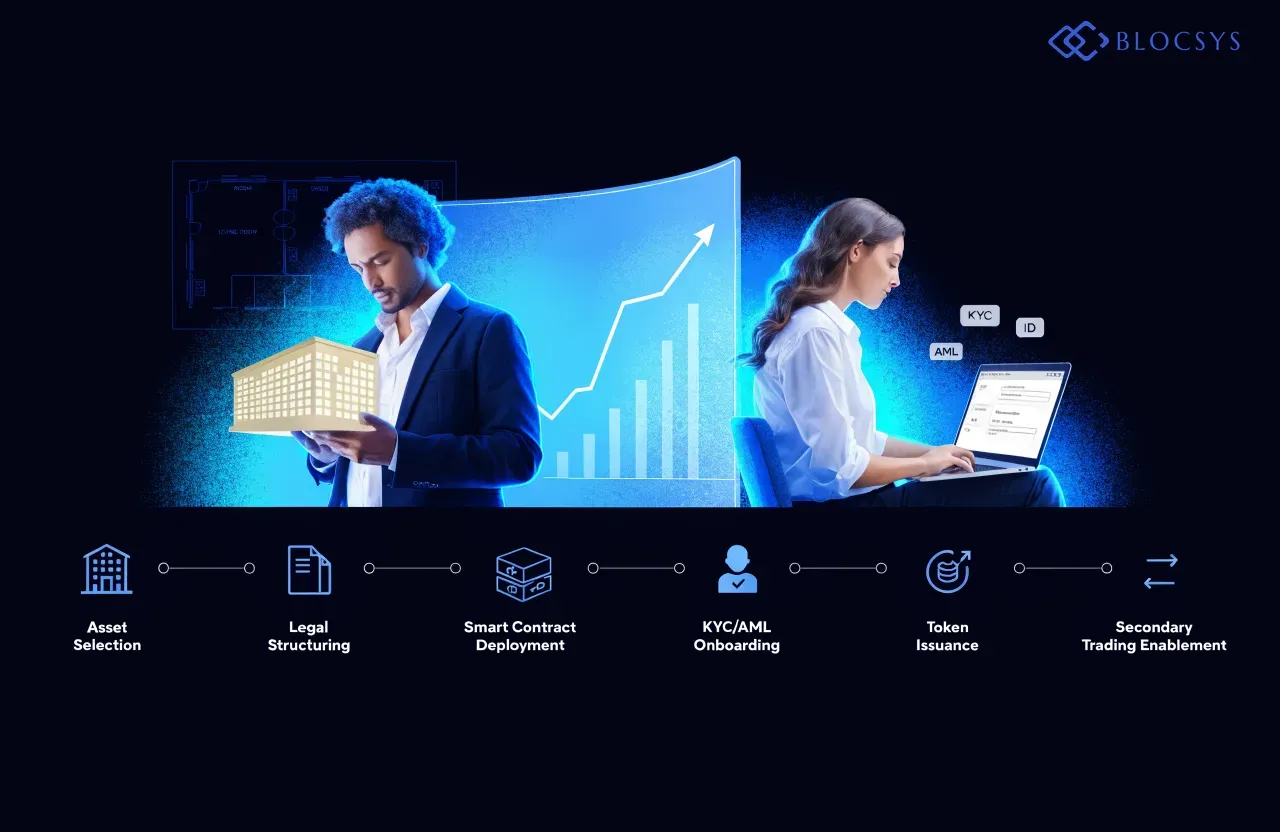
So how does an enterprise actually get from idea to live platform? Here’s the sequence we typically walk clients through.
- Define the legal structure and target jurisdictions before writing a single line of code
- Select blockchain infrastructure suited to privacy, throughput, and compliance needs
- Build or integrate KYC/AML and investor accreditation workflows
- Design smart contracts for issuance, transfer restrictions, and dividend automation
- Integrate qualified custody and wallet infrastructure
- Establish secondary trading pathways, whether internal or through licensed venues
- Run a pilot issuance before scaling to full cap table tokenization
Enterprises that skip the legal and compliance groundwork tend to hit walls later, often expensive ones. Getting the sequence right upfront saves months of rework down the line.
Real-World Use Cases Across Industries
Tokenized Equities aren’t confined to fintech. Real estate development firms have tokenized equity stakes in specific projects, giving investors fractional exposure without full property ownership complexity. Venture-backed startups have tokenized late-stage funding rounds to give employees liquidity options before an IPO. Renewable energy companies have used equity tokenization to raise project-specific capital while keeping investors informed through transparent, on-chain reporting.
Private equity firms are also experimenting with tokenized fund interests, letting limited partners trade positions on secondary venues instead of waiting out multi-year lockups. Across every one of these cases, the pattern is the same: real assets, real ownership, better infrastructure.
Global Tokenized Equity Momentum and GIFT City
Global interest in Tokenized Equities isn’t limited to the usual financial capitals. GIFT City in India has quietly emerged as an international financial hub worth watching. Positioned as a gateway between domestic capital and global investors, it’s attracting attention from fintech firms and institutions exploring digital securities and blockchain-based capital market infrastructure.
While GIFT City’s regulatory framework is still maturing compared to established hubs like Singapore or Switzerland, its trajectory matters. It represents a broader global pattern: financial centers worldwide are building dedicated zones for blockchain innovation and tokenized capital markets, not just tolerating them on the sidelines.
For enterprises thinking about global expansion, GIFT City is one signal among many that Tokenized Equity infrastructure is becoming a genuinely international conversation. It sits alongside momentum in Dubai’s DIFC, Singapore’s MAS sandbox programs, and the EU’s evolving digital asset frameworks. None of these hubs has fully “solved” tokenized equity regulation yet. However, the direction is unmistakable, and enterprises building platforms today should design with multi-jurisdiction flexibility in mind rather than betting on a single regulatory regime.
Challenges and Future Opportunities in Equity Tokenization
It’s not all smooth sailing. Regulatory fragmentation across jurisdictions remains the biggest hurdle for enterprises building global platforms. Secondary market liquidity, while improving, is still thinner than public equity markets. Custody standards continue evolving, and interoperability between different blockchain networks isn’t fully solved yet.
That said, the trajectory points toward consolidation. Expect clearer regulatory frameworks, deeper institutional custody partnerships, and AI-driven compliance automation that flags risk in real time rather than after the fact. AI integration is already showing up in fraud detection, investor risk scoring, and automated regulatory reporting across Tokenized Equity Platforms — and that layer will only get more sophisticated.
The opportunity for enterprises willing to move now is significant. Early movers in real world asset tokenization are setting standards that latecomers will have to follow.
Why Blocsys Is the Ideal Enterprise Equity Tokenization Partner
Building a compliant, scalable Tokenized Equity Platform isn’t a weekend project. It requires deep expertise across blockchain architecture, securities compliance, custody integration, and smart contract security — all working together without gaps.
That’s exactly where Blocsys fits in. We’ve spent years delivering enterprise-grade asset tokenization platform solutions, and our Equity Tokenization Platform Development services are built specifically for institutions that can’t afford to compromise on security or compliance.
Our team handles everything from smart contract architecture to KYC/AML integration, custody partnerships, and secondary trading infrastructure. Whether you’re a private equity firm exploring tokenized fund interests or a fintech startup building an Equity Token Platform from scratch, we design systems that scale with regulatory requirements, not around them.
We also support adjacent RWA verticals, including corporate bond tokenization, carbon tokenization, and digital asset platform development, giving enterprises a single trusted partner across their broader tokenization strategy.
What Sets a Trusted Tokenized Equity Platform Development Partner Apart
Not every blockchain vendor understands securities law, custody requirements, and institutional-grade compliance simultaneously. That combination is rare, and it’s exactly what enterprises should screen for before signing a development contract. If you’re evaluating tokenization platform development partners, ask about their compliance automation experience first, not just their smart contract portfolio.
Frequently Asked Questions
Here are direct answers to the questions we hear most often about Tokenized Equities and enterprise equity tokenization platforms.
What are tokenized equities?
Tokenized equities are digital tokens representing real ownership shares in a company, issued and managed on a blockchain. Each token carries the same economic rights as traditional stock, including dividends and voting power, but settles instantly and can be divided into fractional units. Unlike generic crypto assets, tokenized equities are backed by actual corporate ownership and typically fall under existing securities regulations.
Why are tokenized equities becoming the fastest-growing segment of RWA markets?
Tokenized Equities are growing faster than other RWA categories because private equity markets are enormous, largely illiquid, and already data-driven. Blockchain infrastructure directly solves liquidity and transparency gaps that traditional equity ownership has struggled with for decades. Combine that with maturing regulatory frameworks in the US, UK, EU, Singapore, and UAE, and you get accelerating institutional adoption. Enterprises also gain operational efficiency through automated dividend distribution and real-time cap table management, which makes the business case even stronger.
How do tokenized equities work on blockchain?
Tokenized equities work by encoding ownership rules, transfer restrictions, and corporate actions into smart contracts deployed on a blockchain. When an investor purchases a token, ownership updates instantly on the shared ledger instead of through a manual registry update. Smart contracts automatically enforce compliance checks, such as investor accreditation status, before allowing any transfer. Dividend distributions, voting rights, and reporting can all be automated through the same contract logic, reducing manual back-office work significantly.
What are the benefits of tokenized equities for enterprises and investors?
Enterprises benefit from automated compliance, instant cap table updates, and reduced administrative overhead compared to traditional share registries. Investors benefit from fractional ownership access, faster settlement, and emerging secondary market liquidity that traditional private equity rarely offers. Both sides gain transparency, since blockchain records are auditable in real time rather than reconciled periodically. This alignment of incentives is a major reason institutional adoption keeps accelerating heading into 2026.
How do tokenized equities improve liquidity?
Tokenized equities improve liquidity by enabling fractional ownership, which widens the pool of eligible investors for any given asset. A broader investor base naturally supports more frequent trading activity. Additionally, licensed digital securities exchanges and alternative trading systems are emerging specifically to support secondary trading of tokenized shares. This gives investors exit paths that didn’t previously exist for private company equity, which historically stayed locked up until an IPO or acquisition event.
Which blockchain is best for tokenized equity platforms?
There’s no single best blockchain for every use case. Enterprises typically choose between permissioned chains, which offer more privacy and control suited to regulated securities, and public chains with layer-2 privacy solutions, which offer broader interoperability. The right choice depends on jurisdiction requirements, investor base, custody integration needs, and transaction throughput. A knowledgeable equity tokenization platform development partner should help evaluate these tradeoffs based on your specific regulatory and business requirements rather than defaulting to one chain.
What compliance requirements apply to tokenized equities?
Compliance requirements vary by jurisdiction, but generally include KYC/AML verification, investor accreditation checks, and transfer restriction enforcement. In the US, tokenized shares typically fall under existing securities law and require registration or a valid exemption. The UK, EU, Singapore, and UAE each maintain their own frameworks addressing digital securities and crypto-assets. Enterprises need legal counsel involved early, and compliance logic should be built directly into smart contracts rather than handled manually after issuance.
How much does it cost to build a tokenized equity platform?
Costs vary widely based on scope, ranging from a focused pilot for a single share class to a full enterprise-grade platform with custody integration and secondary trading support. Key cost drivers include smart contract complexity, compliance automation depth, custody partnerships, and the number of jurisdictions supported. Working with an experienced development partner helps avoid costly rework by getting the legal structure and technical architecture right from the start. Contact Blocsys for a scoped estimate based on your specific requirements.
How can businesses launch enterprise tokenized equity platforms?
Businesses should start by defining their legal structure and target jurisdictions before any technical development begins. From there, the roadmap includes selecting blockchain infrastructure, building KYC/AML workflows, designing smart contracts for issuance and dividend automation, integrating qualified custody, and establishing secondary trading pathways. Most enterprises run a pilot issuance for one share class or funding round before scaling platform-wide. Partnering with a specialized development team significantly reduces implementation risk and timeline.
Why should enterprises choose Blocsys for tokenized equity platform development?
Blocsys combines blockchain engineering expertise with deep understanding of securities compliance, custody integration, and institutional-grade security requirements. Our Equity Tokenization Platform Development services cover the full lifecycle, from legal structuring support through smart contract deployment, KYC/AML integration, and secondary trading infrastructure. We’ve also built adjacent RWA solutions, including real world asset tokenization platforms, giving clients a partner who understands the broader digital securities ecosystem, not just isolated token contracts.
Conclusion
Tokenized Equities aren’t a passing trend. They represent a structural shift in how ownership, liquidity, and capital formation work across global markets. From institutional adoption in the US and Europe to emerging hubs like GIFT City, the momentum behind equity tokenization in 2026 is broad, not isolated to one region or one investor type.
If you’re an enterprise, financial institution, or fintech founder exploring how to build your own Tokenized Equity Platform, now’s the time to move. The infrastructure, regulatory clarity, and institutional appetite have all matured enough to support real, production-grade deployment.
Reach out to Blocsys to discuss Equity Tokenization Platform Development, and let’s build the digital capital markets infrastructure your organization needs to compete in this next chapter of finance.
Ready to move beyond theory and build an intelligent platform that delivers real-world value? Blocsys Technologies specialises in engineering enterprise-grade AI and blockchain solutions for the fintech, Web3, and digital asset sectors. Connect with our experts today to discuss your vision and chart a clear path from concept to a secure, scalable reality.
