
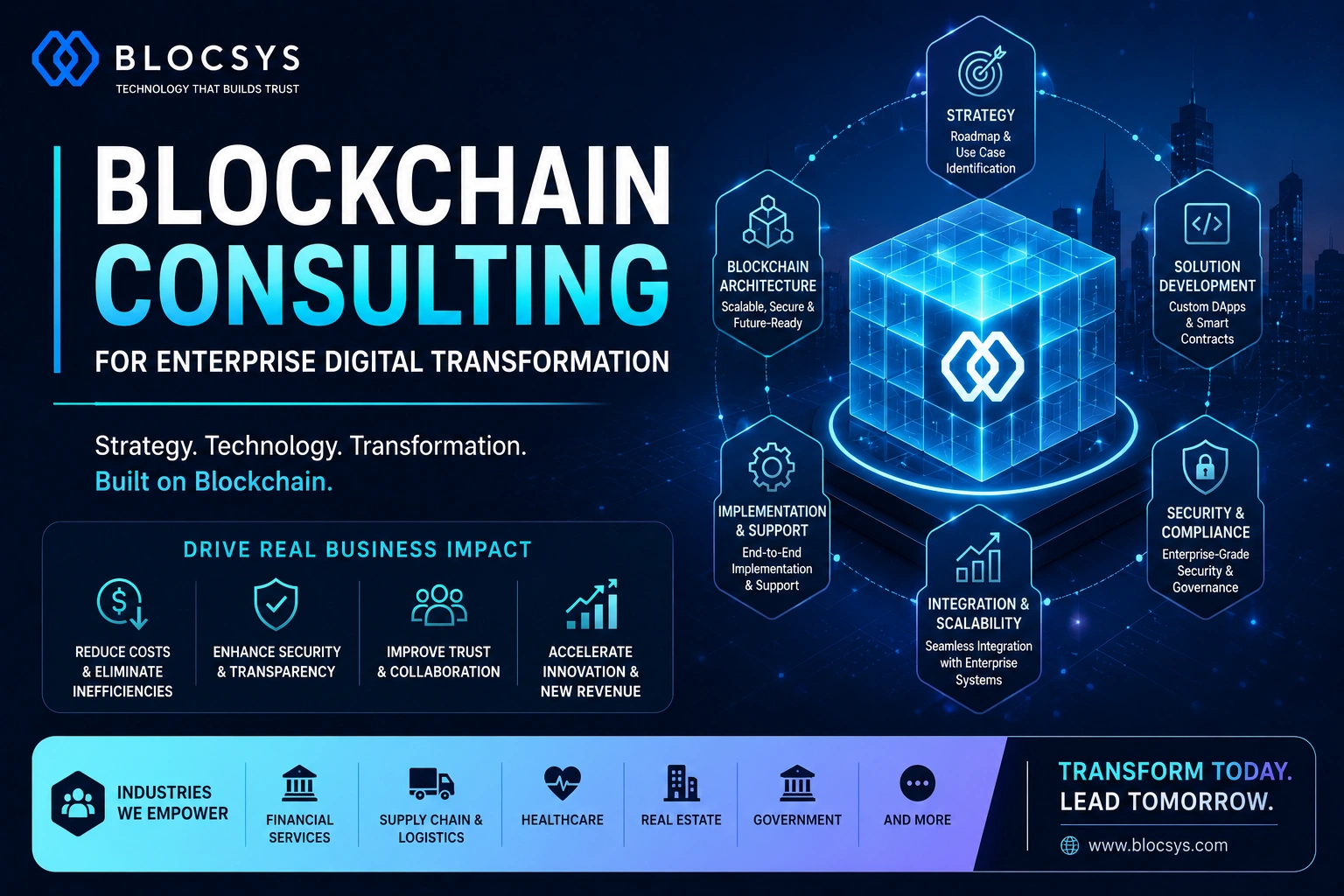
How Blockchain Consulting Helps Enterprises Accelerate Digital Transformation
Enterprises don’t adopt new technology because it’s trendy. They adopt it because the old way of doing things starts costing more than it saves. That’s exactly where blockchain sits for many organizations today, somewhere between curiosity and commitment. Blockchain Consulting exists to close that gap, helping enterprises figure out whether blockchain actually solves their problem before they spend a dollar building anything. If you’re a CTO, CIO, or digital transformation lead trying to separate real opportunity from hype, this is the conversation you need to have first.
Blockchain Consulting is professional advisory work that helps organizations assess, plan, and implement blockchain technology to meet specific business goals. It covers everything from feasibility analysis and blockchain strategy to architecture design, network selection, and enterprise blockchain development. Done right, it’s less about pushing a technology and more about validating whether that technology fits the problem at hand.
What Is Blockchain Consulting, Really?
At its core, blockchain consulting is a structured advisory process. Consultants work with your team to understand business objectives, technical constraints, and regulatory realities before recommending any solution. That’s an important distinction, because a lot of vendors skip straight to “here’s our platform” without asking whether you need a distributed ledger at all.
Good Blockchain Consulting Services combine several disciplines: business analysis, systems architecture, cryptography fundamentals, regulatory awareness, and software engineering. You’re not just hiring someone who understands blockchain. You’re hiring someone who understands your industry and can translate blockchain capabilities into outcomes that matter, whether that’s faster settlement, verifiable provenance, or reduced reconciliation costs.
The biggest mistake we see enterprises make isn’t choosing the wrong blockchain platform. It’s skipping the question of whether they need a blockchain at all before committing budget and engineering time to one.
Why Enterprises Need Blockchain Consulting
Enterprises don’t lack technical talent. What they often lack is objective, cross-industry perspective on where blockchain genuinely adds value versus where a traditional database would do the job just as well. That’s the practical case for bringing in outside expertise.
According to Deloitte’s 2024 Global Blockchain Survey, a majority of surveyed executives said blockchain and digital assets are a top-five strategic priority for their organization, yet many still cite regulatory uncertainty and integration complexity as barriers to scaling pilots into production. That gap between interest and execution is precisely where consulting earns its keep.
Here’s why that matters practically:
- Internal teams may not have deep experience with consensus mechanisms, tokenomics, or smart contract security patterns.
- Legacy system integration requires architects who’ve done it before, not just blockchain developers who’ve built greenfield apps.
- Compliance requirements vary significantly by jurisdiction and asset type, and getting this wrong is expensive.
- Enterprise blockchain projects fail more often from poor scoping than from poor code.
Enterprise Blockchain Consulting reduces the guesswork. Instead of your team learning through trial and error, an experienced partner brings pattern recognition from dozens of prior engagements across industries.
How Blockchain Consulting Supports Digital Transformation
Digital transformation isn’t a single project. It’s an ongoing shift in how a business operates, decides, and delivers value. Blockchain fits into that picture as one tool among many, useful specifically when trust, transparency, or multi-party coordination are the bottleneck.
Consultants help enterprises modernize legacy systems by identifying where distributed ledgers can replace fragmented reconciliation processes. Think about a supply chain where five different companies each keep their own version of the truth. A shared, permissioned ledger removes the need for constant cross-checking, and that alone can meaningfully cut administrative overhead.
Moreover, blockchain consulting connects technical implementation to broader digital transformation goals like automation, data integrity, and customer trust. Consequently, the technology stops being a standalone experiment and becomes part of a coherent enterprise strategy.
Identifying the Right Blockchain Use Cases
Not every business problem needs a blockchain. That’s a sentence every honest consultant will say early in a client relationship. So how do you know if yours does?
Signs Blockchain Might Fit Your Problem
Blockchain tends to add real value when multiple, mutually distrusting parties need a shared source of truth without a central intermediary. If your use case involves auditability, provenance tracking, automated settlement, or asset tokenization across organizational boundaries, it’s worth a closer look.
On the other hand, if your problem is purely internal data storage, or if a single trusted party already controls the data, a traditional database is usually faster, cheaper, and simpler. A responsible blockchain consulting company will tell you this directly, even when it means recommending a smaller engagement.
Blockchain Feasibility Assessment
Feasibility assessment typically examines four dimensions: business value, technical fit, regulatory exposure, and integration complexity. Consultants map current workflows, quantify pain points, and model what a blockchain-based alternative would actually change operationally, not just theoretically.
This is where experienced teams differ from generic technology vendors. A rigorous assessment includes cost-benefit modeling, stakeholder interviews, and often a small proof-of-concept before any large commitment. If you’re estimating investment at this stage, Blocsys’s Blockchain Consulting engagement typically starts here, and our Cost Estimator Tool can give you a project-specific range once scope is defined, rather than a generic industry figure.
Blockchain Strategy Development
Once feasibility is confirmed, the next step is building an actual Blockchain Strategy. This isn’t a slide deck of buzzwords. It’s a working document that defines objectives, success metrics, technology choices, timelines, and governance structure.
A solid strategy answers practical questions: Which business unit owns this initiative? What’s the minimum viable version? How will you measure success in six months versus two years? Enterprises that skip this step often end up with impressive pilots that never make it to production because nobody planned the path forward.
Technology and Blockchain Network Selection
Choosing between public, private, and permissioned networks is one of the most consequential early decisions. Public networks like Ethereum offer strong decentralization and liquidity access, useful for tokenized assets that need broad market reach. Permissioned networks like Hyperledger Fabric or enterprise-grade EVM-compatible chains offer more control, which matters for regulated industries handling sensitive data.
| Network Type | Best Fit | Trade-off |
|---|---|---|
| Public Blockchain | Tokenization, DeFi, public transparency | Less control over validators, variable transaction costs |
| Permissioned Blockchain | Consortiums, supply chain, interbank settlement | Requires trusted network operators, less liquidity |
| Hybrid Architecture | Regulated tokenized assets needing public reach | Higher architectural complexity |
There’s no universally “best” choice here. The right network depends on your regulatory environment, expected transaction volume, and who needs access to the data.
Enterprise Blockchain Architecture and Development
Architecture planning determines whether a blockchain project scales gracefully or collapses under its own complexity. This includes decisions on data layers, off-chain storage, node infrastructure, and how the ledger connects to your existing enterprise systems.
Enterprise Blockchain Development then translates that architecture into working software: smart contracts, APIs, wallets, and admin dashboards. Unlike consumer-facing crypto apps, enterprise builds have to account for uptime guarantees, disaster recovery, and often integration with ERP or core banking systems that were never designed with distributed ledgers in mind.
Smart Contract Strategy
Smart contracts automate business logic directly on the blockchain, removing manual steps in processes like settlement, escrow, or compliance checks. However, poorly audited smart contracts have caused significant financial losses across the industry, which is why security review isn’t optional.
A thoughtful smart contract strategy defines what logic belongs on-chain versus off-chain, establishes upgrade patterns, and builds in formal auditing before deployment. Blocsys’s Blockchain Development team treats contract audits as a standard phase, not an afterthought.
Integration With Legacy Systems
Here’s the part enterprises underestimate most: connecting blockchain infrastructure to systems that have run the business for twenty years. Legacy ERP, CRM, and core banking platforms weren’t built with blockchain APIs in mind, so integration usually requires middleware, oracles, and careful data mapping.
Interoperability between different blockchain networks adds another layer. Cross-chain bridges and standards like LayerZero or Chainlink’s CCIP are increasingly used to let enterprise systems communicate across multiple ledgers, though this space is still evolving and requires careful security review before production use.
Security, Compliance, and Governance Planning
Security in enterprise blockchain deployments covers more ground than most people expect: smart contract audits, key management, node access controls, and consensus-layer resilience. Consultants typically recommend third-party audits before mainnet deployment, along with ongoing monitoring for anomalous transactions.
Compliance requirements depend heavily on your industry and jurisdiction. Financial institutions handling tokenized securities in the United States need to consider SEC guidance on digital assets, while firms operating in the European Union must account for the Markets in Crypto-Assets Regulation (MiCA), which became fully applicable across EU member states in December 2024. Enterprises in the UAE working with digital assets often engage with frameworks set by the Dubai Virtual Assets Regulatory Authority (VARA) or the Abu Dhabi Global Market. None of these apply universally, so jurisdiction-specific legal review is essential before launch.
Governance planning defines who can propose changes, approve transactions, and manage network participants over time. For consortium blockchains especially, this needs to be agreed upon before development begins, not after multiple companies are already relying on the system.
Tokenization and Digital Assets
Tokenization converts rights to a real-world asset, whether that’s a bond, equity share, or piece of real estate, into a digital token on a blockchain. Enterprises are exploring this to improve liquidity, enable fractional ownership, and reduce settlement times compared to traditional clearing processes.
Boston Consulting Group has previously projected that tokenized assets could represent a multi-trillion-dollar market by the end of the decade, though such projections are inherently forward-looking and should be treated as illustrative rather than guaranteed outcomes.
Consider a hypothetical scenario: a mid-sized asset manager wants to offer fractional access to commercial real estate. The business problem is limited liquidity and high minimum investment thresholds. A blockchain-based approach could tokenize ownership stakes, letting investors trade fractional shares on a compliant secondary market. This would require securities law review, custody infrastructure, and KYC/AML integration before any token issuance, and it remains illustrative unless built and validated with regulatory counsel. Firms exploring this path often start with Blocsys’s Real World Asset Tokenization or Equity Tokenization Platform services, alongside Corporate Bond Tokenization for fixed-income use cases.
Real-World Enterprise Use Cases Across Industries
Different industries approach blockchain from different angles, but the underlying pattern is consistent: reduce friction where multiple parties need to trust shared data.
- Financial Services and Fintech: Faster cross-border settlement, tokenized bonds, and programmable compliance checks embedded in smart contracts.
- Supply Chain: Provenance tracking for goods, reducing disputes and enabling faster recalls when quality issues arise.
- Healthcare: Verifiable credential sharing and audit trails for sensitive records, always designed with data protection regulations like HIPAA or GDPR in mind.
- Manufacturing: Component traceability across multi-tier supplier networks.
- Insurance: Automated claims processing through parametric smart contracts triggered by verified data feeds.
- Digital Assets and Investment Firms: Custody infrastructure and compliant tokenization frameworks for new asset classes.
Document-heavy industries also benefit from tamper-proof verification. Solutions like Blockchain Document Verification System for Secure Digital Proof and Tamper-Proof Document Verification Platform show how blockchain applies well beyond finance, into certification, credentialing, and legal proof of authenticity. Similarly, agricultural and food businesses have explored platforms like Blockchain-Powered Organic Certification & Food Traceability Platform to verify sourcing claims end to end.
Blockchain Consulting Versus Traditional Technology Consulting
Traditional IT consulting generally optimizes existing systems or migrates them to new infrastructure. Blockchain consulting, by contrast, often introduces an entirely new trust model into the business, one where data verification doesn’t depend on a single central authority.
That distinction changes the skill set required. You need people who understand cryptographic proofs, tokenomics, and decentralized governance, not just cloud migration or software integration. A dedicated Blockchain Consulting Company brings that specialized depth, while still coordinating closely with your existing IT and compliance teams.
Benefits, Challenges, and ROI Considerations
The benefits of well-scoped blockchain consulting are tangible: reduced reconciliation costs, faster multi-party transactions, stronger audit trails, and new revenue models through tokenization. But these benefits only materialize when the use case genuinely calls for distributed ledger technology.
Challenges are real too. Scalability limits on some public networks, regulatory uncertainty in emerging jurisdictions, integration friction with legacy systems, and the ongoing need for specialized talent all add complexity. Enterprises should budget for change management as much as for engineering, since blockchain often changes how teams work together, not just what software they use.
ROI depends on measurable outcomes, not vague promises. Consultants should help define specific metrics upfront, whether that’s settlement time reduction, dispute rate decrease, or new revenue from tokenized products, and track them against a baseline. Because every enterprise’s cost structure differs, we’d recommend using a project-specific assessment, like Blocsys’s Cost Estimator Tool, rather than relying on generic industry averages.
Enterprise Blockchain Implementation Roadmap
A typical roadmap moves through five stages: discovery and feasibility, strategy definition, architecture and prototype, pilot deployment, and full-scale rollout. Each stage should have clear exit criteria before moving to the next, which prevents enterprises from over-investing in unproven concepts.
Teams that need specialized capacity without a lengthy hiring cycle often turn to Dedicated Blockchain Engineering Teams, particularly during the architecture and development phases when demand for skilled engineers spikes.
The Future of Blockchain Consulting in 2026
Looking ahead, enterprise blockchain adoption is shifting from experimentation toward production-grade infrastructure, especially in tokenized finance and supply chain transparency. Regulatory clarity is improving in several markets, including the EU’s MiCA framework and evolving guidance in Singapore and the UAE, which should reduce some of the hesitation enterprises have shown historically.
At the same time, interoperability between chains, AI-assisted smart contract auditing, and institutional-grade custody solutions are areas worth watching closely, though these remain actively developing fields rather than fully settled standards.
Why Blocsys Is a Trusted Blockchain Consulting and Development Company
Blocsys works with enterprises, fintech companies, and digital asset businesses to move blockchain initiatives from early assessment through to production. Our approach starts with honest feasibility evaluation, not a predetermined push toward blockchain, because we’d rather tell you a database solves your problem than build something you don’t need.
From there, our teams support strategy development, architecture design, smart contract engineering, and full Blockchain Developers or Web3 Developers staffing, depending on what your project requires. Whether you’re exploring tokenization through our DeFi and dApp Development services or planning enterprise integration, Blocsys brings enterprise-grade technical credibility paired with practical, business-first consulting.
Frequently Asked Questions
Here are direct answers to the questions we hear most often about blockchain consulting.
What is blockchain consulting?
Blockchain consulting is advisory work that helps enterprises assess, plan, and implement blockchain solutions aligned with specific business goals. It covers feasibility analysis, blockchain strategy, network selection, architecture design, smart contract planning, security, compliance, and enterprise blockchain development. The goal is validating whether blockchain fits the problem before committing engineering resources to it.
How can blockchain consulting help enterprises with digital transformation?
Blockchain consulting connects distributed ledger capabilities to broader digital transformation goals, like automating manual reconciliation, improving data transparency across partners, and modernizing legacy systems. Consultants identify where shared trust and multi-party coordination are genuine bottlenecks, then design blockchain solutions that integrate with existing enterprise infrastructure rather than replacing it wholesale.
Why do enterprises need blockchain consulting instead of building in-house?
Internal teams often lack cross-industry experience with consensus mechanisms, smart contract security, tokenomics, and jurisdiction-specific compliance requirements. Blockchain consulting brings pattern recognition from prior engagements, reducing costly trial and error. It also provides objective feasibility assessment, which internal teams under pressure to deliver a blockchain project may struggle to give honestly.
What does a blockchain consultant actually do day to day?
A blockchain consultant conducts stakeholder interviews, evaluates technical feasibility, designs architecture, selects appropriate networks, and defines governance and compliance requirements. They also coordinate with development teams during Enterprise Blockchain Development, review smart contract security, and help define measurable success metrics tied to real business outcomes rather than technical novelty alone.
How does blockchain consulting identify suitable use cases?
Consultants look for problems involving multiple, mutually distrusting parties who need a shared source of truth without a central intermediary. Signs include provenance tracking needs, cross-organization settlement friction, or asset tokenization opportunities. If a single trusted party already controls the data, a traditional database is usually recommended instead of a blockchain solution.
What industries benefit most from enterprise blockchain consulting?
Financial services, fintech, supply chain, healthcare, manufacturing, insurance, and digital asset businesses see the most consistent value. Each industry applies blockchain differently, from tokenized bonds in finance to provenance tracking in supply chain and verifiable credentials in healthcare, but all share the same underlying need for trusted, shared data across organizational boundaries.
What’s included in a typical blockchain consulting strategy?
A blockchain strategy typically includes defined business objectives, success metrics, technology and network selection, a phased implementation roadmap, governance structure, and compliance requirements specific to the industry and jurisdiction. It also identifies which stakeholders own the initiative and what a minimum viable deployment looks like before scaling to full production.
How does blockchain consulting reduce implementation risks?
Consulting reduces risk through structured feasibility assessment, smart contract audits, phased rollouts with clear exit criteria, and jurisdiction-specific compliance review before deployment. Rather than committing to full-scale development immediately, consultants recommend proof-of-concept phases that validate technical and business assumptions early, when changes are far less costly to make.
How much does enterprise blockchain development cost?
Cost varies significantly based on network choice, integration complexity, smart contract scope, and regulatory requirements, so generic figures rarely reflect reality. Blocsys recommends using a project-specific assessment through our Cost Estimator Tool once your use case and scope are defined, rather than relying on industry-wide averages that don’t account for your specific architecture.
How can businesses choose the right blockchain consulting company?
Look for a company that starts with honest feasibility assessment rather than pushing blockchain as a default answer. Check for cross-industry experience, demonstrated smart contract security practices, familiarity with relevant regulatory frameworks, and a track record of moving projects from proof-of-concept into production, not just building pilots that never scale.
Blockchain won’t fix every enterprise problem, and honestly, that’s the point of getting consulting involved early. When the use case is right though, blockchain consulting gives you a clear path from idea to production, backed by strategy, architecture, and security planning that actually holds up. If your organization is evaluating blockchain as part of its digital transformation roadmap, Blocsys can help you assess feasibility, build a strategy, and move from proof of concept to a working enterprise solution. Reach out to explore Blockchain Consulting and Blockchain Development options tailored to your industry and goals.
Ready to move beyond theory and build an intelligent platform that delivers real-world value? Blocsys Technologies specialises in engineering enterprise-grade AI and blockchain solutions for the fintech, Web3, and digital asset sectors. Connect with our experts today to discuss your vision and chart a clear path from concept to a secure, scalable reality.
